Press release: Highways England wants to hear your views

The organisation is using the mobile visitor centre for the second year following 2017’s successful trial to engage with the public, and will give road users and local residents the chance to speak to staff that will be coming to their area, starting with Essex and Suffolk throughout March.

The minibus facility will open out into a larger exhibition, which will feature displays and presentations about road works in the area and road safety.

Highways England Capital Delivery Team Leader, Aran Nugent, said:

We are aware that the work we do has an impact on our road users, and so Highways England is eager to better engage with drivers and local residents so we can hear their comments, allay their concerns and answer any questions they may come to us with.

This mobile exhibition offers us an excellent opportunity to better get into those communities we will be working alongside, so we can speak with people to explain the work we are doing and the benefits it will bring for them, their town and this region. Last year we had a good response with people coming along to learn about roadworks and share their views, so we hope that interest will continue and grow further in 2018.

In the last financial year (2017/18), Highways England spent £61.4 million on essential maintenance across the East, including £3.5 million on new noise barriers on the M40 in Buckinghamshire, £3.1 million for a new roundabout with Harwich Road and the A120 near Wix, and a £3.5 million repair to the accident damaged Saddlebow Interchange on the A47 near King’s Lynn.

This essential maintenance work is in addition to the longer term investment work, including new dual carriageways on several sections of the A47, widening the A12 in Essex, the £1.5 billion Cambridge to Huntingdon A14 upgrade, and the £4.4 – £6.2 billion Lower Thames Crossing.

Now drivers will be able to speak to Highways England staff about this whole range of road works that are happening soon and further in the future, with £34.4 million committed to maintaining the East’s roads over the next year.

In the next financial year (2018/19), Highways England’s maintenance work will include £2.75 million on resurfacing the A14 between Newmarket and Bury St Edmunds, £2.5 million on bridge repairs on the M1, A14 and A1, £2.25 million on resurfacing the A12, and a further £2.24 million on replacing digital message signs on the same road. Our work in the next year will include laying enough tarmac to fill 20 football pitches, enough white lining to fill an Olympic swimming pool, and enough cats’ eyes to reflect enough light collectively to be seen from space.

In March, the exhibition is set to visit:

  • Boreham House on Thursday 15 and the town’s Springfield Sainsbury’s on Friday 16
  • Chelmsford city centre (outside Barclays) on Monday 19 and Tuesday 20
  • Lion Walk, Colchester town centre on Wednesday 21, Thursday 22
  • Braintree Freeport on Friday 23
  • Great Bromley Village Hall on Monday 26
  • Bricklayer’s Arms, Little Bentley on Tuesday 27
  • Bypass Nurseries, Capel St Mary, on Wednesday 28
  • Ipswich County Council (Russell Road) on Thursday 29

The exhibition will then head to Hertfordshire, Cambridgeshire and Bedfordshire in April, before covering the A47 with Norfolk and Peterborough in May.

These dates may be subject to change, and interested visitors are asked to stay up to date with the latest information by following @HighwaysEast on Twitter.

Members of the public are invited to attend the mobile visitor centre to speak with Highways England staff, which will include traffic officers at some of the exhibitions.

General enquiries

Members of the public should contact the Highways England customer contact centre on 0300 123 5000.

Media enquiries

Journalists should contact the Highways England press office on 0844 693 1448 and use the menu to speak to the most appropriate press officer.


Press release: Change of Her Majesty’s Ambassador to Iran

Change of Her Majesty’s Ambassador to Iran – GOV.UK

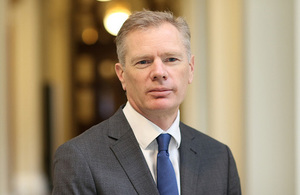
Rob Macaire has been appointed Her Majesty’s Ambassador to Iran in succession to Nicholas Hopton.

Rob Macaire

Mr Rob Macaire CMG has been appointed Her Majesty’s Ambassador to the Islamic Republic of Iran in succession to Mr Nicholas Hopton who will be transferring to another Diplomatic Service appointment. Mr Macaire will take up his appointment in April 2018.

Commenting on the appointment, Foreign Secretary Boris Johnson said:

Iran has an important role to play in the Middle East region, but it is essential that it does so in a constructive way – something I made clear during my visit to Tehran in December last year. The Iran deal, signed in 2015, was a huge diplomatic success. The product of years of patient and persistent diplomacy that extinguished the threat of a nuclear-armed Iran.

In that vein, I am pleased that Rob will be applying his wealth of international experience to leading the government’s engagement in Tehran. We face challenges – including the ongoing cases of British dual-nationals detained in Iran – and areas for potential collaboration. I look forward to working with him across these areas.

Mr Macaire said:

I am honoured to be appointed the new British Ambassador to Iran. The UK’s continued engagement with Iran is vital to our goal of making the Middle East region a safer and more stable place. I look forward to working with the Government of Iran and with international partners to preserve the nuclear deal and deepen our bilateral relationship, through constructive engagement on human rights, trade, and seeking political solutions to the conflicts in Yemen, Syria and elsewhere.

CURRICULUM VITAE

Full name: Robert Macaire CMG
Married to: Alice Macaire
Children: Two
2016 – present Language Training
2011 – 2016 BG Group plc. Director of Government/Public Affairs and Political Risk
2008 – 2011 Nairobi, British High Commissioner
2006 – 2008 FCO, Director, Consular Services
2004 – 2006 New Delhi, Political Counsellor
2002 – 2004 FCO, Head, Counter Terrorism Policy Department
1998 – 2002 Washington, First Secretary, Middle East and Counter-terrorism
1998 FCO, Head of Sierra Leone Unit, Africa Directorate
1997 –1998 FCO, Head of Southern Africa Section, Africa Directorate
1996 – 1997 FCO, Head of MEPP Section, Near East and North Africa Department
1995 – 1996 FCO, Head of Levant Section, Near East and North Africa Department
1991 – 1995 Bucharest, Second Secretary (Know How Fund)
1990 FCO, Falkland Islands Department

Published 14 March 2018


Statement to Parliament: PM Commons Statement on Salisbury incident response: 14 March 2018

With permission, Mr Speaker, I would like to make a Statement on the response of the Russian government to the incident in Salisbury.

First, on behalf of the whole House, let me pay tribute once again to the bravery and professionalism of all the emergency services, doctors, nurses and investigation teams who have led the response to this appalling incident.

And also to the fortitude of the people of Salisbury. Let me reassure them that – as Public Health England have made clear – the ongoing risk to public health is low. And the government will continue to do everything possible to support this historic city to recover fully.

Mr Speaker, on Monday I set out that Mr Skripal and his daughter were poisoned with a Novichok: a military grade nerve agent developed by Russia.

Based on this capability, combined with their record of conducting state sponsored assassinations – including against former intelligence officers whom they regard as legitimate targets – the UK government concluded it was highly likely that Russia was responsible for this reckless and despicable act.

And there were only two plausible explanations.

Either this was a direct act by the Russian State against our country.

Or conceivably, the Russian government could have lost control of a military-grade nerve agent and allowed it to get into the hands of others.

Mr Speaker, it was right to offer Russia the opportunity to provide an explanation.

But their response has demonstrated complete disdain for the gravity of these events.

They have provided no credible explanation that could suggest they lost control of their nerve agent.

No explanation as to how this agent came to be used in the United Kingdom; no explanation as to why Russia has an undeclared chemical weapons programme in contravention of international law.

Instead they have treated the use of a military grade nerve agent in Europe with sarcasm, contempt and defiance.

So Mr Speaker, there is no alternative conclusion other than that the Russian State was culpable for the attempted murder of Mr Skripal and his daughter – and for threatening the lives of other British citizens in Salisbury, including Detective Sergeant Nick Bailey.

This represents an unlawful use of force by the Russian State against the United Kingdom.

And as I set out on Monday it has taken place against the backdrop of a well-established pattern of Russian State aggression across Europe and beyond.

It must therefore be met with a full and robust response – beyond the actions we have already taken since the murder of Mr Litvinenko and to counter this pattern of Russian aggression elsewhere.

As the discussion in this House on Monday made clear, it is essential that we now come together – with our allies – to defend our security, to stand up for our values and to send a clear message to those who would seek to undermine them.

This morning I chaired a further meeting of the National Security Council, where we agreed immediate actions to dismantle the Russian espionage network in the UK, urgent work to develop new powers to tackle all forms of hostile state activity and to ensure that those seeking to carry out such activity cannot enter the UK, and additional steps to suspend all planned high-level contacts between the United Kingdom and the Russian Federation.

Let me start with the immediate actions.

Mr Speaker, the House will recall that following the murder of Mr Litvinenko, the UK expelled four diplomats.

Under the Vienna Convention, the United Kingdom will now expel 23 Russian diplomats who have been identified as undeclared intelligence officers.

They have just one week to leave.

This will be the single biggest expulsion for over thirty years and it reflects the fact that this is not the first time that the Russian State has acted against our country.

Through these expulsions we will fundamentally degrade Russian intelligence capability in the UK for years to come. And if they seek to rebuild it, we will prevent them from doing so.

Second, we will urgently develop proposals for new legislative powers to harden our defences against all forms of Hostile State Activity.

This will include the addition of a targeted power to detain those suspected of Hostile State Activity at the UK border. This power is currently only permitted in relation to those suspected of terrorism.

And I have asked the Home Secretary to consider whether there is a need for new counter-espionage powers to clamp down on the full spectrum of hostile activities of foreign agents in our country.

Mr Speaker, as I set out on Monday we will also table a government amendment to the Sanctions Bill to strengthen our powers to impose sanctions in response to the violation of human rights.

In doing so, we will play our part in an international effort to punish those responsible for the sorts of abuses suffered by Sergey Magnitsky.

And I hope – as with all the measures I am setting out today – that this will command cross-party support.

Mr Speaker, we will also make full use of existing powers to enhance our efforts to monitor and track the intentions of those travelling to the UK who could be engaged in activity that threatens the security of the UK and of our allies.

So we will increase checks on private flights, customs and freight.

We will freeze Russian State assets wherever we have the evidence that they may be used to threaten the life or property of UK nationals or residents.

And led by the National Crime Agency, we will continue to bring all the capabilities of UK law enforcement to bear against serious criminals and corrupt elites. There is no place for these people – or their money – in our country.

Mr Speaker, let me be clear.

While our response must be robust it must also remain true to our values – as a liberal democracy that believes in the rule of law.

Many Russians have made this country their home, abide by our laws and make an important contribution to our country which we must continue to welcome.

But to those who seek to do us harm, my message is simple: you are not welcome here.

Mr Speaker, let me turn to our bi-lateral relationship.

As I said on Monday, we have had a very simple approach to Russia: engage but beware.

And I continue to believe it is not in our national interest to break off all dialogue between the United Kingdom and the Russian Federation.

But in the aftermath of this appalling act against our country, this relationship cannot be the same.

So we will suspend all planned high level bi-lateral contacts between the United Kingdom and the Russian Federation.

This includes revoking the invitation to Foreign Minister Lavrov to pay a reciprocal visit to the United Kingdom and confirming there will be no attendance by Ministers – or indeed Members of the Royal Family – at this Summer’s World Cup in Russia.

Finally, Mr Speaker, we will deploy a range of tools from across the full breadth of our National Security apparatus in order to counter the threats of Hostile State Activity.

While I have set out some of those measures today, Members on all sides will understand that there are some that cannot be shared publicly for reasons of National Security.

And, of course, there are other measures we stand ready to deploy at any time, should we face further Russian provocation.

Mr Speaker, none of the actions we take are intended to damage legitimate activity or prevent contacts between our populations.

We have no disagreement with the people of Russia who have been responsible for so many great achievements throughout their history.

Many of us looked at a post-Soviet Russia with hope. We wanted a better relationship and it is tragic that President Putin has chosen to act in this way.

But we will not tolerate the threat to life of British people and others on British soil from the Russian government. Nor will we tolerate such a flagrant breach of Russia’s international obligations.

Mr Speaker, as I set out on Monday, the United Kingdom does not stand alone in confronting Russian aggression.

In the last twenty-four hours I have spoken to President Trump, Chancellor Merkel and President Macron.

We have agreed to co-operate closely in responding to this barbaric act and to co-ordinate our efforts to stand up for the rules based international order which Russia seeks to undermine.

I will also speak to other allies and partners in the coming days.

And I welcome the strong expressions of support from NATO and from partners across the European Union and beyond.

Later today in New York, the UN Security Council will hold open consultations where we will be pushing for a robust international response.

We have also notified the Organisation for the Prohibition of Chemical Weapons about Russia’s use of this nerve agent. And we are working with the police to enable the OPCW to independently verify our analysis.

Mr Speaker, this was not just an act of attempted murder in Salisbury – nor just an act against UK.

It is an affront to the prohibition on the use of chemical weapons.

And it is an affront to the rules based system on which we and our international partners depend.

We will work with our allies and partners to confront such actions wherever they threaten our security, at home and abroad.

And I commend this Statement to the House.


News story: Tribunal, Trade Marks and Designs Case Worker Examiner

Purpose

The Intellectual Property Office (IPO) is the official government body responsible for Intellectual Property (IP) rights in the United Kingdom. These rights include patents, designs, trade Marks and copyright.

We are responsible for the granting of IP rights, which promotes creativity and enables the economy and society to benefit from knowledge and ideas.

These available posts sit within our Tribunal, Trade Marks and Designs Division. We are specifically responsible for granting registered rights in trade marks and designs as well as independently administering the associated Tribunal function too.

Roles and Responsibilities

Main Duties (depending on role offered):

Tribunal Case Work Examiner:

  • ensuring the timely and efficient processing of cases before the Tribunal according to the legislation set out under the Trade Marks Act 1994 (and the Trade Marks Rules 2008) and/or the Designs Act 1949 (and the Designs Rules 2006)
  • inspection of statements of case/counter statements ascertaining whether the correct grounds have been pleaded and notifying the parties of any perceived deficiencies where appropriate
  • ensure that all evidence admitted into the proceedings complies with the relevant legislation and published guidance material and that any deficiencies are identified and notified to the parties
  • consideration of and determining on a preliminary basis any request made once the evidence timetable has been set for extension of time and stay requests, consolidation, cross-examination and disclosure
  • respond to all litigants whether in writing or on the telephone in an impartial, professional and customer friendly way
  • proactively keeping own knowledge up to date and developing self
  • developing a thorough understanding of the relevant sections of the legislation, case law and associated practice
  • improving our service to customers by joining in with continuous improvement activities

Trade Marks or Designs Examiner:

  • examination of applications to register Trade Marks under the Trade Marks Act 1994 (and the Trade Marks Rules 2008) and/or the Examination of Designs under the Designs Act 1949 (and the Designs Rules 2006)
  • analysis of arguments and evidence submitted in support of applications so that well thought through and sound decisions are made
  • clearly communicating to customers (ranging from professional Attorneys to Unrepresented Applicants) on all aspects of the application and registration process
  • assisting applicants and representatives in overcoming any objections raised against their application and providing excellent customer care
  • proactively keeping own knowledge up to date and developing self
  • developing a thorough understanding of the relevant sections of the legislation, case law and associated practice
  • improving our service to customers by joining in with continuous improvement activities

How to apply

Full details of this role and how to apply are available on the Civil Service Jobs website.

The closing date for applications is 26 March 2018.

For more information please email adminvacancies@ipo.gov.uk.


Press release: Scrapyard permit dodger claims end-of-life vehicles were for resale

Max Newbery denied running a scrapyard, claiming vehicles were bought with the intention of resale

The owner of an Exeter scrapyard has been given a suspended prison sentence for operating an illegal vehicle dismantling business.

Max Newbery was also ordered to pay £8,470 costs at the end of a 2-day trial before Exeter magistrates.The case was brought by the Environment Agency.

The court heard that in March 2014, the Environment Agency suspended the defendant’s environmental permit after he failed to pay the site’s annual permitting fee over a period of 5 years.

The scrapyard, at Barley Villas Yard, Redhills, Exeter, continued to accept vehicles despite it no longer being a permitted facility. Between 27 March 2014 and 25 February 2016 a minimum of 51 vehicles were accepted at the scrapyard.

When questioned, Newbery claimed he bought the vehicles with the intention of selling them on. He refused to accept they were waste as defined by the 2008 Waste Framework Directive which states that waste is ‘any substance or object which the owner discards or intends or is required to discard’.

Two women who took cars to the defendant’s scrapyard both said they were disposing of their vehicles. One described her’s as ‘Scrap, not a goer’ and the other, ‘Nobody would buy it.’ An Environment Agency officer, who visited the site, said in his professional opinion, all the cars brought to the scrapyard were end-of-life vehicles.

When questioned about the poor condition of some of the vehicles, Newbery claimed they had been ‘vandalised by children’, yet there was no CCTV at the site and little in the way of security to safeguard the vehicles he insisted were suitable for re-sale.

In addition to suspending his permit, the Environment Agency served Newbery with an Enforcement Notice requiring him to carry out improvements to the infrastructure of the scrapyard to minimise the risk of pollution and protect human health. Newbery said complying with the notice would be ‘expensive’ and it was therefore ‘unreasonable’ of the Agency to expect him to do so.

Magistrates were told the defendant’s business had an annual turnover of more than £50,000 and that he had recently obtained planning permission for the site. This had increased its value to around £600,000 and had prompted Newbery to try to sell it.

Jacob Hess of the Environment Agency said:

Scrapyard operators are required by law to put in place appropriate environmental safeguards to protect human health and the environment. The defendant continued running his scrapyard without making any of the legally required infrastructural improvements.

He avoided investing in the business as this would eat into his profits and continued making money from an illegal site.

Appearing before Exeter magistrates, Max Newbery, of Barley Villas Yard, Redhills, Exeter received a 24-week prison sentence, suspended for 2 years, and was ordered to pay £8,470 costs after being found guilty of operating a regulated waste facility without a permit and failing to comply with an enforcement notice in contravention of the Environmental Permitting (England and Wales) Regulations 2010.

Editor’s notes

Environmental permits are necessary to minimise the risk of pollution or harm to human health from operations at waste sites such as scrapyards. There are set procedures for de-polluting and dismantling of end-of-life vehicles that contain potentially hazardous substances including engine oil, clutch fluid, coolant, brake fluid, gearbox oil, lead acid batteries, power steering fluid, screen wash, fuels, CFC’s and lead wheel balancing weights.