Press release: Environment Agency says that a different approach is needed to tackle flooding over next 50 years

A different approach is needed to tackle flooding over next 50 years, Environment Agency Chief Executive James Bevan has said today

  • Country is better protected than ever against flooding
  • Every £1 invested in flood schemes saves £10 in damages avoided
  • During this century a new approach is needed to tackle flood risk in 21st Century

Over the next century a different approach is needed to protect the country from flooding, the Environment Agency’s Chief Executive said in a keynote speech at the annual Flood and Coast Conference today (Tuesday 20 March).

As he revealed that every £1 invested in new flood schemes saves the economy £10 in damages avoided, Sir James Bevan said that despite huge advances in flood protection, what worked so well in the past will not be enough in the future. Rising sea levels and higher populations in built-up areas will mean new approaches are needed to combat increasing flood risk. Since 2015, new flood schemes completed by the Environment Agency have benefitted more than 100,000 homes but to continue building on this success new 21st century approaches are needed.

These include a call for greater business investment, quicker emergency response and increased use of natural flood schemes, in addition to ‘hard’ defences, in order to reduce the impact of flooding on communities around the country. He questioned how these challenges should be dealt with and suggest that more concrete – simply building our flood defences higher and higher – is not the answer.

As he laid out his thoughts on the future of flood protection, Sir James Bevan said that tough questions had to be asked about what to protect. He questioned whether there might be a case for considering future funding priorities.

He said that everyone has a part to play to reduce flood risk and that homeowners in flood risk areas should know the risks and what action they can take – and he praised communities and flood groups who have already taken great steps in this area.

Sir James Bevan said:

Almost every day in this country, when rivers and tides rise, rain falls and storms blow, thousands of people sleep safe and unaware that they are being protected by flood defences.

But what works so well now – and has done in the past – may not be enough in the future. Over the next fifty years if we are going to give the country the best possible protection against flooding, we are going to need a different approach.

The Environment Agency manages flood risk on over 36,000 km of river, 9,000km raised flood defences and over 22,000 flood structures – from the Thames Barrier to local pumping stations. Since 2016, it has upgraded its response capability with more than 6,500 staff trained and ready to help protect communities when floods threaten, 40km of temporary barriers, 250 mobile pumps, and 500,000 sandbags. Partnerships to help respond during incidents have also been strengthened – including with the army.

Government is investing £2.6 billion in flood and coastal erosion risk management projects between 2015 and 2021.

Now in its third year, the annual Flood and Coast Conference brings together experts from across the globe to share ideas and opportunities to work together to tackle the risk of flooding and coastal erosion. More on the conference here: https://www.floodandcoast.com/.

The Environment Agency is currently working in its next National Flood and Coastal Erosion Risk Management Strategy which will address these challenging questions raised in Sir James Bevan’s speech.


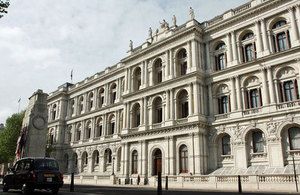
Press release: Statement on OSCE report on Russian presidential election

Statement on OSCE report on Russian presidential election – GOV.UK

FCO statement on the OSCE report into the Russian presidential election

placeholder

An FCO spokesperson said:

The OSCE/ODIHR election observation mission to the Russian Presidential elections has now issued their initial report.

The report makes clear that restrictions on fundamental freedoms, in particular freedom of expression and assembly, including the detention of activists, resulted in a lack of genuine competition in the election. The Russian Central Election Commission also placed restrictions on candidate registration, and President Putin benefited from dominating coverage in the state media.

We continue to call on the Russian Government to comply with its international commitments in the Council of Europe and OSCE to ensure respect for human rights and fundamental freedoms, including freedom of expression.

Published 20 March 2018


News story: Action Counters Terrorism: Report suspicious activity and behaviour

Action Counters Terrorism: Report suspicious activity and behaviour to tackle terrorism

Communities defeat terrorism. With the enduring terrorist threat, it is now more important than ever that everyone plays their part in tackling terrorism. Your actions could save lives.

Don’t worry about wasting police time. No call or click will be ignored. What you tell the police is treated in the strictest confidence and is thoroughly researched by experienced officers before, and if, any police action is taken.

Any piece of information could be important, it is better to be safe and report. Remember, trust your instincts and ACT. Action Counters Terrorism.

How can I report?

Reporting is quick and easy. You can report in confidence online via our secure form: www.gov.uk/ACT. Alternatively, you can call the police confidentially on 0800 789 321. All reports are kept confidential and you can report anonymously.

In an emergency always call 999.

What should I report?

Like other criminals, terrorists need to plan. You can report suspicious activity or behaviour – anything that seems out of place, unusual or just doesn’t seem to fit in with everyday life.

Watch the ACT film to learn more

What could potentially be terrorist-relates suspicious activity or behaviour?

Research

  • Meetings, training and planning can take place anywhere. Do you know someone who travels but is vague about where they’re going?
  • Do you know someone with passports or other documents in different names, for no obvious reason?
  • Do you know someone who looks at extremist material, including on the so-called Dark Web, or shares and creates content that promotes or glorifies terrorism?
  • Have you noticed someone embracing or actively promoting hateful ideas or an extremist ideology?

Gathering materials

  • Suspicious materials can be ordered online as well as in store. Have you noticed someone receiving deliveries for unusual items bought online?
  • If you work in commercial vehicle hire or sales, has a sale or rental seemed unusual?
  • Have you noticed someone buying large or unusual quantities of chemicals, fertilisers or gas cylinders for no obvious reason?
  • Have you noticed someone acquiring illegal firearms or other weapons or showing an interest in obtaining them?

Storing materials

  • Terrorists need to store equipment while preparing for an attack. Have you noticed anyone storing large amounts of chemicals, fertilisers or gas cylinders?
  • Have you noticed anyone storing illegal firearms or objects that could potentially be weapons?

Hostile Reconnaissance

  • Observation and surveillance help terrorists plan attacks. Have you witnessed anyone taking pictures or notes of security arrangements or CCTV?

Financing

  • Cheque and credit card fraud are ways of generating cash. Have you noticed any suspicious or unusual bank transactions?

If you’d like more information or resources, visit www.gov.uk/ACT or follow Counter Terrorism Policing on social media:

#ActionCountersTerrorism


News story: Afghan security and stability remains top of UK agenda

Defence Secretary meeting UK personnel in Afghanistan. Crown copyright.

The security, development and governance of Afghanistan remains crucial to reducing the terrorist threat to the UK, the Defence Secretary reaffirmed in his first visit to Afghanistan.

Defence Secretary Gavin Williamson said:

A secure Afghanistan will help keep the streets of Britain safe. Building the security services that will be the foundation of stability and peace in Afghanistan remains top of our agenda and I have seen first-hand the crucial role our brave Armed Forces are playing in realising that vision.

In his meeting with Minister of Defence Bahrami, the Defence Secretary reaffirmed the UK commitment to Afghanistan, citing the continued funding for the Afghanistan National Security Forces, our support for the Afghan National Army Officer Academy (ANAOA) and the recent uplift of UK troops to around 650.

Mr Williamson also met with UK personnel who are based at ANAOA in Qargha, on the western outskirts of Kabul. They are helping to train the next generation of Afghanistan’s military leaders through mentoring training staff and instilling the Sandhurst ethos at the academy.

More than 3,000 officers have passed out of the academy since 2013, and, this year, ANAOA has nearly as many female cadets in training as have graduated in total since the academy opened.

The Defence Secretary also met UK troops who lead the Kabul Security Force (KSF), which provides force protection for NATO staff in Kabul. In last five weeks alone, the KSF have undertaken over 2,800 protection journeys and Mr Williamson experienced first-hand the vital role they play, travelling with UK personnel in a Foxhound armoured vehicle.

He also commended their efforts in responding to some of the recent terrorist attacks in Kabul, in which the KSF supported Afghan Security Forces by evacuating guests to safety extracted of guests following the Intercontinental Hotel terrorist attack and provided first aid to Afghan soldiers following an attack on an Afghan Army compound in January.

The UK has played an important role in supporting Afghanistan over the last 16 years and is committed to continuing this in the future. Through the NATO Resolute Support Mission, the support the UK provides on issues such as security, development and governance is crucial to building a stable state and reducing the terrorist threat to the UK.


News story: African leaders meet in Botswana for summit on wildlife crime

UK Minister for Africa Harriett Baldwin addressed African leaders and attendees at an illegal wildlife trade summit in Botswana last week (16-17 March).

The Giants Club Summit 2018 brought together countries in Africa with large elephant populations with the aim to find ways to improve cooperation on conservation and law enforcement to tackle the illegal wildlife trade. Representatives from Botswana, Gabon, Uganda and Kenya attended the two-day conference, along with delegations from the UK, China, the European Union and the UN.

The only minister to attend from a non-African country, Minister Baldwin met with Botswana’s President Ian Khama to discuss the pressing need to end the illegal wildlife trade and tackle the corruption which enables it to operate.

The summit hosted a range of talks from African leaders and key conservationists alongside live demonstrations of ground breaking new technology which is being deployed in African countries to catch poachers.

Minister Baldwin said:

The UK is taking a leading role in ending the illegal wildlife trade globally and we will continue to push for action at every opportunity.

The illegal wildlife trade is taking a devastating toll on the populations of endangered animals across the world. We will only stamp out this terrible crime by taking global action and building consensus.

The Giants Club Summit is a vital opportunity for Africa-led initiatives and conservation techniques to be shared and discussed, bringing key African countries together to work for a shared approach to conserving their precious wildlife. Botswana is an excellent example of conservation bringing sustainable development to the people. Tourism is a thriving industry here and it pays dividends to the country and local communities.

Giants Club

In October 2018, the UK will host the fourth international conference on the illegal wildlife trade, bringing global leaders to London to tackle the strategic challenges of the crime.

The UK recently consulted on proposals to ban UK domestic ivory sales. The Department for Environment, Food and Rural Affairs received over 70,000 responses, and will publish its response to this consultation shortly.

Further information