Statement to Parliament: Northamptonshire County Council: statement
Mr Speaker, with permission, I wish to make a statement about the independent inspection report on Northamptonshire County Council.
Everyone in this House, regardless of party, appreciates the crucial role that local government plays as the frontline of our democracy.
Delivering vital services on which we all depend and helping to create great places to live.
And, in doing so, making the most of every penny they receive from hard-pressed taxpayers to secure better outcomes.
All of which builds confidence and trust between local authorities and those they serve.
Which is why the situation in Northamptonshire is of such concern.
Prior to my instigation of the report, there were signs that Northamptonshire’s situation was deteriorating.
External auditors at Northamptonshire had lodged adverse value for money opinions in audit reports…
…suggesting that the council was not managing its finances appropriately.
The former leader resigning in May 2016, also signalled the need for change.
As late as last year, the Local Government Association conducted a financial Peer Review…
…which concluded there were issues with delivering the Next Generation reforms and, again, with the mismanagement of its finances.
The then Chief Executive Paul Blantern resigned in October 2017.
These reports, along with the concerns raised by district councils in Northamptonshire…
…and by Hon Members of this House with local constituencies…
…prompted me to act, as I was concerned that there were potentially fundamental issues within the authority.
On 9 January 2018, I informed the House that I had concerns regarding the financial management and governance of the council.
I therefore decided to exercise my powers under section 10 of the Local Government Act 1999 to initiate a Best Value inspection of the council.
And I appointed Max Caller, an experienced former Chief Executive and Commissioner, to conduct this…
…and report on whether the council was complying with its Best Value duty.
Mr Caller submitted his report on 15 March.
And I placed a copy in the library of this House so that everyone could see what he had found and see his recommendations.
And before I go any further, I would like to thank Mr Caller, and his assistant inspector, Julie Parker…
…for their dedication and focus in conducting such a thorough and prompt review.
When I commissioned the Best Value inspection, I asked the Inspector to consider 4 things in particular:
First, whether the council has the right culture, governance and processes to make robust decisions…
…on resource allocation and to manage its finances effectively.
Second, whether the council allowed adequate scrutiny by councillors.
Third, whether there were strong processes and the right information available to managers and councillors…
…to underpin service management and spending decisions.
And fourth, whether the council was organised and structured appropriately to deliver value for money.
Mr Speaker, I have reflected on the contents of the Caller report.
It is balanced, it’s rooted in evidence and compelling.
The Inspector has identified multiple apparent failures by Northamptonshire County Council in complying with its Best Value Duty.
Failures on all counts.
Whilst I recognise that councils across England have faced many challenges in recent years, the Inspector is clear that…
… Northamptonshire’s failures are not down to a lack of funding or because it is being treated unfairly or is uniquely disadvantaged compared to other councils.
In fact, his report says that:
“for a number of years, NCC has failed to manage its budget and has not taken effective steps to introduce and maintain budgetary control”.
Furthermore, the complex structure of financial support meant oversight was difficult and accountability blurred.
This report says that Northamptonshire’s Next Generation approach – which envisaged outsourcing many of the council’s functions – had no:
“hard edged business plan or justification to support these proposals”.
This “…made it difficult to ensure a line of sight over costs and operational activity”…
…and “made it impossible for the council, as a whole to have any clarity or understanding as to what was going on”.
Similarly, the inspector found that Northamptonshire County Council used capital receipts to support revenue spend…
…without documentary evidence demonstrating compliance with the Statutory Guidance and Direction.
Furthermore, until this February, there was no report to full council on the proposed projects and their benefits.
He says that “Savings targets were imposed without understanding of demand, need or deliverability…
…and it is clear that some Chief Officers. did not consider that they were in any way accountable…
…for the delivery of savings that they had promoted.”
On the question of scrutiny, the report says that:
“The council did not respond well, or in many cases even react, to external and internal criticism…
…Individual councillors appear to have been denied answers to questions that were entirely legitimate to ask…
…and scrutiny arrangements were constrained by what was felt the NCC executive would allow.”
Mr Speaker, I want to emphasise that the report also indicates that the hardworking staff of Northamptonshire County Council…
…are not at fault and have worked hard to provide quality services.
With all of this mind, it is clear that I must consider whether further action is necessary to secure compliance with the Best Value duty.
In doing so, I want to reassure the residents of Northamptonshire that essential services will continue to be delivered.
The Inspector is clear that “the problems faced by NCC are now so deep and ingrained that it is not possible to promote a recovery plan…
… that could bring the council back to stability and safety in a reasonable timescale.”
He recommends that “a way forward, with a clean sheet, leaving all the history behind, is required”.
I am therefore minded to appoint Commissioners to oversee the Authority…
…using my powers under section 15 of the Local Government Act 1999.
From day 1, I propose that they take direct control over the council’s financial management and overall governance.
Getting these basics right must be the first step in stabilising this authority.
I also propose giving them reserved powers to act as they see fit across the entirety of the authority’s functions…
…if they consider that they must step in.
My officials are writing to the council and district councils today to this effect and they can make representations on my proposal.
I will consider any representations carefully before reaching a final decision.
The Caller report makes a clear recommendation on restructuring, and notes there are a number of options available.
So, in addition, I’m inviting Northamptonshire County Council and the district and borough councils in the area…
…to submit proposals on restructuring local government.
I would like those councils to think about what is right for their community and the people they serve…
…and to come forward with proposals.
This invitation and the letter to Northamptonshire that I mentioned earlier have been published today and copies placed in the Library.
It is clear to me that any proposals from the councils should seek to meet the criteria for local government restructuring…
…that I have previously shared with the House.
Namely, that proposals should:
- improve local government
- be based on a credible geography
- and command a good deal of local support
I will be particularly interested in hearing how the councils have consulted with their communities…
…to ensure that Northamptonshire’s future is truly locally-led.
Mr Speaker, the findings of Mr Caller’s inspection report on Northamptonshire County Council are extremely serious.
Which is why this government is prepared to take decisive action…
…to ensure that local people receive the high quality services they need and deserve.
And to restore faith in local government in Northamptonshire.
I commend this Statement to the House.

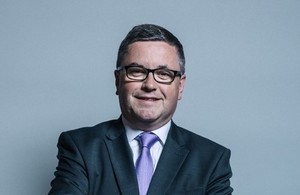 Solicitor General, Robert Buckland QC MP