Press release: More support for disabled people plus other welfare and pension reforms start in April

An increase in the State Pension rate and extra financial support for disabled people in the workplace are among a number of welfare reforms that have come into effect from April 2018.

1 April

Access to Work grants

Delivering on the government’s commitment to support disabled people into work, Access to Work grants have increased by over £15,000 so people can now claim up to £57,200 a year. Access to Work can cover workplace adaptations, assistive technology, transport and interpreters and is one of the ways the government is helping disabled people to enter and thrive in employment.

The increase ensures that more disabled people, particularly from the deaf community, are able to benefit from the grant and achieve their career aspirations.

2 April

Funeral Expenses Payment

For people on qualifying benefits, Funeral Expenses Payments contribute towards the cost of arranging a funeral. From 2 April, it has been made simpler for people to claim a Funeral Expenses Payment. Changes include extending the period in which a claim can be made and allowing recipients to receive contributions from friends and family without them being deducted from the payment.

6 April

Sure Start Maternity Grants

Sure Start Maternity Grants are a one-off payment of £500 for people on certain income-related benefits to help with costs when they have their first child, for example to buy baby equipment. Sure Start Maternity Grants are now available to kinship carers, foster carers and adoptive parents who then have their own first-born child.

Automatic enrolment into a workplace pension

To help workers to save for their future, the automatic enrolment pension contribution rates also increased from 2% to 5% on 6 April 2018.

Automatic enrolment was created to help people with their long-term pension savings and works by requiring employers to enrol all eligible staff into a workplace pension. An estimated 10 million people will be newly saving or saving more later this year and the increase in minimum contribution rates will build on this success.

Support for Mortgage Interest

People on certain benefits can get help towards the interest on their mortgage through Support for Mortgage Interest (SMI). To make the system fairer and ensure a safety net remains for the future, from 6 April this has been replaced with an interest-bearing loan that is only repayable after the property is sold if there is enough equity after the mortgage is paid off. The loan is optional and claimants who accept the loan will see no change in SMI payments.

9 April

Universal Credit work allowances

The amount which families with children and disabled people can earn before their Universal Credit is gradually reduced (work allowances) has been increased by 3%, helping families keep more of what they earn.

State Pension

The State Pension has also increased from 9 April, in line with the ‘triple lock’. The full basic State Pension was put up by 3% to £125.95 a week. This means that the government will have raised the full basic State Pension by £1,450 a year since 2010. The full rate of the new State Pension also increased by 3%, to £164.35 a week.

Other changes from April

Housing costs and Universal Credit

People in receipt of Housing Benefit will receive an extra 2 weeks’ support with their rent when they move onto Universal Credit.

In addition, new Universal Credit claimants will be able to claim Housing Benefit for support with their temporary accommodation costs. This will enable local councils to recoup more money they spend on temporary accommodation directly from DWP, protecting more than £70 million in 2018 to 2019.

Disability and carers’ benefit rates

Benefits for the additional costs of disability and benefits for carers have been increased by 3% in line with prices. The main rates for most working-age benefits in addition to Child Benefit, and certain elements of Working Tax Credit and Child Tax Credit, will remain the same.

National Living Wage

The National Living Wage increased by 4.4% to £7.83 an hour from 1 April, benefitting over a million workers.

Media enquiries for this press release – 020 3267 5144

Follow DWP on:
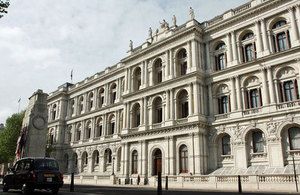


Press release: Foreign Secretary call with French counterpart on Syria: 9 April 2018

Foreign Secretary call with French counterpart on Syria: 9 April 2018 – GOV.UK

Foreign Secretary Boris Johnson spoke to the French Minister for Foreign Affairs Jean-Yves Le Drian about Saturday’s attack in Douma, Syria.

placeholder

A Foreign & Commonwealth Office spokesperson said:

The Foreign Secretary has this morning spoken to his French counterpart, Jean-Yves Le Drian, about the horrific attack in Douma, Syria on Saturday and ahead of an emergency session of the United Nations later today, which was called for by the UK alongside allies.

Speaking to Le Drian, the Foreign Secretary underlined the urgent need to investigate what had happened in Douma and to ensure a strong and robust international response. They noted that international investigators mandated by the UN Security Council had found the Asad regime responsible for using poison gas in at least 4 separate attacks since 2014 and agreed that those responsible for this attack must be held to account.

They both condemned the use of chemical weapons by anyone anywhere and they agreed to work together to stand up for the Chemical Weapons Convention and to ensure that there was no impunity for those that use such barbaric weapons. They agreed that today’s meeting of the United Nations Security Council in New York would be an important next step in determining the international response and that a full range of options should be on the table.

Published 9 April 2018


News story: Pan-London launch of Project Servator

Project Servator teams gather for the launch at the Tower of London. MOD Crown Copyright.

On Thursday 5 April 2018, the Metropolitan Police Service (MPS) hosted a formal launch event at the Tower of London to mark the London wide introduction of Project Servator. The Ministry of Defence Poilce (MDP) Whitehall Project Servator team attended the launch, which was followed by a joint Servator deployment with officers from the MPS and British Transport Police (BTP) in and around Parliament Square.

Project Servator is a policing tactic that is designed to deter, detect and disrupt all forms of criminal activity, including terrorism. Project Servator sees the deployment of specially trained highly visible and covert police officers, supported by other resources such as dogs, firearms officers, marine police units, plain clothes officers, vehicle checkpoints, Automatic Number Plate Recognition (ANPR) and CCTV.

Joint Project Servator deployment at Westminster. MOD Crown Copyright.

The MDP has had a fully trained Project Servator team operating from its Whitehall station since February 2018 and work in partnership with colleagues in the MPS and BTP on Servator deployments in and around the Whitehall area.

MDP Deputy Chief Constable (right) with colleagues from Metropolitan Police Service and City of London Police. MOD Crown Copyright.

The MDP Deputy Chief Constable Peter Terry, who attended the MPS Servator launch event, said:

The Ministry of Defence Police is delighted to be working together with our colleagues in the Metropolitan Police Service, British Transport Police and the City of London Police on the implementation of Project Servator in London. Our joint Servator deployments in and around Whitehall add an extra dimension to the existing security arrangements that are already in place and provide a highly visible and reassuring police presence for the public.

The positive feedback we have received from our customers and the public testifies to the positive impact of Project Servator in providing reassurance and encouraging community engagement.

In addition to Whitehall, the MDP also has Project Servator teams operating at the Atomic Weapons Establishment sites in Berkshire and at Portsmouth Naval Base. We are also preparing to launch Project Servator on the Clyde in conjunction with Police Scotland.


News story: London seminar: Complex commissioning for complex needs


News story: The Chancellor for the Duchy of Lancaster to visit China in a ‘Golden Era’ for the two countries

David Lidington, the Chancellor for the Duchy of Lancaster and Minister for the Cabinet Office, will make a three-day visit to China this week, building on the announcement of a new chapter in the ‘Golden Era’ between the UK and China during the Prime Minister’s visit earlier this year.

Mr Lidington will lead the UK’s 10th UK-China Senior Leadership Forum to the country. The Leadership Forum is a unique partnership that brings together British Parliamentarians and senior members of the Communist Party of China for frank discussions, debates and collaboration.

The theme of the 10th Leadership Forum this year is ‘Partners for Progress: Strengthening the UK-China relationship in the Golden Era’ and will focus on practical cooperation between the UK and China in light of Brexit. Other prominent figures who are members of the Forum are former Cabinet Office Minister Oliver Letwin, Lord Mandelson and Lord Sassoon.

The Chancellor for the Duchy of Lancaster will give the keynote speech at the Forum’s meeting in the International Department of the Communist Party of China. He is expected to discuss the importance of the relationship between Britain and China and opportunities for further cooperation on trade and other issues that will arise following Brexit. He will also give a speech about Brexit to Chevening alumni which will include members of the Chinese Government.

This will be the first Ministerial visit since the PM visited in January and comes at an important juncture in Chinese politics – straight after the National People’s Congress and at the start of Xi Jinping’s second Presidential term.

Mr Lidington will be meeting a number of officials from the Chinese Government, including the newly appointed Vice President, Wang Qishan. He will be the first British politician to meet Vice President Wang, who previously served as President Xi’s anti-corruption tsar.

Speaking ahead of the visit, David Lidington, the Chancellor for the Duchy of Lancaster and Minister for the Cabinet Office, said,

I am delighted to be returning to China at a moment of renewed strength between our two countries. Our relationship with China is, and will remain, a clear priority for the UK Government.

As the UK prepares to leave the European Union, I am confident that we can deliver on our bold vision for a Britain outside the EU that remains open for business and is the same outward-looking, globally minded country that we always have been.

That is why I believe we are now entering a new chapter in the ‘Golden Era’ of UK-China relations, in which co-operation between us is stronger than ever before, and in which we can tackle mutual threats together, and take advantage of the exciting new opportunities that await us both.