News story: Foreign Secretary concerned by report on media freedoms in China

placeholder

Foreign Secretary, Jeremy Hunt said:

I am concerned by the findings in the Foreign Correspondents’ Club of China report about media freedoms and the deteriorating situation for journalists in China.

Its publication coincides with the sentencing of journalist Liu Feiyue, one of over 60 journalists currently detained in China.

The UK is also concerned about the sentencing of Wang Quanzhang, a lawyer whose case I raised with Chinese State Councillor Wang Yi last July. He has spent the last three and a half years in pre-trial detention, much of that time incommunicado.

We urge the Chinese government to ensure fundamental civil and political rights are protected, in line with China’s constitution and its international commitments.

Further information

Published 29 January 2019


Press release: New government guidance encourages pesticides industry to prepare for EU exit

The Government has today (29 January) issued guidance to manufacturers and users of Plant Protection Products (PPPs) on what action they need to take now to minimise any disruption once the UK leaves the EU.

The high scientific standard to which decisions on the use of pesticides are made will not change. We will continue to be guided by the most up-to-date scientific assessment of the risks to animals and the environment.

If the UK leaves the EU on 29 March without a deal, pesticides currently available in the UK at the point of exit will continue to be so, allowing products to be marketed and used as normal.

Future PPP applications for use and renewals in the UK will continue to be considered by the Health and Safety Executive (HSE), on behalf of the UK Government (Defra) and the devolved administrations. The format and data requirements for new applications will remain the same as they do now, minimising disruption for businesses.

The key change would be that if a business wishes to place a new pesticide on the EU market they will need to make a separate application to the EU, a process which could take up to three years.

Farming Minister George Eustice said:

Delivering a negotiated deal with the EU remains the Government’s top priority, but it is our job to responsibly ensure we are prepared for all scenarios, including no deal.

Whether the UK leaves the EU with or without a deal will not change the high scientific standard to which decisions on the use of pesticides are made. We will continue to be guided by the most up to date scientific assessment of the risks to people, animals and the environment.

If the UK leaves the EU with a deal there will be an Implementation Period (IP) during which the UK will continue to follow decisions made by the EU on pesticide approvals and Maximum Residue Levels (MRLs).

The key difference for businesses is that, during the IP, the UK will not be able to act as a ‘leading authority’ under the EU regime and the HSE will be unable to conduct active substance or MRL evaluations. Therefore businesses wishing to supply new pesticides to the UK and/or EU markets would need to make an application to a competent authority in an EU Member State.

Businesses that may be affected by either scenarios should read the latest guidance on the UK regulation of pesticides after the UK leaves the EU.



News story: HMRC hosts event for businesses who export and import with the EU

The event outlined the changes businesses will need to respond to, as they import and export with EU companies, under a range of scenarios.

Mel Stride said:

This is part of the vital preparation to ensure that businesses are ready for leaving the EU.

Opportunities abound for a global Britain to strike out for rich new fields of trade and investment – however, preparations are needed to be able to capitalise on them.

HMRC is doing everything it can to make clear to businesses what is required of them ahead of when we leave.

In recent months, HMRC has published technical notices, partner packs, letters and guidance setting out the implications for a no deal scenario.

There is a real need for businesses trading to be ready and able to comply with any new rules and be emboldened to continue trading confidently.

The event, held at the QEII Centre in central London, heard from speakers who updated businesses with the latest information and actions to take around customs, VAT and excise, specifically including:

  • customs processes
  • roll-on roll-off port locations and changes
  • VAT processes

The event also hosted information stalls for the Department for Environment, Food & Rural Affairs, Border Delivery Group, Department for Transport, Government Digital Service and the Home Office.

Businesses will also receive a letter in early February with further details and information with guidance published on GOV.UK.


News story: Our email addresses are changing

placeholder

CICA has updated its email accounts to Office 365 and this will mean a small change to the email address you currently use to contact us. Our email address will no longer contain ‘.gsi’ but the rest of the address will remain the same (as below)

Current: Example.name@cica.gsi.gov.uk

New: Example.name@cica.gov.uk

This change will not compromise our security accreditation and you can continue to send emails in the usual way, safely and securely. You should start using our new email address from now. Our .gsi address will be removed shortly and we will let you know when this will be, nearer the time.

If you have any questions about this change, please contact us at business.change@cica.gov.uk

Published 29 January 2019


News story: New online service for commercial drivers to pay DVSA fines

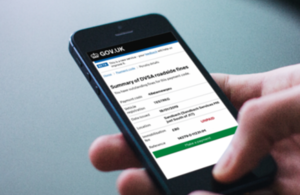
A picture of a mobile phone with the new online payment service shown on screen

A new service on GOV.UK, developed by the Driver and Vehicle Standards Agency (DVSA), makes it easier to pay a roadside fine.

DVSA examiners have the power to carry out spot checks on commercial vehicle drivers in England, Scotland and Wales. They can give you a fine (called a fixed penalty) if you commit an offence.

You can now pay these fines using the secure pay a DVSA roadside fine service on GOV.UK, instead of using Chip and PIN at the roadside.

The service is available 24-hours a day and can be accessed anywhere in the world. It works on mobile phones, tablets and computers. It lets you pay:

  • fixed penalties for vehicle defects and other offences such as breaking the rules around drivers’ hours
  • immobilisation fees
  • court deposits

You can either pay the fine yourself or ask for it to be sent to your company to pay it for you.

The rules for when you can be fined, how much you have to pay and the deadline for paying the fine are not changing.

Foreign-registered vehicles

Foreign-registered vehicles are subject to the same rules as vehicles registered in Great Britain.

But UK-based drivers will still have 28 days to pay fixed penalties.

How the online service works

  1. The DVSA examiner will ask you for an email address or mobile phone number, for either yourself or a nominated payer.

  2. You’ll get an email or text message with a DVSA payment code and a link to pay the fine on GOV.UK.

  3. Enter your debit or credit card details to make the payment.

  4. You’ll get an email or text message to confirm you’ve paid the fine.

The DVSA examiner will also be told you’ve paid the fine. If they had immobilised your vehicle, they’ll release it when any other outstanding issues have been resolved.

What the text messages and emails look like

Email

Text message

Quicker and more efficient payment

Gordon MacDonald, DVSA Head of Enforcement Policy, said:

DVSA’s priority is protecting everyone from unsafe drivers and vehicles.

This new service will allow for easier, more efficient payment of fines at the roadside, freeing up our staff to focus on the most dangerous rogue operators on Britain’s roads.

Roadside vehicle checks

You can find out more about roadside vehicle checks for commercial drivers and fines and financial deposits on GOV.UK.

Published 29 January 2019
Last updated 5 February 2019 + show all updates

  1. Added translations in Bulgarian (български), French (Français), German (Deutsch), Spanish (Español), Polish (Polski), Romanian (Română) and Welsh (Cymraeg).
  2. Added translation