Press release: Environment Agency approves permit variation

The new permit variation includes a number of improvement conditions, required in order to meet the environmental standards within which industry can operate, as laid out in our sector guidance.

In addition to the permit variation a separate new bespoke Radioactive Substances Activities permit has also been issued for the handling of naturally occurring radioactive materials (NORM) which result from standard oil and gas production activities.

In deciding whether or not to issue the permits, all relevant considerations and legal requirements have been taken into account. Comments received during the public consultation period, held between 20 February and 20 March 2017, were also considered as part of the decision process.

An Environment Agency spokesperson said:

This variation is necessary following our review of all oil and gas permits granted before October 2013. Although the activities at Palmers Wood have not changed significantly since the existing permit was issued, this variation updates the permit to the current regulatory requirements.

An environmental permit sets out stringent conditions that all oil and gas sites must adhere to. We do not issue an environmental permit for a site if we consider that activities taking place will cause significant pollution to the environment or harm to human health.

View the oil and gas mining waste permit issued for Palmers Wood Oilfield, Surrey.

For further information, please email KSLE@environment-agency.gov.uk.


Speech: A message from the British Ambassador to Ireland on the Common Travel Area

You may have read recent news reports about the Common Travel Area.

I would like to reassure you that the UK and Irish governments have worked intensively on measures to ensure the continuation of the CTA. We have an agreement which is almost ready to sign. This work reflects the fact that, right from the start of the EU Exit process, and throughout the negotiations, the Prime Minister has been clear that maintaining the UK and Ireland’s Common Travel Area is a top priority for the UK.

The same is true for Ireland, and the EU has fully accepted that the CTA – a bilateral arrangement – will continue whatever the final outcome of the negotiations. I can assure all British citizens living in Ireland and all Irish citizens in the UK: you don’t need to take any action to protect your status under the CTA, or the rights associated with it.

The CTA is a long-standing arrangement between the UK, the Crown Dependencies (Jersey, Guernsey and the Isle of Man) and Ireland that has its origins in the 1920s, long before either the UK or Ireland joined the EU. As Dr Butler said in his article, it is complex, and has never been codified into a coherent collection of documents. So officials across the whole of government in both countries have worked together to create a solid framework for the CTA, to ensure that the rights and privileges UK and Irish nationals enjoy in each other’s countries will continue, whatever the circumstances of the UK’s exit from the EU.

British citizens in Ireland and Irish citizens in the UK will continue to be able to live and work in each other’s countries, and to access healthcare, education, social welfare and benefits including state pensions. They will also still be able to vote in certain elections in the other’s country as they do now. The UK has taken steps to ensure legal certainty of the status of Irish citizens in the UK, and to provide clarity for them.

The Immigration and Social Security Coordination Bill that is currently before the UK Parliament preserves the rights that Irish citizens have in the UK. This reaffirms the UK Government’s intention to protect these arrangements and preserve the special relationship we have with Ireland after the UK leaves the EU. Where new domestic legislation in the UK is needed to ensure the continuation of the CTA and the rights that come with it, my Government is taking urgent action to put it in place before 29 March.

On Friday 1 February, the UK and Irish governments signed an agreement guaranteeing continued access to state pension and benefits for UK and Irish nationals and their qualifying family members when in the other’s state. The agreement ensures that the rights of UK and Irish nationals living and working in each other’s state are protected after the UK leaves the EU.

Specifically it ensures that workers only pay into one social security scheme at a time, and provides for the export of certain benefits between the UK and Ireland. It also ensures that social security contributions paid by UK and Irish nationals can be used to meet entitlement criteria for accessing benefits in each other’s state. Other agreements covering all aspects of the CTA are close to completion.

I advise British Citizens living in Ireland to subscribe to alerts on the UK’s Living in Ireland guide and to follow to the Embassy’s Twitter account @britemdublin for updates.


News story: Resilient technologies to improve UK railways: apply for funding

The UK rail industry transported 1.7 billion passengers and 110 billion tonnes of freight between 2017 and 2018.

New technologies are needed to help meet passenger needs, offer better journeys and increase sustainability in rail services.

£5.5 million is available from the Department for Transport for organisations to develop ‘first of a kind’ demonstrators. These should use existing technologies and develop these further for the rail industry.

This is a Small Business Research Initiative (SBRI) competition.

Rail Minister Andrew Jones said:

We have already seen some truly innovative projects developed for the benefit of passengers in these competitions, helping to drive forward a greener, cleaner and more reliable rail network.

This additional funding will spark even more innovation and ideas that deliver for commuters.

We are also investing £48 billion to modernise our railways over the next 5 years, ensuring people have the safe, frequent and punctual journeys they deserve.

Improving resilience

The competition aims to reduce costs, double capacity, lower carbon emissions and improve customer experiences.

It is across 4 themes:

  • infrastructure resilience, including protection against adverse weather conditions
  • operational resilience, such as using data to inform train maintenance activities
  • freight, including improved routing and tracking capabilities
  • noise and environment, including innovations mitigating engine noise

16 projects are expected to be funded across all 4 themes.

Projects should produce an interactive and innovative demonstrator that shows rail industry stakeholders and customers how a technology will work in a real-world rail environment. This can be:

  • within a railway station
  • in rolling stock
  • on railway infrastructure
  • in the environment close to the railway

Competition information

  • the competition opens on 25 February 2019 and the deadline for registration is at midday on 17 April 2019
  • organisations of any size are eligible to apply, working alone or collaborating with others as subcontractors
  • total eligible costs can be between £250,000 and £350,000 including VAT
  • projects will be 100% funded
  • briefing events will be held in London on 26 February 2019, Manchester on 28 February 2019 and Cardiff on 7 March 2019, where organisations can find out more about making an application


Speech: Getting the right leadership is vital for patient safety

“Trust me, I’m a doctor.” A phrase so reassuring that it’s a punchline.

We trust doctors and nurses more than any other profession. It’s a bond of trust that is both implicit and unspoken. You see us at our weakest, our most vulnerable. You hold our lives, and the lives of our loved ones, in your hands.

I was reminded of this unspoken bond of trust last week on a visit to The Princess Alexandra Hospital in Harlow. I met a mother with her newborn. Everything had gone well with the delivery and she was looking forward to taking her healthy baby home.

The visible joy, and relief, in her face is something every parent has felt. I’ve felt it myself with all 3 of my children.

We trust nurses and doctors, we trust the NHS, with something more precious to us than life itself. You have saved the lives of people I love.

We trust you because we know that you’ll do everything you can to help us. That you won’t give up on us. That the safety and life of my child is as important to you as it is to me.

But we can’t take that trust for granted. It has to be earned, and it must be protected. I think that’s why, when that trust is forsaken, the shock is so profound. When I learned what happened at Gosport, I was shocked.

Families had entrusted their loved ones into the care of doctors and nurses. Elderly relatives, at their most vulnerable and frail, were failed by a system that took that trust for granted. Think about your grandmother, your grandfather: how would you feel if the people you trusted most had let you down?

I get it. I understand. As Health Secretary, I’m sorry to those families in Gosport, Liverpool Community Hospital, Mid Staffs and everyone else who has been let down. But I’m not here today to point fingers and blame people.

Instead, we must learn the right lessons about creating a caring, compassionate culture, about protecting and renewing the bond of trust between the public and the NHS – our nation’s most loved and respected institution.

Because the other thing I was reminded of last week is that leaders create the culture. Because after I spoke to that new mother I spoke with the Chief Exec, Lance McCarthy, and I asked him what they do when things go wrong. What’s his approach to mistakes?

And he gave me a brilliant answer. He said: “If we’ve made a mistake, then we’ve made a mistake. We should be open and honest, and apologise. And not be afraid to apologise because of any potential legal action.”

As Secretary of State, that’s exactly what I want to hear. Because we all make mistakes. We should strive to avoid them, of course, but the fact of a mistake isn’t the biggest problem. It’s how we respond to them and how we learn from them, that’s what’s most important. And we must never let our fear of the consequences, stop us from doing the right thing.

So what Lance has done at his Trust is introduce a ‘behaviour charter’. Patients, their families and medical colleagues know what they can expect: openness, honesty, trustworthiness.

That way when mistakes do happen there’s an honest conversation: this is what went wrong, we’re sorry, this is what we’re doing to fix it.

It’s not an admission of liability. It’s an acknowledgement that we can do better. It’s often the first step towards acceptance for the patient and their family. And it’s a vital part of the process of continuous improvement we need to see everywhere in the NHS. Taking responsibility, learning the lessons that need to be learned, continuous improvement.

And what Lance has found is that clinical negligence claims haven’t gone up at his trust since they introduced this new charter. In fact, Lance believes, when people feel like they’ve been treated with honesty and candour, they’re less likely to resort to legal action.

The simple act of saying sorry maintains the bond of trust with the public even when things don’t go as planned. But this isn’t just a moral issue for the NHS ‒ as important as that is ‒ it’s a financial issue as well.

Compensation pay-outs have quadrupled from half a billion to £2 billion pounds a year over the past decade. That is unacceptable and it’s clearly unsustainable.

If we don’t do something about the growing number, and value, of clinical negligence claims, it threatens to swallow up the record £20.5 billion a year we’re putting into the NHS, and derail our Long Term Plan to transform the health service.

And that infuriates me, because it’s an injustice for taxpayers and our hardworking NHS staff. This is a once in a generation opportunity to put our health service on a forward footing so we can look to the future with confidence.

We can’t afford to let it go to waste. There is a moral and financial urgency to act. We must improve patient safety, so there’s:

  • less paperwork for medical staff and more time for patients
  • faster resolution for those who are wronged
  • more money for frontline NHS services and less taxpayers’ money going to lawyers

That’s what I want to see. That’s the approach we’ll be taking in our new patient safety strategy.

Creating a more just culture in the NHS, a more open, honest and trustworthy culture, starts at the top. Getting the right leadership is vital. We need more people with clinical backgrounds and more people from outside the NHS.

We need to ensure they get the right support, training and development so they can lead their organisations effectively and create the right culture for staff and patients.

How do we strengthen this leadership? How do we encourage more inspirational leaders into the NHS? And how do we ensure we can hold to account that leadership once in place?

First, and perhaps counter intuitively, I think we must cut the turnover rate at the top. To improve leadership in the NHS we must fire fewer people and attract the best talent. NHS leaders have some of the toughest ‒ yet most rewarding ‒ jobs in the country. So let’s support them to do the job they need to do ‒ and that will encourage more to step up.

Next, we need to have a better structure, both to support and hold to account. Today we’re publishing Tom Kark’s review into how we can improve NHS leadership. I’d like to thank Tom for his work on this and I welcome his recommendations.

Kark recommends that all directors must meet minimum competency standards to sit on the board of any health organisation, and where training is needed to meet those new standards, then it should be made available

He also recommends a central directors’ database where information about qualifications and employment history can be easily accessed

These new recommendations will ensure the fit and proper persons test is met and that unqualified or unsuitable staff can’t just move somewhere else in the NHS. We accept these recommendations in full and will get on with implementing them immediately.

I’ve asked Dido Harding to consider the further recommendations, and how we can implement these recommendations, throughout the health service.

Third, we’re working with the Healthcare Safety Investigation Branch and NHS Improvement to give more support to families when things go wrong.

A new family engagement model will ensure relatives play an integral part in any investigation, that their concerns, and their complaints, are listened to and acted on.

Nobody should feel like they’re being fobbed off or a nuisance. We must give families all the information in an open and transparent way. And ensure they’re treated with sensitivity and compassion before, during and after any investigation.

That’s the same approach we’ll be taking when independent medical examiners start being introduced across England from April. Every death will be scrutinised by either a coroner or a medical examiner.

Medical examiners will be someone bereaved families can talk to about their concerns. They will ensure investigations take place when necessary, help detect and deter criminal activity, and promote good practice.

This new system will be overseen by a new independent National Medical Examiner. And training will take place to ensure a consistency of approach and a record of scrutiny.

Finally, we need to encourage whistleblowing. Despite our best efforts, mistakes happen. We’re all human, we’re all fallible. Any doctor who says they’ve never made an error isn’t telling the truth. And the truth is more important than any one error.

Mistakes should be seen as an opportunity to learn and improve, not a need for cover-up and denial. Honest feedback is a gift.

So whistleblowers are doing the NHS a great service. Someone, who has the courage to speak up and put their head above the parapet, should be encouraged and embraced. Yet, sadly, all too often, they’re ignored, bullied and worse: forced out.

Making someone choose between the job they love and speaking the truth to keep patients safe, is morally abhorrent and operationally foolish. It’s an injustice I am determined to end.

We must change the way the system views whistleblowers: from a problem, to part of the solution. We must embed a ‘learn not blame’ culture in every part of the NHS, and ensure there are protections for staff and the public who speak up to save lives.

So we must get the right leaders to create the right culture. A just culture, an open, honest and trustworthy culture. A culture of learn not blame. Saying sorry when we get it wrong, earning the public’s trust, never taking it for granted. Encouraging and supporting people with the bravery to speak up.

There’s no one solution to patient safety. It’s a series of steps. It’s a path of continuous learning and improvement. There will always be more we can do, and we must always keep striving to do better.

I want Britain to be the best country in the world to be born. That begins with making the NHS the best – and safest – place in the world to give birth. I want every parent to experience the same joy the mother of that newborn did, thanks to our brilliant NHS. Thanks to our brilliant NHS staff.

So let us renew that bond of trust with the public. Make it a public, spoken, bond of trust: we will always be open with you, we will always be honest with you.

When things go right and when things go wrong, you can always trust the NHS to be there for you and your family.
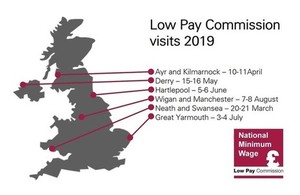


Press release: Low Pay Commission’s 2019 visits announced

2019 visits map

The Low Pay Commission (LPC) has announced its visits programme for 2019. It is looking to meet businesses and workers affected by the National Minimum Wage and National Living Wage.

Commissioner Professor Sarah Brown said:

These visits are a vital part of our evidence base – talking to employers and employees allows us to find out what is going on more quickly and to gather more detail than aggregate statistics can ever tell us.

The LPC organises an annual programme of visits to gather evidence in support of its recommendations to government. The visits are attended by members of the Commission and LPC Secretariat. The purpose of the visits is to hear first hand evidence from employers, workers and anyone else with a view on the National Minimum Wage rates and their effects.

The visit locations were chosen because most have a higher than average proportion of workers paid the minimum wage. The LPC also seeks to visit a combination of cities and more rural areas, and places with a different industrial make-up, to gain a rounded view of the effects of the minimum wage across the UK.

On the visits, the LPC hosts meetings and travels to businesses and workers at their place of work to see the effects of the minimum wage ‘on the ground’. Meetings with colleges, public sector organisations and charities are also welcomed.

2019 visit locations

20-21 March Neath and Swansea
10-11 April Ayr and Kilmarnock
15-16 May Derry
5-6 June Hartlepool
3-4 July Great Yarmouth
7-8 August Wigan and Manchester

Contact the LPC for more information or to arrange a meeting in any of the locations

Current and future minimum wage rates

  Current rate Future rate (from April 2019) Increase
NLW £7.83 £8.21 4.9%
21-24 rate £7.38 £7.70 4.3%
18-20 rate £5.90 £6.15 4.2%
16-17 rate £4.20 £4.35 3.6%
Apprentice rate £3.70 £3.90 5.4%
Accommodation offset £7.00 £7.55 7.9%

Notes

  1. The Low Pay Commission is an independent body made up of employers, trade unions and experts whose role is to advise the Government on the minimum wage. The LPC’s 2018 Report was published on gov.uk on Tuesday 27 November. Evidence gathered on previous visits contributed to the 2018 report.
  2. The National Living Wage is the statutory minimum wage for workers aged 25 and over. It was introduced in April 2016 and has a target of 60% of median earnings by 2020, subject to sustained economic growth. The April 2019 increase will maintain the path to this target.
  3. Different rates apply to 21-24 year olds, 18-20 year olds, 16-17 year olds and apprentices aged under 19 or in the first year of an apprenticeship.
  4. Rates for workers aged under 25, and apprentices, are lower than the NLW in reflection of lower average earnings and higher unemployment rates. International evidence also suggests that younger workers are more exposed to employment risks arising from the pay floor than older workers. Unlike the NLW (where the possibility of some consequences for employment have been accepted by the Government), the LPC’s remit requires us to set the rates for younger workers and apprentices as high as possible without causing damage to jobs and hours.
  5. The Accommodation Offset is an allowable deduction from wages for accommodation, applicable for each day of the week. In April 2019 it will increase to £7.55 per day.
  6. The National Living Wage is different from the UK Living Wage and the London Living Wage. Differences include that: the UK Living Wage and the London Living Wage are voluntary pay benchmarks that employers can sign up to if they wish, not legally binding requirements; the hourly rate of the UK Living Wage and London Living Wage is based on an attempt to measure need, whereas the National Living Wage is based on a target relationship between its level and average pay; the UK Living Wage and London Living Wage apply to workers aged 18 and over, the National Living Wage to workers aged 25 and over. The Low Pay Commission has no role in the UK Living Wage or the London Living Wage.
  7. The nine Low Pay Commissioners are:
  • Bryan Sanderson
  • Professor Sarah Brown
  • Professor Richard Dickens
  • Kate Bell
  • Kay Carberry
  • Simon Sapper
  • Neil Carberry
  • Clare Chapman
  • Martin McTague

Published 6 February 2019