Speech: Repeated violations of Ukraine’s territorial integrity by Russia

Thank you Mr President and may I also thank all of our briefers. Mr President, the Russian Ambassador spoke at length and in colourful and imaginative language about many other actors as he introduced this topic but he said nothing about Russia’s role. The German Ambassador – an eyewitness to Minsk -showed us why with his accounts of the events of the time and Russia’s actions.

Mr President, the United Kingdom welcomes this opportunity to discuss the repeated violations of Ukraine’s sovereignty and territorial integrity at the hands of Russia. Russia’s aggression towards Ukraine is not limited to the Donbas and Crimea – Russia seeks to undermine Ukraine at every opportunity; undermining the ceasefire; supplying the Russian-backed separatists with weapons and calling illegitimate elections- all in breach of the Minsk agreement. These actions have a tragic impact on the lives of Ukrainian civilians. As the French Ambassador said: in the five years since this conflict began, over 12,800 people have lost their lives. Almost 25,000 have been injured. And 3.5 million people are in need of humanitarian assistance. Russia bears a heavy responsibility for the ongoing loss of life.

Despite the parties recommitment the ceasefire on 29 December, violations are increasing and that continues to be military activity in the disengagement zones. However, our understanding of the situation within non-government controlled territory is limited because the OSCE Special Monitoring Mission is unable to carry out its mandate. It is unable to do so because of Russia’s repeated refusal to support the Special Monitoring Mission. This threatens the ceasefire and ultimately the security of Ukraine and the wider region. A raft of incidents that Russia is yet to provide an explanation for, only reinforces this conclusion. For example, the downing of an SMM long range UAV near the Ukraine-Russia border, outside Ukraine government control last year. And just last week, SMM twice observed the Russian electronic jamming system ‘ZHITEL’ in the Donbas. I would ask the Russian Ambassador to ensure his country’s support for the Special Monitoring Mission and to allow them to observe. I ask what people have to hide?

Mr President, a further example of Russian attempts to destabilise Ukraine is the illegitimate elections in the non-government controlled territories of the so-called Luhansk People’s Republic and Donetsk People’s Republic in the Donbas last November. This represents a clear breach of the Minsk agreements and unnecessarily increases tensions. Russia could use its considerable influence on the Russian backed separatists to encourage them to comply with them its commitments. Instead Russia fuels the conflict by supplying weapons and personnel to the armed formations.

Mr President, next month marks the fifth anniversary of the illegal annexation of Crimea by Russia. And it’s worth reminding ourselves of the facts. In response to Russia’s plans for an illegal and illegitimate referendum in Crimea. The Security Council on the 15th March 2014 voted on a draft resolution that reaffirmed the sovereignty, unity and territorial integrity of Ukraine and noted that Ukraine had not authorised the referendum and that it had no validity. Russia vetoed that resolution. Following the illegal and illegitimate referendum in Crimea on 16th March, on 27th March 2014, the United Nations General Assembly adopted Resolution 68262 supported by one hundred member states which affirmed the General Assembly’s commitment to the territorial integrity of Ukraine within its internationally recognised borders and underscored the invalidity of the referendum.

Mr President, we not only object to the illegal annexation of Crimea because it is illegal. We also object to it due to the Russian government’s appalling treatment of many of those who live there. Human rights violations are prevalent. Ethnic and religious groups such as the Crimean Tatars are persecuted. Mr President, despite calls in General Assembly resolutions for the United Nations High Commissioner for Human Rights to visit Crimea, Russia continues to refuse. We, the international community must stand united and call for Russia to release all political prisoners and allow urgent, unrestricted access for human rights monitoring organisations immediately. Again, what does the Russian Federation not want the world to see?

Mr President, less than three months ago, Russian authorities admitted to using force in the Black Sea to seize three Ukrainian naval vessels injuring three Ukrainian servicemen. These actions are not in conformity with the United Nations Convention on the Law of the Sea and they are a blatant attempt to destabilise Ukraine by harming economic activities of other ports of the Berdyansk and Mariupol -hampering Ukraine’s ability to manage its economy. Let me be clear, Mr President, Russia’s actions in Ukraine have no basis in international law. We cannot and will not ignore such actions. They represent a serious challenge to the international rules-based order. This is an order which benefits us all and keeps us safe. To protect it, the international community must continue to stand united and remain focused on Russia’s behaviour and its attempts to integrate Crimea into Russia – including through the construction of a bridge across the Kerch straits.

I would like to end by reiterating the United Kingdom’s full support for Ukraine’s independence, sovereignty and territorial integrity – including within its internationally recognised borders and territorial waters. We look forward to discussing the situation in Ukraine further at the forthcoming General Assembly debate on 20th February. And I take note of the Russian Ambassador’s enthusiasm for Security Council meetings on Ukraine and look forward next time to hearing about what Russia is doing to meet its obligations and bring an end to the suffering of the people of Ukraine. Thank you, Mr President.


News story: Ethics group to oversee use of large data sets by the Home Office

placeholder

The Biometrics and Forensics Ethics Group (BFEG), a non-departmental public body, will now be asked to consider ethical issues relating to large and complex data sets. The BFEG will provide independent oversight of the Data Ethics Governance Framework, which was established to ensure balanced consideration of the use of data within the Home Office.

The move is aimed at strengthening the public’s assurance on the use of data within the department.

Chris Hughes OBE, Chair of the BFEG, said:

With ever increasing volumes of data and the implementation of new data protection legislation it’s more appropriate than ever to expand the BFEG remit to consider large and complex data sets.

The expansion will build on the committee’s existing work and will work to ensure that the use of an individual’s personal data is legitimate and proportionate, contributing to justified trust in the Home Office.

The BFEG will continue to consider the ethical aspects of:

  • the application and operation of technologies which produce biometric and forensic data and identifiers;
  • ethical issues relating to scientific services provided to the police service and other public bodies within the criminal justice system;
  • applications for research involving access to biometric or forensic data; and
  • matters relating to the management, operation and use of biometric or forensic data.

Published 12 February 2019


News story: LLWR donation will help save lives in country areas

LLWR has funded a new £1,500 medical kit that will help save lives in rural parts of west Cumbria.

The company answered a call from Community First Responder Karen Eddy, a Building Manager on the LLWR Site, who asked for help to supply a new kit for the Bootle & District Group, including defibrillator, oxygen and pulse oximeter.

Typically, First Responders will be called out in cases of an immediate threat to life, such as a suspected heart attack, stroke or respiratory arrest, where they can be expected to arrive ahead of an ambulance, so they provide an invaluable lifeline, particularly in country areas.

Karen is also a member of the Gosforth & District Group, and her patch includes Drigg, Calderbridge, Ravenglass, Gosforth, Eskdale and Wasdale.

“We are absolutely over the moon with this donation,” she said. “Without it we would not have been able to get the kit. Although we work on a voluntary basis for North West Ambulance Service, we fund all our own equipment, through donations and fundraising.”

Karen can be called out a couple of times a week and is permitted by LLWR to leave work in the event of an emergency in the local community. She is permanently on call and was a little late into work one morning recently after being called out TWICE on the same night. But she loves the unpaid role.

“If you can help save a life, what more can you do?” she added. “It’s the ultimate.

“The Bootle & District Group will be at the Black Combe Country Fair in August to promote our case and give people a chance to try CPR and other life saving techniques.

“We rely on donations from our local community to keep our equipment up to date and our bleeps functioning so are always looking for opportunities to raise awareness.”

Karen is one of many at LLWR who volunteer to give their time in community roles, and the company supports their efforts with special leave when required.

Cath Giel, Head of Public Affairs, said: “It’s only fair that when those such as Karen show such incredible community spirit, we get behind them. Karen and her colleagues in the First Responders are doing a remarkable job.”

For further information on the role of Community First Responder go to www.nwas-responders.info


News story: Extra dial-in and 1-2-1 sessions announced for Get the Ship in Shape: accounting for, and tracking, personnel competition

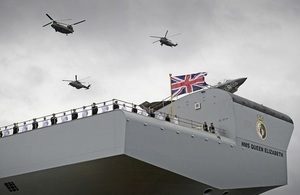
Navy personnel stood on board an aircraft carrier with 3 helicopters and a fast jet

The dial-in will be held on 27 February 2019, 10:00am to 12:00pm

A dial-in session providing further detail on the problem space and a chance to ask questions in an open forum. If you would like to participate, please register on the Eventbrite page.

The 1-2-1s will be held on 28 February 2019, 9:00am to 12:00pm

A series of 20-minute one-to-one teleconference sessions; giving you the opportunity to ask specific questions. If you would like to participate, please register on the Eventbrite page.

Please sign up using the Eventbrite links and contact accelerator@dstl.gov.uk with any questions.

Published 12 February 2019


Press release: Summit held to maximise East Midlands benefits from HS2

At the event in Nottingham on Thursday 7 February, they heard how communities and businesses can maximise the potential of Britain’s new railway line, including through tens of thousands of new jobs in the region, with billions of pounds injected into its economy.

Regional leaders from all the East Midlands councils were present, alongside MP for Broxtowe, Anna Soubry, and representation from the Department of Transport, the Railway Industry Association, Midlands Connect, East Midlands Chamber and the Derby and Derbyshire, Nottingham and Nottinghamshire (D2N2) Local Enterprise Partnership (LEP).

HS2 Minister, Nusrat Ghani, said:

HS2 is already underway and supporting more than 7,000 jobs at 2,000 businesses, including 300 companies across the Midlands.

Once built it will be a catalyst for regeneration in the region. The East Midlands HS2 Growth Strategy predicts it will add nearly £4 billion to its economy and around 74,000 jobs.

We will continue to work closely with local authorities and businesses as we drive this ambitious project forward, to ensure that the East Midlands benefits from the full potential of HS2.

Bridgeway Consulting

The visit was hosted by Bridgeway Consulting Limited, who are providing ground investigations and engineering surveys to prepare for HS2 in Birmingham and London. Through its contract with HS2 Ltd, the SME has been able to create new jobs and upskill 60 employees across a range of disciplines.

Following the roundtable, Nusrat and Allan were given a tour of the company’s Nottingham facility by Managing Director, Pino De Rosa, where they were able to see live structural monitoring and mobile mapping for HS2 sites.

Nusrat and Allan were given a tour of the company’s Nottingham facility.

Allan Cook, Chair, HS2 Ltd, said:

Bridgeway Consulting is a prime example of how HS2 is creating careers and opportunities for local people years before the first high-speed trains arrive in the East Midlands. HS2 requires over 30,000 people to design and build the railway, and what we’re seeing today is just the beginning for this once-in-a generation investment.

What is also evident here is the joined-up approach taken by local government and businesses to ensure the East Midlands is well equipped to maximise the benefits HS2 will bring. The government has committed to the Eastern leg of HS2 and it is imperative that this momentum is maintained.

Apprentices

Bridgeway Consulting currently employ 10 apprentices, of which 9 have worked directly on HS2. Nusrat and Allan also spent time with some of these apprentices, learning about their training before being given demonstrations of three ground investigation drilling rigs that they have helped operate on HS2 sites.

Co-founded in 1995 following railway privatisation, Bridgeway Consulting has grown to one of the leading consulting and contracting companies in the UK.

Pino De Rosa, Managing Director of Bridgeway Consulting Limited, said:

HS2 is a once in a lifetime infrastructure project that will transform opportunities for the people of the Midlands and the North and we’re proud to be working on it. So far the project has enabled us to create a number of job and training opportunities within our organisation and going forward it will give us the confidence to further invest in our people, equipment and technology.

HS2 will benefit businesses and communities across many sectors and will have a positive impact on the wider Midlands Engine and Northern Powerhouse workforce.

Apprentices demonstrated three ground investigation drilling rigs.

From 2033, passengers in the region will be served by a new East Midlands Hub in Toton, Nottinghamshire, which will provide high-speed connections to core UK cities including Leeds, Newcastle, Birmingham and London.

Phase Two

Just last month the Transport Secretary reaffirmed the government’s commitment to building Phase Two of HS2 – which extends from Birmingham to the East Midlands and on to Leeds in the east, and from Birmingham to Manchester in the west – adding that a failure to do so would represent a ‘betrayal to the North and Midlands.’

It came after authorities and businesses across the Midlands and the North published an open letter to political party leaders calling on them to commit to completing Phase Two.

HS2 is a key part of the government’s Industrial Strategy, which aims to deliver growth right across the country.

Once built, HS2 will become the first new railway built north of London since the Victorian era, unlocking the potential for hundreds of thousands of jobs and boosting the economies of towns and cities across the country. Construction on Phase One is already underway, which will link Birmingham with London by 2026.