Press release: Next generation of artificial intelligence talent to be trained at UK universities

  • New industry-funded AI Masters, and 16 dedicated Centres at universities across the country to train the next generation of AI PhDs
  • prestigious Alan Turing Institute AI research fellowships now open – allowing Britain to retain and attract the very best global talent
  • new figures show that inward investment to the UK AI sector has increased by 17% over the past year, more than the whole of Europe combined

Thousands of graduates to become qualified experts in artificial intelligence (AI) as part of a new joint government-industry package to drive up skills in the AI sector, Business Secretary Greg Clark and Digital Secretary Jeremy Wright announced today (21 February 2019).

For the first time, the UK will have a nationwide programme of industry-funded AI Masters courses coupled with work-based placements.

The new skills and talent package is a major milestone of the modern Industrial Strategy’s AI Sector Deal which was launched in April 2018. It is supported by industry funding and up to £110 million government investment, including:

  • up to 200 new AI Masters places at UK universities funded by companies such as DeepMind, QuantumBlack, Cisco and BAE Systems. The Masters programme marks the first nationwide effort to address the skills gap at this level, in collaboration with the Institute of Coding and British Computer Society
  • 1,000 students will have the opportunity to enhance their skills with new PhDs at 16 dedicated UK Research and Innovation AI Centres for Doctoral Training (CDTs), located across the country
  • up to 5 AI research Fellowships, created in collaboration with The Alan Turing Institute to both attract and retain the best research talent from around the world.

The announcement comes as new figures prepared for Tech Nation by Dealroom.co reveal the number of venture capital investments into the UK’s rapidly growing AI sector leapt by 17% last year.

Business Secretary Greg Clark said:

The UK has long been a nation of innovators. This AI skills and talent investment will help nurture leading UK and international talent to ensure we retain our world-beating reputation in research and development.

Artificial intelligence has great potential to drive up productivity and enhance every industry throughout our economy, from more effective disease diagnosis to building smart homes. Today’s announcement is our modern Industrial Strategy in action, investing in skills and talent to drive high skilled jobs, growth and productivity across the UK.

Digital Secretary Jeremy Wright said:

The UK is not only the birthplace to the father of artificial intelligence, Alan Turing, but we are leading the way on work to ensure AI innovation has ethics at its core.

We want to keep up this momentum and cement our reputation as pioneers in AI. Working with world class academic institutions and industry we will be able to train the next generation of top-tier AI talent and maintain the UK’s reputation as a trailblazer in emerging technologies.

As companies throughout the UK increasingly use AI in processes from manufacturing to fashion and construction to medical imaging, upskilling people to develop and maintain the new technology is crucial to its success in boosting productivity. This is part of the government’s continued drive to be a world-leader in harnessing the economic benefits of AI and the data-driven revolution, as part of the modern Industrial Strategy.

The schemes, aimed at people of different stages in higher education and available to researchers at a variety of levels, helps to build advanced AI skills at all levels, a key commitment contained within the AI Sector Deal.

Dame Wendy Hall, AI Skills Champion said:

I’m delighted to see the recommendations of the review that Jérôme Pesenti and I wrote just over a year ago, coming to life in such a comprehensive set of skills and talent initiatives.

They provide a great impetus to developing AI skills and talent and I strongly encourage industry, universities and those of you who aspire to be part of putting the UK at the forefront of the AI and data revolution to get involved in these 3 initiatives.

Finally, to develop the best and brightest AI researchers in the UK, the government is funding a new globally prestigious Fellowship programme. The first wave has been launched by The Alan Turing Institute.

Adrian Smith, Institute Director, The Alan Turing Institute said:

Artificial intelligence represents an incredible opportunity to transform our economy and our lives for the better. The Turing AI Fellowships will be crucial in building UK leadership capability, driving forward ambitious research and ensuring that the UK can attract, retain, and develop world-leading research talent.

UK Research and Innovation Chief Executive, Professor Sir Mark Walport, said:

Artificial intelligence is a disruptive technology in a range of sectors, enabling new products and services and transforming data science. It allows us to develop new approaches to challenges as diverse as early disease diagnosis and climate change.

To maintain its leadership in AI, the UK will need a new generation of researchers, business leaders and entrepreneurs equipped with new skills. Working with partners across academia and industry, the centres announced today will provide the foundations for these future leaders.

The Industrial Strategy sets out Grand Challenges to put the UK at the forefront of the industries of the future, ensuring that the UK takes advantage of major global changes, improving people’s lives and the country’s productivity. Artificial intelligence and data is one of the 4 Grand Challenges which will see AI used across a variety of industries and put the UK at the forefront of the AI and data revolution. Exploring the best skills package to equip people with the expertise to make the most of AI was a key commitment of the AI and Data Grand Challenge’s £950 million Sector Deal.


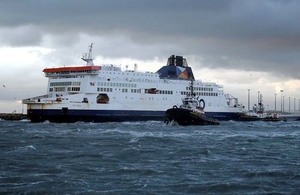
News story: Pride of Kent report published

Pride of Kent

Photo: REUTERS/Pascal Rossignol

Our report into the passenger ferry Pride of Kent striking a jetty and grounding in Calais, France on 10 December 2017, is now published.

The report contains details of what happened and the subsequent actions taken: read more.

Published 21 February 2019


Speech: Standing united behind Ukraine’s sovereignty

Thank you very much Madam President,

We welcome this debate and the opportunity to discuss the situation in Ukraine. I would like to start by joining those colleagues who reiterated the unwavering support to Ukraine’s sovereignty, independence and territorial integrity, including within its internationally recognised borders and territorial waters.

Today marks the annual commemorations of the lives sadly lost during the 2014 Euromaidan protests. We offer our deepest condolences to the families of those who lost loved ones.

Today also marks the fifth anniversary of the beginning of the Russian military operation to illegally annex Crimea from Ukraine.

Madam President, last week my Russian colleague stood with Foreign Minister Arreaza and pledged to defend the UN Charter, this included ‘respect for the sovereign equality of members’ and ‘respect for the territorial integrity and political independence of all states’.

However, the forcible Russian seizure of 10,000 square miles from Ukraine broke the first principle of international law: that countries may not acquire territory or change borders by force. It also violated a number of international agreements and commitments, including; Article 2 of the United Nations Charter, the Helsinki Final Act, the Budapest memorandum and the 1997 Russia-Ukraine Treaty of Friendship.

The General Assembly reacted to Russia’s actions by passing resolution 68/262 on 27 March 2014, affirming the territorial integrity of Ukraine – within its internationally recognised borders and the absence of any legal basis to change the status of Crimea.

Madam President,

As my German colleague said earlier, in another context in the Security Council, to listen to the Russian account of what happened in Crimea, one would think it was Ukraine that had invaded Russia. And not the other way round.

Madam President,

We do not only oppose the illegal annexation because it violates international law, we oppose it also because of the serious human rights violations Russia continues to commit in the Crimean peninsula. This includes the widespread persecution of ethnic and religious groups such as the Crimean Tatars and those who express opposition to the illegal annexation of the peninsula. In detention centres, these victims have been mistreated and tortured to punish or to extort “confessions”. It is no coincidence that Russia continues to ignore calls in General Assembly Resolutions for the High Commissioner for Human Rights to visit Crimea.

Madam President,

The United Kingdom is also deeply concerned by the ongoing militarisation of Crimea and the Sea of Azov by the Russian Federation. In December last year the General Assembly adopted a new resolution calling on the Russian Federation to withdraw its military forces from Crimea and Russia has ignored this.

Only three months ago, the Russian Federation used force to seize three Ukrainian naval vessels and took 24 servicemen captive – including three who were severely injured during the incident. Russia’s use of force, including use of firearms against Ukraine’s vessels, constituted clear aggression and escalation. These unacceptable actions are not in conformity with the United Nations Convention on the Law of the Sea, and they have no basis in international law.

We cannot and will not ignore such a serious challenge to the international rules based order. We call on the international community to continue to stand united and remain focused on Russia’s behavior and attempts to consolidate its illegal annexation of Crimea.

Madam President,

Turning to eastern Ukraine, the conflict there remains volatile, fueled by Russia’s total disregard for Ukraine’s sovereignty and territorial integrity. Russia has incited and then supported military activity by armed formations, including through the deployment of Russian troops into Ukrainian territory. Russia’s refusal to allow the OSCE Special Monitoring Mission to carry out its mandate within non-government controlled territories gives the impression she has something to hide and it threatens both the security of Ukraine and the wider region.

Russia’s concerted campaign to destabilise Ukraine includes its support, last November, for illegitimate elections that do not represent the will of the people in the non-government controlled territories. Such action unnecessarily fuels tension between parties to the conflict. Moreover, it is a clear breach of the Minsk Agreements.

Madam President,

As with all conflicts, it is sadly the civilians that suffer the most. Since the fighting started, over 10,000 people have lost their lives, almost 25,000 have been injured, 3.4 million are in need of humanitarian assistance and there are around 1.5 million internally displaced persons.

Ukraine’s crisis is not a frozen conflict. Russia created this conflict and, rather than use its considerable influence to ensure Russian-backed armed formations comply with their Minsk commitments, Russia continues to supply weaponry and personnel to these armed formations. Russia needs to withdraw its military personnel and weapons, cease its support for the armed formations and abide by the Minsk Agreement commitments she signed up to. This would be a much more convincing way to demonstrate commitment to ‘the principles of the founding charter that governs the behaviour of the international community’ than by giving a press conference.

Madam President,

The United Kingdom once again calls on the international community to stand united behind Ukraine and oppose Russia’s continued attempts to destabilise another Member State of the UN, undermine her sovereignty and steal her territory.

Thank you.


Press release: Joint statement on behalf of Prime Minister May and President Juncker

placeholder

Their discussions covered:

  • which guarantees could be given with regard to the backstop that underline once again its temporary nature and give the appropriate legal assurance to both sides. Both reconfirmed their commitment to avoiding a hard border on the island of Ireland and to respect the integrity of the EU’s internal market and of the United Kingdom. The Prime Minister acknowledged the EU’s position and notably the letter sent by President Tusk and President Juncker on 14 January. She welcomed the continued engagement of Task Force 50 with her team;
  • the role alternative arrangements could play in replacing the backstop in future, where they tasked the Commission’s Chief Negotiator Michel Barnier and Secretary of State Stephen Barclay with considering the process the European Commission and the UK will follow; and
  • whether additions or changes to the Political Declaration can be made that are consistent with the EU and UK Government positions and increase confidence in the focus and ambition of both sides in delivering the future partnership envisaged as soon as possible. The Commission’s Chief Negotiator and the Secretary of State will follow up.

The two leaders agreed that talks had been constructive, and they urged their respective teams to continue to explore the options in a positive spirit. They will review progress again in the coming days, seized of the tight timescale and the historic significance of setting the EU and the UK on a path to a deep and unique future partnership.

President Juncker and Prime Minister May agreed to talk again before the end of the month.

Published 20 February 2019


Speech: I don’t want you to panic

Emma Howard Boyd, Chair of the Environment Agency
Climate Action Society, University College London, Wednesday 20 February 2019

Good evening.

“I want you to panic.”

This simple message came from 16-year-old climate activist Greta Thunberg.

It caught the world’s attention.

It ignited Friday’s schools climate strike.

And – in a world where people talk about climate change all the time in unthreatening generalities – it brilliantly communicated the fact that climate change is an immediate problem.

We need activists like Greta Thunberg to push climate change up the agenda.

And, to challenge people in positions of power – (like me) – to work harder, and do better, because…

Last year – the Intergovernmental Panel on Climate Change said we have 12 years to limit global temperature rise to 1.5ºC above pre-industrial levels. Otherwise adapting to hotter days, fiercer fires, storms, and rising seas, will get radically more difficult.

Last month – the World Economic Forum’s Global Risks Report ranked extreme weather events first, and the failure of climate change mitigation and adaptation second, on its table of global risks by likelihood.

Last week – the Institute for Public Policy Research released a report saying that since 1950, the number of floods across the world has increased 15 times, extreme temperature events 20 times, and wildfires seven-fold.

But… as members of the Climate Action Society, I am going to assume that you already know all of that.

Instead, I’m going to talk about what climate change could mean for you in the next stage of your career.

Whether you go to work in private business, public service, academia, the media, or a great green NGO like Greenpeace, WWF, or Friends of the Earth… every organisation will be touched (in one way or another) by climate change.

At the Environment Agency, one of our roles is as a Category 1 emergency responder during flood incidents.

In December 2015, I was in France taking part in the negotiations for the Paris Agreement.

At the same time, the Environment Agency was responding to some of the worst flooding England had ever seen.

On December 5, 341.4 millimetres of rain fell in 24 hours at Honister Pass in the Lake District – a record.

The flooding of northern towns and villages did not let up until February.

The strain such events puts on individuals, families, and communities, stays long after the flood water has receded.

The emotional distress remains throughout the recovery, when every rain cloud brings fresh fear.

In those urgent situations – (which we know are set to become more severe because of climate change) – it is vital that my colleagues don’t panic.

They need to act calmly and professionally to help people get through the immediate impacts, and return to normal as quickly as possible.

If that sounds like something you’d be interested in, then I’d love you to consider working for the Environment Agency.

But, there are many other less obvious organisations that need people like you…

People who understand the urgency of acting on climate change, and have knowledge, skills, and enthusiasm to bring to that work.

When we talk about tackling climate change the emphasis is usually on reducing emissions.

This is with good reason: the world is not doing enough.

But, sadly, because of the increasing physical impacts that are now part of all future climate scenarios, we also need to increase our efforts to prepare for them.

Adaptation is not a competing agenda to reducing emissions, the two things go together.

It doesn’t make sense to build an energy efficient house that could be washed away in a flood.

Globally, climate resilience measures are predominantly provided by the public sector, but cross-sector collaboration is key.

According to the Institution of Civil Engineers, over 45% of National Infrastructure and Construction up to 2020/21 will be financed through the private sector.

As people’s routines are disrupted by natural forces – shareholders, workers, and customers will increasingly demand that brands help their lives run smoothly.

At the World Economic Forum in January, David Attenborough told the old joke:

“Anyone who thinks you can have infinite growth on a finite planet is either a madman or an economist.”

But, he wasn’t only there to criticise business and Government leaders.

He was trying to convince them to use their power to improve the way their organisations operate.

As students at a top university, soon to embark on your careers – you can help those organisations to improve the sustainability and resilience of their business models.

They need you.

It’s not easy to run a successful business on any scale.

During a routine farm inspection recently, a farmer told a colleague of mine:

“It’s hard to go green when you’re in the red.”

The Environment Agency’s job – as a regulator – is to help that farmer to do better.

But, that doesn’t mean going soft on pollution incidents or environmental crime.

I became Chair of the Environment Agency after 25 years working in finance.

I was in the City during the 2008 financial crash, and that strengthened my belief in the need for strong regulation.

I don’t want to let the kind of regulatory failures that happened in finance, happen in the natural world.

You can’t bail out nature like you can bail out a bank.

One of the difficulties with convincing businesses of the need to take action on climate change has traditionally been that some see it as a drain on resources rather than a money-spinner.

This is changing in some areas…

For instance, the Climate Change Act helped to reduce the UK’s greenhouse gas emissions to 43% below 1990 levels by 2017.

And, the UK economy grew by two thirds during the same period.

Unfortunately, the economic benefits of preparing for the impacts of climate change are less well understood.

Businesses have a lot to gain from realising the long-term opportunities in adaptation.

Mark Carney, the Governor of the Bank of England has said: “Financing the transition to a low carbon economy is a major opportunity for investors and creditors. It implies a sweeping technological revolution, including investments in long-term infrastructure at roughly quadruple the current rate.”

Much of that technology already exists. Including “green” infrastructure – like natural flood management and soil improvement.

For New York City, watershed management has saved $5bn in capital costs and $300m annually.

On the border of Brazil and Paraguay, returns on investment in soil conservation have significantly extended the life expectancy of the Itaipu Dam, paving the way for greater energy security.

In China, improved land management and watershed restoration on the Loess Plateau has eliminated the need for drought-related emergency food aid to a region that is home to 50m people.

Restoring mangroves in Vietnam has enhanced sea defences and improved the livelihoods of people using local resources.

These are all good individual projects, but we also need to be flexible in our general approach.

Adaptation pathways enable us to respond to the latest science, economics and environmental changes as our understanding improves.

The Thames Estuary 2100 project – which looks at protecting London beyond the life of the current Thames Barrier – is an example of this.

Don’t prepare for the previous record storm, build back better for the next one.

Governments and businesses need to cooperate internationally.

As the impacts get more severe, we have so much to learn from countries who already deal with large scale natural disasters.

In Bangladesh, deaths from tropical cyclones declined more than 100-fold in 40 years, from 500,000 deaths in 1970 to just over 4,000 in 2007.

This was achieved by developments in early warning systems, cyclone shelters, evacuation plans, coastal embankments, reforestation schemes, increased awareness and communication.

I am working to increase international partnership on this as UK Commissioner to the Global Commission on Adaptation.

The GCA will be publishing its first report at the UN Climate Summit in September.

At the Environment Agency, international partnership is necessary to ensure our work in England is world class.

We are part of I-STORM – the International Network of Storm Surge Barriers – which brings together professionals from the USA, The Netherlands, and beyond, to review each other’s work, and improve standards of flood protection all over the world.

Our collaboration with the Bureau of Meteorology in Australia, helps us stay on the cutting edge of flood forecasting and warning.

We are driving up standards in waste regulation and plastics reduction as part of the European Environment Protection Agencies network.

And, the Environment Agency Pension Fund is showing that you can put in a strong financial performance and influence companies to reduce their carbon emissions.

Right now, the details of the UK’s future relationship with the European Union are still not known.

Whatever the outcome, international cooperation and progress towards targets like the Paris Agreement, and the UN’s Sustainable Development Goals, continue to be essential.

We are working to guarantee this whatever happens.

For instance, last week the Government launched a new system to ensure the UK maintains current restrictions on the use of fluorinated greenhouse gases in the event of a no deal Brexit.

The business world needs more people to make the case for investment in climate measures and natural capital from the inside.

The environment is not universally well represented in boardrooms.

Company boards have to take environmental risk seriously and not see it as an operational expense.

This goes for managing their own impacts like pollution incidents, but they should also put aside funds to ensure business continuity in severe weather.

If the centre of town is cut off by a flood, then people will take their business elsewhere. Meaning that an entire community, and all those who rely on it, suffer.

However, if businesses were to collaborate to make areas more resilient, they could drive down costs, and ensure whole districts are able to get back to normal quickly after the storms have passed.

Finance provides another way to help companies realise this.

A few years ago, the Environment Agency Pension Fund set up the Transition Pathway Initiative with the Church of England National Investing Bodies.

The TPI, which is run out of the Grantham Institute at the London School of Economics, assesses how companies are preparing for the transition to a low-carbon economy.

It is now supported by asset owners and managers with over £8.17 trillion of assets under management.

We use the results of the TPI’s analysis to inform investment decision-making and our engagement with companies.

On adaptation specifically – if you could show people how much certain property protections are worth to their business in hard numbers before a future storm, you could use this as a clear way of demonstrating the value of climate measures.

If strong locks on your doors keep insurance premiums down, then resilience measures such as water resistant insulation in walls and under the floor should do the same for flooding.

The good news for you is that one of the best places in the world to begin looking for employment in green business is here in London.

The international operations of the City, the existing expertise and demand for sustainable investments – and the fact that the London insurance market is already a world leader in natural hazard protection – makes it a leading green financial centre.

And, that’s a great springboard from which to leap into all kinds of new environmental projects.

To conclude.

David Attenborough’s main message at Davos was:

“The Garden of Eden is no more… We need to move beyond guilt or blame, and get on with the practical tasks at hand.”

As you leave UCL and go on to do whatever comes next, I want you to remember that every sector of society has a role to play in those practical tasks.

You can be the change you want to see in business, government, NGOs, academia, the media, or wherever you go next.

As members of the Climate Action Society, I know you appreciate the urgency of our climate change crisis, so…

I don’t want you to panic.

Because we need to go to work.

Thank you very much.