UK Disabilities Minister calls on Welsh sporting clubs to be more inclusive

On a two-day visit to North West Wales with Ynys Môn MP Virginia Crosbie, the minister urged local organisations to look at ways to make themselves more accessible to the disabled community, after seeing inclusive sports clubs in Anglesey.

During her time in Wales, the minister took part in a training session with the Anglesey Hawks Wheelchair Basketball Club in Holyhead and visited the Anglesey Group of Ynys Mon Riding For The Disabled, meeting one of their blind dressage riders.

The Minister made her visit as the figures show there are 1.3 million more disabled people in employment since 2017, with employers across the UK creating more inclusive and diverse workforces through government schemes like Access to Work and Disability Confident. The minister spoke to the organisations she met about how including people with disabilities in work and leisure benefits the wider community.

Minister for Disabled People, Health and Work Chloe Smith MP said:

Disabled people deserve the same opportunities as everyone else and I urge all Welsh sporting organisations and clubs, big or small, to be more inclusive of everyone in their wider community.

Both the Anglesey Hawks and Anglesey Riding Centre are two wonderful examples of inclusive organisations and it was a delight to see how they are harnessing the power of sport and physical activity, excluding no one.

Exercise can have a transformative effect on both your physical and mental health and it is imperative there is equal access for everyone.

Virginia Crosbie MP said:

I am really pleased the minister was able to visit these two excellent Ynys Môn sports organisations.

It is vital our communities are active whatever their age, skill level or disability and that there is access for all.

Being active helps with general health, it prevents a host of illnesses as well as keeping people fit.

These two organisations are beacons on the island for inclusive sporting activities and I thank them for allowing myself and the minister to visit and meet staff and members.

The Anglesey Hawks Wheelchair Basketball Club was set up in 2014 and train weekly at Holyhead Leisure Centre. The club has players of all ages and both disabled and able bodied, playing equally together. The club also supports players who aspire to play at a national level, with some current members having represented Wales and multiple members playing for Wheelchair Basketball North Wales.

Anglesey Hawks Head Coach Charlie MacPherson said:

We were excited to welcome the Minister for Disabled People to our club, to meet some of our members and have a go at sport that really does change lives.

The Anglesey group of Ynys Mon Riding for the Disabled is celebrating its official 50th birthday in October. The charity provides therapeutic and learning opportunities for both children and adults with physical and learning challenges. It also supports many riders who have competitive aspirations, with one of their riders representing Wales at the British Dressage Para Home International.

Sara Jones-Williams, chair of Ynys Môn RDA (Anglesey) Group said:

As a lifelong volunteer with the Ynys Môn RDA (Anglesey) Group, I am inspired by the riders, volunteers and local people who assist the group to achieve the RDA UK strapline #itswhatyoucandothatcounts.

Providing physical, social and life skills to riders whilst engaging with the bigger community, has helped many of the riders we support in many aspects of their daily life as well as achieving some impressive results within their competitive aspirations.  Every rider has a journey and that journey is equally important to them and the group.

As part of her two-day visit to Wales, the minister also visited Tyddyn Môn in Brynrefail.

The charity employs 60 local people and supports 50 adults with a learning disability on Anglesey. It provides 24-hour care and support for 24 of these people in seven supported living houses across Anglesey. Another group attend the day and work opportunities service based at Tyddyn Môn farm, where the charity provides work-based training and work experience through a number of social enterprises, in addition to wellbeing activities.

During her visit, the minister attended a practice of the charity’s music group, as well as separate cooking and pottery sessions.

Dr Michelle Freeman, CEO of Tyddyn Môn said:

It was a pleasure to welcome the Minister for Disabled People, Health and Work, Chloe Smith MP, to the charity farm.

The people supported by the charity enjoyed showcasing the good work they are doing in the social enterprises on the farm and in the local community.

Media enquiries for this press release – 0115 965 8781

Follow DWP on:


Renewing our vision of a Security Council that has real impact on the ground

Mr President, I would like to thank Albania as Chair of the Informal Working Group for their excellent stewardship of this important topic.  I also thank our briefers for their reflections on the Council’s working methods.

President, as we emerge from Covid virtual working methods, it is welcome that we are back to full participation in open debates like this, to remain connected with the wider UN membership.  And, I agree with my Russian colleague, my US colleague and others who say that we really value in-person meetings — although we managed well through the period of virtual working. Still, we have more to do to ensure the Council stays effective and efficient.

Our vision remains that the Council is able to solve problems though interactive debate, building consensus, responsible pen-holdership, and making decisions that have real impact on the ground.  Sometimes, that means discussion in private not public, and we look forward to a full return to the consultations room.

On pen-holding, there is a longstanding convention of pen-holding to support consistency. But, as we have seen and heard, it is a flexible practice, as Ms Sievers said, and that we, the UK, have shared with Germany on UNITAMS, and we now share with Gabon on UNOCA.

It means being responsive to prevent conflict or deter escalation, and discussing issues even if uncomfortable for some. But all Council members have a responsibility to uphold the UN Charter.  The GA resolution 76/262 on the veto, that we co-sponsored, is a welcome step in ensuring transparency and accountability when a member of the Council blocks action to maintain international peace and security — for example, as we saw  on DPRK.

President, we also need to do more to ensure that we are using the Council’s time efficiently. That means respecting the Council’s mandate, not using it as a platform for propaganda and misinformation.

Sadly, Russia has done just that, consistently, since its illegal invasion of Ukraine. It still denies this is a war, even as its missiles continue to rain down on civilian targets.

With respect to the Russian Federation’s allegations about our pen-holding on Libya, I made clear in the Council yesterday, our national position, shared by many others, that withdrawal of the Wagner Group mercenaries is an essential part of making progress in Libya. And on Yemen, I simply note that this is one file where we have made progress this year, since the start of the year, thanks to work of Members of this Council, countries of the region and the UN — the hard won truce is holding.

President, if we are discussing procedure today, we should look at the founding rules of the UN.

Regrettably, the real challenge for the functioning of this Council is that a permanent member has torn up the UN Charter and invaded a sovereign neighbour.  The global impacts are profound and affecting many of those issues on which the Council is seized.

I am sure we will hear from Member States today about their concerns about divisions in the Council.  It will not be adjusted working methods that resolves this, but an end to Russia’s illegal war.

Thank you.


If this city could talk: Improving flood resilience in Newcastle

Press release

The Environment Agency and Newcastle City Council have launched a pilot to give residents and visitors to Newcastle the chance to boost their flood resilience

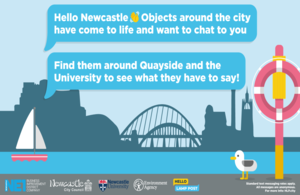
Poster for the Hello Lamp Post pilot launch in Newcastle

The Hello Lamp Post pilot launches in Newcastle

Residents and visitors to Newcastle can find out how to become more resilient to flooding by having a virtual conversation with an everyday item on the street.

The Environment Agency and Newcastle City Council have launched a pilot with Hello Lamp Post to mark the tenth anniversary of “Thunder Thursday,” which saw a month’s worth of rail fall within two hours – on 28 June 2012 – flooding 500 homes in the city.

Hello Lamp Post allows people to have 2-way ‘chats’ with objects in their local environment. QR codes have been attached to the Quayside and around the University, with more to come in different locations; anyone with a smartphone can scan the QR code or text the number on the sign to begin a conversation.

Users will be able to find out what measures they can take to reduce their own flood risk in a digestible, informative and playful way. Information around climate change and relevant special events that are happening nearby can also be provided.

Studies have shown that taking steps to prepare for flooding and knowing what to do in a flood can significantly reduce the damages to a home and possessions, reduce risk to life, and reduce the likelihood of suffering from mental health impacts in the future.

The first interactive objects are now live at Newcastle Quayside and the Urban Science Building at Newcastle University.

Alex Scaife, Flood Resilience Engagement Advisor, for the Environment Agency, said:

We know the devastating impact flooding can have which is why community engagement has always been a key part of our flood defence work.  We’re always looking for new and better ways to talk to people and now we can reach residents and visitors as they are walking through the city.

This clever piece of modern technology will explain all the whys, what and the what ifs of flood risk and resilience. I would encourage everyone in Newcastle to try out this new, interactive service.

To find out if you are living in a flood risk area and for information about how to sign up for flood alerts visit: Check for flooding in England

Published 28 June 2022


OSCE has been an important platform to hold Russia to account: UK statement to OSCE

Thank you, Mr Chair. In contrast to the previous speaker, I would like to start by paying tribute to Poland’s professionalism, and that of the OSCE Secretariat, in chairing the OSCE at this extraordinary time.

Since our last Annual Security Review Conference, the European security situation has changed fundamentally. Despite the claims of the Russian delegate, one participating State stands out in particular. Russia has withdrawn from the Open Skies Treaty. Russia has forced 2 of 3 OSCE missions in Ukraine to close – and is on track to make the third close later this week. Russia refused to explain its extraordinary troop build-up, despite its OSCE commitments on military transparency under the Vienna Document. Then on 24 February, without provocation, Russia invaded Ukraine and in doing so launched the biggest war in Europe since 1945. Russia has trampled on the OSCE’s core principles such as the non-use of force, respect for sovereignty and territorial integrity, and the protection of human rights and fundamental freedoms.

The fact that Russia is trying to distract us with disinformation suggests that they know, as well as we do, that none of their other excuses for invading Ukraine has any solid foundation whatsoever.

Since its invasion, Russia has continued to show contempt for international humanitarian law and OSCE principles.  As G7 leaders said yesterday, we solemnly condemn the abominable attack on a shopping mall in Kremenchuk and stand united with Ukraine in mourning the innocent victims of this brutal attack. This is part of a wider pattern of indiscriminate Russian attacks that have killed thousands, including of their own men and women, and driven millions more from their homes. Indiscriminate attacks on innocent civilians constitute a war crime. The first Moscow Mechanism report found credible evidence of violations of fundamental rights by the Russian Armed Forces, including the right to life, freedom from torture and other inhuman and degrading treatments and punishment.

There was also evidence of humanitarian convoys and healthcare facilities being attacked, of arbitrary arrests and extrajudicial killings. We are horrified by reports of sexual violence committed by Russian Armed Forces in Ukraine. Even OSCE staff in Ukraine have been affected; we condemn the detention of the three remaining SMM staff and call for their immediate release.

Mr Chair, despite what Russia claims, Russia continues to deploy its military forces to, and operate from, Belarusian territory.  Belarusian forces have not been directly involved in the conflict to date, but their deployment to the Ukrainian border is likely preventing some Ukrainian troops from supporting operations elsewhere. This is unacceptable. Belarus is enabling this war.

Beyond Ukraine, Russia’s invasion has led to steep price rises in commodity markets and is massively exacerbating the disastrous impacts we are now seeing to global food security. The consequences of Russia’s aggression are hitting the poorest and most vulnerable people in the world hardest.

Mr Chair, in its response to this awful war, the OSCE has continued to demonstrate its enduring relevance.

Before Russia’s invasion, OSCE mechanisms were deployed to try to prevent conflict – and then to send an early-warning signal. The Polish Chair-in-Office tabled the Renewed European Security Dialogue to find a diplomatic solution – Russia refused to engage in good faith. Ukraine triggered Vienna Document Chapter 3 to seek an explanation of Russia’s military build-up – Russia boycotted every meeting. The Secretary General’s early-warning letter, sent 10 days before Russia’s invasion, turned out to be prescient.

Since Russia’s invasion, the OSCE has been an important platform to hold Russia to account. 47 participating States, primarily at Foreign Minister level, used the Reinforced Special Permanent Council on 24 February in order to support Ukraine and defend the OSCE’s principles. At the weekly Permanent Councils and Forums for Security Cooperation, participating States have continued to call out Russian aggression, abuses, and lies. The OSCE’s Moscow Mechanism has already delivered one report already on human rights concerns during this war, and is on track to deliver another. These will be shared with other international investigations, to hold perpetrators to account.

Going forward, the OSCE, as Europe’s regional security organisation, will continue to matter post-conflict. For example, its decades of experience in managing and resolving conflicts will help Ukraine to rebuild and recover.

Mr Chair, the OSCE matters beyond the situation in Ukraine. We strongly support its ongoing work in supporting conflict-affected populations and promoting conflict resolution – notably in Georgia, Moldova, Nagorno-Karabakh, the Western Balkans and Central Asia – including managing the situation in Afghanistan. This includes the invaluable work of the OSCE Special Representative on the South Caucasus, the Personal Representative on the Conflict Dealt with by the Minsk Conference, the OSCE Mission to Moldova and the OSCE Special Representative for the Transnistrian Settlement Process. These OSCE activities make a significant impact across the OSCE’s three dimensions – including on human rights, democratic governance, environmental and economic activities and fundamental freedoms.

Mr Chair, the UK remains a steadfast supporter of the OSCE and its principles. As the situation in Ukraine and beyond has shown, these principles are now more relevant now than ever. We must keep holding each other to account against them, because that makes us all safer, and is the right thing to do.

Thank you.


Defence Secretary Speech at RUSI Land Warfare Conference 2022

Can I thank Dr Sarah Ashbridge and RUSI for hosting this event. Obviously RUSI is an incredibly old institution, almost as old and esteemed as the British Army.

I’m delighted that Dr Rob Johnson, has recently been appointed Director of my Office for Net Assessment and Challenge, and that’s exactly the task that he’s going to be put to, which is challenging many of you in this room about choices you make and challenging me I hope, about the political or policy decisions as well. So, I’m delighted to welcome you to the Ministry of Defence, and definitely don’t hold off on the challenge.

Ruthless challenge and self-criticism is one of the things that should make our Army world leaders. It certainly does in some of our units and I think it’s something that we should really embrace. There’s nothing wrong with hearing criticism or critique. Indeed, a young platoon commander is always foolish to ignore the old guardsman in the back of his TAC HQ across the country telling you you’re going in the wrong place. Some of my colleagues used to ignore those guardsmen and are probably still there.

So, for many years this Land Warfare Conference has been pondering on the “utility of land power in the 21st Century” and Russia’s invasion of Ukraine in 2014 as a “harbinger for the future of warfare in Europe”. So many previous events with such similar titles have obviously passed through these walls.

Well, we can no longer afford to just ponder. Together, we must act, and fast.

And General Sir Patrick Sanders is the right man to ‘mobilise’ the army in order to do so.

It was a (much younger) Lt Col Patrick Sanders lecturing at RUSI in 2008, after a particularly demanding tour in Iraq commanding 4 Rifles Battlegroup, who emphasised the importance of combat cohesion, the realities of attrition, implications of the media environment, and the “remarkable morale of the British soldier, which only grows higher the closer they get to danger”.

And in 2015, as a ‘lowly’ Major General at that stage, he was back to stress the Army’s core purpose as “protecting the national interest on land, where all conflicts are ultimately resolved.” and that “politicians need and expect sovereign political choice and options, with the division one of the cornerstones of UK hard power, without which soft power is simply bluff.”

As one of those politicians I agree and here is what I need from you today.

‘My mission and your role in it’, if you will.

Our job is to protect people and that will always require a presence on land, so long as that’s where people live.

And just as you always have to ‘go to war with the army you have, not the army you would like’ – because even today we can’t predict where or when it might be – so must we mobilise to deter and contain with the forces that we have now.

The odds of it being a war in Europe have shortened almost as much as the timeline, so we must act.

We can’t protect the British people, or our allies, with just transformation strategies and glossy equipment brochures.

And while it is true that the Army must not become blinkered, fixated on a single priority, countering Russian aggression is neither a uniquely European challenge nor solely for armoured formations.

The Army must contribute to the defence of our values and interest – manifested as the international rules-based system that has kept us safe and prosperous for three quarters of a century – and do so wherever it is threatened.

The threat is global, multi-domain, above and below the threshold of open conflict.

So, I take the mobilisation of ‘Op MOBILISE’ to be the ruthless prioritisation of readiness and relevance.

And to be relevant you must be modern, forward looking, and prepared to challenge the often deeply held doctrines, too often bordering on the nostalgic.

Too many times in the Army of recent years we have seen ‘form before function’ and knee jerk reactions to change.

We have also forgotten the premium of being forward and present in the world.

My determination to shift from an emphasis on warfighting contingency to persistent presence for containment – a positional strategy of deterrence-by-denial, for both geographic and influence spaces – must not become another false choice of one approach over another, but a deliberate rebalancing.

We must always be ready to fight, wherever positioned, and in whichever domain, and in doing so contain the Kremlin’s aggression, because it is increasingly clear that President Putin cannot be ‘deterred’ by threat of punishment or the costs imposed upon his people.

As Minister Shoygu told me himself, while I was in Moscow earlier this year, “no one can suffer like the Russians”.

There is almost a perverse pride in that suffering, and I believe that is what distinguishes us and our allies from the Putin regime – we serve our people to protect and prevent suffering, while they exploit innocent people’s suffering in the service of their imperialist ambitions.

Putin must be contained, sealed-off from their sources of influence, funds, and technological capability.

But he and his government must also be made utterly transparent, a light shone through them and every one of their lies, every corrupt practice, every immoral deed, exposed to the world and to the Russian people. As they too suffer from this tyranny.

We will not be able to deliver this unless we are honest about our own historical failures. In Army leadership, in the MOD, and yes in political leadership.

And I have seen it from all perspectives.

It was a summer morning in July 1991 when me and my fellow young officers on the Platoon Commanders Battle Course were summoned onto the drill square to be told the details of ‘Options For Change’; the Government-of-the-day’s response to the end of the Cold War.

I was lucky, while my regiment was losing a battalion it was not disappearing altogether. Some of those around me – fresh out of Sandhurst, with new regimental berets – were not so lucky.

In 1991 the world had reason to be optimistic. The Soviet Union had collapsed, Al Qaeda was just a glimmer in the eye of a small religious cohort and China had not yet appeared on the world stage.

So, it was right for the government of the day to review their defence spending and defence postures. And yes that meant also the Treasury seeking a ‘peace dividend’ in exchange for the decades of investment in large, static formations in Germany.

The problem was and is, that successive governments, both Labour and Conservative, have kept coming back for that dividend. They have gone from being investors to corporate raiders. Which is why I was pleased that this Prime Minister reversed that trend by investing £24 billion in a record settlement.

I have now been both Security Minister and Defence Secretary for over six years. I have been ‘read-in’, briefed and informed of our adversaries’ intentions, their plots and their capabilities on an almost daily basis.

I have read thousands of Secret or Top-Secret documents over the last few years and so I am intimately aware of the threat we face and the direction of that threat.

Security prevents me from sharing the details of such documents and intelligence reports, but I can say, however, that we have consistently underestimated Russia’s appetite for aggression; almost forgotten Al Qaeda (wrongly); missed the rise of China; and comforted ourselves that cyber is at least out of sight and therefore out of mind for the average voter.

Outside the world of Security and Defence that could be true by too many people not in the circle of reading. We have done our best to meet some of our National Cyber Security Centre investments and new defence capabilities, but not in resilience across government as you’ve seen Covid has exposed.

While we meet our commitments, we have also made some good decisions in order maximise our outputs, we are – like many in Europe – treading a fine line.

Defence has become a constant competition between capabilities and mass – between one domain or another. And commitments have been made without any real honesty as to the costs twenty years down the line.

Take for example the aircraft carriers. Announced with fanfare by Gordon Brown in 1998 and completed twenty years later.

In the early stages there was no honesty as to the financial costs, opportunity costs, or ‘required enablers’, and what they would mean for the rest of Defence in the long term.

Like so many projects there was an inherent culture of ‘someone else will pay.’ That lack of realism has impacted right across our Armed Forces.

In Land, too many Army leaders and politicians focused on platform numbers while meeting rising costs by hollowing out force elements and their readiness.

At sea the cost of overruns was met with sacrificial dry docks and maintenance facilities.

What use is boasting about how many tanks or ships you have if you have no spares or no ammunition?

What is the point of demanding more brigades if the ones you have possess no Electronic Warfare or sufficient air defence?

How long do we think our reformed armoured brigades will last when their enemy’s artillery out-range them by tens of kilometres?

There are many lessons from Ukraine and there will be many more to come. Some of the lessons in-fact prove many of the Defence Command Paper’s assumptions.

For example, helping countries with their own resilience by not only training but assisting or equipping.

It was the new Ranger Regiment that we sent to train Ukrainians on NLAWs just a week or two before Russia’s invasion.

And ‘Future Soldier’, while reducing infantry units invested in more deep fires and EWSI.

When the PM took the strong decision to invest an extra £24 billion in Defence in 2020, he broke with convention and recognised the need to reverse the decline.

It was a strong start, and we now we investing over £43bn in the Army’s Equipment Plan over the next decade.

The next challenge is to ensure that we spend such an investment in the right places and use the resulting equipment in the right ways.

There are too many examples where wargaming has exposed our vulnerabilities only to be ignored because the results presented an inconvenient truth.

I am delighted that Patrick is in post at this critical time. I know he is the right leader at the right time for the British Army.

And as I have always said, as the threat changes so must the funding.

If governments have historically responded every time the NHS has a winter crisis, so must they when the threat to the very security that underpins our way of life increases.

Sometimes it is not about what dividend you can take out, but about what investment in people and equipment you can put in.

For too long Defence has lived on a diet of smoke and mirrors, hollowed-out formations and fantasy efficiency savings, while in the last few years the threat from states have started to increase.

And right now, Russia is THE most direct and pressing threat to Europe. To our Allies and our shores.

I am serious when I say that there is a very real danger that Russia will lash out against wider Europe. And that in these days of long-range missiles and stealth, distance is no protection.

As the Chief of the General Staff so correctly pointed out this morning, the threat has changed. And as the Prime Minister and his fellow NATO leaders are addressing in Madrid today, so must our response.

Russia is not our only problem. An assertive China ready to challenge the rules-based system and democracy. Terrorism on the march right across Africa. And Iranian nuclear ambitions, to date still unresolved.

The threat is growing and is global and multi-domain. It is now time to signal that the peace dividend is over, and investment needs to continue to grow.

Before it becomes too late to address the resurgent threat and the lessons learned in Ukraine it is time to ‘mobilise’ – to be ready and to be relevant.

Thank you.