Sellafield to star on BBC One this weekend

News story

Sellafield will feature in one of the BBC’s flagship primetime shows this Sunday.

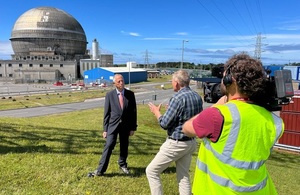
Sellafield Ltd head of policy Phil Hallington is interviewed by BBC Countryfile presenter Tom Heap

Sellafield Ltd head of policy Phil Hallington is interviewed by BBC Countryfile presenter Tom Heap

The Sellafield site will play a leading role in a Countryfile report about the past, present, and future of the UK’s nuclear industry.

Presenter Tom Heap and a film crew visited the Sellafield site, in West Cumbria last week to record footage and interviews.

The programme will document Sellafield’s history as the birthplace of the UK nuclear industry and its continued contribution to the UK energy sector via spent fuel and waste management services.

Phil Hallington, Sellafield Ltd head of policy, was interviewed for the show. Filming locations included the Fuel Handling Plant and the Windscale Advanced Gas-cooled Reactor waste store.

Matt Legg, Sellafield Ltd external communications manager, said:

We’re always on the look-out for high quality opportunities to tell the Sellafield story to a national audience.

BBC Countryfile is a show we’ve been keen to feature on for a long time because of its focus on rural communities.

The crew were all impressed with the size and scale of our operation and the dedication and professionalism of the people they met on site.

It’s a news report so it will be an honest portrayal of our past, present, and future operations, including references to incidents of the past.

But we’re confident the programme will present our site in a positive light and emphasise the incredible contribution we make to the UK every day.

BBC Countryfile is on BBC One at 7pm on Sunday, 3 July.

Published 1 July 2022


Prime Minister signs landmark science agreement with New Zealand

  • Prime Minister agrees major Research, Science and Innovation Arrangement with New Zealand
  • arrangement demonstrates commitment to closer bilateral relationship, bringing UK and New Zealand researchers and business together to address shared challenges
  • UK also launches global programme in AgriTech, supporting UK businesses grow and scale by establishing connections to New Zealand’s leading AgriTech industry

The Prime Minister Boris Johnson signed a historic agreement with New Zealand’s Prime Minister Jacinda Ardern at Downing Street today (Friday 1 July), strengthening the UK and New Zealand’s collaboration in research, science, and innovation.

The Research, Science and Innovation Arrangement demonstrates a commitment to developing deeper links between our science and innovation communities, strengthening collaboration between the 2 nations and building on areas of shared scientific and innovative excellence.

Co-operation under the arrangement is expected to be wide-ranging, from joint research and development of new technologies, to visits and exchanges of scientists, and innovation missions between businesses.

The UK is working with New Zealand’s Ministry for Business, Innovation and Employment (MBIE) to deliver the agreement, which will support the ambitions set out in the UK’s Integrated Review to develop strategic science partnerships, and strengthen the UK’s presence in the Indo-Pacific region.

Science Minister George Freeman said:

This is another step in our Science Superpower mission to widen and deepen our post-Brexit global science programmes.

Today’s agreement with our New Zealand allies and partners represents another victory for our bilateral relations in science and innovation, particularly in the Indo-Pacific, where we are also building strong working relationships with Australia, Indonesia, Japan and South Korea. This is in addition to the Science and Innovation Memorandums of Understanding I have now agreed with Israel, Switzerland, Sweden and Canada.

As I made clear at the recent G7 science summit in Frankfurt, and at the 47 nation Eureka Innovation Summit in Lisbon last week, the UK is more committed than ever to deepening our international research collaborations.

The agreement made today will give us the chance to deepen our collaborations with New Zealand’s outstanding science and research community in a number of areas, from space, quantum and photonics, to Antarctic research and Agritech.

The combination of our long-standing UK leadership in plant and animal science with New Zealand’s world class AgriTech eco-system will also provide an exciting opportunity to build partnerships and collaborations, showcasing the best of UK innovation in efficient farming, and helping UK businesses grow and scale while enabling access to global markets.

The arrangement will support the UK’s access to New Zealand’s niche capabilities in areas such as quantum technology, enabling collaboration that will further global scientific development in these important fields. The agreement will promote joint work between our most innovative businesses and brightest researchers, while supporting our ambition to become a global Science Superpower and Innovation Nation.

The UK government is also announcing an Innovate UK Global Business Innovation Programme (GBIP) in AgriTech with New Zealand today, an endeavour which will support innovative UK businesses to build high-potential connections with New Zealand’s AgriTech industry.

The programme will enable access to New Zealand businesses, universities, labs and investors, allowing innovators to work with their counterparts to develop solutions to common industry challenges, such as advancing the use of robotics and satellite data for more efficient and precise farming. British SMEs will also be supported in bringing their products and services closer to global markets. Recruitment for eligible individuals is planned to commence today.

Opportunities are already being explored with the British High Commission in Wellington to put the arrangement into action, and deepen the connections between our research and innovation communities.



UN Human Rights Council 50: UK statement during the Urgent Debate on Afghanistan

Thank you Mr President,

Let me begin by expressing my condolences to the victims of the earthquake in Afghanistan.

And let me thank the High Commissioner, Special Rapporteur and Ms Fawzia Koofi for their powerful interventions this morning.

It is almost one year since the Taliban takeover of Afghanistan.

Tragically, our worst fears have come true when it comes to girls’ education.

Many secondary schools continue to be closed to girls, despite Taliban commitments that secondary education would be open to all by 23 March. Afghanistan is the only country where girls cannot attend secondary school. As the father of three girls myself, I find that heartbreaking.

An entire generation of girls are missing out on equal access to opportunities, their hopes and dreams shattered, the gains of the last decades squandered.

But education isn’t the only way women’s and girls’ rights have been cruelly curtailed. Women and girls face increasing restrictions on their ability to work and to travel. Women cannot leave their homes without a mahram. Some remain trapped in their homes, facing domestic violence with no way out.

This suffering is, of course, not limited to women and girls. In August, the Taliban announced an amnesty for all Afghans yet we continue to receive credible reports of former security force members, being tortured orkilled. Many Afghans, including religious and ethnic minorities, LGBT+ persons, and civil society activists, continue to face discrimination, harassment, and death threats.

The UK remains committed to supporting the Afghan people. We delivered £286m of aid to Afghanistan in the last financial year and we will do the same this year. We are allocating at least 50% of that aid to women and girls and recognise the urgent need for funding to women’s organisations, to ensure vital services are delivered to women across Afghanistan.

Mr President,

We call on the Taliban to uphold women’s and girls’ rights. And we stand with the women and girls of Afghanistan and commend their extraordinary bravery.

Thank you.


Foreign Secretary Liz Truss meeting with the French Foreign Minister Catherine Colonna: 1 July 2022

News story

Foreign Secretary Liz Truss met French Foreign Minister Catherine Colonna at the French Ministry of Foreign Affairs in Paris.

Foreign Secretary Liz Truss and French Foreign Minister Catherine Colonna

Following the NATO Summit in Madrid, the Foreign Secretary stressed the UK’s commitment to European security and noted the need for close cooperation with France to strengthen the NATO Alliance.

The Foreign Secretary and Foreign Minister Colonna agreed that the G7 and NATO summits showed the UK and France are united in their response to Russia’s war in Ukraine. The two agreed to build on the summits to maintain international unity in supporting Ukraine’s fight for freedom and self-determination.

The ministers discussed the importance of increasing assistance to Ukraine to reverse Russian advances. They also spoke about cooperation on sanctions to undermine Putin’s war machine and the need for the free world to counter threats from the likes of Russia and China by strengthening security and economic ties.

They spoke about the UK-France relationship and agreed to take forward work to deepen cooperation, as agreed by the Prime Minister and President Macron during their recent discussions, including preparations for a UK-France summit.

Finally, the Foreign Secretary raised the UK’s concerns with the Northern Ireland Protocol and highlighted the need for UK legislation in order to fix elements of the Protocol and uphold the Belfast (Good Friday) Agreement, in the face of the EU’s unwillingness to make the necessary changes to the Protocol. She reiterated the UK’s preference for a negotiated solution, and stressed that resolving issues like this would unleash the full potential of the UK-France relationship.

Published 1 July 2022


Forward Thinking conference – call for papers

We can confirm that this year’s Forward Thinking conference will be taking place at Nottingham Trent University.

Abstracts are still being welcomed and the deadline to submit has been extended to Wednesday 14 September.

Following the success of last year’s Forward Thinking conference, the Insolvency Service is planning the next conference on Friday 18 November 2022.

The theme for the conference is ‘Forward Thinking: Insolvency Response in uncertain times’. We want to provide a platform for insolvency academic research and technical discussions while facilitating a stronger link between academia, the insolvency sector and policy makers, and encourage feedback from interested parties.

Call for papers

We’re now inviting scholars, researchers, postgraduate students, insolvency practitioners and anyone else with an interest in insolvency law and related areas to submit their abstracts for an academic or technical paper for presenting at the conference, including:

  • an academic research paper, or
  • a technical issue relating to insolvency practice

The Insolvency Service welcomes submissions in all areas of personal or corporate insolvency, whether UK or international in focus, and papers should be focused on the central theme of this year’s conference, an insolvency response in uncertain times and economic shocks.

The deadline for submission of abstracts is Wednesday 14 September. At this stage, we would like you to submit an abstract of the paper with a maximum of 500 words only.

For selected papers, the final draft will need to be submitted by Friday 14 October ready to be presented at the conference venue in person.

Research submissions will be considered by a panel of insolvency law academics and representatives from the Insolvency Service. Technical submissions will be considered by a panel of Insolvency Service representatives.

Conference format

We expect the conference to feature about 8 papers. Speakers will have approximately 20 minutes to present their paper, with additional time for questions from those at the event and online delegates.

Papers selected for presentation at the conference will be published online, hosted by the Insolvency Service.

Submission of Abstracts

If you wish to submit an abstract, maximum 500 words, please send it to: conference@insolvency.gov.uk.

Your covering email should include:

  • whether you are submitting a research paper or a technical issue
  • your name
  • firm/affiliation/role (where applicable)
  • email
  • telephone number

These details will be removed when the abstract is forwarded to the panel for consideration. Please ensure the abstract does not contain information or acknowledgments that could reveal your identity, firm or affiliation.

Further information

The venue will be confirmed shortly and if you have any queries, please contact conference@insolvency.gov.uk.