Intervention to improve underperforming schools to begin from September 2022

Underperforming schools will be the focus of new government powers to raise standards of education for young people locally.

The new powers will mean schools with two or more consecutive Ofsted ratings below ‘Good’ may be matched with a strong multi-academy trust, to support their improvement. The government laid regulations in Parliament yesterday, Thursday 30 June, to enable this to happen from 01 September.

The government’s 55 Education Investment Areas, where education standards are currently among the weakest, have been prioritised as the focus of new intervention powers to help rapidly improve underperforming schools.

Strong multi-academy trusts have a good track record of improving underperforming schools as sponsored academies, with those academies on average improving more quickly than similar local authority schools.

Currently only schools with Inadequate Ofsted ratings are eligible for this type of intervention, but 900 schools across the country with consecutive Ofsted ratings below Good will now newly be eligible.

The government will initially look to contact around a third of the eligible schools about potential intervention, on the basis they have a recent Requires Improvement rating from 01 May 2021 or later.

Schools’ individual circumstances including their existing capacity to improve will be considered before intervention goes ahead, but those in Education Investment Areas are expected to be prioritised during the coming academic year.

Schools Minister Baroness Barran said:

For too long education outcomes, and therefore children’s life chances, have been different depending where in the country they grow up.

We are rapidly increasing our delivery of support and investment to our Education Investment Areas to right that wrong and give every child the chance to fulfil their potential.

This is just one way in which the government is working to raise standards in Education Investment Areas. Other initiatives include:

  • Tax-free bonuses to retain teachers of STEM subjects in their first five years of teaching, worth a maximum of £9,000 over three years for those teachers working in the most disadvantaged schools in Education Investment Areas
  • Making up to £150 million available to the Connect the Classroom programme to install modern wireless internet throughout whole schools, including for all schools in the 24 Priority Education Investment Areas, and to schools below Good in the remaining 31 Education Investment Areas
  • Up to £86m in funding to support strong trusts to expand over the next three years, heavily targeted towards Education Investment Areas and Priority Education Investment Areas, to grow the number of strong academy trusts and increase the number of schools that have the support of a strong trust

The government aims to provide 500,000 teacher training and development opportunities across the country by 2024, including two new specialist national professional qualifications in literacy and early years leadership, as well as a £30,000 starting salary for teachers to attract and retain the very best talent.

This work builds on the government’s Schools White Paper released in March, which set a blueprint to radically raise education standards across the country and placed a significant emphasis on supporting teachers through strong multi-academy trusts and salary investment, to make sure that every child can be taught by an excellent teacher.

The government’s mission is for the average GCSE grade in English and maths across the country to rise from 4.5 in 2019 to 5 by 2030; and for 90% of children leaving primary school to meet the expected standards in reading, writing and maths by 2030, up from 65% in 2019.

Ministerial appointment: 1 July 2022

Press release

Kelly Tolhurst MP is appointed Treasurer of HM Household (Deputy Chief Whip).

The Queen has been pleased to approve the appointment of Kelly Tolhurst MP as Treasurer of HM Household (Deputy Chief Whip).

Published 1 July 2022


PM meeting with Prime Minister of New Zealand: 1 July 2022

Press release

Prime Minister Boris Johnson hosted the Prime Minister of New Zealand, Jacinda Ardern, today to discuss how the two countries could approach shared global challenges together.

The Prime Minister hosted the Prime Minister of New Zealand, Jacinda Ardern, today to discuss how the two countries could approach shared global challenges together.

The two Prime Ministers welcomed the Free Trade Agreement signed between the two countries in February this year, and the Prime Minister thanked New Zealand for its support for UK accession to CPTPP.  

The two leaders welcomed the agreement to expand the Youth Mobility Scheme, allowing young British nationals and New Zealanders to work more easily in both countries. They also signed the Research, Science and Innovation Arrangement, strengthening the UK and New Zealand’s collaboration across all three areas to address issues such as climate change.

Reflecting on the Commonwealth Heads of Government Meeting and NATO summit in Madrid this week, the leaders discussed current geopolitical challenges and agreed on the importance supporting countries around the world in defending their sovereignty. The Prime Minister also thanked Prime Minister Ardern for New Zealand’s support in training Ukrainian Armed Forces in the UK.

The leaders discussed the UK’s increased engagement and investment in the Pacific region, and agreed on the importance of working closely with Pacific Island leaders to support their economic resilience.  

Prime Minister Ardern updated on her work tackling violent extremism online as part of the Christchurch Call to Action, and the Prime Minister agreed more needed to be done to combat disinformation and drive the use of responsible algorithms.

Published 1 July 2022


Liquidation

Press release

In a recent case, Kevin Rooney, Traffic Commissioner for the West of England, made the decision to not only revoke the licence of Mulholland International Limited and to find that Wendy Mulholland the licence holder and transport manager has lost her repute, but to also disqualify her immediately and indefinitely from holding a licence or acting as a transport manager within the UK or EU.

Mulholland International Limited was granted a standard international goods vehicle operator’s licence in March 2018 authorising the use of six vehicles and two trailers. It was called to public inquiry in January 2021 where the commissioner curtailed it to 3 vehicles only having accepted an undertaking for a full systems compliance audit to be carried out by 31 May 2021.

Mulholland Tippers Ltd applied for a standard national licence in June 2020 to authorise four vehicles. The application was determined and refused at the same January 2021 public inquiry.

The compliance audit never happened, and the commissioner discovered that the company entered creditors voluntary liquidation in October 2021 and was estimated to owe £254,715 including HMRC VAT of £80,346 HMRC PAYE of £52,958 and a Bounce-back loan of £37,077.

The commissioner said “Wendy Mulholland treats the tax-paying British public with disdain. This is a three-vehicle operation. How it could possibly have generated such a deficit in such a short period of time is beyond me. It is for the liquidators to undertake their statutory duties in that regard. Wendy Mulholland should not be allowed to continue within the haulage industry.”

Further details can be found here.

Published 1 July 2022


Belgo-British Conference: 1 July 2022

World news story

The UK Business and Energy Secretary opened the conference alongside his Belgian counterpart in front of key figures from government, business and academia.

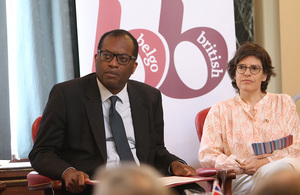
UK Business and Energy Secretary at Belgo-British conference

On 1 July 2022, Kwasi Kwarteng, UK Business and Energy Secretary and Tinne Van der Straeten, Belgian Minister for Energy, opened the 16th Belgo-British Conference at the Foreign, Commonwealth and Development Office in London.

Chaired by Sir Robin Niblett, Director of Chatham House, and Mr Johan Verbeke, former Belgian Ambassador to the UK, the conference brought together key figures from government, politics, business, academia and civil society to discuss opportunities for the UK-Belgium relationship in a changing geopolitical and economic context, including energy security.

UK Business and Energy Secretary, Kwasi Kwarteng, said:

Our long and close relationship with Belgium has rarely been as important as it is in today. In light of Putin’s continued atrocities in Ukraine, it is vital that we continue to work with allies like Belgium to boost energy security in the UK and across Europe.

I was delighted to attend the Belgo-British Conference, which follows the signing of the Joint Declaration on bilateral cooperation by our Prime Ministers last December. Belgium is and will remain a key partner for collaboration on energy, trade, business, research and innovation.

Belgian Minister for Energy Tinne Van der Straeten said:

In today’s world, it is important to have good friends. Belgium and the United Kingdom are friends, close neighbours and allies. The invasion of Ukraine by Russia shows that this alliance stays more relevant than ever.

We need to stand side by side, now and in the future, to defend democratic values, human rights, energy sustainability and security. The Belgo-British conference aims to do exactly that. Alone you go fast, but together we go further.

Published 1 July 2022