Man arrested and illegal fishing net seized at Newbiggin by the Sea

Press release

Fisheries Enforcement Officers from the Environment Agency arrested one man on suspicion of poaching sea trout at Newbiggin by the Sea.

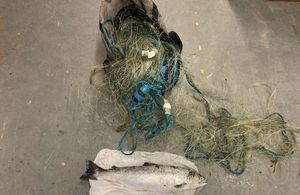
Illegal fishing net and dead sea trout

Illegal netting arrest made at Newbiggin by the Sea

Fisheries Enforcement Officers from the Environment Agency have arrested a man on suspicion of poaching sea trout and seized an illegal fishing net at Lyne Sands, north of Newbiggin by the Sea.

Officers, carrying out targeted patrols, made the arrest at 0820 hours on 30th June 2022. During the operation, they seized the illegal gill net measuring 8m x 3m  and a dead sea trout. The investigation is ongoing.

David Shears, Senior Fisheries Enforcement Officer for the Environment Agency, said:

Unattended and unlicensed gill nets are not only capable of killing fish indiscriminately, they will also kill any other wildlife that are unfortunate enough to get entangled in them

This incident highlights how vital it is for people to provide information to us and demonstrates that we will take action. We actively patrol the rivers and coastline around the North East and we continue to target all aspects of illegal fishing activity, particularly where potentially damaging methods are used.

A licensed, strictly regulated and managed sea trout fishery operates off the coast of Northumberland and local byelaws apply to ensure sea trout may only be taken by a limited number of licenced netsmen, during the approved season (26th March to 31st May). It is also illegal to use nets to catch salmon in the North East.

Those who operate unlicensed nets risk prosecution, with unlimited fines and possible prison sentences available to the courts, and Environment Agency officers can seize equipment and vehicles.

Information about illegal fishing can be reported to the Environment Agency’s 24-hour incident hotline on 0800 80 70 60.

Published 5 July 2022


PM call with President Zelenskyy: 5 July 2022

Press release

Prime Minister Boris Johnson spoke to Ukrainian President Volodymyr Zelenskyy this morning.

The Prime Minister spoke to Ukrainian President Volodymyr Zelenskyy this morning to update on progress and discussions held at G7 and NATO last week.

President Zelenskyy set out the current situation in Ukraine, and recent Russian advances, and the Prime Minister updated on the latest UK military equipment, including 10 self-propelled artillery systems and loitering munitions, which would be arriving in the coming days and weeks.

The Prime Minister said the world was behind Ukraine, and he believed President Zelenskyy’s military could retake territory recently captured by Putin’s forces.

On grain, the leaders agreed on the importance of getting it out of Ukraine as soon as possible, and the Prime Minister said the UK continued to work closely with partners on next steps and stood ready to help in any way possible.

The leaders also discussed the cases of British born Ukrainian fighters, who had been captured by Russian forces in recent weeks.

Speaking about yesterday’s recovery and reconstruction conference for Ukraine in Lugano, the Prime Minister said he welcomed Ukraine’s rebuild plans, and looked forward to the UK hosting next year’s event.

The pair also discussed Eurovision 2023, and the Prime Minister said the UK had asked the EBU to consider Ukraine’s proposals for the event.

Published 5 July 2022


UN Human Rights Council 50: UK statement on Contemporary Forms of Racism

World news story

The UK delivered a statement during the Interactive Dialogue with the Special Rapporteur on Contemporary Forms of Racism.

Thank you,

The United Kingdom thanks the Special Rapporteur for her report on combating the glorification of Nazism.

Let us be clear: neo-Nazism has no place in any of our societies.

That is why in 2025, we will open a Holocaust Memorial and Learning Centre to remind us why we must be relentless in the fight against Holocaust denial and distortion, antisemitism, and their repellent sibling ideology – neo-Nazism.

We share the Special Rapporteur’s alarm that Russia has sought to justify its military invasion in Ukraine with outlandish claims that Ukraine is controlled by neo-Nazis.

The Kremlin’s false statements dishonour those who fought to defeat Nazism in Europe.

They cause real pain to the victims and survivors of the Holocaust.

Putin is trying to distract us, and the Russian people, with disinformation because he knows, as well as we do, that none of his excuses for invading Ukraine hold water.

The simple truth is that Putin is responsible for the needless deaths of thousands of men, women and children.

Special Rapporteur,

Instead of spreading falsehoods about Ukraine, what must the Russian government do to tackle racism, xenophobia and related intolerance in Russia itself?

Published 5 July 2022


Foreign Secretary’s remarks at the Freedom of Religion or Belief Conference

Good Morning,

Ladies and Gentlemen, Excellencies, I’m delighted to welcome you to the Freedom of Religion or Belief conference.

This is the first of its kind to be hosted in the United Kingdom.

I hope there will be many more. I’d like to thank Fiona Bruce for all her hard work as the Prime Minister’s Special Envoy and Lord Ahmad as our Minister for Human Rights.

The freedom to believe, to pray and commit acts of worship, or indeed not to believe is a fundamental human freedom and has been one since the dawn of time.

Societies that allow their people to choose what they believe are better, stronger and ultimately more successful.

This fundamental right is covered in the very first clause of Magna Carta and Article 18 of the Universal Declaration of Human Rights.

It is one of the Four Freedoms Franklin D. Roosevelt said were “essential everywhere in the world”.

Yet throughout history, we have seen oppressors crack down on freedom of religion or belief in order to exert control. Whether it the appalling persecution of the Jewish community over centuries or Stalin trying to stamp out religion in the Soviet Union.

Today there is further evidence of this around the world.

In Nigeria, terrorist groups in the North East, including Islamic State West Africa and Boko Haram, indiscriminately attack those who do not subscribe to their extremist views.

Just a month ago, at least 40 people were killed in a heinous attack by gunmen while worshipping at the St Francis Catholic Church in Ondo State.

In Xinjiang, the evidence is clear of the extraordinary scale of China’s targeting of Uighur Muslims and other ethnic minorities, including severe restrictions on the freedom of religion.

In Afghanistan, many of those with a belief the Taliban does not condone are forced to follow this in secret or flee for their safety. They also die at the hands of Da’esh, or see their places of worship attacked.

These are a handful of examples. And we know that Hindus, Humanists and many others are prosecuted and persecuted for their beliefs.

Persecution ranges from exclusion and discrimination to forced conversion, destroying places of places of worship and targeted killings.

The Bishop of Truro’s 2019 review for the UK Government provided recommendations to support members of all faiths, beliefs and those of no religious belief.

I welcome all of those recommendations, and we have taken forward the 22 in a way that will make a real change for everyone persecuted for their religion or belief.

Over the next two days, we will see people from across the world come together to discuss freedom of religion or belief, and the practical steps we can take to advance it.

Ukraine is on the frontline of this struggle.

They are a free democracy, one of the first countries to join the International Religious Freedom or Belief Alliance, fighting for their future.

Vladimir Putin and his enablers claim that Russia is waging a holy war, but in truth they believe nothing is sacred.

We are seeing growing evidence of heinous war crimes committed by Russian troops.

Innocent civilians are having to shelter from Russia’s indiscriminate bombardment in places of worship.

Churches, synagogues, and mosques have been reduced to rubble. Religion is proving to be collateral damage from Putin’s aggression.

To Ukraine’s delegation in the audience today, I want to say: the UK will not rest until you prevail and until your people are free to live, believe and thrive.

And I can see that sentiment is shared across this conference.

We all want a world where people are free to believe.

That is why since becoming Foreign Secretary I have taken a strong stand against anti-Semitism, condemning the hateful act of terrorism at a Texas synagogue earlier this year.

I continue to stand with our international partners in calling out the shocking persecution of Uighur Muslims in Xinjiang. I am at the forefront of standing up for all those suffering in Ukraine including Orthodox Christians.

Authoritarians and oppressors feel threatened by the freedom of religion or belief, fearing it will encourage people to think freely and question their authority.

We cannot allow them to win. That is why we’re deepening links with our allies and partners to build a Network of Liberty around the world.

As St Paul told the Corinthians: “Be on guard, stand firm, be courageous, be strong”.

So let’s work together in that spirit to defend freedom of religion or belief and show the potential for positive change.

Together, we can forge ahead to a fairer, safer world for people of faith across the globe.

Thank you.


Residents and business owners to be given final say on proposed street name changes

Press release

All councils in England will need to get agreement from two-thirds of people who live or run businesses on a street before changing its name.

  • Residents and business owners will be given the final say on whether their street name should be changed
  • Follows a public consultation on the changes – with almost 90% of people supporting plans for the community to make the decision
  • Councils will have to get agreement from two-thirds of people before they can change the name

Residents and business owners will have the final say over whether their street name can be changed, the Department for Levelling Up, Housing and Communities announced today (5 July 2022).

Under the plans, all councils in England will need to get agreement from two-thirds of people who live or run businesses on a street before changing its name, subject to parliamentary approval.

The government set out plans to give local people more powers over proposed name changes earlier this year. Today’s announcement follows a public consultation – with over 90% of those responding backing the plans.

The move will improve local democracy and make sure that names that are valued by the community and form a key part of an area’s identity are not erased without proper consideration.

Consent to change street names has been a legal requirement in the past, but currently many councils can change names without consulting residents. The government wants to make sure that the law is consistent across England.

Housing Minister Stuart Andrew said:

Street names are often central to an area’s identity and hold cherished memories for those that have lived in the community past and present.

It is right that we put the decision to change a street’s name in the hands of the people who would be most directly affected – and the feedback we’ve received through our consultation shows that people strongly agree with this.

The changes we are bringing forward will strengthen local democracy and make sure councils can’t push through changes that residents do not want.

These changes will also give residents the opportunity to oppose changes to street names, on the basis that they often cause additional costs and time for residents, who have to change their personal details with the bank and utility providers.

The changes will be introduced following the passage of the Levelling Up and Regeneration Bill, which is currently making its way through Parliament.

Published 5 July 2022