Update on the proposed acquisition of Ultra Electronics Holdings plc by Cobham Ultra Acquisitions Limited

Press release

The acquisition of Ultra by Cobham has been cleared to proceed.
Following advice from the Ministry of Defence and after careful consideration of responses to a consultation, the Business Secretary has today (Wednesday 6 July) cleared the acquisition of Ultra by Cobham to proceed.

The announcement follows the Business Secretary consulting on steps to address the national security concerns raised by the proposed acquisition of Ultra, a UK defence company, by Cobham, a defence, aerospace, and communications company that was acquired by US private equity firm Advent International. The government consultation on the undertakings offered by the companies to address the concerns identified ran until 3 July 2022.

The Business Secretary has accepted the undertakings from the parties to mitigate national security risks, with a small number of changes to reflect the responses to a consultation on them.

The undertakings to mitigate the national security concerns came into force today and details are available on the decision notice. In summary, the undertakings are:

  • SecureCos: creating 2 new ‘SecureCos’, UK legal entities which encompass the UK Ultra facilities that deliver the sensitive capabilities to HM Government
  • Board Representation: placing an HM Government appointed non-executive director on the Board of each SecureCo to protect UK national security interests and provide oversight of any disinvestment or divestment of sensitive capability
  • Articles of Association: giving HM Government the right to approve the Articles of Association of each SecureCo and draft their strategic objectives which would transfer to any future owner, locking that protection in. Any changes would be subject to the HM Government Director’s agreement
  • Step-In Rights: giving HM Government strong step-in rights (similar to a ‘special share’), enabling transfer of ownership of the SecureCos on national security grounds, either to a third party or the government
  • Access to Intellectual Property: giving HM Government the power to access intellectual property and / or to transfer knowledge or training necessary for HM Government to exercise its step-in rights effectively
  • ITAR Protections: requiring Advent to institute an HM Government-approved control plan to prevent International Traffic in Arms Regulations controls applying to ITAR-free products designed and manufactured by Ultra

Separate to the public interest intervention and the mitigation of national security concerns, the government has agreed a deed offered by the parties to:

  • maintain a corporate headquarters of the Ultra Group in the UK
  • increase engineering R&D expenditure by at least 20% by the end of 3 years
  • continue in good faith with Ultra’s proposal to establish a centre of excellence for cyber capabilities in Maidenhead
  • by the end of the 3-year period, increase the number of UK-based engineering R&D FTEs by at least 15%
  • by the end of the 3-year period, increase the number of UK-based manufacturing FTEs by at least 10%
  • maintain the aggregate number of UK-based engineering and manufacturing FTEs above a baseline level, equivalent to the number of associated FTEs at deal close minus any headcount changes associated with Ultra’s existing transformation programme
  • establish a scholarship fund of up to £5,000,000 to support over 100 university undergraduates from under-represented backgrounds in the UK to pursue degrees in engineering and related disciplines
  • by the end of the 3-year period at least double the number of apprentices employed by Ultra

In addition, by the end of the 3-year period, Cobham commits to establishing programmes intended to:

  • promote the objective of reducing Ultra’s greenhouse gas emissions to net zero by 2050
  • promote the objective of increasing the levels of diversity in the UK workforce of the Ultra Group

Published 6 July 2022



Defence Academy hosts Capture the Flag challenge

News story

The Defence Academy has held a Capture the Flag competition which saw personnel from across Defence battle it out in cyber-security challenges.

A side-on image of a man sat at a keyboard with people next to him out of focus

Air Marshal Ian Gale, Director General of Joint Force Development, at the event.

Over 50 teams took part in the event which was designed identify future talent and combat skills by testing competitors’ existing skills.

A team from 21 Signals Regiment narrowly took the first-place position, edging up from second place just two minutes before the competition’s end.

One of the aims of the Defence Academy is to deliver a cyber workforce with a consistent cyber operations skill set and a technological edge.

Air Marshal Ian Gale, Director General of Joint Force Development, attended the event and said; “Events like this are crucial in identifying those personnel who have an aptitude for working in the cyber domain.

“As part of Joint Force Command the Defence Academy play a critical role in training and educating our personnel to face the threats of the future.”

Whilst the Defence Academy caters to those already working in Defence there are plenty of resources to develop your own cyber skillset.

The NCSC offer a certified training scheme which offers high quality cyber security training whether you’re a newcomer to the field or have skills you would like to develop further.

Access NCSC Training Scheme

Published 6 July 2022


Government seeks views on Highly Protected Marine Areas (HPMAs)

News story

The Government has today (6 July 2022) launched a consultation to gather views and evidence on five candidate sites for pilot Highly Protected Marine Areas (HPMAs).

Underwater image of the ocean

Defra is consulting on five candidate pilot Highly Protected Marine Areas which are geographically spread around English waters.

Highly Protected Marine Areas (HPMAs) will have the highest levels of protection in our seas. They will conserve all species and habitats within the HPMA boundary, enabling nature to fully recover.

This is the latest step in the Government’s progress towards our ambitious ocean commitments and builds on the existing Marine Protected Area (MPA) network extending across 40% of English seas.

To enable the ecosystem to recover to as natural a state as possible, activities such as fishing, dredging, construction and anchoring are set to be prohibited in HPMA sites.

Environment Minister Rebecca Pow said:

Highly protected marine areas will offer the highest levels of protection in our seas. They will help a wide range of valuable habitats and species to fully recover, boosting the resilience of our ecosystem and allowing the marine environment to thrive.

As demands on our oceans increase, it is more important than ever that we take decisive action to safeguard nature whilst ensuring we can continue to meet the sustainable needs of those who rely on our seas.

Defra is consulting on five candidate pilot HPMAs which are geographically spread around English waters and cover inshore and offshore habitats. These are:

  • Two inshore sites: Allonby Bay (Irish Sea) and Lindisfarne (Northern North Sea).

  • Three offshore sites: North East of Farnes Deep (Northern North Sea), Inner Silver Pit South (Southern North Sea) and Dolphin Head (Eastern Channel).

The five candidate pilot sites are a mixture of natural and degraded sites and include a wide range of biodiversity such as sheltered intertidal mudflats, subtidal kelp forests, and biogenic and rocky reef. They are also home to valuable marine species, commercially important fish stocks, and include blue carbon habitats which play an important role in capturing and storing carbon. The candidate sites were selected using ecological analysis and advice from Natural England and the Joint Nature Conservation Committee (JNCC).

Chair of Natural England, Tony Juniper, said:

By supporting the full recovery of vital marine ecosystems, Highly Protected Marine Areas will be a critical mechanism to reverse the damage imposed on our ocean and safeguard it for future generations.

The five candidate sites outlined today present the chance to protect some of our most vulnerable marine wildlife, and I welcome this consultation as we take the next step forward in securing the long-term sustainability of our ocean.

The consultation will run for 12 weeks from today, 6 July 2022. The evidence gathered will inform which candidate sites are taken forward as pilot HPMAs. The first HPMAs will be designated in 2023.

Published 6 July 2022


New bill introduced to ensure thousands of seafarers receive fair pay

  • new pay protection laws on minimum wage for thousands of seafarers regularly entering UK waters
  • laws will prevent firms undercutting fair pay for seafarers by using legal loopholes to pay low wages
  • government publishes response to the consultation on Seafarers’ Wages Bill

The UK government has today (6 July 2022) introduced new legislation to make sure seafarers get paid at least equivalent to the UK National Minimum Wage.

We are closing a loophole that allowed seafarers who work on vessels that regularly serve UK ports, to be paid below an equivalent to the UK National Minimum Wage for the simple fact that the vessel operates an international service.

Following P&O Ferries’ decision to dismiss 800 loyal and hardworking workers without consultation or notice, the government took immediate action to begin changing the law on seafarer pay protection.

The changes mean that thousands of seafarers regularly entering the UK will receive fairer pay, putting the UK ahead of every EU state in its pay protections.

The Seafarers’ Wages Bill – introduced in the House of Lords today – enables port authorities to deny access to services calling regularly at UK ports who do not pay their workers equivalent rate to the UK National Minimum Wage (NMWe) for time spent in UK waters – closing a legal loophole which was exploited by P&O Ferries.

Maritime Minister Robert Courts said:

Britain’s rich maritime history and exciting future is thanks to the extraordinary men and women who work at sea.

Fair pay for seafarers is a must and the new laws we’ve introduced in Parliament today send a clear signal to operators that the UK will not let seafarers be priced out of their jobs by rogue bosses.

Following P&O Ferries’ shameful conduct, the government launched the consultation on the Seafarers’ Wages Bill in May 2022. The response, published alongside the introduction of the bill today, shows that the overwhelming majority of respondents agreed that pay protection must remain at the forefront of the sector’s objectives.

The government spoke extensively with industry on how it can rapidly shape new laws on seafarer pay protection and has used the information and perspectives to shape the bill’s scope and compliance policies.

Vessels and services that call on UK ports at least every 72 hours on average, or more than 120 times a year, will fall under these new pay requirements and the ports, Maritime and Coastguard Agency and Department for Transport will all have a role in ensuring compliance.

In parallel, the Insolvency Service’s criminal and civil investigation into the circumstances of the redundancies made by P&O Ferries continues.

Labour Markets Minister Paul Scully said:

Just because someone works out at sea, it doesn’t mean they should be excluded from the protections UK workers receive.

That’s why we’ve moved at pace to get this bill across the line, levelling the playing field and ensuring everyone working in UK territorial waters will benefit from the equivalence of the National Minimum Wage.

We hope seafarers will soon see the difference in their pay packets, as we continue to protect and enhance the rights of all workers

As part of the Secretary of State for Transport’s seafarer protections 9-point plan, we are continuing to work with our near European neighbours on bilateral agreements.

This discussion focuses on exploring agreements that help to improve seafarer welfare and protections and the potential development of bilateral minimum wage corridors.

British seafarers are recognised as some of the most highly skilled worldwide and the UK’s Maritime 2050 strategy sets out a plan for a fairer global maritime industry.

Seafarers’ Charity. Deborah Layde, Chief Executive, said:

After P&O Ferries appalling disregard for their hardworking seafarers, many of whom had given many years of loyal service to the company, I am delighted to see government taking steps to ensure fair pay and enhanced protections for seafarers regularly entering UK ports.

The Seafarers’ Charity welcomes The Seafarers’ Wages Bill as an important step in recognising the substantial contribution seafarers make to our economy in what can be a very demanding job.

At The Seafarers’ Charity we fully support efforts to ensure that all seafarers receive equivalent pay and protections as those working ashore.


Outbreaks of Koi herpesvirus (KHV) disease in 2022

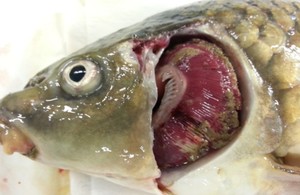
Carp showing clinical signs of KHVD - gill necrosis

KHV is a serious viral disease of fish and is a listed disease in the United Kingdom. It affects all varieties of common and ornamental carp species (Cyprinus carpio) and can result in large scale mortalities. Fish with KHV disease may show the following signs, especially when water temperatures are between 16 to 28 °C:

You must contact the FHI if you suspect an outbreak of KHV. This includes fish with the above signs, or deaths of carp or carp hybrids.

There is no risk to public health.

Sites with KHV disease must undergo a formal monitoring programme immediately following the outbreak. The FHI visit these sites to look for evidence of disease and to inspect compliance with the conditions of the statutory controls in place.

Confirmed designation

If a notifiable disease is confirmed, FHI places controls to limit the spread of disease (these are known as confirmed designations). The following conditions are applied under disease controls:

  • No person may, without the previous consent in writing of the FHI, move any aquatic animal including eggs, and gametes, into, out of or within a confirmed designation area.

  • Disposal of dead aquatic animals, including eggs and gametes, must be by an approved method for disposal of Category 2 animal-by-product waste in compliance with local Environmental Health department requirements

  • Notify the Fish Health Inspectorate immediately should mortalities re-occur or spread to other waters within the designated area.

  • Notify the FHI in advance of all intended physical changes to sites within the designated area – such as site boundaries, number or size of waters, use of the site. FHI written permission will be required beforehand for all such changes.

  • All requests for consents required under this Confirmed Designation Notice must be submitted to the FHI with a minimum of 5 working days’ notice.

New outbreaks

When laboratory testing confirms KHV disease at a site, the FHI place statutory controls to limit the spread of the disease. These controls restrict movement of aquatic animals.

Disease controls have been applied at:

Diseases controls lifted at:

Further information

You can:

Background

Koi herpesvirus disease (KHV) is a listed disease under The Aquatic Animal Health (England and Wales) Regulations 2009. KHV outbreaks have been subject to statutory controls in the UK since 2007. The UK maintains a surveillance programme for this disease.

When the FHI confirm an outbreak, they take steps to control and, wherever possible, remove the disease. This may involve movement controls on susceptible species in the affected area, enhanced biosecurity, culling of fish, and cleaning and disinfecting of the premises.

Once statutory controls are in place the site operators must write to the FHI to get permission to move live fish into, out of, or within the designated area, and to make material changes to the site or site activities. This also applies to fish eggs and gametes.

Published 6 July 2022
Last updated 16 November 2022 + show all updates

  1. A confirmed designation has been lifted.

  2. A confirmed designation has been lifted.

  3. A confirmed designation has been lifted.

  4. A confirmed designation has been lifted.

  5. A new disease outbreak listed.

  6. A number of confirmed designations have been lifted.

  7. A disease control has been lifted.

  8. A disease outbreak lifted.

  9. A new disease outbreak listed.

  10. A new disease outbreak listed.

  11. A new disease outbreak listed.

  12. A new disease outbreak listed.

  13. List has been updated with the new outbreak confirmed at Swan Lake

  14. A new disease notification has now been listed.

  15. A new disease notification has now been listed.

  16. New outbreak of KHV listed.

  17. Three new KHV outbreaks confirmed.

  18. Two confirmed designations now revoked, and removed from the ‘applied at’ section, and moved to the ‘controls lifted at’ section.

  19. 2 new disease outbreaks listed.

  20. A new disease notification listed.

  21. A new disease outbreak listed.

  22. First published.