Biggest renewables auction accelerates move away from fossil fuels

  • Biggest ever round of government’s flagship renewables auction scheme delivers record capacity of almost 11GW of clean energy, almost double the capacity achieved in the previous round
  • enough to power around 12 million British homes with clean, affordable, homegrown energy, helping to reduce our exposure to volatile global prices
  • almost 7GW of capacity from new offshore wind projects will increase the country’s overall capacity built and under construction by 35%

A record amount of renewable energy has today (7 July 2022) been secured through the biggest ever round of the UK government’s flagship auction scheme.

The fourth round of the Contracts for Difference (CfD) scheme has been the most successful ever, securing almost 11GW across a range of clean technologies, including offshore wind, solar, onshore wind, and – for the first time ever – floating offshore wind and tidal stream – helping to boost British energy security and independence with cleaner, more affordable and diverse energy created in the UK.

CfDs give certainty to project developers to invest in new renewable energy infrastructure by protecting them from volatile wholesale prices. A unique benefit of the CfD scheme is that when wholesale electricity prices are high, as they have been in recent months, generators pay money back into the scheme to reduce the net costs of the scheme to consumers.

The greatest capacity – almost 7GW – has been secured from new offshore wind projects around the coastline of Great Britain, enough to increase the country’s overall capacity built and under construction by 35% and take a significant step towards meeting the government’s 50GW of offshore wind ambition by 2030.

The competitive nature of the scheme has continued to place downward pressure on prices – the per unit (MWh) price of offshore wind secured in this round is almost 70% less than that secured in the first allocation round, in 2015.

Onshore wind and solar energy were both included in a CfD auction for the first time since 2015. Onshore wind secured almost 0.9GW of new capacity, clearing at a per unit price that was more than 45% lower than in the first CfD round in 2015, while solar secured more than 2.2GW.

The fourth round also saw developing technologies tidal stream and floating offshore wind projects successful for the first time. Tidal stream returned a capacity of 41MW and floating offshore wind returned 32MW.

Overall, 93 projects with existing planning permission across England, Scotland and Wales have won contracts through the competitive auction process, which is more than in all 3 previous rounds combined.

This helps solidify the UK’s role as a world-leader in renewable electricity, driving investment in new, future-proof industries, creating skilled jobs and helping reduce emissions across the country. The results also represent significant progress towards achieving ambitions set out in the British Energy Security Strategy, including for the offshore wind sector alone to support around 90,000 high-skilled jobs across Great Britain by the end of the decade.

Business and Energy Secretary Kwasi Kwarteng said:

Eye-watering gas prices are hitting consumers across Europe. The more cheap, clean power we generate within our own borders, the better protected we will be from volatile gas prices that are pushing up bills.

Thanks to today’s record renewable energy auction, we have secured almost 11GW of clean, home-grown electricity – which would provide as much power as around 6 gas fired power stations.

These energy projects already have planning permission, now they have a funding contract in place. We’re going to these projects built as soon as possible to better protect millions of British families from rising costs.

As well as securing a record level of clean electricity generation capacity, the fourth CfD round has delivered energy from a greater number of renewable technologies than ever before, helping to ensure a more secure, more resilient energy system.

It is a significant step towards securing a future where Great Britain is powered by cheaper, reliable, homegrown energy, delivering on ambitions laid out in the British Energy Security Strategy. An increase in renewables will drastically reduce the country’s exposure to the volatile global fossil fuel prices that are pushing up energy bills for millions of households.

Energy Minister Greg Hands said:

This fourth round shows the government’s Contracts for Difference scheme continues to be a roaring success.

Not only has it secured a record capacity of clean electricity, it ensures the UK will have a future powered by a resilient and diverse supply of homegrown energy by bringing forward a greater range of renewable technologies than ever before.

The government’s British Energy Security Strategy set out how Great Britain will accelerate the deployment of renewable technologies, with an ambition to see 95% of electricity being low carbon by 2030. The strategy also set out an increased ambition for the number of clean jobs in the UK by supporting 90,000 in offshore wind by 2030.

RenewableUK Deputy Chief Executive Melanie Onn said:

Today’s record-breaking auction results show that there is a way to replace unaffordable gas with low-cost clean power generated by a wide range of renewable technologies led by wind, both offshore and onshore. Thanks to the rapid construction times of new onshore wind and solar sites, billpayers will start to feel the benefits of today’s auction next year.

The auction also showed that the UK is maintaining its position as a world-leader in innovative renewable energy technologies like tidal stream and floating wind, which will both play an increasingly significant role in our transition to clean power to meet our net zero goal.

Working closely with government, we need to make this country the most attractive place to invest in. This is particularly important if we want to develop our supply chain in new technologies like floating wind, tidal stream and green hydrogen, in which we can lead the global market and seize the export opportunities this offers.

  • The Contracts for Difference fourth allocation round ran between December 2021 and July 2022
  • successful energy projects that have received contracts through the competitive auction process in the fourth allocation round
  • Contracts for Difference are 15-year private law contracts between renewable electricity generators and the Low Carbon Contracts Company (LCCC), a government-owned company that manages CfDs at arm’s length from government
  • contracts are awarded in a series of competitive auctions, known as allocation rounds, which have been run approximately every 2 years but will be held annually from March 2023. In the auction process, the lowest price bids within each pot and / or ringfence are successful, which drives efficiency and cost reduction
  • CfDs give greater certainty and stability of revenues to electricity generators by reducing their exposure to volatile wholesale prices, while protecting consumers from paying for higher costs when electricity prices are high
  • the scheme has delivered substantial new investment and helped deliver significant reductions in the costs of capital for some renewable technologies
  • the CfD fourth round had budget funding of £295 million per year (2011-2012 prices)
  • this saw £210 million allocated to the pot supporting offshore wind projects, with £10 million for established technologies and £75 million for less-established technologies, including ringfenced funding of £24 million for floating offshore wind projects and £20 million for tidal stream projects
  • monetary support (pot budget) estimates, including the £295 million total figure and split across the 3 pots, are presented in 2011-2012 prices in line with the Control for Low Carbon Levies. These figures are an estimate of annual support in the most expensive year in the first 4 years following deployment. Actual annual figures will vary over the lifetime of the contract depending on future wholesale electricity prices, and outcomes of the competitive auction process
  • the homes powered estimate reflects the equivalent number of homes that could be powered based on an estimate of the annual generation from the capacity procured in AR4. It is not possible to continuously power a home through intermittent renewables – this capacity will work alongside the rest of the electricity system to power homes and businesses. The estimate is calculated using household consumption estimates sourced from the published National Energy Efficiency Data, and technology specific load factors published in the CfD Allocation Round 4 Standard Terms Notice. The actual generation will vary based on site specific factors. The same estimated load factors are used in the comparison of AR4 generation with Hinkley Point C. For Hinkley Point C the load factor published in the BEIS Electricity Generation Costs report is used


Africa Debate 2022: Minister Ford’s Speech

Good morning everyone, it’s absolutely wonderful to be here, thank you very much to the Invest Africa team for inviting me to come along to speak.

I know that this morning my colleague Anne-Marie Trevelyan, Secretary of State for International Trade, gave an overview of the Government’s work to strengthen economies and spread economic opportunity across Africa.

She gave some very encouraging examples of how British and African businesses are making the most of trade and investment opportunities.

My focus as the Minister for Africa is somewhat broader. It takes in 5 different priorities all of which – ultimately – are supporting building a more resilient continent.

One of those priorities is of course to strengthen our economic partnerships; to help unlock opportunity, spread prosperity and thus transform lives.

But the other four are each a foundation that helps to support that prosperity long into the future.

First, there’s freedom. We believe that where people are free to choose who makes the laws that govern them, countries are more likely to live in peace; and with peace comes prosperity.

Also, good governance gives investors the transparency and stability they need in order to be able to invest in good faith.

Secondly, there’s climate change. Climate change is the greatest ever threat to global prosperity and many African nations are on the front line. So we are working to tackle climate change, protect nature, build more sustainable economies.

And thirdly, because none of us can thrive surrounded by insecurity, we work with countries to try to counter direct threats to them, as well as to threats to the UK and to our interests.

Our fourth priority is to educate, empower and end violence against women and girls. Because no economy will ever reach its potential until it deploys the talents of all of its people.

And the overarching aim of all this work is to try to help, build the resilience of countries and to help them have a much more durable prosperity.

For far too long, African countries have endured the fallout from global forces outside their control.

Take back over a decade ago, the 2008 Global Economic Crisis, Africa suffered contagion from what happened in the global financial markets. And the African businesses and African governments were left with holes in their balance sheets from plummeting commodity prices.

Then take climate change. Many vulnerable communities are finding life increasingly untenable as a consequence of the greenhouse gases that are emitted elsewhere in the world.

And right now, since Putin’s war against Ukraine, we’ve seen the most dramatic rise in global food, fuel and fertiliser prices in recent history. The consequences of Russia’s illegal aggression are hitting the poorest the hardest, and many of those most exposed are in Africa.

Can I remind you that there are no sanctions in place from the UK that are preventing exports of Russian grain or fertiliser to third countries. It is Russia’s illegal blockade that is preventing Ukrainian grain from leaving that country, and it’s that blockade that is hurting global supplies.

So time and time again, African countries find themselves buffeted by these global forces and we want to help African countries to insulate themselves against these pressures.

So over the past 9 months I have had the chance to visit 14 African countries. I’ve seen examples of the positive impacts the UK support can have. And I have seen the many qualities that make the continent such an attractive destination for investment and for new business.

For example, during my trip to Kenya in January, I saw how our investment of £75 million, through TradeMark East Africa, has eased trade by improving the capacity and efficiency of the Kenyan Ports Authority.

Back 10 years ago, before this investment, it took 10 days on average for goods arriving at Mombasa Port to then leave the port. That turnaround time is now just 3 and a half days. More goods moving more quickly means that the costs of trade are dramatically reduced, helping trade from Kenya, but also helping those who are importing into this country.

We are also working to support the creation of an African Continental Free Trade Area because trade integration is such a powerful tool to accelerate growth.

We have trained over 190 African trade negotiators, we are working with the Secretariat to cut red tape on cross-border trade and in March, when I last met His Excellency Wamkele Mene here in London, we announced a package of assistance to get the Agreement up and running.

And we are also – and this is a new announcement that I am sharing with you today – launching a pilot for our Standards Partnership programme in Ghana and Rwanda. This programme will strengthen supply chains, reduce barriers to trade by helping both countries meet global standards and regulations.

Then there’s British International Investment – the UK’s Development Finance Institution – this continues to be a core part of our economic partnership, offering honest, reliable alternative to financing, to other forms of financing that may come with more strings attached.

Under our G7 presidency, BII pledged to work with its G7 counterparts and multilateral development banks to ramp up the volume of investment into the African private sector – with a collective target of a massive $80bn by 2027.

BII will target 30% of all new investments into green projects in developing countries over the next 5 years. This will make it one of the world’s largest climate finance providers to African economies.

So what have I seen? In Senegal, I learned about the transformative impact the recent BII partnership to expand Dakar’s port infrastructure will have within the country and beyond. This will be Senegal’s largest ever onshore foreign direct investment and will help to drive free trade and to drive economic growth.

In Tanzania, I saw how AgDevCo, a UK-funded agribusiness investor, has transformed ‘Africado’ into a thriving business. They’re exporting avocados including to many British supermarkets, but they’re also, in doing this, boosting the livelihood of 2,000 local smallholders.

During my visit to Nigeria, I saw the impact of £70m invested in women entrepreneurs and their small businesses.

In January again, I visited Malindi Solar in Kenya, this is East Africa’s largest solar plant, built by the UK firm Globeleq using £32m of BIl financing. It’s is the sort of green investment our partners need to transition into renewable energy, and help them to reduce their exposure to the increasingly unpredictable hydrocarbon markets.

All of these examples show that development finance is a win-win for African countries and for those who conduct business there.

But we know development finance is not enough.

So I am also very impressed by the range of impactful projects our export credit agency, UKEF, has supported across the continent.

UKEF’s very flexible financing rules recognise the global nature of modern supply chains. This flexibility has played a significant role in encouraging oversea buyers to source from UK businesses, whilst also building capacity and creating jobs within developing countries.

British companies who use UKEF find these development benefits offer a major competitive advantage when bidding for contracts compared to some of our other international competitors.

Back in January, I launched Growth Gateway, this is a new business support service to expand trade between the UK and Africa. So far, they have connected more than 150 African & UK businesses.

Growth Gateway are here today. Where are you? Back of the room. Stand up. You’re there! They’re here, and they have a ‘green trade & investment’ event next Thursday. Please do reach out, speak to Growth Gateway, and find out what they can help do for your business.

I am also delighted that, next year, the UK is planning to host a second UK-Africa Investment Summit following on from the success that we had in the first summit back in January 2020. Just before Covid right? But wasn’t it fantastic? And we’re gonna do it again. This is demonstrating the UK’s commitment to partner with African countries in order to drive growth, trade and investment opportunities all across the continent.

So ladies and gentlemen, creating resilient futures through sustainable economic growth is at the heart of all need we do, all we must do, and all we are doing.

My pledge is you is that I will continue to do all I can to support a freer, safer, greener and more prosperous Africa, helping to deliver opportunity for all. And the UK Government stands ready to work with each one of you who shares that aim.

Thank you very much.


Home Secretary meeting with INTERPOL Secretary General

News story

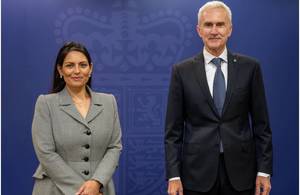
Home Secretary Priti Patel welcomed INTERPOL Secretary General Jürgen Stock to the Home Office on Wednesday 6 July 2022.

Home Secretary Priti Patel and INTERPOL Secretary General Jürgen Stock

Home Secretary Priti Patel and INTERPOL Secretary General Jürgen Stock

The Home Secretary welcomed the Secretary General back to London and emphasised the high priority she attaches to international co-operation in order to enforce the law – and that she was always seeking to ensure that the police and law enforcement agencies have the tools they need to do that.

The Secretary General thanked the Home Secretary for her warm welcome and congratulated her on the leadership she continued to show internationally, in particular at the G7 Interior Ministers’ meeting in London in September 2021 and since. He also wanted to congratulate British police and the National Crime Agency for their work with European partners in recent days on the operation to arrest suspected people traffickers across Europe.

The Home Secretary sought assurances that Russia was not able to abuse INTERPOL systems following its invasion of Ukraine. The Secretary General was adamant that he is now implementing INTERPOL’s strongest monitoring process to ensure that there can be no such abuse of INTERPOL systems for political purposes in contravention of INTERPOL’s Constitution and that action would be taken immediately in the event of any non-compliance being identified. The Home Secretary thanked him for this reassurance.

They went on to discuss a variety of issues, including how partners continue to work together to tackle criminality in such fields as corruption and online child sexual exploitation and abuse. They agreed on the importance of communicating how INTERPOL could support its membership in tackling international criminality and providing reassurance that robust mechanisms were in place to prevent misuse of its systems and therefore build trust.

They also noted the ongoing globalisation of crime, with criminals using new technology for nefarious means just as law enforcement agencies are harnessing new technology to detect criminality and bring perpetrators to justice.

The Home Secretary and Secretary General also looked ahead to INTERPOL’s 100th anniversary in 2023 and agreed that it would be an excellent opportunity to promote the evolution of its work, noting that the UK will then host the annual INTERPOL General Assembly in 2024.

Home Secretary Priti Patel said:

INTERPOL is a critical pillar of global law enforcement. People need to know that their government is doing all it can to keep them safe and the work we do with INTERPOL is an essential element of that.

INTERPOL – as a global police information hub – plays a vital role in working with our police and law enforcement agencies to protect the British public and make our streets safer.

INTERPOL Secretary General Jürgen Stock said:

I was pleased to congratulate the Home Secretary on her leadership in promoting co-operation to protect communities and bring criminals to justice and to thank her for her continued support in the implementation of the G7 commitments and INTERPOL’s work to make the world safer, especially in preventing online child sexual abuse.

Published 6 July 2022


UN Human Rights Council 50: UK statement on Central African Republic

World news story

The UK delivered a statement during the High Level Interactive Dialogue on the human rights situation in the Central African Republic (CAR).

Thank you, Mr Vice-President.

I would like to begin by welcoming the recent abolishment of the death penalty in the Central African Republic. The United Kingdom recognises this as a vital step towards ensuring human rights for all.

However, we remain dismayed by on-going human rights violations and abuses by all parties in CAR. These can trigger displacement across the country and contribute to the deteriorating humanitarian situation. As of 1 May 2022, 658,000 Central Africans have been internally displaced whilst 738,000 have fled to neighbouring countries.

Continued targeting of humanitarian personnel and the indiscriminate killing of civilians is unacceptable and must stop.

We call on the Government of CAR to open an independent investigation into the allegations of violations of International Humanitarian Law and the violations and abuses of human rights in the CAR, including allegations of abuses committed by the Central African Armed Forces and the private Russian mercenary group, Wagner. The Wagner Group plays a destabilising role in the country, worsening the humanitarian situation and undermining UN work. The government must ensure all actors are held to account.

Mr Agbetse,

We would welcome your views on how this Council can best work to address the deepening humanitarian crisis, including what support the international community can provide to CAR in this regard.

Thank you.

Published 6 July 2022


WTO TRIPS Council July 2022: UK statements

PARAGRAPH 8 OF THE MINISTERIAL DECISION ON THE TRIPS AGREEMENT ADOPTED ON 17 JUNE 2022

Thank you, Chair.

The UK would like to thank you and the Secretariat for navigating the TRIPS Council through a complex negotiating process during MC12. While the process for reaching the consensus-based TRIPS Decision was by no means perfect, and lessons could be learned, your leadership and guidance was valuable in helping us reach an outcome and will no doubt be required moving forward. We also extend our gratitude to all Members for their cooperation and patience throughout the process.

The UK has listened carefully and understood concerns raised by developing countries, particularly those regarding use of the compulsory licensing system. Bearing such feedback in mind, the UK engaged constructively in discussions on how compulsory licensing could help developing countries to achieve their public health policy objective of accessing COVID-19 vaccines.

After a series of intense negotiations, we understand the aim of this Decision is to make it easier for eligible Members, who choose to do so, to make exports of life-saving COVID-19 vaccines more streamlined, while preserving incentives to invest in innovation embedded in IP rights.

The UK will engage constructively and in good faith, being guided by evidence and noting the distinction between vaccines, therapeutics, and diagnostics. We welcome all Members’ views and the opportunity to engage bilaterally on the matter.

We are pleased to see the IP framework has been put in use by licensing partnerships for COVID-19 treatments underway, including via the Medicines Patent Pool.

Chair, we also thank delegations for the unofficial room document RD/IP/49 circulated today. This text will certainly form part of our analysis of the matter. Given the complexities of therapeutics and diagnostics, we will use the time available, and we call on others to do the same, to gather and analyse evidence and engage bilaterally during the summer months, so that we are able to deliver on the mandate via multilateral evidence-based discussions after the summer. We see the TRIPS Council, with you, Chair, at the helm, as the right forum to hold these discussions.

Thank you, Chair.

INTELLECTUAL PROPERTY AND INNOVATION: IP LICENSING OPPORTUNITIES

Thank you Chair,

We would like to thank the US for drafting and presenting this paper, and share some of the UK’s experience in this area.

Firstly, on the kinds of licensing that are possible in the UK for each right:

In essence – a licence is an agreement between the IP right owner and another party. It grants them permission to do something that would be an infringement of the rights without the licence.

IP can be “licensed-out” or “licensed-in”. The rights owner can “license-out” to another company in return for a fee. A business can “license-in” if it wants to use another company’s IP to develop its own business and products. In the UK, licences can be for patents, trade marks, designs and copyright as well as trade secrets/know how. Any licence arrangement, including any financial element, is made directly between the licensee and the right owner.

In the case of patents, the patent holder can request that the patent be endorsed with a “licence of right” in the register. This means that the owner must grant a licence to anyone who wants one.

The licence will still be an ordinary, commercial licence and the terms and fees will be a private matter between the licensee and licensor. The main advantages of having a patent endorsed with a licence of right is that it lets other people know that the owner is willing to licence the patent. Annual renewal fees are also reduced to half the usual cost if the patent is endorsed with a licence of right.

Though notifying the UK Intellectual Property Office of the grant or assignment of a licence for patents is not mandatory, it is recommended and will be recorded in the patents register.

Trade marks can also be licensed by the owner to give a licensee permission to use their registered mark. This can form part of a wider commercial arrangement, such as a franchise agreement. The terms of the licence are also between the licensee and the licensor, for example if the licence is exclusive, so the mark cannot be used by anyone else, including the registered owner, or limited to a particular geographical area.

Again – notifying the UK Intellectual Property Office of the grant or assignment of a licence for a trade mark is not mandatory, but is recommended and will be recorded in the trade mark register.

A design owner can give someone else permission to use their registered design by granting them a licence, and in this instance, notifying of the grant or assignment of a licence for registered designs is required and will be recorded in the designs register.

Licences can also be granted for unregistered designs. In addition to usual licensing arrangements, a licence of right must be made available to third parties in the last 5 years of the term of protection for a UK unregistered design right.

A copyright owner may decide whether and how to license use of their work, and any licence agreed can relate to one or more of the rights granted by copyright, and can also be limited in time, geographical extent or any other way. An exclusive licence can also be granted, which enables the licensee to use the copyright work in the manner specified by the licence to the exclusion of all others, including the copyright owner. Notably, licensing may be carried out by direct negotiation, or through agents or collective management organisations (CMOs).

A copyright owner may also prefer to allow limited access to, and use of, their work without charge – and one way to do this is by using a Creative Commons Licence.

In instances where a copyright owner is unknown or cannot be found, individuals or businesses may apply to the UK Intellectual Property Office for an “orphan works” licence. Subject to completion of a diligent search, and payment of appropriate fees, such a licence will be limited to the UK for a maximum length of seven years and will be non-exclusive. The paid licence fees are retained for eight years in case the right holder comes forward.

We would also like to note that the UK is also considering IP licensing as part of its Futures Programme, to anticipate potential evolution in the kinds of IP licensing that may occur due to emerging technologies and new business models.

The UK would also like to briefly look at the benefits of IP licensing:

When a company licenses the right to manufacture and sell products. the costs and risks are shared between the licensor and the licensee. The licensor will receive revenue from licensing but will not take the risk of manufacturing, promoting, or selling the licensed products. The licensee will have the right to use the IP without incurring the expense and risk of undertaking research, or the cost of developing the product.

Some of the potential benefits to the licensor will include increasing revenue by broadening the reach of IP into different markets. Market penetration would be increased by licensing another business to sell in territories that the owner cannot cover.

Though exceptions and limitations exist within the IP framework, a licence usually provides a higher degree of business certainty than relying on an exception.

The potential benefits to a licensee include reducing research and development costs by ‘licensing-in’ innovation. By taking a licence, a business may tap into expertise that it does not have in-house. A business may save time and get its products or services to market more quickly by acquiring a licence to use existing IP, rather than starting from scratch. Acquiring a licence to use existing IP may help a business obtain a competitive advantage over its competitors.

So, both licensors and licensees can benefit from collaboration to develop new products and services, creating a highly beneficial partnership.

I hope that these highlights from how licencing of IP works in the UK have been of interest to members, and I would like to again thank the US for their paper on this topic.

Thank you, Chair.