Defence Secretary Ben Wallace visits Armed Forces of Ukraine as training programme starts across the UK

News story

The first cohort of Ukrainian soldiers taking part in a major new UK-led military programme, which will train up to 10,000 Ukrainians over the coming months, have arrived in the UK.
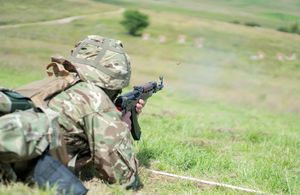
Ukrainian solider

Ukrainian solider

The programme is part of the UK’s enduring commitment to support Ukraine in its fight against Russia’s unprovoked invasion, which so far amounts to more than £2.3 billion in military aid and includes more than 5,000 NLAW anti-tank weapons and M270 multiple launch rocket systems.

Defence Secretary Ben Wallace, who visited the training this week, said:

This ambitious new training programme is the next phase in the UK’s support to the Armed Forces of Ukraine in their fight against Russian aggression.

Using the world-class expertise of the British Army we will help Ukraine to rebuild its forces and scale-up its resistance as they defend their country’s sovereignty and their right to choose their own future.

Around 1,050 UK service personnel are deploying to run the programme, which will take place at MOD sites across the North West, South West and South East of the UK. Each course will last several weeks and will be conducted by elements from 11 Security Force Assistance Brigade.

The training will give volunteer recruits with little to no military experience the skills to be effective in frontline combat. Based on the UK’s basic soldier training, the course covers weapons handling, battlefield first aid, fieldcraft, patrol tactics and the Law of Armed Conflict.

The Government has rapidly procured AK variant assault rifles for the training programme, meaning Ukrainian soldiers can train on the weapons they will be using on the front line. This effort was supported by the Welsh Guards, who tested more than 2,400 such rifles in 17 days to ensure they were ready for the Ukrainians to commence their training.

The UK has also gifted clothing and equipment to support Ukrainian soldiers in their training and deployment back to Ukraine. Each soldier will be issued with:

  • Personal protective equipment including helmets, body armour, eye protectors, ear protectors, pelvic protection, and individual first aid kits
  • Field uniforms and boots
  • Cold and wet weather clothing
  • Bergens, day sacks and webbing
  • Additional equipment required for field conditions including ponchos, sleeping bags, and entrenching tools

The UK has a long history of supporting Ukrainian service personnel through Operation ORBITAL, which trained 22,000 Ukrainians between 2015 and 2022. The new programme will build on this success and demonstrate the UK’s continued leadership in responding to Ukraine’s military requirements as the war evolves.

Published 9 July 2022


Curfews proposed for parents who fail to pay child maintenance

The change is being considered as part of fresh proposals that will get more of the money that is owed to the children of separated parents.

The Child Maintenance Service (CMS) collected or arranged £1 billion in child maintenance payments last year, operating as a crucial weapon in the battle against child poverty. Child support payments help lift around 140,000 children out of poverty each year.

Curfew orders would be another method of enforcement, alongside current powers which include passport and driving license confiscation and earnings deduction orders, to tackle parents who continually refuse to pay maintenance owed.

As an alternative sanction to prison, which is costly and prevents maintenance getting to children, curfews would act as a deterrent by restricting and disrupting non-compliant parents’ lifestyles, stopping them, for example, from going out for dinner, to the pub or going on holiday.

The curfews would be monitored by an electronic tag with an electronic monitoring service applying the tag, monitoring and making sure the parent complies with the rules of the tag. If parents fail to comply, the CMS would be able refer them back to court which might then extend the curfew order or impose a prison sentence.

DWP Lords Minister Baroness Stedman-Scott said:

For children in low-income households, maintenance payments can make all the difference, lifting them out of poverty.

We are not afraid to go after those parents who deliberately and repeatedly refuse to pay for their children.

Curfew orders are another step towards providing the CMS with a full arsenal of powers to make sure children get the financial support they need to have the best start in life.

This builds on a new powers introduced earlier this year to digitise all communications to parents and improvements to help the service trace the paying parent, calculate maintenance and enforce arrears more effectively.

The consultation is published here and closes on 12 August 2022.

Further information

  • The Child Maintenance Service was established in 2012 to replace the old Child Support Agency, to increase levels of cooperation between separated parents and encourage parents to meet their responsibilities to provide their children with the financial support they need to secure better outcomes in life.
  • [Get help arranging child maintenance] (https://child-maintenance.service.gov.uk/get-help-arranging-child-maintenance/) is a new digital service that helps parents decide what type of child maintenance arrangement is right for them and their circumstances.
  • Curfew orders will take account of each individual’s circumstances.
  • This power will only apply to paying parents living in England, Scotland, or Wales as with our current powers of driving licence and passport disqualification and commitment to prison.
  • The consultation period begins on 9 July 2022 and runs until 12 August 2022.
  • Curfew orders will be added to the enforcement powers of the CMS subject to parliamentary approval.

Media enquiries for this press release – 0115 965 8781

Follow DWP on:


Russia’s deeply irresponsible veto will have a tragic impact on 4.1 million Syrians

Thank you President.

I’d like to start by expressing the UK’s deep condolences following the deaths of former Prime Minister Shinzo Abe and former President José Eduardo dos Santos.

I’d like to start by thanking Ireland and Norway for their sterling efforts and masterful diplomacy as penholders to find a reasonable compromise on this text.

It is deeply regrettable that Russia has yet again vetoed a humanitarian resolution on Syria. This is a deeply irresponsible veto that will have a tragic impact.

The UN and humanitarian organisations have repeatedly described a 12-month renewal as essential, not least to provide operational hope for the 4.1 million Syrians who desperately rely on the support provided by the cross-border mechanism.

The penholders consulted Council members extensively and their balanced text also provided important support for early recovery, resilience and livelihoods planning, reflected in the widespread support it received.

A renewal for six months will create significant operational challenges for frontline NGOs – to their planning, their procurement, their hiring of staff and ultimately their sustainability.

We will not support the resolution tabled by the Russian Federation, which simply serves to slice in half the fragile certainty we are giving to humanitarian operations, and to bolster the Assad regime.

We do need to find a way forward to preserve this vital humanitarian lifeline and the penholders have our full support as they seek to do that.

Thank you Mr President.


Monkeypox: continuing transmission in interconnected sexual networks

The latest UK Health Security Agency (UKHSA) technical briefing on the current UK monkeypox outbreak shows no signs of a decline in the outbreak. In line with global observations, there is no evidence of sustained transmission beyond these networks.

The outbreak continues to grow and information from cases strongly suggests the virus is passing primarily via close or sexual contact. UKHSA Health Protection teams in all regions of England continue to identify and risk assess close contacts of confirmed cases.

The majority of people with monkeypox can be safely managed at home and there have been no deaths in the UK. Most people experience mild disease but it can cause a significant illness in some that requires hospitalisation, including severe pain.

A vaccination programme is beginning, and sexual health services will offer the vaccine to anyone considered to be at higher risk of exposure. This includes people with a recent history of multiple partners, participating in group sex, attending sex on premises venues, or have recently had a bacterial sexually transmitted infection.

Up to 6 July 2022, there were 1,517 laboratory confirmed cases in the UK. The median age of confirmed cases in the UK was 36 years old. In England, 99% of cases are male and 74% are known to be London residents. 16% (226) of England cases reported recent foreign travel, with 176 of these reporting travel within Europe.

The briefing includes a breakdown of events that cases reported attending, 572 in total. 17% of those who provided information had been to a sex-on-premises venue and while this does not confirm transmission occurred there, UKHSA continues to conduct outreach work with event organisers and to provide guidance on how to minimise risk across a range of settings.

Dr Meera Chand, Director of Clinical and Emerging Infections, UKHSA said:

It’s concerning that we are continuing to see the outbreak grow and we urge the public to do all they can to help us slow the spread.

If you’ve recently had new or multiple sexual partners, please be vigilant to the symptoms of monkeypox, and be aware that many of the cases we’re seeing are finding only a single, or few, lesions.

If you are concerned that you may have monkeypox, take a break from events, meeting with friends or having sexual contact. Instead, stay at home and contact 111 or your local sexual health service for advice. Please contact the clinic ahead of your visit and avoid close contact with others until you’ve been reviewed by a clinician.

To assist with our contact tracing, we encourage everyone to ensure they exchange contact details with sexual partners.

If you are called forward for vaccination, we strongly recommend that you take it.

UKHSA will continue to publish regular technical briefings as the response to the outbreak continues.

Latest UK case numbers are available on GOV.UK.


Official opening for Romsey Flood Alleviation Scheme

Romsey Flood Alleviation Scheme, which will better protect 127 properties, was officially unveiled today (Friday 8 July) by Caroline Nokes MP for Romsey and Southampton North.

The scheme that became operational in autumn 2021, reduces flooding from the River Test and surface water. Costing approximately £9.5 million to build, of which the Environment Agency contributed approximately £6.4 million through government grant in aid.

Romsey has a history of flooding in the 1960s, 1995, 2000 and 2001. In the winter of 2013/2014, water overtopped Fishlake Stream and the Barge Canal, badly flooding 36 homes and 44 commercial properties with devastating consequences for families and businesses.

Simon Moody, Area Director, Environment Agency, said:

The climate emergency is bringing greater risks. We’re seeing more extreme weather, with an increase in flooding. Our response must be to protect our communities as best we can, make them more resilient, and to tackle both the causes and consequences of climate change.  We can make a difference if we all work together, like we have done on this scheme.

The flood alleviation scheme includes a tilting weir structure used to control the flows of Fishlake Stream and earth embankments to contain the excess water within a flood plain. At the Causeway, more earth embankments have been built to manage flood water as well as a new bridge and a spillway to enable the flood plain to drain into the River Test.

The risk of surface water flooding has been reduced by improvements to the existing drainage system including ditches, pipes and road drainage at Mainstone junction and Middlebridge Street.

As well as reducing flooding, there are additional ecological benefits from the scheme. Some 150 metres of new water vole habitat have been created and 150 metres of river environment have been enhanced by managing vegetation and improving the structure that controls water flow in the Barge Canal. The London plane trees, some of the oldest in the country, were also carefully preserved during construction.

Members of the local community were consulted throughout the scheme’s development to ensure they were happy with the design. As a result, the new bridge on the Causeway is a Dutch, carbon-friendly design made of glass-reinforced plastic and is covered in timber to blend in with the picturesque surroundings.

The scheme, which took 3.5 years to build, has been developed through partnership working with Hampshire County Council and Test Valley Borough Council.

Councillor Edward Heron, Executive Lead Member for Transport and Environment Strategy at Hampshire County Council, said:

This is an important scheme and we have been delighted to play our part in helping protect residents in Romsey. We contributed £1.5 million towards the total cost and worked in partnership with the Environment Agency, the Borough Council and other local stakeholders on the planning, design and construction of the scheme.

While there will always be a risk of flooding, thanks to the work that has been completed, residents’ properties, businesses, roads and other infrastructure are now much better protected and more resilient.

In addition to building and maintaining flood defences the Environment Agency also runs a free flood warning service. You can sign up for free flood warnings in minutes on gov.uk at Check for flooding – GOV.UK (www.gov.uk) or call Floodline free on 0345 988 1188.

The scheme was funded from flood and coastal erosion risk management grant in aid (£6.4 million), local levy from the Southern Regional Flood and Coastal Committee (£1.2 million), Hampshire County Council contribution (£1.5 million), Test Valley Borough Council contribution (£0.3 million) and EU funding (£0.1 million).

Photos of the flooding, the scheme and its opening are available on request.

In the 2020 Budget the Government doubled its investment in flood and coastal erosion risk management in England by committing a record £5.2bn in 2021-27. This long-term commitment will better protect hundreds of thousands of properties, including homes, businesses, schools and hospitals from the risk of flooding.