Romsey flood alleviation scheme is officially unveiled

Romsey flood alleviation scheme, which will better protect 127 properties, was officially unveiled today (Friday 8 July) by Caroline Nokes MP for Romsey and Southampton North.

The scheme that became operational in autumn 2021, reduces flooding from the River Test and surface water. It cost approximately £9.5 million to build, of which the Environment Agency contributed approximately £6.4 million through government grant in aid.

Romsey has a history of flooding in the 1960s, 1995, 2000 and 2001. In the winter of 2013/2014, water overtopped Fishlake Stream and the Barge Canal, badly flooding 36 homes and 44 commercial properties with devastating consequences for families and businesses.

Simon Moody, Area Director, Environment Agency, said:

The climate emergency is bringing greater risks. We’re seeing more extreme weather, with an increase in flooding. Our response must be to protect our communities as best we can, make them more resilient, and to tackle both the causes and consequences of climate change.  We can make a difference if we all work together, like we have done on this scheme.

The flood alleviation scheme includes a tilting weir structure used to control the flows of Fishlake Stream and earth embankments to contain the excess water within a flood plain. At the Causeway, more earth embankments have been built to manage flood water as well as a new bridge and a spillway to enable the flood plain to drain into the River Test.

The risk of surface water flooding has been reduced by improvements to the existing drainage system including ditches, pipes and road drainage at Mainstone junction and Middlebridge Street.

As well as reducing flooding, there are additional ecological benefits from the scheme. Some 150 metres of new water vole habitat have been created and 150 metres of river environment have been enhanced by managing vegetation and improving the structure that controls water flow in the Barge Canal. The London plane trees, some of the oldest in the country, were also carefully preserved during construction.

Members of the local community were consulted throughout the scheme’s development to ensure they were happy with the design. As a result, the new bridge on the Causeway is a Dutch, carbon-friendly design made of glass-reinforced plastic and is covered in timber to blend in with the picturesque surroundings.

The scheme, which took 3.5 years to build, has been developed through partnership working with Hampshire County Council and Test Valley Borough Council.

Councillor Edward Heron, Executive Lead Member for Transport and Environment Strategy at Hampshire County Council, said:

This is an important scheme and we have been delighted to play our part in helping protect residents in Romsey. We contributed £1.5 million towards the total cost and worked in partnership with the Environment Agency, the Borough Council and other local stakeholders on the planning, design and construction of the scheme.

While there will always be a risk of flooding, thanks to the work that has been completed, residents’ properties, businesses, roads and other infrastructure are now much better protected and more resilient.

In addition to building and maintaining flood defences the Environment Agency also runs a free flood warning service. You can sign up for free flood warnings in minutes on gov.uk at Check for flooding – GOV.UK (www.gov.uk) or call Floodline free on 0345 988 1188.

The scheme was funded from flood and coastal erosion risk management grant in aid (£6.4 million), local levy from the Southern Regional Flood and Coastal Committee (£1.2 million), Hampshire County Council contribution (£1.5 million), Test Valley Borough Council contribution (£0.3 million) and EU funding (£0.1 million).

In the 2020 Budget the Government doubled its investment in flood and coastal erosion risk management in England by committing a record £5.2 billion in 2021-27. This long-term commitment will better protect hundreds of thousands of properties, including homes, businesses, schools and hospitals from the risk of flooding.


UK provides increased support for Ukraine’s energy sector

  • UK government announces further £5 million to support Ukraine’s energy sector, helping provide safety and security equipment for their civil nuclear sector
  • follows £10 million announced last week to fund and help reconnect power across the country, and a further £7 million previously allocated to supply generators
  • this builds on the ongoing UK-wide effort to support Ukraine in the face of Russia’s brutality

The UK’s Business and Energy secretary, Kwasi Kwarteng, announces today a £5 million support fund designated to providing safety and security equipment to Ukraine’s civil nuclear sector, supporting the country’s ongoing effort to stand with Ukraine.

The civil nuclear support fund will see high priority items, which could include personal protective equipment, communications systems, and radiation monitoring equipment, supplied to Ukraine. This will enable the high levels of safety and security required to be fully restored at Chernobyl and Ukraine’s other nuclear sites following Russian attacks.

The provision of vital equipment to Ukraine also contributes to widespread efforts to supply equipment for guard forces and to enhance the detection of the illicit movement of materials within Ukraine and across its borders, helping the country recover from Russian control of Chernobyl.

Business and Energy Secretary Kwasi Kwarteng said:

Energy systems play an indispensable role in ensuring national security and economic resilience.

Today the UK is ramping up our support to the Ukrainian people in their time of need by helping reconnect power across the country and protecting the safety and security of Ukraine’s nuclear sector, ensuring their frontline is fully equipped in the face of Russia’s brutality.

Melinda Simmonds, UK Ambassador to Ukraine said:

Ensuring Ukraine has access to available energy will not only make sure the economy continues to function, but will also keep people warm and allow hospitals to provide emergency healthcare when it’s needed.

I’m proud of all the UK is doing to support Ukraine in the face of Russian aggression.

Today’s news follows the Foreign Secretary’s announcement last week of a £10 million Energy Support Fund, forming part of a package to help Ukraine defeat Putin and rebuild the country. This fund will help keep Ukraine’s energy system running in wartime, enabling essential repairs to energy infrastructure and help reconnect power across the country. The package included both immediate financial and longer-term support for the Ukrainian people, utilising UK expertise and British businesses to accelerate Ukraine’s economic recovery.

Together this brings UK support for Ukraine’s energy sector to £22 million, including the UK’s £7 million donation of over 850 generators earlier this year that are already in use, helping to power essential services such as hospitals and shelters.

These support packages come as international partners and allies from around the world joined together last week for the Lugano Conference on Ukraine’s Recovery in Switzerland in a united stand with Ukraine.

The £22 million figure includes:

  • the £10 million Energy Support Fund from the Energy Resilience and Energy Security programme, announced before the invasion. This 3-year FCDO fund is intended to keep Ukraine’s energy systems running in wartime and prepare for modern-era post-war reconstruction, with the other £7 million transferred to BEIS to supply 856 portable generators
  • today’s £5 million from BEIS allocated to support Ukraine’s nuclear sector. The United Kingdom will procure these items of equipment and work with the International Atomic Energy Agency to deliver them to Ukraine


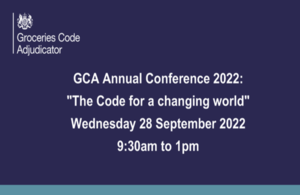
GCA to host annual conference on 28 September 2022

News story

Mark White, the Groceries Code Adjudicator (GCA) will hold his second annual conference on 28 September 2022.

Registration is now open for the GCA Annual Conference 2022: “The Code for a changing world”, which the GCA will hold online on Wednesday 28 September, between 9:30am and 1pm (BST).

This year’s conference brings together supplier representatives, designated retailers and other experts to discuss challenges the grocery sector is facing and support available for suppliers. There will be an opportunity to ask speakers and panel members questions throughout the conference and meet with the Groceries Code Adjudicator, Mark White and Code Compliance Officers in the afternoon.

Mark White said:

As the groceries sector faces a range of challenges from inflationary pressures to raw ingredient shortages, my annual conference offers a unique opportunity for the sector to come together and discuss how these challenges can be resolved.

We are putting together some really interesting expert panels and talks, including a close look at our recent survey results and I encourage everyone to attend.

The event is free to attend. Register now to guarantee your place.

The GCA will share information about how to set up meetings with the Adjudicator and Code Compliance Officers closer to the event.

Published 11 July 2022


2022 Youth Mobility Scheme for South Korean nationals: 2nd ballot

As in previous years there are a total of 1,000 places available to South Korean nationals for 2022.

The majority of places were allocated in the first ballot in January this year, while the remaining places will be made available in this second ballot in July 2022. If your application is successful you will be able to live, work and study in the UK for up to 2 years.

How to apply for the ballot

If you would like to be in with the chance to apply for the scheme you should send one email per applicant to:SouthKorea.YMS2022@fcdo.gov.uk between midday (12pm) on Monday 25 July 2022 to midday on Wednesday 27July 2022 (Seoul time).

The header or subject line of your email must contain your name, date of birth (DD/MM/YYYY) and passport number as shown in your passport.

This must be written in English only.

For example: Kim Jayne – 31/03/2000 – Passport123456789.

The main body of your email should include the following information, written in English:

  • Name
  • Date of birth
  • Passport Number
  • Mobile phone number

The email account will only be open for 48 hours and all emails received within this timeframe will be sent an automated reply confirming receipt. Please remember to check your junk inboxes.

Once the ballot closes, allocations for the remaining places will be chosen at random by UKVI. If you have been successful a second email will be sent to you by Friday 29 July to confirm acceptance and provide further instructions on how to make an appointment, along with documentary evidence required to apply for your entry clearance.

Please note successful applicants must prepare online applications and online credit card payments no later than 30 August 2022. Failure to submit your payment online by this date will automatically remove your name from the list and your allocation will be retracted. After you have paid online you have 90 days to book your appointment at the Visa Application Centre (VAC) and submit your paperwork for consideration.

If you are a South Korean national living overseas you can also apply following the instructions above, and if you are chosen to apply you will be able to do so in your country/territory of residence. Applications cannot be submitted for the Youth Mobility Scheme in the UK.

If you’re unsuccessful you will receive an email by 29 July and no further action is required.

Further information about the scheme can be found on gov.uk and any enquiries relating to the application process, online application forms and questions in general should be directed to the UKVI International Enquiry Line.


RAF fighter aircraft deploy to Finland and Sweden for joint training

The deployments, which took place over the last month at the request of the host nations, allowed the partner air forces to develop their joint tactics and strengthen their ability to operate alongside each other.

Two F-35Bs and four Typhoons conducted high-end warfighting training with Finnish F-18 Hornets and Swedish Gripen aircraft, underlining the UK’s commitment to strengthening our collective defence capabilities.

The deployments are a practical demonstration of the mutual security assurance declarations that the UK signed with these nations in May, as they progress their respective applications to join NATO. All three nations already work together through the UK-led Joint Expeditionary Force, which is a coalition of 10 member nations who cooperate to maintain the security of Northern Europe.

Secretary of State for Defence, Ben Wallace, said:

Finland and Sweden are important defence partners and we welcome their applications to join NATO, which will make the alliance stronger as we face a renewed threat in Europe.

These deployments highlight our determination to enhance that partnership and ensure our forces can work together seamlessly.

The F-35 deployment to Finland was only the second time that the aircraft type has landed in the country, after two US F-35A visited for an air show in June. The F-35B’s arrival was of particular interest to the Finns as they recently announced that they will purchase F-35 aircraft. The UK Lightning Force will continue to develop their partnership with the Finnish Air Force as they integrate their new aircraft.

Swedish Defence Minister Peter Hultqvist said:

The Joint Expeditionary Force contributes to regional security and stability. Joint exercises, like the one here in Såtenäs, strengthen our ability to operate together in response to a crisis in our neighbourhood. This is particularly important in today’s challenging security environment.

The fighter jets were supported by teams of specialists from RAF Marham and RAF Lossiemouth. A Voyager aircraft from RAF Brize Norton also provided air-to-air refuelling to extend the duration of the combat sorties and an A400M Atlas deployed the support team to Sweden.

Working with similarly advanced air forces such as the Finnish and Swedish also provides an opportunity to learn from each other and identify areas of mutual benefit. The deployed teams spent time further integrating their systems, so that they can share information quickly on the exercise and in the future.

These exercises are part of a series of bilateral and Joint Expeditionary Force exercises planned this year at Finland and Sweden’s request. Later this month the UK will deploy the F-35B to Norway for further integration training with the Norwegian Air Force.

The Typhoon Force also deployed aircraft to Konya in Türkiye for similar integrated fighter training with the Turkish Air Force, flying alongside Turkish, Pakistani, Jordanian and Azerbaijani aircraft in simulated combat scenarios. The Typhoons forward deployed from Romania where they are currently supporting the NATO Air Policing mission.