Vacancy for an Inspector of Marine Accidents (Fishing), Southampton

News story

We have an exciting opportunity for someone with UK commercial fishing experience and a recognised maritime qualification to join our team of accident investigators.

Your key responsibilities will include:

  • deploying to accident sites and leading investigations
  • collecting evidence and interviewing witnesses
  • conducting detailed analysis in order to identify safety issues and draft recommendations
  • writing investigation reports and safety bulletins
  • giving evidence at inquests and fatal accident inquiries
  • providing in-house fishing vessel expertise
  • representing the MAIB at fishing industry working groups and other safety fora

You must be prepared to travel throughout the UK (for which you will need a full UK driving licence) as well as overseas.

For further information about this position and how to apply see Civil Service Jobs, Inspector of Marine Accidents – Fishing, Ref: 221789

Closing date: 14 August 2022.

Published 18 July 2022


Exhibition of Beer’s flood history to open in Devon

Press release

Lessons learned from historic flooding are to be shared with the current generation to urge them to act now and protect their own loved ones and property.

Black-and-white photo of floodwater running through a shopping street in Beer in the 1950s

Flooding in Beer in the 1950s

A free exhibition of historic flood photographs and maps of Beer and surrounding area is being held at The Mariners’ Hall in Fore Street, Beer, thanks to the Environment Agency, Beer Emergency Response Team and The Westcountry Rivers Trust.

Residents and visitors are invited to come along to the event on 28 July 2022 from 10am to 4pm and share their experiences or just take in the photographs on display.

Chris Khan, a flood resilience officer at the Environment Agency, said:

We are hosting this event because your neighbourhood is at risk of flash flooding. This type of flooding happens extremely quickly with potentially devastating impacts as seen in Beer and Boscastle in 2004 and Coverack in 2017.

More than 750 people attended a similar exhibition in Sidmouth in 2018 and over 500 in Colyton in 2019. Both were an amazing success with people coming from all over the country. The photographs are a real eye-opener and leave you questioning how you would react.

Beer has a history of flooding, like this event in August 2004

While the Environment Agency hopes attendees will leave with the information they need to prepare, act, survive, Beer Emergency Response Team hopes to attract new members to support its newly created Community Emergency Plan for the village.

Westcountry Rivers Trust will also display posters on some of its work done in the area and share potential solutions and opportunities to improve Beer’s waterways and increase its resilience against flooding.

Refreshments will be available.

Find out how you can reduce the impact of flooding on your home at www.befloodready.uk

Editor’s notes

A brief history of flooding in Beer:

  • 17 July 1926. Practically every house in the village was flooded within the space of a few minutes. The Dolphin Hotel was flooded to several inches.
  • 5 August 1931. Flood water poured down the hillsides into the main thoroughfare. Little damage was done. No rain fell at Colyford which is not far away.
  • 15 July 1937. Several cottages and houses flooded.
  • 16 July 1956. The observer at Beer said that an inch probably fell in 15 minutes. There was some flooding and damage in the village.
  • 1 July 1985. Surface water flooding in Fore Street – watercourse overflowed – water coming up through the drainage systems of properties.
  • 15 May 1994. A number of properties and businesses affected.
  • 18 June 1996. At least seven properties affected.
  • 25 August 1999. Fore Street flooded.
  • 11 August 2004. Significant flooding and damage in the village. At least 18 properties flooded.
  • June and October 2021. The most recent flooding to occur in the village.
Published 18 July 2022
Last updated 18 July 2022 + show all updates

  1. First published.


Farnborough International Airshow 2022

News story

Countries, territories and organisations invited by UK Defence and Security Exports (UKDSE) to attend FIA 2022

Countries, territories and organisations invited by UKDSE to attend Farnborough International Airshow (FIA) 2022.

  • Algeria
  • Australia
  • Austria
  • Bahrain
  • Bangladesh
  • Belgium
  • Botswana
  • Brazil
  • Brunei
  • Bulgaria
  • Canada
  • Chile
  • Colombia
  • Croatia
  • Czech Republic
  • Denmark
  • Egypt
  • Estonia
  • Finland
  • France
  • Germany
  • Ghana
  • Greece
  • Hungary
  • Iceland
  • India
  • Indonesia
  • Ireland
  • Israel
  • Italy
  • Japan
  • Jordan
  • Kazakhstan
  • Kenya
  • Korea (Republic of)
  • Kuwait
  • Latvia
  • Lithuania
  • Luxembourg
  • Malaysia
  • Montenegro
  • Morocco
  • NATO
  • Netherlands
  • New Zealand
  • Nigeria
  • North Macedonia
  • Norway
  • Oman
  • Pakistan
  • Peru
  • Philippines
  • Poland
  • Portugal
  • Qatar
  • Romania
  • Saudi Arabia
  • Singapore
  • Slovakia
  • Slovenia
  • South Africa
  • Spain
  • Sweden
  • Switzerland
  • Taiwan
  • Thailand
  • Tunisia
  • Turkey
  • UAE
  • Ukraine
  • UN
  • USA
  • Uzbekistan
  • Vietnam

Published 18 July 2022


Proposed change to how Hinkley Point C stores radioactive waste

Press release

The Environment Agency has launched a consultation on the way radioactive waste will be stored at Hinkley Point C nuclear power station near Bridgwater.

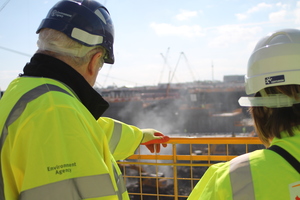
Two staff members of the Environment Agency looking over a construction site

The Environment Agency has launched today a four-week public consultation

Pressurised water reactors at Hinkley Point C will use uranium fuel to create heat and generate electricity when operating. Once used within the reactor, nuclear fuel will be stored on-site before being sent off-site to a Geological Disposal Facility (GDF).

NNB Generation Company (HPC) Limited was originally issued a radioactive substances environmental permit in 2013. In the original design radioactive waste was to be stored on-site in ‘wet storage’ – a method of submerging and storing in water.

The operator has now decided to change the technology by which it will store spent nuclear fuel, from wet storage to ‘dry storage’. Dry storage will see used nuclear fuel stored in sealed containers within a facility, before it is sent to the GDF. This means the operator now seeks to change its radioactive substances environmental permit to remove or amend specific conditions related to the previous wet storage technology that are no longer relevant.

The operator has said altering the storage method will not change the expected radiation dose to the general public from discharges or the wider environment, which remains incredibly small.

Separately, NNB Generation Company (HPC) Limited will be seeking the necessary changes to its Development Consent Order for Hinkley Point C in the autumn.

The Environment Agency has launched today a four-week public consultation where you will be able to view the application and send it your comments.

All of the documents are available to view and download online at https://consult.environment-agency.gov.uk/nuclear/hpc-variation-rsr-permit-fuel-store/.

Paper copies can be made available on request.

Please send your comments via above website or in writing, quoting reference EPR/ZP3690SY, to

  • Email: nuclear@environment-agency.gov.uk
  • Post: Hinkley Point C Consultation, Environment Agency, Nuclear Regulation Group, Red Kite House, Howbery Park, Wallingford, Oxfordshire, OX10 8BD.

The consultation closes at 23.59 on Sunday 14 August 2022. After the consultation ends all comments made during consultation will be considered before a final decision is published in September 2022.

Editors notes

For more about the Environment Agency and its regulatory role with Hinkley Point C visit  [Hinkley Point: nuclear regulation – GOV.UK (Hinkley Point: nuclear regulation – GOV.UK (www.gov.uk)

Published 18 July 2022


UK sets out proposals for new AI rulebook to unleash innovation and boost public trust in the technology

  • Comes as Data Protection and Digital Information Bill introduced to Parliament, including measures to use AI responsibly while reducing compliance burdens on businesses to boost the economy

  • Regulators like Ofcom and the Competition and Markets Authority (CMA) will apply six principles to oversee AI in a range of contexts

New plans for regulating the use of artificial intelligence (AI) will be published today to help develop consistent rules to promote innovation in this groundbreaking technology and protect the public.

It comes as the Data Protection and Digital Information Bill is introduced to Parliament which will transform the UK’s data laws to boost innovation in technologies such as AI. The Bill will seize the benefits of Brexit to keep a high standard of protection for people’s privacy and personal data while delivering around £1 billion in savings for businesses.

Artificial Intelligence refers to machines which learn from data how to perform tasks normally performed by humans. For example, AI helps identify patterns in financial transactions that could indicate fraud and clinicians diagnose illnesses based on chest images.

The new AI paper published today outlines the government’s approach to regulating the technology in the UK, with proposed rules addressing future risks and opportunities so businesses are clear how they can develop and use AI systems and consumers are confident they are safe and robust.

The approach is based on six core principles that regulators must apply, with flexibility to implement these in ways that best meet the use of AI in their sectors.

The proposals focus on supporting growth and avoiding unnecessary barriers being placed on businesses. This could see businesses sharing information about how they test their AI’s reliability as well as following guidance set by UK regulators to ensure AI is safe and avoids unfair bias.

Digital Minister Damian Collins said:

We want to make sure the UK has the right rules to empower businesses and protect people as AI and the use of data keeps changing the ways we live and work.

It is vital that our rules offer clarity to businesses, confidence to investors and boost public trust. Our flexible approach will help us shape the future of AI and cement our global position as a science and tech superpower.

The UK is already home to a thriving AI sector, leading Europe and third in the world for levels of private investment after domestic firms attracted $4.65 billion last year. AI technologies have unlocked benefits across the economy and the country – from tracking tumours in Glasgow and improving animal welfare on dairy farms in Belfast to speeding up property purchases in England. Research this year predicted more than 1.3 million UK businesses will be using artificial intelligence and investing over £200 billion in the technology by 2040.

The extent to which existing laws apply to AI can be hard for organisations and smaller businesses to navigate. Overlaps, inconsistencies and gaps in the current approaches by regulators can also confuse the rules, making it harder for organisations and the public to have confidence where AI is used.

If rules around AI in the UK fail to keep up with fast moving technology, innovation could be stifled and it will become harder for regulators to protect the public.

Instead of giving responsibility for AI governance to a central regulatory body, as the EU is doing through its AI Act, the government’s proposals will allow different regulators to take a tailored approach to the use of AI in a range of settings. This better reflects the growing use of AI in a range of sectors.

This approach will create proportionate and adaptable regulation so that  AI continues to be rapidly adopted in the UK to boost productivity and growth. The core principles require developers and users to:

  • Ensure that AI is used safely
  • Ensure that AI is technically secure and functions as designed
  • Make sure that AI is appropriately transparent and explainable
  • Consider fairness
  • Identify a legal person to be responsible for AI
  • Clarify routes to redress or contestability

Regulators – such as Ofcom, the Competition and Markets Authority, the Information Commissioner’s Office, the Financial Conduct Authority and the Medicine and Healthcare Products Regulatory Agency – will be asked to interpret and implement the principles.

They will be encouraged to consider lighter touch options which could include guidance and voluntary measures or creating sandboxes – such as a trial environment where businesses can check the safety and reliability of AI tech before introducing it to market.

Industry experts, academics and civil society organisations focusing on this technology can share their views on putting this approach into practice through a call for evidence launching today.

Responses will be considered alongside further development of the framework in the forthcoming AI White Paper which will explore how to put the principles into practice.

The government will consider ways to encourage coordination between regulators as well as looking at their capabilities to ensure that they are equipped to deliver a world leading AI regulatory framework.

Professor Dame Wendy Hall, Acting Chair of the AI Council, said:

We welcome these important early steps to establish a clear and coherent approach to regulating AI. This is critical to driving responsible innovation and supporting our AI ecosystem to thrive. The AI Council looks forward to working with government on the next steps to develop the White Paper.

The government is today also publishing the first AI Action Plan to show how it is delivering against the National AI Strategy and identifying new priorities for the year ahead.

The government has invested more than £2.3 billion in AI since 2014. Since publishing the National AI Strategy last year, the government has announced new investment in the long term needs of the sector, including funding for up to 2,000 new AI and data science scholarships, and opened up new visa routes so the industry has the skills and talent to continue to thrive.

As part of the strategy, the AI Standard Hub was unveiled at the start of the year. The Hub will provide users across industry, academia and regulators with practical tools and educational materials to effectively use and shape AI technical standards.  The interactive hub platform, led by the Alan Turing Institute with the support of the British Standards Institution and National Physical Laboratory, will launch in Autumn 2022.

Ends

Notes to Editors:

  • The policy paper ‘Establishing a pro-innovation approach to regulating AI’, which includes a link to the call for evidence, is here.

  • The ten-week call for evidence will run until 26 September. Organisations and individuals working across AI are encouraged to provide feedback to inform the government’s work in this area.

  • The Full AI Action Plan can be found here

  • Today the Alan Turing Institute is publishing an independent report which found there is a need for greater coordination between regulators to meet the challenge of regulating the use of AI.

  • The Data Protection and Digital Information Bill is introduced to Parliament today. The Bill will strengthen the UK’s high data protection standards, introduce tougher fines for nuisance calls and cut down on unnecessary paperwork to free-up businesses. The reforms will also modernise the Information Commissioner’s Office so it can better help businesses comply with the law.