Sewing skills making a difference

News story

Our employees can volunteer in response to Covid-19 during work time, if they are not a key worker. Tracey Standring is one of those volunteers.
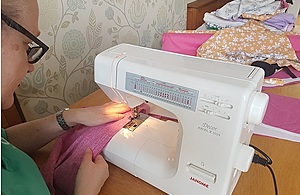
Sellafield Ltd employee sitting sewing PPE as a volunteer

Tracey is putting her sewing skills to good use

Employees are bringing different attributes to the volunteer cause, including Tracey Standring of Corporate Planning at the Risley office in Warrington who is putting her sewing skills to good use in her spare time.

Tracey, alongside fellow sewers in a purposely-formed local Trafford ‘Scrub Hub’, have been supplying numerous hospitals and clinics with protective medical scrubs, scrub bags and headbands, and are now focused on supplying nursing homes that have insufficient and inadequate PPE.

She said:

It’s fantastic how people are pulling together to support the community, I really wanted to volunteer but was struggling to know how I could contribute. I found a pattern to make scrubs that are desperately needed and realised this was how I could make a difference.

Our team has distributed more than 100 sets of scrubs and 450 scrub bags so far to Trafford General Hospital, Salford Royal Infirmary, Altrincham General Hospital, Wythenshawe Hospital, Manchester Children’s Hospital, a number of medical centres and GP surgeries as well as care and nursing homes. We have lots more scrubs in preparation and others awaiting fabric.

So far, the group have been sewing scrub bags with recycled duvet covers and pillow cases as well as donated fabric, however sourcing material has been a challenge.

Tracey with the donated fabric

Tracey’s work colleague Brenda Martin has been contacting our supply chain to request any surplus fabric, and she has recently received a donation from Carrington Textiles who supply fabric to the manufacturer of Sellafield Ltd’s PPE clothing.

Tracey added:

We have a GoFundMe page for the Trafford group and have raised over £1500 so far to buy fabric. Meanwhile, we’ve had the offer of using the textiles room in a local secondary school to help production, we are trying to get more sewers signed up and I’ve been asked to help project manage the hub group.

The community spirit, togetherness and innovative ways in how we work to support communities are vital in the process of managing this crisis.

Published 7 May 2020



Update on Company Names Tribunal services

News story

We have plans in place to maintain services for customers while ensuring the ongoing protection of staff.

Company names Tribunal

Following government advice on measures to tackle the spread of the coronavirus, we are able to confirm that our services are mainly unaffected at present.

Our people are our top priority. The majority of our staff are equipped to work from home and are doing so to avoid unnecessary travel and social contact. Our sites remain open for essential work that can only be undertaken on site.

Online services

We are still able to process fees, paper forms, faxes and paper correspondence. But, we ask customers to use our online services whenever possible. This will give us the best chance of continuing to deliver our services.

For services that are not available online, we have created an email address called paperformcontingency@ipo.gov.uk which can be used instead of faxing, or posting documents to us. For now, our fax machine is still operating. We will review this and will let you know if we are going to shut the fax service down. Please do not send duplicate copies to the email and fax. This will slow down the processing of yours and others’ forms.

Hearings service

Aldgate Tower where we undertake Tribunal hearings is currently not operational.

  • we will continue to operate hearings via telephone, Skype or other virtual methods
  • no further physical hearings will be booked or take place until 1 June 2020 (this date will be kept under review)
  • parties will be contacted over the next few days if their current hearing arrangements need to change

We will continue to update this page with any changes to services, as well as providing more details as they develop.

Published 7 May 2020


Low Pay Commission urges action on illegal underpayment of apprentices

Press release

The LPC’s non-compliance and enforcement report looks at why so many apprentices are underpaid and what can be done about it.

The Low Pay Commission (LPC) today publishes its third stand-alone report into compliance with and enforcement of the National Minimum Wage (NMW). The report uses data from 2019 to investigate the nature and extent of underpayment. This dates from prior to the current Covid-19 outbreak and shutdown, which have had significant impacts for many low-paid workers and their employers.

Bryan Sanderson, Chair of the LPC, said:

The current situation has brought to the attention of all of us the importance of low-paid workers to many of our vital services, including health and social care and the production and distribution of food. The priority is clearly to try to secure the survival of businesses and jobs which are very much at risk. Ultimately, an effective enforcement regime is an essential contributor to the objectives of protecting workers and ensuring a level playing field for businesses too.

The Government has made progress in recent years but more can still be done to protect the most vulnerable, in particular apprentices.

The report examines underpayment of all groups of low-paid workers, but focuses in particular on apprenticeships, where surveys show around one in five apprentices earn less than their legal entitlement. The LPC’s analysis suggests that confusion around the requirement to pay apprentices for their training hours is likely to account for a large proportion of this underpayment. The LPC makes several recommendations to Government to better protect apprentices, by reviewing how it investigates these cases and better communicating the risks they face.

The report also looks at the problems workers face in accessing their payslips and understanding whether or not they are underpaid. Recent changes to the rules have improved workers’ rights, but still need to be publicised and enforced.

Overall, the report finds that the amount of measured underpayment fell slightly in 2019 from 2018, with over 423,000 workers recorded as underpaid. But this level remains higher than in many previous years, and the prevalence of underpayment varies significantly by occupation. HM Revenue and Customs’ enforcement activity in 2018/19 secured the repayment of more arrears for more workers than ever before. The report considers what HMRC’s statistics do and do not tell us about their work, and what more needs to be done to ensure the enforcement regime is as effective as possible in meeting the needs of underpaid workers.

Recommendations

In full, the LPC’s recommendations to the Government in its 2020 non-compliance and enforcement report are:

  • We recommend the Government evaluates what data are recorded in non-compliance investigations, and considers how this can be used to develop measures of cost-effectiveness.

  • We recommend the Government monitors the effects of the increase in the threshold for naming employers found to have underpaid workers.

  • We urge the Government to take responsibility for the delivery of the new higher NLW target in the sectors where it is the main source of funding.

  • We recommend the Government uses targeted communications to both apprentices and their employers to highlight underpayment risks, and in particular the problem of non-payment of training hours.

  • We recommend HMRC review the way they record apprentice underpayment, and to publish the numbers and profile of the apprentices they identify as underpaid.

  • We therefore recommend that HMRC review their approach to investigations involving apprentices, to understand whether these investigations would identify non-payment of training hours.

  • We join the Director of Labour Market Enforcement in recommending that the Government reviews the regulations on records to be kept by an employer, to set out the minimum requirements needed to keep sufficient records.

Notes for editors

  1. The current report follows a similar report in 2019, which also made a series of recommendations to the Government. These covered how the Government communicates with employers and workers; the guidance available to employers; and the resumption of naming rounds for non-compliant employers. In its written evidence on enforcement to the LPC, BEIS announced its acceptance of all of last year’s recommendations.

  2. The National Living Wage (NLW) is the statutory minimum wage for workers aged 25 and over. Different minimum wage rates apply to 21-24 year olds, 18-20 year olds, 16-17 year olds and apprentices aged under 19 or in the first year of an apprenticeship.

  3. The age threshold for the NLW will be reduced from 25 to 23 in 2021, and then further to 21 by 2024. This follows a review of the structure of the National Minimum Wage youth rates and recommendations made by the LPC last autumn.

  4. The NLW was introduced in April 2016 and had a target of 60% of median earnings by 2020, subject to sustained economic growth.

  5. The Government published its remit to the LPC for 2020 alongside the 11 March Budget. This confirmed a new target for the NLW, to reach two-thirds of median earnings by 2024. In the remit, the Government asks the LPC “to monitor the labour market and the impacts of the National Living Wage closely, advise on any emerging risks and – if the economic evidence warrants it – recommend that the government reviews its target or timeframe. This emergency brake will ensure that the lowest-paid workers continue to see pay rises without significant risks to their employment prospects.” The full remit letter is available here.

  6. Rates for workers aged under 25, and apprentices, are lower than the NLW in reflection of lower average earnings and higher unemployment rates. International evidence also suggests that younger workers are more exposed to employment risks arising from the pay floor than older workers. Unlike the NLW (where the possibility of some consequences for employment have been accepted by the Government), the LPC’s remit requires us to set the rates for younger workers and apprentices as high as possible without causing damage to jobs and hours.

  7. The Accommodation Offset is an allowable deduction from wages for accommodation, applicable for each day of the week. In April 2020 it will increase to £8.20 per day, matching a commitment made in 2013 to increase it to the level of the National Minimum Wage.

  8. The National Living Wage is different from the UK Living Wage and the London Living Wage calculated by the Living Wage Foundation. Differences include that: the UK Living Wage and the London Living Wage are voluntary pay benchmarks that employers can sign up to if they wish, not legally binding requirements; the hourly rate of the UK Living Wage and London Living Wage is based on an attempt to measure need, whereas the National Living Wage is based on a target relationship between its level and average pay; the UK Living Wage and London Living Wage apply to workers aged 18 and over, the National Living Wage to workers aged 25 and over. The Low Pay Commission has no role in the UK Living Wage or the London Living Wage.

  9. The Low Pay Commission is an independent body made up of employers, trade unions and experts whose role is to advise the Government on the minimum wage. The rate recommendations introduced today were agreed unanimously by the Commission.

  10. The nine Low Pay Commissioners are: Bryan Sanderson, Professor Sarah Brown, Professor Richard Dickens, Kate Bell, Kay Carberry, Simon Sapper, Neil Carberry, Clare Chapman and Martin McTague.

  11. Bryan Sanderson can be contacted via the Low Pay Commission’s press office (0207 211 8132).

Published 7 May 2020


Changes to exemptions from the Veterinary Medicines Regulations (VMR) for small pet animals

The VMD has made some changes to how you apply, to include:

  • a new active substance in a medicine for a small pet animal that is exempt from the VMR under Schedule 6 (that is a medicine that does not have to be authorised)
  • a new route of administration or target species for an active substance that is already approved

and how we assess the application.

Certain changes will be effective immediately and will apply to all applications for new active substances.

Applications

The following must now be provided when you apply to include a new active substance, or a new route of administration or target species for an active substance that is already approved in a Schedule 6 product.

You must list the Chemical Abstracts Number (CAS) number, where one is available, on your application form. This is the unique numeric identifier designating only one substance. This can be found on the safety data sheet for the chemical/active substance.

You must send your application form to the following email address: pet.exemptions@vmd.gov.uk.

The guidance on Exemption from authorisation for medicines for small pet animals includes the application form and the list of approved active ingredients.

Assessment of active substance

The VMD considers the potential risk to the user and the environment when we assess applications. This risk assessment will now be applied to applications under the exemption scheme. As a result, warnings or restrictions may be included on the product package in addition to the current label requirements.

You do not need to provide any additional information when you apply unless we have specifically asked you to.

These changes should not cause any delays in dealing with applications.

Consolidated list of active substances

We now publish a consolidated list of approved active substances, including CAS number to ensure accurate and transparent identification of the substances. Duplicate substances under different names are now listed together with one CAS number.

These changes should not have an impact on existing products marketed under Schedule 6. However, if you think they do, you should contact the VMD as soon as possible at pet.exemptions@vmd.gov.uk.

Consultation on possible future changes to the exemptions to the VMR for medicines for small pet animals

The VMD will be proposing further changes which will affect all products covered by the Schedule 6 exemption. These will include introducing a requirement for the VMD to be notified about all Schedule 6 products marketed in the UK.

The proposal will be open to public consultation in Autumn 2020. If, following consultation, we introduce a requirement for the VMD to be notified about all Schedule 6 products marketed in the UK, there will be a transition period before notification becomes mandatory, during which companies can notify us of products on a voluntary basis.

For further information and to be included on our mailing list for updates about the scheme, email pet.exemptions@vmd.gov.uk.


Tackling impunity through the ICC

Thank you, Mr President.

Mr President, it is a pleasure to see the Prosecutor, Madame Bensouda, with us today, albeit in a slightly different format from what we are used to. I would like to thank the Prosecutor for briefing us today on her nineteenth report to the Security Council on the situation in Libya.

The United Kingdom strongly supports the work of the International Criminal Court to tackle impunity and hold accountable those responsible for the most serious crimes in Libya. The Court’s work is of vital importance, especially given the continued, flagrant breaches of international humanitarian law, including the ongoing targeting of civilian infrastructure, and violations and abuses of international human rights law. It is particularly appalling, at a time when countries are facing an unprecedented shared-threat from COVID-19, that healthcare facilities are among the civilian infrastructure, apparently, being deliberately targeted. Civilians, including migrants and refugees, are paying an unacceptable price with their lives during this conflict. The United Kingdom is clear in its view that civilians should be protected in armed conflict, and when they are targeted – including through sexual and gender-based violence – those responsible for violations of the law, should be held accountable. The United Kingdom will continue to support the ICC in the crucial role it has to play in making this happen. We welcome the progress the Prosecutor is making in her investigations, including her work on new warrants.

Mr President, The United Kingdom is grateful for the Prosecutor’s updates on the cases against Mr Qadhafi, Mr Al Werfalli and Mr Al-Tuhamy. We note the rejection of Mr Qadhafi’s appeal by the ICC’s Appeal Chamber, when it upheld the decision of the Pre-Trial Chamber and dismissed Mr Quadafi’s admissibility challenge. We note with particular concern reports of Mr Al-Werfalli’s continued involvement in serious crime three years after the first arrest warrant was issued for him.

We continue to support the Prosecutor’s call for all relevant states, including states parties to the Rome Statute and non-states parties, to cooperate with the ICC in the arrest and surrender of warranted individuals.

Mr President, we note the reports of escalating violence in and around Tripoli leading to the death, injury and displacement of significant numbers of civilians. Reports of shelling and airstrikes that may constitute a violation of international humanitarian law are especially worrying. It is not acceptable that civilians, including migrants and refugees, remain at risk; this is why it is imperative that all parties cease fighting.

The United Kingdom notes the references in the Prosecutor’s report once again to indiscriminate abductions, arbitrary detentions and extra-judicial killings; these are unacceptable. We are particularly concerned that MP Siham Sergewa remains missing and we are pleased that the ICC’s investigations continue.

Mr President, it is clear that the ongoing conflict is having an unacceptable impact on the humanitarian and human rights situation in Libya. We continue to urge the Libyan parties to cease fighting and engage in constructive dialogue. An inclusive political solution – as set out by the Berlin Conference – offers the best hope for the stability and future prosperity that the Libyan people need and deserve. We continue to call on all parties to the conflict to comply with their obligations under international law, including international humanitarian law.

Support for international criminal justice remains central to the United Kingdom’s foreign policy. We continue strongly to support the mission of the ICC, including getting justice for victims, and are committed to continuing to provide our full support to the Prosecutor and her team in their ongoing investigations in Libya.