Public advised to cover faces in enclosed spaces

  • People who use public transport or visit shops should consider covering their mouth and nose, based on advice from SAGE
  • Face coverings are not a replacement for social distancing and regular handwashing which remain the most important actions, says Chief Medical Officer
  • Public urged not to buy medical grade masks so they can be saved for frontline health and care workers, but instead make their own face coverings at home

The public is advised to consider wearing face coverings in enclosed public spaces where you may be more likely to come into contact with people you do not normally meet, the government announced today.

After careful consideration of the latest scientific evidence from the Scientific Advisory Group for Emergencies (SAGE), the government confirmed face coverings can help reduce the risk of transmission in some circumstances.

Face coverings can help us protect each other and reduce the spread of the disease if you are suffering from coronavirus, but not showing symptoms. People with coronavirus symptoms, as well as members of their household, should continue to follow the advice to self isolate.

They may be beneficial in places where it is hard to follow maintain social distancing measures. This applies when using public transport, such as trains, buses and metro systems, or when visiting shops.

They do not need to be worn outdoors, while exercising, in schools, in workplaces such as offices, and retail, or by those who may find them difficult to wear, such as children under two or primary aged children who cannot use them without assistance, or those who may have problems breathing whilst wearing a face covering.

The public is being strongly urged not to purchase surgical masks or respirators, which are prioritised for healthcare workers working in more high-risk environments where the risk is greatest.

Instead the public is encouraged to make face coverings at home, using scarves or other textile items, which many will already own. Read the guidance on how to wear and make a cloth face covering.

Health Minister Jo Churchill said:

At all times our strategy for keeping the public and the NHS safe during this crisis has been guided by the science.

Today, thanks to the evidence provided by our expert scientists, we are advising people to consider wearing a face covering if they can in enclosed public spaces where social distancing is impossible, for example on public transport or in shops. This may help prevent you spreading the virus to others.

You do not need a clinical mask which are prioritised for our healthcare workers. Instead a face covering is sufficient and we encourage people to make these at home with items they will already own.

Professor Chris Whitty, Chief Medical Officer said:

Wearing a face covering is an added precaution, that may have some benefit in reducing the likelihood that a person with the infection passes it on.

The most effective means of preventing the spread of this virus remains following social distancing rules and washing your hands regularly. It does not remove the need to self-isolate if you have symptoms.

COVID-19 can be spread directly by droplets from coughs, sneezes, and speaking. These droplets can also be picked up from surfaces by touch and subsequently from touching the face. That is why hand hygiene is so important in controlling the infection.

Evidence shows a face covering can help in reducing the spread of droplets and therefore potentially infecting others, and could help to reduce the spread of infection as lockdown measures start to be lifted. It is important the public refrains from touching their face covering when wearing it, where possible, to avoid hand to mask transmission of the virus.

Government will not be supplying face coverings centrally as at home items and fabrics readily available on the market can be used, but it is important to wash them after every use.

Research from the WHO showed that where masks were recommended for prolonged periods of time, some wearers failed to maintain good handwashing practices or follow social distancing policies, putting others at risk. As England has demonstrated strong adherence to social distancing, the government is confident face coverings can be recommended as an added precaution in certain environments rather than an essential part of social distancing policies.

For workers in various sectors, or in public transport, the government is advising they continue to follow the advice of their employers and make sensible workplace adjustments. Further guidance on safer workplaces and on transport will be published shortly.

Government has produced guidance for employees and in it they emphasise and reassure employers that for the majority the most effective way they can ensure that their employees are safe at work is to make sensible workplace adjustments, including erecting perspex screens which many supermarkets have already introduced.

Face coverings do not need to be worn in schools.


Tech stopping the inspection blues

News story

How do we make sure the complex equipment being fabricated by our suppliers is up to the right standards during a lockdown?

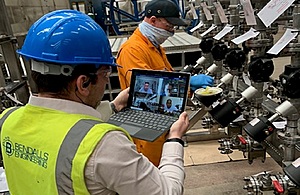
Sellafield Ltd employees using Microsoft Teams to inspect stainless steel.

The Box Encapsulation Plant project team carrying out inspections using Microsoft Teams

It’s questions like this that may not have been the first things we thought of as a potential problem when the crisis hit, but they still need sorting.

For our Box Encapsulation Plant (BEP) project team it has meant the successful innovative use of the kind of technology that’s becoming the norm across our business for keeping in touch.

Microsoft Teams wasn’t even on our radar a couple of months ago, but the team are now using it to successfully conduct highly complex inspections on stainless steel equipment, miles away.

Deputy Project Manager for BEP Mike Critchley said:

During this ongoing lockdown period, a projects task team have been working with the Inspection and Quality Assurance Department to look at ways we could help the supply chain to continue work.

This highlighted several areas where we have had to adopt a ‘do things differently’ attitude and move away from the traditional way of attending the supplier works’ to confirm the quality of the product.

We wanted to restart inspection whilst maintaining the safety of everyone involved. We need to maintain design intent through inspections and factory acceptance tests.

One of the first examples of this is testing stainless steel equipment. Luckily, it’s a visual process – if iron is present (meaning the steel isn’t quite up to standard), it reacts with potassium ferricyanide and goes blue.

The team worked with our Joint Venture team, with Joint Venture Quality Manager Shaun Lees helping to revise the existing process and approving documentation.

BEP Quality Manager Dave Tracey added:

The ferroxyl test was witnessed remotely using Microsoft Teams while interacting with the on-site inspector. We recorded the live streams, which means we have it available for assessment and auditing.

It worked brilliantly and we think it could be used for other inspections, such as manufacturing process steps, nondestructive tests, product and packaging, and marking.

Microsoft Teams is being rolled out across the organisation to help our employees stay connected during the crisis.

Published 11 May 2020


DBS Webinar for Skills for Care

News story

DBS facilitated a webinar for Skills for Care around DBS checks in the social care sector. FAQs have now been compiled based on the session.

Laptop icon on a purple background, with text that reads 'DBS Webinar for Skills for Care'

Last week, the Disclosure and Barring Service (DBS) hosted a webinar for Skills for Care, around DBS checks in the social care sector.

The webinar aimed to improve understanding of:

  • emergency COVID-19 Barred List(s) checks and free-of-charge checks
  • the DBS eligibility tool
  • barring referrals

The webinar can be found online here.

A collection of questions were sent in prior to the webinar and these were answered throughout, but a number of questions were also received throughout the presentation and afterwards. All questions have now been answered and collated in an FAQs document, which can be found below.

DBS Webinar – FAQs [Word] (MS Word Document, 19.9KB)

DBS Webinar – FAQs [PDF] (PDF, 125KB, 4 pages)

Published 11 May 2020


Issues with our services have been resolved

News story

We will continue to monitor the services closely.

The issues we experienced earlier today with the services below have been resolved.

  • Business e-services portal
  • Business Gateway
  • MapSearch
  • Local Land Charges (search function on e-services)
  • Find a property
  • Property Alert

We do not expect any further issues but will continue to monitor the services closely.

We are sorry for any inconvenience caused by these issues and thank you for your patience while we resolved them.

Published 11 May 2020


First construction site to come safely back online

The facility – more commonly known as BEPPS-DIF – is the first of our construction sites to come back online after we paused all but essential projects construction work in March.

Today around 29 people will join the handful of those who started last week on the site. The first group have mainly involved in getting the site ready for a restart of work.

Those who are starting today, and the others who will follow them, will see a very different place to the one they left in March.

We spoke to 2 members of the BEPPS-DIF team who have been working on the site to find out what their views are.

Chris Whitaker is an electrician for Balfour Beatty and has been making sure the emergency lighting is set up and that there’s power in the building.

He said:

I was extremely nervous when first got told I was coming in. My wife is pregnant and I don’t want to bring anything home. Getting to see all the physical changes people had put in made me feel a lot better.

It looks a lot different, and because it looks different it makes you feel and act differently.

It’s a well thought-through process. You are directed to a parking bay, which has the same number as your designated table in the canteen.

In the canteen, there’s plenty of space. It can take 150 people, but there will only be about 28 now, and when you sit at a table you have 2.1 metres space around you. I thought that places like the canteen might cause problems for social distancing, but it felt really good and I felt safe.

There are lines sprayed on the floor to help you keep 2.1 metres apart. I’ve been working on my own but I feel confident that today I’ll be okay because I have seen what has been done.

We’ll be working in a 4m2 working area. Some rooms are obviously less than that, I know that, but in a big room having this much space will give us plenty of room to move about and do our job. I’ve not yet seen it in effect, but it sounds like a great idea. Giving that much more space to people while they are working. I know I’ll be able to move about and not feel trapped or stifled.

The key thing I’d say to people returning today is come in with an open mind. What has been done is really good but ultimately the people that are working here are the key to making it work.

I’m not dreading coming in.

Matt Ritson works for SPIRE, which is handling logistics and one of his roles will be to check people coming onto site.

Matt said:

I came back a couple of weeks ago. It’s very different coming in now compared to back in March.

There are one-way systems for walking around the buildings and the site itself, 2.1 metre floor markings, and everyone gets a designated table for meals and a car parking space.

I was nervous about coming back onto site but it’s clear our safety has been taken very seriously. Everyone wants to protect our colleagues and their families.

It’s easy to keep the social distancing using the lines so I can’t see it being a problem when more people are on the site.

My general worries about Covid-19 are still there, but what I would say is that being on the construction site feels safer than shopping in our local supermarket. The processes in place are a lot stricter.

When working I don’t feel separate from my colleagues because we’ve been issued radios to keep in touch. There are hand sanitisers and wipes everywhere.

I also know that if I have any concerns there are people around who are willing to listen and make changes if required.

I think people coming back this week will be surprised – it’s like a military operation, designed to keep us safe.

The facility is the first of our project construction sites to restart after the pause, and as such is acting as a pilot for other projects.

We will be regularly reviewing all measures put in place, including those on BEPPS-DIF and other projects and other areas of site and our offsite offices.

Any measures brought in will depend on what is appropriate, practical and possible in differing spaces, but the overriding driver will be to keep the workforce safe.

You can read more about the changes we have made to the site here.