Health and Social Care Secretary Steve Barclay Oral Statement on urgent and emergency care

Mr. Deputy Speaker, with permission, I’d like to make a statement on our support for urgent and emergency care.

I know that this is an issue that has been of great concern to Honourable Members and I wanted to update the House – at the earliest opportunity – on the work that we’ve been doing over the summer.

Bed occupancy rates have broadly remained at winter-type levels with Covid cases in July still high, at 1 in 25 testing positive – that compares with 1 in 60 currently.

This is without the decrease in occupancy that we would normally see after winter ends and ambulance wait times have also continued to reflect the pressures of last winter, although I am pleased, Mr Deputy Speaker to see recent improvements for example the West Midlands today is meeting their Category 2 time of less than 18 minutes.

Mr. Deputy Speaker, I’d like to update the House on the nationwide package of measures that we are putting in place to improve the experience for patients and colleagues alike.

First, Mr. Deputy Speaker, we have boosted the resources available to those on the frontline.

We’ve put in an extra £150 million of funding to help Trusts deal with ambulance pressures this year and on top of this, we’ve agreed a £30 million contract with St John Ambulance so that they can provide national surge capacity of at least 5,000 hours per month.

We’re also increasing the numbers of colleagues on the frontline.

We’ve boosted national 999 call handler numbers to nearly 2,300, about 350 more than September last year and we have plans to increase this number further to 2,500 by December, supported by a major national recruitment campaign.

By the end of the year, we’ll have also increased 111 call handler numbers to 4,800.

As well as this, we have a plan to train and deploy even more paramedics and Health Education England has been mandated to train 3,000 paramedic graduates nationally each year – double the number of graduates that were accepted in 2016.

Second, Mr. Deputy Speaker, we are putting an intense focus on the issue of delayed discharge – which is the cause of so many of the problems that we have seen in urgent and emergency care, and I think that’s recognised across the House.

This is where patients are medically fit to be discharged but remain in hospital, taking up beds that could otherwise be used for those being admitted.

Delayed discharge means longer waits in A&E, lengthier ambulance handover times and the risk of patients deteriorating if they remain in hospital beds too long – particularly the frail elderly.

The most recent figures, from the end of July, show that the number of these patients is just over 13,000 similar numbers to the winter months.

We’ve been working closely with trusts where delayed discharge rates are highest, putting in place intensive on-the-ground support.

More broadly, our National Discharge Taskforce is looking across the whole of health and social care to see where we can put in place best practice and improve patient flow through our hospitals. And as part of that of work, we’ve also selected Discharge Frontrunners who will be tasked with testing radical solutions to improve hospital discharge – and we’re looking at which of these proposals we can roll out across the wider system and launch at speed.

This, of course, is not just an issue for the NHS.

We have an integrated system for health and care and must look at the system in the round, and all the opportunities where we can make a difference.

For instance, patients can be delayed as they are waiting for social care to become available and here too, we have taken additional steps over the summer.

We have launched an International Recruitment Taskforce to boost the care workforce and address issues in capacity.

And on top of this, we’ll be focusing the Better Care Fund, which allows Integrated Care Boards and local authorities to pool budgets, to reduce delayed discharge.

And in addition, we are looking at how we can draw on the huge advances in technology that we’ve seen during the pandemic and unlock the value of the data that we hold in health and care and that includes through the Federated Data Platform.

Finally, Mr Deputy Speaker, we know from experience that the winter will be a time of intense pressure for urgent and emergency care.

The NHS has set out its plans to add the equivalent of 7,000 additional beds this winter, through a combination of extra physical beds and the virtual wards which played such an important role in our fight against Covid-19.
Another powerful weapon this winter will be our vaccination programmes.

Last winter, we saw the impact that booster programmes can have on hospital admissions, if people come forward when they get the call.

This year’s programmes gives us another chance to protect the most vulnerable and reduce demands on the NHS.

Our autumn booster programmes for Covid-19 and flu are now getting under way and will be offered to a wider cohort of the population, including those over 50 with the first jabs going in arms this week, as care home residents, staff and the housebound become the first to receive their Covid-19 jabs. And over the summer, we became the first country in the world to approve a dual-strain Covid-19 vaccine, that targets both the original strain of the virus and the Omicron variant.

And indeed this weekend, the MHRA approved another dual-strain vaccine, from Pfizer, and I’m pleased to confirm that we will be deploying that as well, along with the Moderna dual-strain vaccine as part of our Covid-19 vaccination programme, and in line with the advice of the independent experts at the JCVI.

Whether it’s for Covid-19 or flu, I’d urge anyone who’s eligible to get protected as soon as you are invited by the NHS, not just to protect yourself and those around you but to ease the pressure on the NHS this winter.

Today, I have also laid before the House a Written Ministerial Statement on the work that we’ve been doing over the summer and I just wanted to draw the House’s attention to one particular feature within that written ministerial statement that has garnered interest in the House in the past. In November 2021 the government announced that it would make £50 million available in funding for research into motor neurone disease over five years. Following work over the summer between the Department of Health and Social Care and BEIS, through the National Institute for Health Research and UKRI, to support researchers to access funding in a streamlined and coordinated way, we’re pleased to confirm that this funding has now been ringfenced. The Department of Health and Social Care and BEIS welcome the opportunity MND scientific community of researchers as they come together through a network and link through a virtual institute.

I commend this statement to the House.



COP26 President’s opening remarks at the Africa Adaptation Summit Opening Ceremony

Patrick, thank you very much.

Presidents, your excellencies, sisters and brothers, if I may: I want to thank everyone for all the inspiring words we’ve heard, and indeed the pragmatic suggestions, as that’s what actually matters, Patrick, as you’ve said.

And I want to thank you, Patrick, you and your team at the Global Centre on Adaptation for putting this together, together with the African Union, with Akin and the African Development Bank.

This is a critical summit. I want to start by saying that, unlike Kristalina, I have no original jokes to offer. But I’ve noted the joke you made, and I’ll be using it – like a good politician, I’ll be repeating it and claiming it as my own at future events!

Friends, we are ten months since COP26. And, as I think we’ve heard, that was an important milestone on adaptation and the work that we do around this.

We have the Glasgow/Sharm-El-Sheik Work Programme, which has got going on the global goal on Adaptation.

And in Glasgow we also had the event – that I was very pleased to be part of – on launching the African Adaptation Acceleration Program. And Akin, you talked about the £20 million of UK funding for the program.

This is all about making sure that we are driving policy and project support to those working to design and implement transformational adaptation interventions.

And so whether that’s in agriculture or infrastructure, or innovative finance, as Ngozi said (and others have commented): at the end of the day, we have to see tackling climate change also as a growth opportunity. For jobs, for the economy.

And I think unless we encourage everyone to do that, we will not make the progress that we need to make.

Ban and other leaders have referenced the commitment that we got at COP of developed countries at least doubling their collective provision on adaptation finance for developing nations by 2025.

I can tell you that this wasn’t an easy process, but we got there. And the reality now is that countries have to deliver.

You will all have seen the OECD figures that have come out for 2020 on the $100bn goal. We are moving in the right direction when it comes to adaptation, but the reality is we are going to have to quicken that pace.

Patrick, you said not to talk about all the things that have been going wrong in the world when it comes to climate, so let me just say this: the one thing I think every single one of us can say, just looking in our own countries, our continents, is that the chronic threat of climate change has got worse since COP26.

Things aren’t getting better.

I could give you all the examples of Africa, which I’ve got here, but I’m not going to because you know all of this.

I can tell you from a UK point of view, for the first time, we had wildfires this summer; we have droughts being declared; we have climate emergencies in terms of temperature levels being declared this summer.

Climate change does not recognise borders. And I think the sooner every world leader recognises that, the better.

We’ve got sixty-two days to COP27. Patrick, you said we want to see what is actually going to happen.

One of the things that we did agree was that there would be a progress report on the $100bn delivery plan, that is being worked on by our friends in the Canadian and German governments.

We will publish that before COP27, so we will be able to see what progress is actually being made.

And of course, this is going to require all the providers – the MDBs and others – to set out clear, ambitious adaptation finance targets when we meet in Egypt.

And I also want to acknowledge the brilliant work that Kristalina and her team have done on the RSD; that is really quite remarkable, so thank you so much for all your leadership on that.

We know that the annual adaptation costs are expected to reach at least $140bn a year by 2030, and frankly public finance is not going to be enough. We are going to need private finance. And so in a way I agree; I wish we did have more of the private finance providers around this table.

You’ve all set out very clearly the challenges we have and how we rise to those. And I want to acknowledge, firstly, the enormous support and help that I’ve got from Amina over the past years in this role; but also to make the point that, as she said, we need to make sure that when we get to COP27, we have to demonstrate that what we achieved at COP26 is starting to be delivered.

I said in Glasgow that the pulse of 1.5 is weak. And I have to say to you friends, it does remain weak right now.

On the positive side, we were able to show in Glasgow that the multilateral system, however unwieldy, can work when we all understand that it’s in our collective self interest.

And so what we do need to ensure in the coming days, weeks, and two months to COP27, is that we’re delivering on adaptation.

I want to end by what Akin said. He said: ‘you’re all doers in this room’.

So I have to say friends, now we just need to get it done.

Thank you.


No change to MHRA advice on the safety and effectiveness of COVID-19 vaccines for those who are pregnant or breastfeeding

News story

Our advice remains that the COVID-19 vaccines are safe and effective during pregnancy and breastfeeding

We are aware of false claims on social media that our advice on the safety and effectiveness of COVID-19 vaccines while pregnant or breastfeeding has changed.

We would like to reassure the public that our advice has not changed. Our advice remains that the COVID-19 vaccines are safe and effective during pregnancy and breastfeeding and there is substantial evidence to support this advice.

For our latest advice, please see our Summary of Coronavirus Yellow Card Reporting or the Summary of Product Characteristics.

Published 5 September 2022


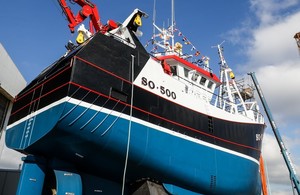
Government backing puts wind in sails of Middlesbrough boat builders

Press release

UK Export Finance support unlocks new contract to export fishing boat to Ireland.

  • Parkol Marine Engineering, a family-owned business, was established in 1971 and is renowned for its quality vessels
  • A new 23-meter ship is the second to be built as part of a Bond Support deal worth £3m from UK Export Finance
  • The ship will be launched today at its Middlesbrough site and transported to Ireland

Family-owned shipbuilder, Parkol Marine Engineering, has announced the launch of its new vessel, Green Isle, which on completion will sail to the west coast of Ireland from Middlesbrough, marking its expansion across the country. The boat is the second to be built as a result of a new £3m Bond support package from UK Export Finance (UKEF).

The contract is the second exporting win for the business, with the first contract secured in 2020 for a 27-meter fishing trawler commissioned by Irish fishing company D&N Kirwan. UKEF’s Bond Support deal has helped Parkol and NatWest to provide security for the Buyer’s stage payments in the form of advance payment guarantees.

Louis Taylor, Chief Executive of UK Export Finance said:

The United Kingdom is charting a new course as an independent trading nation and maritime businesses are crucial to driving the Global Britain we are building towards.

Now we can help shipbuilders to grow and harness the benefits of maritime trade using support from UK Export Finance to help Parkol grow their business through exporting.

The support from UKEF reiterates the government’s support for the UK’s maritime industry. Launching its new shipbuilding vision earlier this year, the government committed to investing over £4bn to support shipyards and suppliers across the UK, with new measures including better access to finance and vital skills-building.

Sally Atkinson, Director of Parkol Marine Engineering said:

Exporting has opened up new opportunities for our business. Thanks to UKEF’s support, we’ve unlocked another major contract and expanded our business in Ireland by delivering a high-quality vessel. We’re looking forward to continuing to capitalise on our exporting potential and reach new markets.

David Priestley, Head of Export Finance Managers for UKEF said:

We are pleased to see Parkol launch another ship into Ireland, helped by our support. Its exporting success is testament to its first-rate engineering heritage and investment in its people. We’re looking forward to seeing further growth from the company in the years ahead.

Published 5 September 2022


Darlington man prosecuted for waste offences

He was also disqualified from acting as a company director for three years and ordered to pay £490 costs.

John Burnside Jones (26), of Coniscliffe Road, Darlington was sentenced at Teesside Magistrates’ Court on Friday 2 September 2022 having previously pleaded guilty to involvement in illegally misdescribing waste for financial gain.

Environment Agency officers visited Jones’ waste operation at the Trinity Works site in Haverton Hill, Billingham in January 2019. They found the business to be processing large volumes of waste types which the site’s environmental permit did not allow. The site was also found to lack the required management systems to deal with the environmental risks. Jones was served with notices requiring details of the site’s waste but failed to respond to these in full.

Further investigations by the Environment Agency revealed that between September 2018 and February 2019, over 6,000 tonnes of unpermitted, combustible waste had been transported to the site from as far away as Bristol. Jones had then transported more than 11,000 tonnes of inert waste soils to a nearby landfill site during the same period. The discrepancy between the volumes of incoming and outgoing waste was a result of Jones mixing incoming waste with soil and stones left from previous site operations and falsely describing this resulting mixture as inert waste.

Inert waste incurs significantly lower landfill tax per tonne and may also be disposed of at a much-reduced rate at landfill facilities without the same level of safeguards and protections as would otherwise be required. By fraudulently misdescribing the waste, Jones was able to make large sums of money by flouting his environmental obligations.

In mitigation, Jones stated that although his company had operated the site, he had limited direct involvement and had been very naïve in relying upon others to run the site for him. He had never previously been in trouble and fully co-operated with the investigation. He admitted that he had never seen the site’s environmental permit and was oblivious to its requirements.

The court ruled that the offending was deliberate and committed for financial gain. At an earlier hearing the permit holder James William Mason, 64, of Camden Street, Stockton-on-Tees had pleaded guilty to allowing the illegal waste activities to be undertaken on his site and was ordered to pay a total of £2,528 in fines and costs.

A spokesperson for the Environment Agency said:

The conditions of an environmental permit are designed to protect people and the environment. Failure to comply with these legal requirements is a serious offence that can damage the environment, undermine local legitimate environmental permit holders, put jobs at risk and cause misery for local communities.

We welcome sentencing by the Court, which should act as a deterrent to others considering flouting the law.