The future for environmental regulation and opportunities for the UK to lead internationally

We need good regulation to meet the challenges ahead.

This summer we have experienced the highest ever temperature, the worst drought since the 1970’s and the driest ever July in the south east of the country. Our natural eco-systems and biodiversity are under increasing pressure and threat. We need to be ready for more of these conditions as our climate changes.

We now have increasing public expectations and interest in the environment. The covid pandemic has heightened public awareness and expectations in the environment, undoubtedly leading to wider recognition of the benefits to health and well-being from thriving green and blue spaces.

So, I ask – is our regulatory system up to meeting the challenges? A question not only posed by climate change and moving to a low carbon net zero future, but also the need to become more sustainable, to embed a circular economy and above all to protect people and wildlife.

On the 18th of January, James Bevan our CEO spoke to this Forum on ‘How to regulate better after Brexit: Think differently, speak softly and carry a bigger stick’.

He was right; we do need to think differently. Much of our framework for environmental regulation was put in place to manage fossil fuel powered processes and technologies. And here at the Environment Agency we have some ideas on how this needs to change.

In my 25 years as a regulator, I have seen many improvements that regulation can deliver, for example:

Substantial reductions in radioactive discharges to the marine environment so that additional concentrations in the environment are close to zero.

Substantial reductions in pollutants from industry to air – such as oxides of sulphur and nitrogen, particulate matter, greenhouse gases and methane.

The vast majority of the activities we regulate are in compliance with their requirement. We publish details of these activities every year in our annual Regulating for People the Environment and Growth reports.

There is quite righty a focus on the water environment – and there are success to report, such as: significant investment in water treatment infrastructure, leading to:

Real improvements in bathing water quality with over 98% meeting or exceeding the required standards, and greater biodiversity in our rivers, as a result of reductions in organic pollution phosphorous and ammonia from monitored discharges.

But…. we know that there are still big challenges.

Despite improvements, 86% of our rivers have not reached good ecological status.

In our Water Company Performance report only one third of companies were rated as industry leading, the remaining two thirds were rated as poor or requiring improvement. There is quite rightly considerable public concern on their performance and the state of our rivers. Our Chair has called the sector’s performance on pollution ‘shocking’.

Monitors on storm overflows, installed at our insistence, show that these operate and spill into our rivers too frequently. This is currently the subject of a major investigation by the Environment Agency.

It’s not just water companies, farming is responsible for about 40% of water body failures. It is one of the sectors that causes a large number of serious pollution incidents, there’s no point just cleaning-up the water industry to improve water quality; action on pollution and discharges from farms and other polluters is also needed.

Away from water, waste and other environmental crimes continues to be a scourge on society and costing the economy an estimated £900 million per year

The regulatory framework is complicated, in places too prescriptive, and can be slow to adapt as novel risks emerge from changing practices, new chemicals and substances, or as our knowledge and understanding of risks change.

Innovations in areas like healthcare and manufacturing bring their own environmental challenges. Challenges such as anti-microbial resistance, and the ubiquitous presence of ‘forever’ chemicals requires global solutions, and that’s why the EA supports the government as one of the leading countries on the new United Nations Global Science-Policy Panel on Chemicals, Waste and Pollution Prevention.

So, what does future environmental regulation look like?

Whilst, ultimately, this is a question that will be decided by Government, I offer the following:

Regulation for a fossil fuel driven economy may no longer be appropriate as we transition to a low carbon net zero economy. At the Environment Agency we are already supporting businesses who wish to trial the use of hydrogen in their processes or are developing technologies for carbon dioxide capture and storage; we are ensuring that our regulation is fit to support the development of advanced nuclear technologies and fusion in the production of energy.

If we are to deliver the outcomes in the government’s 25-year plan and improve our environment, nature and health and wellbeing, then there is still a role for traditional regulation. There will still be the need to set standards, and targets, limits on capacities and throughputs and the need for restrictions on chemicals and substances.

But there are some ‘must haves’ to regulation for the future if we are to better support the innovation and technologies that don’t yet exist – across healthcare, the food system, energy etc: it must have sufficient scope, be adaptable, fast paced, risk based, outcome focussed. Regulation must have a progressive framework that is flexible and proportionate, and makes it easier to dial up and dial down the level of intervention as the risks and our understanding of the risks change.

There will continue to be innovations in monitoring, analysis and evaluation, which will support the development of sound evidence and inform all aspects of the regulatory cycle, from policy development, and choice of tools through to individual enforcement actions.

Digital, big data and greater use of citizen science, will help regulators better focus on the highest risk activities and concentrate on where we can make the biggest contributions to outcomes, for example:

The Environment Agency are continuing to invest in digital technologies. We already have systems in place for online registrations and fishing rod licences. We are trialling and rolling out a system of e-alerts for water abstraction licence holders, replacing a paper and letter-based system with electronic alerts. Reducing the time it takes from days to minutes when informing licence holders whether they are able or not able to abstract water. Having benefits for both licence holders and the environment.

Sadly, there still needs to be a big stick, to make sure that offenders are held to account. The deterrent for illegal or criminal activities should outweigh any benefits.

Also, the future needs to be about carrots as well as big sticks. If we are to meet our ambitious targets, regulation and regulators need to support and encourage the front runners. Those who have a positive attitude, who want to do the right things and go beyond compliance.

We have been working on a Regulators Pioneer fund funded SEEBEYOND project, with the Food and Drink sector and Cambridge University. Through the SEEBEYOND project we are exploring how to standardise environmental metrics to measure beyond compliance and help harness moral and market incentives to improve environmental performance of the Food and Drink sector, focussing on GHG emissions, waste, water, and materials usage. This is learning that has the potential to be scaled to other sectors and environmental indicator areas over time.

Regulation will need to work with, support and integrate with fiscal and economic instruments, for example the Environment Agency administers a £bn carbon market through its trading schemes.

Environmental and financial regulation must evolve in lockstep. Greening finance creates opportunities for businesses and the financial sector to go beyond compliance to invest in the solutions for climate and nature challenges. To be most effective these investments and the data that supports them should be grounded in science and verified by experts, such as the Environment Agency.

We have been supporting colleagues in the Treasury and Government to develop technical detail for the UK green taxonomy on climate (mitigation and adaptation) and will continue to provide inputs on the four remaining areas of the taxonomy, at the government’s request.

Looking outwards and inwards.

Having left the European Union, we have an opportunity to review, renew and reform our environmental law for the better.

In a rapidly changing world, we need to rise to the challenge of regulating emerging industries to support innovation whilst responding to emerging environmental issues to limit environmental harm and maintain public trust.

Regulators and regulations need to work with international standards such as ISO 14001 on environmental management systems and ISO 14090 on Adaptation to climate change and the certification and assurance industry.

We need to continue working with colleagues in the international arena such as the IAEA, OECD, Agile Nations Network, so we can share learning and best practice and better understand what good looks like.

There needs to be a discussion across the breadth of society about risk, costs and benefits, and options, so that regulation continues to work and protect all members of society.

We should not be afraid to rigorously review our regulatory systems and hold ourselves to account; building on our successes, but shining a light where changes are needed. Only by continuing to do so will we deliver the better outcomes for sustainable business, people and the environment.

Environmental regulation has been evolving and developing for the last 170 years, it needs to continue to evolve and develop to be fit for the future. Get this right, and the UK will continue to be a leader in developing and applying good regulation and sharing our lessons, so we not only protect and improve our own environment, but are leaders in environmental protection and improvement across the world.


Chancellor Kwasi Kwarteng sets out economic priorities in first meeting with market leaders

  • Chancellor Kwasi Kwarteng met with market and city leaders this morning (Wednesday) and set out the Prime Minister’s new, pro-growth economic approach.
  • This approach includes immediate support for families and businesses, supporting the economy to grow, and fiscal sustainability.
  • The Chancellor also emphasised the importance of supporting the independent Bank of England’s mission to get inflation under control quickly.

Chancellor Kwasi Kwarteng met market leaders this morning (Wednesday) and set out the government’s new, pro-growth economic approach.

Kwasi Kwarteng began by acknowledging the extraordinary challenges that families and businesses across the UK are facing this Winter, exacerbated by Putin’s barbaric invasion of Ukraine. He stressed that the government will immediately focus on supporting families and businesses to navigate the gas crisis this winter and next, supporting the economy to grow, and committing to fiscal sustainability.

Speaking after the meeting, Chancellor Kwasi Kwarteng said:

“We face extraordinary economic challenges in the coming weeks and months and I know that families and businesses across the UK are worried.

“The Prime Minister and I are committed to taking decisive action to help the British people now, while pursuing an unashamedly pro-growth agenda.

“We need to be decisive and do things differently. That means relentlessly focusing on how we unlock business investment and grow the size of the British economy, rather than how we redistribute what’s left.

“With a strong and resilient economy, we deliver more jobs, higher wages, and raised living standards – all while reducing our debt-to-GDP ratio in a fiscally sustainable way.”

Due to the scale of the gas crisis, the government’s first priority will be to support families and businesses in the immediate term. The Chancellor was clear this will mean necessary higher borrowing in the short-term whilst ensuring monetary stability and fiscal discipline over the medium term. He committed to ensuring the economy grows faster than our debts and keeping debt as a proportion of our economy on a downward path.

The Chancellor also reiterated his full support for the independent Bank of England and their mission to control inflation, which is central to tacking cost of living challenges.

Mr Kwarteng stressed that the government will support the economy to grow. He recognised that the rate of growth has been too low and committed to a radical supply side agenda to deliver lasting economic growth. This will mean creating the right conditions for business investment and innovation, reducing burdensome regulation and taxes, which will in turn create jobs, wealth and drive economic growth.

The Chancellor reiterated his aim to get to 2.5% trend growth, delivering a stronger economy and a Britain that works for everyone.

Further information

Meeting attendees:

  • Salman Ahmed, Global Head of Macro and Strategic Asset Allocation, Fidelity
  • Lionel Assant, Senior Managing Director, Blackstone
  • Amanda Blanc, CEO, Aviva –
  • Stephen Cohen, Head of EMEA, Blackrock
  • Constantin Cotzias, Director, Bloomberg Europe
  • Richard Gnodde, CEO, Goldman Sachs International
  • Beatriz Martin, CEO UK & Group Treasurer, UBS
  • Charlie Nunn, Group CEO, Lloyds Banking Group
  • Noel Quinn, Group CEO, HSBC
  • Viswas Raghavan, CEO EMEA & Co-Head Global Investment Banking, JP Morgan
  • Alison Rose, Group CEO, Natwest
  • David Schwimmer, CEO, London Stock Exchange Group
  • CS Venkatakrishnan, Group CEO, Barclays
  • Nigel Wilson, CEO, Legal and General


British High Commissioner visits flood relief camp in Nowshera

World news story

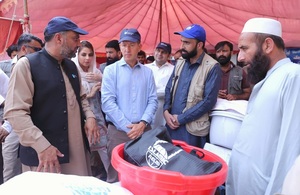
Days after the UK announced an additional £15 million to help affected communities, British High Commissioner Christian Turner visited flood hit villages in Nowshera on Saturday where a UK charity Islamic Relief is providing lifesaving aid to those affected.

British High Commissioner visits flood relief camp in Nowshera

This money will be spent for urgent life-saving support and go towards water and sanitation, shelter and home repairs, and primary healthcare, especially for women and girls.

Accompanied by Islamic Relief Worldwide’s CEO Waseem Ahmad and Islamic Relief Pakistan’s Country Director Asif Sherazi, the High Commissioner witnessed first-hand the devastating impact of the climate catastrophe. Expressing solidarity with the people at the camp, the British High Commissioner reaffirmed the UK’s commitment to Pakistan and observed the challenges faced by the community along with efforts to support those affected.

Islamic Relief is a member of the Disasters Emergency Committee (DEC) that launched the Pakistan Floods Appeal to collect funds for relief efforts; the UK government has announced it will match pound for pound the first £5 million of public donations, as part of the total £15 million pledge.

The High Commissioner also visited village Kakol Abad and met with affected communities. He expressed his sorrow at the losses incurred during the flooding and assured them of UK’s continued support

British High Commissioner Christian Turner said:

The people I have met today are strong and will rebuild. But they need urgent support with water, sanitation and shelter. The UK is helping provide that. The standard you walk past is the standard you accept.

Islamic Relief Country Director Asif Sherazi said:

The situation is worsening with every passing day and in terms of damages, it is surpassing the floods of 2010. We are on ground since 3rd August meeting the needs of the affected across the country with shelters, clean drinking water, cash grants, food and hygiene items. Till now we have reached 30,000 people with lifesaving aid that will be doubled in the next week.

The aim is to support half a million under our emergency response. Since the needs are huge and dire, we really appreciate the UK’s increased support for the humanitarian response and the DEC appeal, and we urge the UK government and other countries for increased funding for the recovery phase too.

Notes to Editors:

  1. According to Pakistan’s National Disaster Management Agency, the flooding has damaged 950,000 houses and destroyed 287,000, with 500,000 people now living in relief camps. The disaster has also destroyed 3,000km of roads and damaged 7,566 schools. In total 745 health centres have been damaged or destroyed.

  2. According to the United Nations Office for the Coordination of Humanitarian Affairs (UN OCHA), over 800,000 livestock have been lost.

  3. The UK pledged over £55 million to partner with Pakistan to fight climate change, manage water more sustainably and unlock climate investment in November 2021 during the COP26 Conference in Glasgow.

  4. The announcement of £15 million in humanitarian funding will go to the relief efforts in the areas worst-hit by the flooding. £5 million of the total £15 million amount will go to the DEC Pakistan Floods Appeal.

  5. UK government match funding will double British public’s own donations to the DEC appeal up to £5 million and will ensure that DEC member charities working on the ground can reach even more people in need. Donations can be made at Disasters Emergency Committee website
  6. When large-scale disasters hit countries without the capacity to respond, the DEC brings together 15 leading UK aid charities to raise funds quickly and efficiently. The 10 DEC members responding so far to the flooding in Pakistan are: Action Against Hunger, Age International, British Red Cross, CAFOD, CARE International UK, Concern Worldwide UK, International Rescue Committee UK, Islamic Relief, Save the Children UK and Tearfund.

More information

For updates on the British High Commission, please follow our social media channels:

Contact
British High Commission
Islamabad
tel. 0300 500 5306

Published 7 September 2022


British High Commissioner congratulates 16 Chevening awardees from Bangladesh

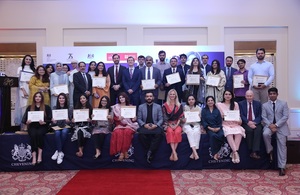
British High Commissioner to Bangladesh Robert Chatterton Dickson congratulated this year’s cohort of Chevening awardees from Bangladesh at a reception at his Residence.

This year, 16 outstanding Bangladeshis have received Chevening Scholarships and will soon be leaving for the UK to start one-year master’s degrees at some of the world’s most prestigious universities.

Chevening Scholarships are the UK government’s global scholarships programme. Since the programme was created in 1983, over 50,000 professionals have had the opportunity to develop in the UK through Chevening. The programme brings together leaders from more than 160 countries and territories, creating networks, friendships, and shared memories and missions that span the world.

The Scholarships are awarded to individuals from all backgrounds who can demonstrate that they have the commitment and skills required to create positive change, and can show how a UK master’s degree will help them do that. The award offers full financial support for scholars to study for any eligible master’s degree at any UK university whilst also gaining access to a wide range of academic, professional, and cultural experiences.

The British High Commissioner Robert Chatterton Dickson said

“Chevening represents the very best of the UK, welcoming exceptional people from across the world to study, grow, and thrive at some of the world’s best universities. Being part of the Chevening network offers participants extra opportunities and instils a particular sense of pride. I am consistently impressed by the passion and commitment of the scholars and alumni I meet. I congratulate the 16 Chevening awardees from Bangladesh for the 2022-2023 cycle and wish them the very best.”

Bangladesh has over 350 successful Chevening alumni. Chevening scholars in Bangladesh hold prominent positions in government, the private sector and academia.

Applications for the next cohort (2023/24) of Chevening Scholarships to study in the UK are open until 1 November 2022, with applications to be submitted via www.chevening.org/apply.

Further information

British High Commission Dhaka
United Nations Road
Baridhara
Dhaka – 1212
Bangladesh

Email: Dhaka.Press@fco.gov.uk

Follow the British High Commissioner to Bangladesh on Twitter: @RCDicksonUK

Follow the British High Commission Dhaka on Twitter, Facebook, Instagram and Linkedin


The UK announces 75 scholarships for Pakistan

World news story

To mark 75 years of UK-Pakistan relations, the British High Commission in collaboration with the British Council hosted a reception in Lahore on 1st Sep 2022 to announce 75 scholarships for Pakistanis to study in the UK

The UK announces 75 scholarships for Pakistan

Taking place on the same day that the UK announced an uplift in Pakistan flood relief funding, taking the total amount pledged to £16.5m, the scholarships will provide future Pakistani leaders with the skills necessary to tackle global challenges.

Minister for School Education, Punjab, Dr Murad Raas, and UK Representative to Punjab, Alex Ballinger, attended as chief guests along with British alumni, Chevening, Commonwealth and GREAT scholars, Foreign, Commonwealth and Development Office (FCDO) officials and dignitaries from across Pakistan.

Alex Ballinger in his address acknowledged the significant contribution of Pakistan’s Chevening alumni in the flood relief efforts, from carrying out fund raising to distribution of essential items. While addressing the audience he also reiterated the UK’s commitment to support Pakistan:

We are with the people of Pakistan at this terrible time. We have all witnessed the devastating impact of these floods which have displaced millions of people and left much of Pakistan submerged.

I’m pleased that on the same day the UK has pledged a total of £16.5m in flood relief funding, we can also announce 75 new UK scholarships which will play a vital part in allowing Pakistan to rebuild by investing in its people.

This year the UK, we will be awarding 63 Chevening scholarships and fellowships along with 12 GREAT scholarships. As with all UK scholarship programmes, the British High Commission will be aiming for gender parity, with at least 50% of the scholarships being awarded to female candidates.

The British High Commission will continue to commemorate the 75th Anniversary of UK-Pakistan relations with a series of events and activities through the rest of the year. The application window for Chevening’s one-year master’s scholarship is open until 01 November 2022.

Notes to editors

  1. Chevening Scholarships are the UK Government’s global scholarship programme, funded by the Foreign, Commonwealth and Development Office (FCDO), partner organisations, and partner universities. The scholarships support study at UK universities – mostly one year taught master’s degrees – for individuals with demonstrable potential to become future leaders, decision-makers, and opinion formers.

  2. Chevening began in 1983 and has developed into a prestigious international awards scheme. Chevening Scholars come from over 160 countries and territories worldwide, and over the past five years we have awarded almost 10,000 scholarships. There are over 50,000 Chevening Alumni around the world who comprise an influential and highly regarded global network.

  3. The name ‘Chevening’ comes from Chevening House in Sevenoaks, Kent – currently the joint official residence of the UK’s Foreign Secretary.

  4. The British High Commission supports inclusion, education and opportunity for all. Anyone who has the ambition, curiosity, a clear vision for the future and the ability to achieve their goals should apply for a Chevening Scholarship. Selected scholars will join a community of over 50,000 alumni worldwide with over 2,000 of these in Pakistan alone.

  5. Prominent Chevening female alumni include: Amna Zamir Shah, the first female judge in Gilgit-Baltistan High Court; Abia Akram, Chairperson Special Talent Exchange Programme (STEP); Fifi Haroon, a senior journalist; and former parliamentarians Yasmeen Rehman, Asiya Nasir and Nafeesa Shah.

  6. The UK has pledged a total of £16.5m to assist with flood relief efforts in Pakistan. The money will be utilised by international NGOs to provide support to those affected by the floods. The total amount pledged is equivalent of 10% the UN flash appeal.

  7. The £16.5m total is made up of an initial £1.5m pledged made by the UK last week, plus an additional £15m pledged on Thursday 1 September. Of this £15m, £5m will go the DEC’s ‘Pakistan Appeal’ and be matched, pound for pound, against public donations. This money will then fund leading UK aid charities (including Islamic Relief) who are providing emergency relief on the ground. The remaining £10m will go to international aid agencies on the ground to help them respond to people’s immediate needs, including through providing water, sanitation, shelter and protecting women and girls. It will also be utilised to support families repair their homes and maintain their livelihoods.

  8. At COP26, the UK pledged over £55 million to partner with Pakistan to fight climate change, manage water more sustainably and unlock climate investment.

  9. More information

Visit Chevening website for detailed information on the eligibility criteria and scholarship specifications.

For updates on the British High Commission, please follow our social media channels:

  • Twitter: @UKinPakistan, @CTurnerFCDO
  • Facebook: facebook.com/bhcpakistan
  • Instagram: @UKinPakistan
  • Website

Published 7 September 2022