Environment Agency crushes tipper truck in waste crime probe

Investigators believe the Ford tipper truck belonged to a group operating at various sites in the capital. Crime officers removed the vehicle from an address at Chesham in Buckinghamshire during a wider probe into organised waste crime.

The 18-year white van had been seen reportedly dumping waste on open land, in empty warehouses and other sites in Croydon, Merton, Mitcham and Southwark in the past year. Material left at the sites included construction waste, tyres and rubbish from house clearances.

Officers continue to investigate the vehicle’s owners, who failed to come forward to claim it before it was destroyed.

Matt Higginson, an Environment Manager for the Environment Agency in the South East, said:

Where individuals threaten to undermine legitimate businesses and illegally dump waste, we have no hesitation in using all powers open to us.

Seizing vehicles involved in waste crime, based upon vital intelligence from the public, is an important weapon in our armoury to disrupt waste criminals and can make a real difference to local communities blighted by illegal dumping of waste.

To avoid unwittingly supporting waste criminals, and facing the possibility of an unlimited fine, we ask the public and businesses to always ask for proof of a waste carrier’s registration and waste transfer note – and take photos of them – before having any waste cleared.

Crushing suspected offenders’ vehicles is one of the tactics of Operation Angola, which investigates large-scale illegal dumping of commercial waste.

Whether a resident or a business, everyone should take responsibility for their own waste. Don’t give rubbish to someone who can’t prove they are a legitimate waste carrier – they may just dump it to avoid paying waste-disposal costs.

Anyone using a company or individual to take away their waste should always obtain a waste transfer note as proof. If in any doubt, call the Environment Agency’s incident hotline on 0800 80 70 60, or Crimestoppers on 0800 555 111, or use the online form at www.crimestoppers-uk.org.

The white 2004 Ford tipper truck was seized using powers under section 34B of the Environmental Protection Act 1990.

The decision to crush the vehicle was taken as there was no value in selling the vehicle.


United Kingdom promotes livelihoods and environmental protection in the Verapaces

World news story

UK project will allow families in Senahú, Alta Verapaz, to improve their coffee and cardamom production while protecting the environment.

HMA in presentation of Darwin Initiative and FEDECOVERA

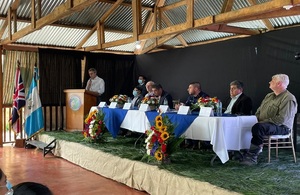
The British Ambassador, Nick Whittingham, attended the launch of the project “Indigenous bio cultural landscapes for livelihoods and connectivity in Verapaces”. It will be financed by the Darwin Initiative and the Fund of the Department of Environment, Food and Rural Affairs (DEFRA) of the British Government.

The initiative will support the productive livelihoods of 10 Q’eqchís and Poqomchíes indigenous cooperatives, benefiting a total of 4,500 families in the municipality of Senahú Alta Verapaz that are associated with the Federation of Cooperatives of Las Verapaces, Limited Liability -FEDECOVERA, RL. – .

The project is carried out in the Sierra Yalijux of Alta Verapaz, an area of high biodiversity whose protection depends on private nature reserves and remnants of forest that are still within the territories of cooperatives and indigenous communities. The project goals are:

  • Rescue and recognize the value of biodiversity through stories and ceremonies associated with good practices on the use and management of natural resources and indigenous knowledge about nature.
  • Improve the income of 4,500 families through sustainable activities in an equitable manner by ethnic group, generation and gender.
  • Restore forest cover to create biological corridors between fragmented and disturbed forests.
  • Reduce the carbon footprint in the production of coffee and cardamom by reducing the use of firewood, ecological processing and production in agroforestry systems.
  • Support women, youth and indigenous communities in alternative livelihoods compatible with nature.

The project has a duration of three years starting September 2022, with financing of £560,000 (approximately 5 million quetzals) from the British government, and a counterpart contribution of £158,000, which makes a total of Q6,462,000 quetzals. It will be implemented by FEDECOVERA, R. L. and the National Association of Private Natural Reserves of Guatemala -ARNPG-, with the support of the University of Greenwich.

Senior authorities from the Ministry of Environment and Natural Resources (MARN) and the National Council for Protected Areas (CONAP) also attended the launch, who are active partners in the project.

Published 27 September 2022


The fundamental building blocks for stability in Afghanistan: UK statement at UN Security Council

Thank you President,

I join others in thanking Deputy Special Representative Potzel, Ghada Waly, Executive Director, and Ms Fawzia Koofi for their sobering briefings and also UNAMA and the Secretary-General for his quarterly report.

As we’ve heard, nearly 60% of the population of Afghanistan officially requires humanitarian assistance, but the true need is much higher.

The World Bank predicts GDP will have contracted by one third by the end of this year, and the Taliban continues increased restrictions on human rights and fundamental freedoms.

I cannot speak more eloquently than Fawzia Koofi did about the restrictions on freedom of movement that women and girls face –  the political, economic, educational and social exclusion that they face.

UNICEF estimates the ban on schooling for girls has cost the Afghan economy at least $500 million during the last year. But the human cost for each of these Afghan girls is immeasurable.

President,

Some Council Members appear determined to politicise the crisis in Afghanistan, and I think their assertions are neither accurate nor helpful.

The UK disbursed $306 million in humanitarian and development assistance for Afghanistan last financial year, and we have committed a further $306 million this financial year.

We are the second largest donor to the World Bank’s Afghanistan Reconstruction Fund, and we continue to work with the World Bank, IMF and others on economic stabilisation.

We recognise the importance of restoring liquidity to the banking system, including a functioning Central Bank able to access Afghanistan’s overseas reserves. But this requires an independent Central Bank operating transparently with professional leadership and proper controls in place to prevent funds being diverted to terrorism.

Calling for reserves simply to be returned before these essential steps are in place is neither responsible nor compatible with a genuine commitment to stopping terrorist financing.

President,

Humanitarian and financial support can help, but it will not resolve Afghanistan’s problems unless the fundamental building blocks for stability are put in place. To do this, the Taliban must uphold, rather than repress human rights, allow unhindered humanitarian access, meet counter-terrorism commitments made in the Doha Agreement, and they must take responsibility for stabilizing the economy.

This means creating an enabling environment for greater investment, including ensuring transparency on revenue and budget, and enabling women – half of the population – to contribute to economic activity.

Finally President,

I take the opportunity to welcome the appointment of Special Representative Otunbayeva. It is vital for Afghanistan’s future that the Taliban cooperate with her and the UN, and we urge all members of the Council to support her as she implements UNAMA’s critical mandate.

Thank you.


UK experts drive Peru’s ongoing response to February’s oil spill in the Pacific Ocean

  • Team of experts from the United Kingdom carried out the workshop “Response to marine pollution: preparedness and best practices from the United Kingdom” with Peruvian authorities.
  • More than 50 representatives from Peru’s environmental, fisheries, and coast guard sectors actively participated in the four-day workshop.

Lima, 26th September. – Between 20 and 23 September, a team of UK-based pollution response experts from the Joint Nature Conservation Committee (JNCC), the Maritime and Coastguard Agency (MCA) and the Centre for Environment, Fisheries and Aquaculture Science (Cefas), delivered the workshop “Marine Pollution Response: preparedness and best practise from the UK”, with Peruvian Governmental authorities.

This 4-day workshop brought together over 50 representatives from Peruvian environment, fisheries and coastguard sectors, including officers from the Minister of Environment, the National Park Service and coastal municipalities. With the support of colleagues from British Embassy in Lima, the UK delegation shared lessons learned from historic UK incidents and discussed key legislation and preparedness principles to ensure an effective and timely response to marine pollution incidents.

The workshop also covered a range of topics including response options, use of satellite and drone technology, socio-economic impacts of spills, evaluating impacts to marine birds and marine mammals, post-spill monitoring and hydrocarbon analysis and fingerprinting. It also included presentations from UK Deputy to the Secretary of State’s Representative for Maritime and Salvage, and sessions from oiled wildlife response organisation Aiuka.

Bethany Graves, from the JNCC, said:

It’s a pleasure to be here, sharing UK experience and knowledge and working closely with Peruvian Governmental agencies to explore opportunities to be better prepared. We have had an excellent week of workshops with good engagement and discussions.

We’re grateful for the British Embassy Lima’s help in the organisation of the workshop and we are glad to see that all who attended found it useful.

The workshop concluded with a table-top exercise in which lessons learned from the previous days were tested and cemented. After this workshop, the UK team will prepare a ‘Recommendations for better Readiness’ report to hand over in the next few months. This will include comments on Peru’s National Contingency Plan and key gaps in preparedness as identified in the workshop (and shared from Peru agencies).

The British Ambassador to Peru, Gavin Cook added:

The oil spill off Lima was a wake-up call. But it’s one the Peruvian government is responding to, in both managing the aftermath of the disaster and thinking longer-term. The UK is proud to be supporting this alongside our broad environmental work in Peru. 

British expertise has a huge amount to offer – especially in the use of technology – and we look forward to continuing to share best practice and drive change.

The workshop was delivered under the Ocean Country Partnership Programme, a UK-led programme funded through the UK government’s £500 million Blue Planet Fund, which aims to help eligible countries reduce poverty, through supporting the sustainable management of their marine environment.

Workshop participants discussing during the table-top exercise.


Close to 1,000 jobs moved from London to Scotland under UK Civil Service shakeup

  • Major progress made with 933 UK Civil Service jobs moved out of London to Scotland
  • UK government has committed to relocate 1500 jobs to Scotland by 2025
  • Cabinet Office second HQ to more than double department’s presence in Glasgow by 2025

Almost 1,000 London-based Civil Service jobs have moved to Scotland since March 2020, the Cabinet Office has announced today.

The latest figures have been announced as Chancellor of the Duchy of Lancaster, Nadhim Zahawi, visited the department’s new second HQ at Atlantic Square, Glasgow ahead of chairing the inaugural Islands Forum in Orkney on Wednesday.

The relocation programme, known as Places for Growth, is moving 22,000  Civil Service jobs out of London by 2030. Already 933 jobs have been relocated from the capital to Scotland since the start of the scheme, with a further 600 high-quality jobs to be permanently based in Scotland by 2025.

The Cabinet Office will more than double its current numbers of Glasgow employees to around 750 by 2025.

Chancellor of the Duchy of Lancaster and Minister for Intergovernmental Relations Nadhim Zahawi said:

We want to drive growth right across the United Kingdom and moving Civil Service jobs out of London is crucial to delivering this. I am delighted to say that the Cabinet Office is leading the way with this work by ensuring we have key decision makers based in Scotland, Wales and Northern Ireland.

It is imperative that we continue to build on this momentum and expand opportunities for people outside of London, giving them the chance to build successful careers right across the UK and bring diversity of thought and experience right to the very top of government.

The number of Senior UK Civil Servants now based in Glasgow has grown by 1,400 per cent under the scheme, with 30 senior officials now permanently located in the city. The government plans to have at least 50 per cent of UK-based Senior Civil Servants located outside of London by 2030.

Cabinet Office roles previously based in London but which are now in Scotland include directors in the Counter Fraud Function, Consulting Hub and Debt Management teams. This signals the end of the era where staff who wanted to climb the ladder to senior level needed to move to London or nearby, or made the long commute from further afield. Staff are now able to lead teams delivering exceptional public services while based anywhere in the UK.

Naomi Hunter, who was born in Edinburgh but moved to London to join the Treasury in 2013, is now a Senior Civil Servant based in the Cabinet Office’s Glasgow HQ. After joining the UK Civil Service, she spent the next seven years living in London and travelling back to Scotland regularly to see family and friends.

Ms Hunter, who leads the strategy team for recovering public sector debt, said:

When I first joined the UK civil service, I moved to London because it was the only option if I was going to progress in my career. The opening of the Cabinet Office HQ in Glasgow has meant I’ve been able to move back to Scotland and still do what I’m passionate about. I’m so pleased for people in Scotland that they no longer need to move south to start their careers or get good, expert jobs in their field.

The expansion has meant graduates are remaining in Scotland, preventing a ‘brain drain’ as young people travel south to further their careers.

Ceilidh MacDonald, aged 27 and originally from Inverness, was her family’s first university graduate. After initially ruling out a job at a central government department due to the requirement to live and work in London, she learned of the Cabinet Office’s expansion in Glasgow and took a role in the Grants team.

Ms MacDonald said:

I thought the only way to have a career was to move to London but when Covid hit, I realised that was the last place I wanted to be. I’m now not only gaining more experience than I ever thought possible in Scotland, but we’re working in the community to get the word out that there’s fantastic opportunities on your doorstep.

Other cities have also benefited from the expansion with hundreds of roles moved to Edinburgh and East Kilbride in departments including the FCDO, Ministry of Justice and the Department for Business, Energy and Industrial Strategy.

It is expected that these jobs will provide a significant boost for local business and enterprise, with government research having shown that workers put around 50% of their salaries back into the local economy.