HMS Albion completes visit to Libya

HMS Albion, a 17,000 tonne vessel with 340 crew, called into Tripoli harbour for a day of events and activities to strengthen cooperation with counterparts from the Libyan Navy and Libya’s Military Medical Corps.

Shortly after her arrival, the Commanding Officer called on the Mayor of Central Tripoli to thank him for such a warm welcome to the city.

Throughout the day, activities included the exchange of best practice in seamanship, navigation, naval engineering and medical support.

At the end of the busy visit the Commanding Officer, Captain Simon Kelly, said:

Our visit to Tripoli was also a wonderful opportunity for the Sailors and Marines on board to interact with their counterparts in the Libyan Armed Forces. During our short time alongside we conducted a wide range of activates from damage control training to delivering a number of official receptions, hosting senior Libyan political, military, and civil society figures, all reinforcing the UK’s cooperation and ongoing commitment to Libya.

Just before sunset, HMS Albion hosted an Official Reception for guests invited from all parts of Libya.

His Majesty’s Ambassador to Libya, Ms Caroline Hurndall, commented:

This visit to Tripoli by the Royal Navy is a symbol of the United Kingdom’s continued commitment to Libya, and of UK readiness to help our Libyan friends achieve stability in their country. Seeing our engineers and medical staff working alongside each other and exchanging ideas is just a small example of the dialogue needed from the whole international community to support Libyans achieve a Libyan resolution to the current fragile situation in this beautiful country.

HMS Albion is conducting operations in the Mediterranean as part of a Royal Navy Littoral Response Group deployment to the region, titled Operation ACHILLEAN.

Published 6 October 2022
Last updated 6 October 2022 + show all updates

  1. Added translation

  2. Added translation

  3. Added translation


Kilmarnock nurse disqualified as a company director for 10 years

Monica Coyle, 51, from Kilmarnock in Ayrshire has been disqualified as a director for 10 years after fraudulently claiming a £30,000 government Bounce Back Loan (BBL).

Coyle, a former NHS nurse, was director of Positive Pulse Limited, a health and wellbeing company which provided health checks to employees of businesses. She had also been president of business and professional women’s group Ayrshire Business Women in 2019.

Coyle applied for the Bounce Back Loan in May 2020 after the Covid-19 pandemic impacted her business.

She falsely declared turnover of £130,000 in her application, rather than the actual turnover of her business, which was less than £5,000.

As a result, Coyle received a BBL of £30,000, of which she spent over £26,000 on personal use.

Bounce Back Loans were earmarked for small to medium sized companies impacted by Covid-19, and the loans were designed to support the company, rather than for the director’s own gain.

Positive Pulse Limited went into Creditors Voluntary Liquidation in February 2022, owing £30,000 to the bank, in respect of the BBL.

The Secretary of State accepted a disqualification undertaking from Monica Coyle, after she did not dispute that she caused the company to apply for, and receive, a BBL of £30,000 which the company was not entitled to, following which she received personal gain.

Her ban is effective from 16 September 2022 and will last for 10 years.

The disqualification undertaking prevents Monica Coyle from directly, or indirectly, becoming involved in the promotion, formation or management of a company, without the permission of the court.

Investigation Manager Steven McGinty said:

‘Bounce Back Loans were made for the economic benefit of the company, not for directors’ personal gain.

‘Monica Coyle exploited the scheme and took taxpayers’ money during the pandemic which she knew she was not entitled to.’

Notes to editors

Monica Coyle is from Kilmarnock and her date of birth is October 1971.

Company number – SC520256

Trading address – 49A Portland Road, Kilmarnock, KA1 2EQ

Disqualification undertakings are the administrative equivalent of a disqualification order but do not involve court proceedings.

Persons subject to a disqualification order are bound by a [range of restrictions] (https://www.gov.uk/government/publications/corporate-insolvency-effect-of-a-disqualification-order ).

[Further information about the work of the Insolvency Service, and how to complain about financial misconduct] (https://www.gov.uk/government/organisations/insolvency-service ).

You can also follow the Insolvency Service on:


AAIB Report: Boeing 737-800 (G-JZHL), Insufficient thrust during takeoff

News story

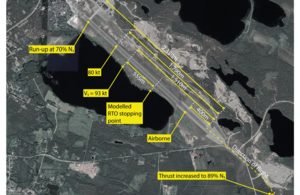
During takeoff at Kuusamo Airport in Finland, a Boeing 737-800 (G-JZHL) climbed slowly due to insufficient thrust, 1 December 2021.

Figure 3: Plan view of take off and second segment climb

During takeoff, the flight crew inadvertently left the thrust set at the 70% engine run-up setting rather than the 89% required for takeoff. This caused the aircraft to become airborne with only 400 m of runway remaining and climb slowly. At 250ft agl, the flight crew realised they had insufficient thrust and applied the correct power. The flight continued with no further incident and no injuries to the crew.

This incident was caused by the thrust not being set correctly, due to the Takeoff Go-around (TOGA) button not being pressed. This happened because the co-pilot was startled by the aircraft starting to move as he commenced the run-up against the brakes, and this occurred because the co-pilot applied insufficient brake pressure. The commander was distracted by a radio call and did not check to see if the thrust was correctly set.

The AAIB has investigated several takeoff performance incidents across the industry, and this incident is further evidence that the current barriers designed to prevent events like these are not fully effective. Therefore, two Safety Recommendations have been made to develop technical specifications and certification standards for a technical solution, and to improve the detection of takeoffs with compromised performance.

Read the report.

Media enquiries call: 01932 440015   or   07814 812293

Published 6 October 2022


Poor infrastructure hampering Armed Forces initial training

Ten Armed Forces establishments have been graded good for their initial training offering. However, persistent weaknesses in resources, infrastructure and accommodation are affecting the quality of recruits’ experiences.

Ofsted has published its 14th annual report on the effectiveness of care and welfare arrangements for recruits, trainees and officer cadets. The annual report draws on evidence from 13 inspections, including a single ungraded inspection of 5 University Royal Naval Units (URNUs) and their headquarters.

Recruits and trainees generally benefit from high-quality training, care and welfare arrangements. But too often, Ofsted found senior officers and their staff spending time dealing with the legacy of a lack of investment in infrastructure, or handling poor maintenance contracts. The RAF Officer Training Academy (RAFOTA) at RAF Cranwell, for example, had classrooms with leaking roofs and accommodation blocks that frequently lacked hot water and heating.

Inspectors also found that the needs of female recruits or trainees were not being considered fully. Women are often accommodated away from their male peers to ensure privacy. But this has led to some being isolated, especially in establishments where there are very few female recruits. In other instances, staff did not always ensure that female recruits were issued with uniforms or equipment that fitted them properly, increasing the risk of injury.

This was the second year that Ofsted has used the revised inspection handbook to inspect care and welfare in Armed Forces initial training establishments.

Inspectors graded the key judgement areas of:

  • training and support
  • personal and professional development
  • quality of facilities
  • infrastructure and resources
  • effectiveness of leadership and management

They also provided an overall effectiveness grade for each establishment.

Ten of the Regular and Reserve establishments were graded good for overall effectiveness and most of the key judgements. ITC Catterick was judged outstanding in 2 of the key judgement areas: quality of training and support, and leadership and management. Two establishments were judged to require improvement: RAFOTA at RAF Cranwell, and the Defence Medical Academy (DMA).

Ofsted’s report recommends that all Regular and Reserve training establishments:

  • urgently deal with the continuing and repeated failures in infrastructure. Provide commanding officers and their teams with clear guidance and funding to improve accommodation and infrastructure so that recruits, trainees and staff can live, learn and work in good-quality, well-maintained settings
  • ensure that female recruits and trainees are given suitable kit and uniforms, and accommodation that provides adequate security, privacy and facilities

His Majesty’s Chief Inspector, Amanda Spielman, said:

I would like to congratulate the commanding officers, and their teams, at the good establishments this year. Their success is indicative of the very good work that so many military and civilian staff do to train and care for recruits and trainees.

However, more remains to be done to address weaknesses in resources, infrastructure and accommodation, which affect the quality of training and recruits’ and trainees’ experiences. I strongly urge colleagues in the Ministry of Defence to deal with the recommendations from this report to ensure future generations of Armed Forces personnel get the high-quality training, care and welfare they deserve.

Inspections of 8 Regular training establishments and 4 Reserve units contributed to the annual report as well as the single ungraded inspection of 5 URNUs and their headquarters. Ofsted used a new inspection model for University Service Units (USUs) and now intends to carry out graded inspections of other USUs using the same model.

All inspections were carried out between October 2021 and May 2022.


Project update on National Underground Asset Register published

News story

The Geospatial Commission publishes a project update on the National Underground Asset Register (NUAR) and invites participation from all asset owners in Northern Ireland and England.

Front cover of NUAR update report

The Geospatial Commission today published an update on the status of the National Underground Asset Register (NUAR) and invited all asset owners from Northern Ireland and England to start participating.

This publication marks the first anniversary of the build phase and provides a summary of progress over the past year, as well as the economic case and a timeline for the next two years.

In line with the government’s growth priorities, NUAR will use modern technologies and ways of working to revolutionise the way buried infrastructure is installed, maintained, operated and repaired across England, Wales and Northern Ireland.

The NUAR platform has developed well over the first 12 months of the build phase, and a large number of asset owners from across all sectors have already provided their data and signed agreements to allow it to be shared with others.

In the next 12 months the Geospatial Commission will continue to seek user feedback, develop the service and engage with stakeholders on the future operational model of NUAR.

National engagement

Following the progress made to date with development of the service and levels of engagement seen across North East England, Wales and London, the Geospatial Commission are now at the stage to invite asset owners from Northern Ireland and the rest of England to start to engage with NUAR.

If you have not already been contacted by the Geospatial Commission team about sharing underground asset data then please email nuaronboarding@cabinetoffice.gov.uk.

Published 6 October 2022