OSCE Warsaw Human Dimension Conference: UK closing statement

Thank you very much Mr Chair.

I would like to say congratulations on the wonderful news to those who have won the Nobel Prize.

I would also like to add our thanks to the organisers of this year’s Human Dimension Conference, to all those who have arranged side events and to all those who have spoken, including through our excellent interpreters.

Now, more than ever, platforms like this are vital to give government officials, international experts, civil society representatives and human rights defenders an opportunity to take stock and reflect on the state of human rights and fundamental freedoms across the OSCE region.

This conference has taken place under the dark cloud of President Putin’s illegal war in Ukraine. A war which has had an impact on human rights and fundamental freedoms, not only in Ukraine and the Russian Federation, but across the OSCE region. The UK strongly condemns the sham referenda in the areas under temporary Russian control. The UK will never recognise the supposed outcome.

I would like to thank the inspiring human rights defenders and civil society representatives for their courage, tireless and selfless work and their bravery in sharing their stories with us over the past two weeks.

I want to reassure you that we have heard you.

We have heard your recommendations: to use OSCE monitoring tools, such as the Moscow Mechanism, effectively and ensure that recommendations are followed up upon; to support Human Rights Defenders working in country as well as in exile; to use our statements to support victims of oppressive governments and to call out those responsible for such oppression. We have noted many more.

We have heard the requests of those working on fundamental freedoms in Russia to differentiate between President Putin’s regime and the people of Russia.

We have heard your calls not to neglect the backsliding of human rights, fundamental freedoms and democracy in other participating States.

We have heard from the formidable and unwavering wives, mothers and sisters of Ukrainian political prisoners, detained civilians, and those forcibly disappeared, many of whom remain detained and many who remain missing to this day, their families resolutely searching for scraps of information on their whereabouts. To name, but a few, of those who are detained or disappeared:

Serhiy Tsyhipa

Mykyta Buzinov

Nariman Dzelyal

Asan Akhmetov

Aziz Akhtemov

Vladyslav Yesypenko

Iryna Danilovych

Mykola Masliy

Yevhen Hurianov

Olha Melnychenko

We share in the hope of their loved ones – that they will be found, released and reunited.

We think of others across the region, including Vladimir Kara-Murza and the 1,300 political prisoners in Belarus.

We urge Russia and Belarus to engage with us and with the families who deserve answers.

We will continue to raise cases until political prisoners are free and the whereabouts of those forcibly disappeared are revealed. We will not forget.

Thank you Mr Chair.


£34 million boost to frigate weapon systems sustains 150 UK jobs

During the next five years, Royal Navy ships will undergo a series of technical upgrades to their Magazine Torpedo Launch Systems and threat countermeasure capabilities, the latter of which will help ensure the ships continue to counter the threat of hostile anti-ship missiles.

The contract was award to Systems Engineering & Assessment (SEA) in Devon.

Sustaining 150 UK jobs across Barnstaple, Beckington and Bristol in the south west of England, the upgrades will ensure that critical systems on Type 23 frigates continue to operate reliably, and that upgrades can be seamlessly adopted and installed until their out of service dates.

The Type-23 frigate carries out a wide variety of operations, including securing the UK’s vital maritime trade routes East of the Suez Canal and safeguarding British interests in the South Atlantic. This week the Royal Navy deployed HMS Somerset to play a leading role in protecting critical energy infrastructure, working with Norway and our allies in the North and Norwegian Seas.

Minister for Defence Procurement, Alec Shelbrooke, said:

These crucial upgrades will help to ensure our Royal Navy ships remain equipped with the latest counter-threat capability.

Supporting 150 jobs at sites across the UK, this contract is another example of how we are investing in the future, sustaining UK jobs and securing cutting-edge defence capabilities.

Type 23 frigates will have electronic upgrades to Seagnat, a system which safeguards the vessel against incoming missiles by firing a variety of decoys to defeat incoming missiles.

Some ships will also undergo a further technical upgrade to their Magazine Torpedo Launch Systems – a close range, quick reaction Anti-Submarine weapon system which launches torpedoes from tubes mounted in the vessel’s magazine.

The contract was placed by the Maritime Equipment and Warfare (MEWT) team at Defence Equipment and Support (DE&S), the procurement arm of the UK Ministry of Defence.

DE&S’ Director Ships Support Rear Admiral Jim Higham:

I’m incredibly proud of our team which has worked so hard to place this contract, ensuring Type 23 has the battle-winning capability it needs to perform their critical role in the Royal Navy fleet now and into the future.

In addition to Type 23 updates, the contract will also upgrade Seagnat systems during the next five years on Type 45 destroyers and Royal Fleet Auxiliary (RFA) tankers, which provide fuel, food, fresh water, ammunition and other supplies to Royal Navy vessels around the world.

The contract also secures five further years of support for the systems on board the vessels with improved provision for spares.

The equipment supported under this contract (Magazine Torpedo Launch Systems, Seagnat and Air Weapons Handling) are used on various ships in the Royal Navy such as Type 23 frigates, Type 45 destroyers, Queen Elizabeth Class (QEC), Royal Fleet Auxiliary vessels and Albion-class Landing Platform Docks.

Richard Flitton, Managing Director at Systems Engineering & Assessment said:

This major contract, SEA’s largest to date, demonstrates the systems knowledge and maritime domain expertise within our UK-based team and builds on our long-standing partnership with the Royal Navy.


New interim Chief Executive of Maritime and Coastguard Agency announced

Press release

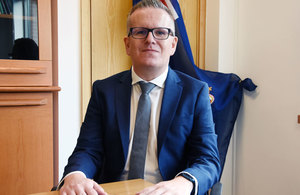
Damien Oliver has been appointed as the interim Chief Executive of the Maritime and Coastguard Agency (MCA).

Damien Oliver

Damien Oliver

Damien will begin his new role on Monday 17 October, which follows the current MCA Chief Executive Brian Johnson’s retirement.

Chairman and board member Christopher Rodrigues said:

Damien has had a number of high-profile roles within the MCA since joining in 2001 and he will bring a wealth of maritime experience and knowledge.

Damien has been responsible for major projects and programmes, procurement, commercial management and innovation, maritime business development which includes the UK Shipping Register and Shipping Concierge within the MCA.

More recently, he has led on the programme to replace the current Coastguard aviation arrangements with the second-generation search and rescue aviation contract (UKSAR2G). And also been in charge of the project to replace the radio network infrastructure for HM Coastguard”.

I am delighted that Damien Oliver will be fulfilling the role of interim Chief Executive, he will help us to maintain the momentum achieved under Brian’s leadership.

I wish Damien every success in this vital role.

Damien Oliver said:

It is a great privilege to be appointed as interim CEO of the MCA. I am very much looking forward to leading the Agency through the coming months.

Transport Secretary Anne-Marie Trevelyan said:

Damien has achieved great things during his impressive career with the agency to date, and I look forward to seeing the direction he gives to the organisation as interim Chief Exec.

The UK’s maritime industry is among the most advanced in the world, but growth is still so important. We’ll continue working together to build a more environmentally-friendly sector, support job creation, and promote the UK flag around the globe.

Published 7 October 2022


Joint targeted area inspections to focus on early help for children and families

Press release

Ofsted, CQC and HMICFRS have published guidance for the thematic focus on early help for families, as part of their programme of joint targeted area inspections (JTAIs).

Local areas’ multi-agency arrangements for helping children and families early will be the focus of upcoming thematic JTAIs carried out by Ofsted, the Care Quality Commission (CQC) and HM Inspectorate of Constabulary and Fire & Rescue Services (HMICFRS), starting in November 2022.

These JTAIs will consider how different agencies across children’s social care, education, health, and the police, work together to reduce risks to children and families, and meet their needs early.

The JTAIs follow research commissioned by Ofsted in early 2022 ‘Early help: concepts, policy directions and multi-agency perspectives’. The independent study, produced by Research in Practice, discussed current early help provision in England, government policy, and how agencies work together to prevent longer-term intervention. Today’s guidance refers to this report and the independent review of children’s social care’s recommendation that government combines targeted early help and help for children in need.

Yvette Stanley, Ofsted National Director for Regulation and Social Care:

Getting the right response at the right time is critical for children and families. All agencies have their part to play in helping children and families early.

Working with CQC and HMICFRS, our JTAIs will help establish a shared understanding of how multi-agency partners work effectively together to help families before significant harm happens, and take timely action to protect children.

Published 7 October 2022


UKHSA and ONS release estimates of excess deaths during summer of 2022

Initial analysis by the UK Health Security Agency (UKHSA) shows that across the 5-heat periods in the summer of 2022, the estimated total excess mortality (excluding coronavirus (COVID-19)) in England was 2,803 for those aged 65 and over. This is the highest excess mortality figure during heat-periods observed since the introduction of the Heatwave plan for England in 2004.

In July, some places in England recorded temperatures of over 40 degrees Celsius for the first time in recorded history and UKHSA issued its first ever Level 4 Heat Health Alert. From 17 to 20 July, when temperatures were at their highest, there were an estimated 1,012 excess deaths in those aged over 65.

The heat-period in the summer of 2022 with the highest excess mortality overall was from 8 to 17 August, which saw an estimated 1,458 excess deaths (excluding COVID-19) in those over the age of 65.

These figures demonstrate the possible impact that hot weather can have on the elderly and how quickly such temperatures can lead to adverse health effects in at-risk groups.

Similarly, ONS analysis from the same timeframe – June to August 2022 – for all age groups and for England and Wales, shows a recorded 3,271 deaths above the 5-year average. This represents a 6.2% increase. This is slightly higher than the UKHSA figure as it does not exclude deaths from COVID-19, those under the age of 65 and does include data for Wales.

Isabel Oliver, Chief Scientific Officer at UKHSA, said:

These estimates show clearly that high temperatures can lead to premature death for those who are vulnerable. Higher excess deaths occurred during the hottest days this year and a warming climate means we must adapt to living safely with hotter summers in the future.

Prolonged periods of hot weather are a particular risk for elderly people, those with heart and lung conditions or people who are unable to keep themselves cool such as people with learning disabilities and Alzheimer’s disease.

Sarah Caul, Head of Mortality Analysis at the ONS, said:

During the UK summer of record-breaking temperatures, there was an increase in deaths. However, these spikes around the hottest days were followed by periods of below average mortality. This is likely to be a result of short-term mortality displacement, especially among older age groups, where people died a few days or weeks earlier than expected. This trend is consistent with what we have seen in previous summers with heatwave periods.

It is also the case that despite peaks in mortality during heatwaves, the majority of days in the winter period (December to March) show a higher number of deaths than we see during summer.