Collaborating with U.S. on Cyber

News story

Strategic Command is working with the U.S. Cyber Command and other partners on a joint operation to improve interoperability and strengthen cyber resilience.

Image showing a laptop screen

Personnel from Defence Digital will be joining the collaborative exercise which will identify threats that could impact the internal systems of participants.

Insights from the operation will be shared with all partners in the interest of bolstering security and unifying our response to malicious cyber activity.

Rear Admiral Nick Washer, Director Operations at Defence Digital said:

Cyber does not recognise geographic borders. Our relationships with partners offer huge shared benefits; operations like this with U.S. Cyber Command put our expertise into practice and enhance our collective defence.

This sentiment was echoed by U.S. Navy Rear Adm. Matthew C. Paradise, deputy director, Operations J-3, U.S. Cyber Command, who added

Defensive Cyberspace Operations helps CYBERCOM meet its mission responsibilities by enabling and improving mission assurance of the joint force, as well as our allies and partners, by maintaining reliable and defensible networks

The information age is making the world more interconnected than ever before, driving opportunity, innovation, and progress. However, this increased digitisation also brings unprecedented complexity, instability and risk, making global partnerships key to our security and economic prosperity.

Published 20 October 2022


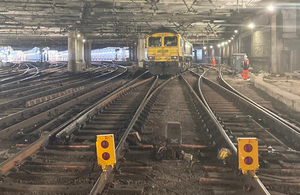
Runaway engineering train at London Liverpool Street station

News story

Runaway engineering train at London Liverpool Street station, 2 October 2022.

The stopping point of the train (courtesy of Network Rail)

The stopping point of the train (courtesy of Network Rail)

At about 11:52 hrs on 2 October 2022, an unattended freight train ran away from platform 3 at London Liverpool Street station. The signaller was alerted to the train’s movement by track sections in the throat of the station showing occupied unexpectedly. The incident happened within a part of the station that was, at the time, under possession for engineering work. The unattended train travelled about 150 metres, before coming to a stop within the possession limits. No one was injured as a result of the incident, although a set of points which the train ran through were damaged.

We have undertaken a preliminary examination into the circumstances surrounding this incident. Having assessed the evidence which has been gathered to date, we have decided to publish a safety digest.

The safety digest will be made available on our website in the next few weeks.

Published 20 October 2022


Appointment of Bishop of Newcastle: 20 October 2022

Press release

Her Late Majesty The Queen approved the nomination of The Right Reverend Dr Helen-Ann Hartley, Suffragan Bishop of Ripon, for election as Bishop of Newcastle.

Her Late Majesty The Queen approved the nomination of The Right Reverend Dr Helen-Ann Hartley, Suffragan Bishop of Ripon, for election as Bishop of Newcastle, in succession to The Right Reverend Christine Hardman following her retirement.

Helen-Ann Hartley was educated at the University of St. Andrews and Worcester College, Oxford. She trained for ministry on the St Albans & Oxford Ministry Course and was ordained Priest in 2006. She served her title at St Mary the Virgin, Wheatley, in the Diocese of Oxford, and was appointed Curate at St Mary the Virgin and St Nicholas, Littlemore, in 2007. During this time she was also Director of Biblical Studies and Tutor in New Testament at Ripon College, Cuddesdon.

In 2012, Helen-Ann moved to New Zealand where she was Dean for the New Zealand Dioceses at the College of St John the Evangelist, Auckland, and in 2014 she was consecrated Bishop of Waikato, Anglican Church in Aotearoa, New Zealand and Polynesia.

Helen-Ann returned to the UK in 2018 when she was appointed to her current role as Suffragan Bishop of Ripon in the Diocese of Leeds.

Published 20 October 2022


AAIB Report: Boeing A75N1 (PT17) Stearman (N707TJ), loss of engine power during flying display and ditching off Sandbanks, Poole, Dorset.

News story

During a display routine flight at Bournemouth Air Festival, a Boeing A75N1 (PT17) Stearman (N707TJ) ditched after a complete loss of engine power in the sea off Sandbanks, Poole, 4 September 2021.

Oil staining on underside of N707TJ (white aircraft) fuselage during accident flight

While performing an aerobatic wing walking display over the sea at Bournemouth Air Festival, the aircraft experienced a reduction in engine power. The pilot stopped the routine and flew the aircraft west, while the wing walker returned to her seat in the front cockpit. The engine subsequently experienced a complete loss of power and the pilot ditched in the entrance of Poole Harbour. The aircraft flipped over on contact with the water, but both the pilot and the wing walker were able to exit the aircraft unaided.

The investigation found that the loss of engine power was due to a failure of the oil inlet pipe most likely due to fatigue, which prevented oil being supplied to the engine. This was precipitated by a fatigue failure of the metal strap which supported the weight of the oil inlet pipe. The fatigue failure was initiated at an area of mechanical damage on the surface of the support strap, which had been caused by over-tightening of the retaining nut.

Following this accident, the operator introduced additional hand signals to enable the wing walker to inform the pilot of any oil or fuel leaks and for the pilot to inform the walker that he intended to ditch.

Read the report.

Media enquiries call: 01932 440015   or   07814 812293

Published 20 October 2022


RSH identifies key risks facing social housing sector in 2022 and beyond

Press release

The Sector risk profile sets out the main risks facing the social housing sector and some of the actions registered providers should be taking to manage those risks.

The Regulator of Social Housing today (20 October) sets out its view of the key risks and challenges facing the social housing sector. Against a very challenging and fast-moving economic backdrop, the Sector Risk Profile highlights a significant number of specific risks for social housing providers that boards need to manage in meeting the regulator’s standards. Some areas of risk are also relevant to councillors where their authority is responsible for local authority homes.

The report shows that providers face substantial financial pressures. High inflation is impacting on operating costs and the cost of debt is rising at the same time as increased cost of living pressures on tenants, a proposed rent cap, and a weakening housing market. To maintain financial resilience, providers need to continue responding appropriately to the changing conditions. Boards and councillors will need to have a clear sense of their priorities and make trade-offs. They must ensure that their mitigating actions are strategic and timely, underpinned by stress testing and robust planning, and communicated effectively to stakeholders.

Alongside their financial viability, tenant safety and the delivery of landlord services are key responsibilities which boards must continue to prioritise. Providers are planning significant investment in existing homes to meet quality, building safety, and decarbonisation commitments. This must be underpinned by robust data on stock condition, a clear understanding of policy changes in these areas, and properly engaging with and listening to tenants. Boards will also need to recognise that delaying investment in existing stock could increase cost pressures over the long term and damage the sector’s reputation.

Demand for new homes remains high even as the economics of development become more uncertain. Providers will need to consider carefully how to assess new development, ensuring that risks are tightly managed, including investment in market-sale homes which could affect providers’ core social housing business.

Fiona MacGregor, Chief Executive at RSH, said:

Providers must take a strategic approach to managing the significant risks we have identified in our Sector Risk Profile and act appropriately to maintain their continued financial viability. Boards and councillors are the custodians of people’s homes, and it’s absolutely vital that tenants’ homes, safety and the delivery of essential landlord services are not put at risk.

The annual publications are available on the Sector risk profiles page.

Notes to editors

  1. For press office contact details, see our Media enquiries page. For general queries, please email enquiries@rsh.gov.uk or call 0300 124 5225.

  2. The Regulator of Social Housing promotes a viable, efficient and well-governed social housing sector able to deliver and maintain homes of appropriate quality that meet a range of needs. It does this by undertaking robust economic regulation focusing on governance, financial viability and value for money that maintains lender confidence and protects the taxpayer. It also sets consumer standards and may take action if these standards are breached and there is a significant risk of serious detriment to tenants or potential tenants.

Published 20 October 2022