Dounreay recycles 98% of reactor decommissioning waste

News story

The site’s oldest reactor, the Dounreay Materials Test Reactor, is leading the way in demolition waste recycling as internal dismantling continues.

Dounreay Materials Test Reactor vessel decommissioning

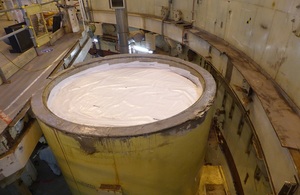
The fuel element storage block has now been demolished. This steel tank was 4.7m high and 2.8m in diameter, surrounded by an iron-shot concrete cylinder, and was capped off by a thick steel top plate. Historically it housed cooling irradiated fuel elements after their removal from the reactor.

During its dismantling, workers segregated recyclable and re-usable material from the waste products. An expected 9 tonnes of steel and 33 tonnes of lead will be recycled, and around 95 tonnes of concrete will be re-used off site.

Facility Manager Donald Buchanan said:

We have applied waste minimisation techniques which require all waste to be segregated and characterised, in compliance with the Scottish Government’s zero waste plan. Some of these materials, which previously might have been disposed of as waste, can now be considered as a valuable resource.

We have carried out a robust programme of characterisation and sampling work to determine the appropriate disposal options and as a result we will be able to recycle and re-use the majority of the material. Only 2% of the waste produced will be disposed of in our low level waste vaults.

Cavendish Nuclear and sub-contractors KDC Demolition, JGC Engineering & Technical Services and Caithness Scaffolding are carrying out the work.

Published 20 October 2022


Putin stands alone on the international stage: UK statement to the OSCE

Thank you Mr Chair. Russia’s actions in Ukraine in recent weeks have dropped to new lows. The increased tempo of long-range strikes, including the use of Shahed-136 drones, against Ukraine’s civilian population and infrastructure have resulted in further tragic loss of life. And extensive areas of Ukraine have been left without power supply ahead of winter. Mr Chair, this cruelty has no excuse. It only reflects one man’s desperation – Vladmir Putin – desperate as he is losing the war and desperate as he wishes to distract from what is happening on the battlefield. And – as a result – civilians are paying the highest price.

Since this Council last met, the Belarusian regime announced that 70,000 Belarusian troops would be part of a regional “group of forces” created under the false guise of “protecting” its border from external threats. This regional military grouping, which includes thousands of Russian troops, is a further attempt at distraction and misdirection – misjudged actions which only serve to strengthen the international community’s opposition to Putin’s illegal war in Ukraine and  further isolate Russia and Belarus.

Mr Chair – I want to focus this week’s intervention on the recent vote at the UN General Assembly, the UN Charter and OSCE principles and commitments.

The strength of the international community’s resolve was recently demonstrated at the United Nations General Assembly on 12 October when, in the face of President Putin’s unprovoked aggression, 143 nations across the globe came together in defence of the UN Charter and in solidarity with Ukraine. The UN General Assembly vote is a powerful demonstration of condemnation of Russia’s outrageous and illegal attempts to annex the Ukrainian regions of Donetsk, Luhansk, Kherson and Zaporizhzhia.

The vote was an important show of international unity against an aggressor that seeks to destabilise the international norms that protect us all. It is indisputable evidence of what we have known for some time – Putin stands alone on the international stage and his actions are driving his country further into self-inflicted isolation. It also demonstrates that the world will not stand by as Russia tramples on the obligations enshrined in the UN Charter, including that no threat or use of force shall be made against the territorial integrity or political independence of any state.

Yesterday, President Putin made another announcement – this time declaring martial law in those areas under temporary Russia control within Ukraine. Martial law will mean further ruthless attempts to enforce control in territory to which Russia has no right, and over people who have already suffered heavily at the hands of Russian forces. Despite what the Kremlin tells us, these moves highlight Russia’s increasing desperation in the midst of its failing invasion. On Kherson, Russia’s plans to forcibly deport Ukrainian civilians are deeply concerning. We remind Russia that any danger posed to civilians is a direct result of its illegal invasion.

On OSCE principles and commitments – we must not allow Russia to disregard what we have all signed up to in this Forum. Putin has contravened the principles and commitments made by all OSCE participating States in the 1975 Helsinki Final Act time and time again. To name but a few – (i) sovereign equality and respect for the rights inherent in sovereignty; (ii) refraining from the threat or use of force; (iii) the inviolability of frontiers; (iv) territorial integrity of states; (v) respect for human rights and fundamental freedoms – the list goes on.

The real-world repercussions for Ukraine of such blatant disregard for OSCE principles can be seen in the recent reports by the Office of the UN High Commissioner for Human Rights (OHCHR):

  • Over seven and a half million Ukrainian refugees across Europe;
  • Seven million displaced people within Ukraine;
  • 6,306 civilian deaths, including 397 children; and
  • 9,602 civilian injuries, including 723 children.

The true numbers are thought to be much higher and they are rising. According to the UN, most of the civilian casualties recorded were caused by the use of explosive weapons with wide area effects, including shelling from heavy artillery, multiple launch rocket systems, missiles and air strikes. Russia’s barbaric and callous tactics are a throwback to a history which should have been learned from and never repeated again.

Russia should end this war. It should cease its assault on Ukraine and it should withdraw its forces from the entire territory of Ukraine. The targeting of civilians and of civilian infrastructure may cause blackouts, but – as we are seeing – Russia’s assaults are not breaking the steadfast resolve of the people of Ukraine, nor the UK, nor the international community’s absolute and unwavering support of them. We will continue to defend what is right. We will continue to champion democracy. We will continue to uphold Ukraine’s right to sovereignty, independence and freedom. Until and after Ukraine prevails.


Transport Strikes (Minimum Service Levels) Bill

The government is today (20 October 2022) introducing the Transport Strikes (Minimum Service Levels) Bill. This meets the Prime Minister’s commitment to introduce this bill within her first 30 days of Parliament sitting and delivers on a commitment in the 2019 Conservative Party manifesto.

The bill paves the way for the introduction of minimum levels of service on transport services, like those already seen in other countries including France and Spain. The bill will ensure that specified transport services – which could include, for example, rail, tubes and buses – will not completely shut down when unions impose strikes.

This bill will balance the right to strike with ensuring commuters can get to their place of work and people can continue to make vital journeys to access education and healthcare during strikes. The bill sets out the legal framework for establishing minimum service levels. It will allow relevant employers and trade unions to negotiate and reach agreement between themselves on minimum service levels referred to as minimum service agreements (MSAs), provide for circumstances in which the MSA can be changed and include enforcement arrangements to ensure parties follow due process in their negotiations.

The bill also provides for an independent determination process should employers and unions fail to reach agreement on an appropriate minimum service level after 3 months, whereby if an agreement has not been reached the Central Arbitration Committee will determine the minimum service level.

The bill also includes a power for the Secretary of State to set interim minimum service levels by regulations which will apply where neither an MSA has been agreed nor an independent determination reached. These regulations will also be consulted upon and will need to be agreed by both Houses of Parliament before they are made.

Under the bill there will also have to be a minimum 3-month gap between these regulations being made and their coming into force. The specific details of how minimum service levels would apply to transport services will be set out in secondary legislation following appropriate consultation. A minimum service level would only be applied to an individual transport service once that secondary legislation has been agreed by Parliament.

The provisions of the bill extend and apply to England, Wales and Scotland. The bill’s provisions relate to the reserved matter of employment rights and duties and industrial relations, and the subject matter of the Trade Union and Labour Relations (Consolidation) Act 1992, and do not engage the legislative consent process.


Prime Minister Liz Truss’s statement in Downing Street: 20 October 2022

The Prime Ministers resignation statement

Prime Minister Liz Truss’s resignation statement – YouTube

I came into office at a time of great economic and international instability.

Families and businesses were worried about how to pay their bills.

Putin’s illegal war in Ukraine threatens the security of our whole continent.

And our country had been held back for too long by low economic growth.

I was elected by the Conservative Party with a mandate to change this.

We delivered on energy bills and on cutting national insurance.

And we set out a vision for a low tax, high growth economy – that would take advantage of the freedoms of Brexit.

I recognise though, given the situation, I cannot deliver the mandate on which I was elected by the Conservative Party.

I have therefore spoken to His Majesty The King to notify him that I am resigning as Leader of the Conservative Party.

This morning I met the Chair of the 1922 Committee Sir Graham Brady.

We have agreed there will be a leadership election to be completed in the next week.

This will ensure we remain on a path to deliver our fiscal plans and maintain our country’s economic stability and national security.

I will remain as Prime Minister until a successor has been chosen.

Thank you.

Published 20 October 2022
Last updated 20 October 2022 + show all updates

  1. Added video and image.

  2. First published.


Gender equality lecture in Ashgabat

World news story

British Ambassador delivers a lecture on gender equality to the youth of central Asia in Ashgabat.

His Majesty’s Ambassador Ms Lucia Wilde and Ms Jessie Kirk, Social Development Adviser at the FCDO and an expert on gender issues, delivered the interactive lecture ‘Gender in the context of conflict and peacebuilding’.

Preventive Diplomacy Academy students from the UN Regional Centre for Preventive Diplomacy for Central Asia (UNRCCA) attended, as well as graduates from across central Asia. Young SDG Ambassadors from Turkmenistan were also in the audience. 

The Ambassador spoke of the importance of female role models. Jessie spoke about the action governments can take to improve gender equality. Students also gave their own insightful and inspiring presentations on their work on gender around central Asia.

Published 20 October 2022