Sellafield site emergency exercise – Wednesday 2 November 2022

News story

An emergency exercise will be taking place at the Sellafield site tomorrow

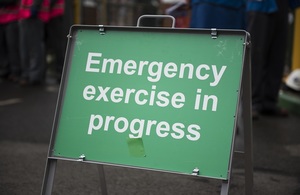
Green street sign that reads 'emergency exercise in progress'

Emergency exercise planned at Sellafield

An emergency exercise will take place during normal business hours at Sellafield on Wednesday 2 November, and may involve the sounding of the site siren which can be heard off-site.

Access to and from the site will be as normal up until approximately 08:30 on the morning of the exercise.

People who live close to Sellafield and have signed up to  receive automated SMS text, email, and telephone warnings from Sellafield, may be contacted.

If you are a local resident and haven’t yet signed up to receive automated alerts, but would like to, follow the instructions here.

Emergency exercises are held regularly at all nuclear licensed sites to test their readiness in the event of an emergency.

Published 1 November 2022


Successful trial for autonomous vehicle with sensor technology

The use of autonomous uncrewed systems for the recce and survey of areas for chemical and radiological material is a step closer to becoming a reality.

The successful Hybrid Area Reconnaissance and Survey (HARS) field trial has taken place to demonstrate the concept of this cutting-edge research.

The technology concept could help keep troops safe, improve efficiency and give the UK armed forces an operational advantage in the future.

HARS trial

This project is a collaboration between the Defence Science and Technology Laboratory (Dstl), the wider Ministry of Defence (MOD) and industry.

Dstl’s HARS Trial Lead Scientist Andy Martin said:

This trial aimed to test the feasibility of the concept and the maturity of the technology. This technology offers an innovative approach, which could significantly change the military’s capabilities in the future by reducing the hazard to soldiers and acting as a force multiplier. That is quite an exciting thing to be involved in.

Some of the key challenges associated with the system are reducing the cognitive burden for personnel and using sensors, which are designed to be manually operated by personnel, applying sufficient automation in the system to allow that to be done remotely and autonomously.

Dstl Lead Operational Analyst Emma said:

We know autonomy could be useful to do those repetitive jobs where people are at risk and we can take them away from that risk.

It has been nice to see it actually in practice, moving around out in the field and demonstrating that this is somewhere that, if we continue to put some work into it, we could make some real progress and do things very differently to the way they’re done now.

The platform used in the trial was the recently developed concept demonstrator which consisted of an uncrewed ground vehicle (Viking) with a chemical and radiological sensor payload:

  • 2 mass spectrometers to identify deposited chemicals on the ground
  • 2 vapour sensors to detect volatile chemicals
  • a gamma radiation spectrometer to detect and identify radiological hazards

Adding this sensor technology to a modular ‘pallet’ means it is more scalable and cost-effective, as it could then be mounted onto the appropriate platform as and when required.

The trial took place over 5 weeks on Salisbury Plain, working with soldiers from FALCON Squadron, 28 Engineer Regiment (C-CBRN) doing back-to-back trials to compare the concept against the performance of a crewed system.

14 Troop Leader, FALCON Squadron, Sebastian, said:

This trial is important because it is working with future technologies so hopefully we will be able to have more time on target, less risk to personnel and better capability to detect whatever is there.

HORIBA MIRA Chief Engineer Andy Maloney said:

This has been a great example of MOD, industry, and end users working together with the expertise from Dstl and the stakeholders able to influence the systems we’re developing. The adaptability of the Viking UGV provides an excellent basis for development of new payloads and novel autonomous behaviours.

Find out more about Dstl’s work including our autonomy and robotics capability and how to work with us.


Bankrupt jailed for hiding property from trustees

Sukhi Sanghera appeared at Warwick Crown Court on Thursday 27 October 2022, where he was sentenced before HHJ Berlin after he was charged with 4 counts of bankruptcy offences.

The court heard that Sukhi Sanghera (50) was made bankrupt in August 2017 by order of the County Court in Warwick, with debts of over £140,000. The Official Receiver was appointed trustee before other trustees were appointed to administer Sukhi Sanghera’s affairs.

As part of his bankruptcy, Sukhi Sanghera, also known as Sukhwinderjit Singh Sanghera or Sukhwinder Singh Sanghera, was obliged to disclose all his assets to the Official Receiver and his trustees, including property.

Sukhi Sanghera, however, failed to disclose to either set of trustees that he was the sole owner of a rental property in Coventry which yielded a monthly rental income of £1,900.

Due to the risk he posed to creditors, the Official Receiver previously sought further bankruptcy restrictions against Sukhi Sanghera.

In August 2019, the Secretary of State accepted a 10-year bankruptcy restrictions undertaking from Sukhi Sanghera after he did not dispute that he failed to disclose the property to the Official Receiver.

Upon sentence, the judge commented that Sukhi Sanghera was a “profoundly flawed and dishonest man….who showed a flagrant disregard for the law and authorities.”

Sukhi Sanghera received 8-month sentences on all 4 bankruptcy offences contrary to the Insolvency Act 1986 and will serve them concurrently.

Glenn Wicks, Chief Investigator for the Insolvency Service, said:

At multiple points Sukhi Sanghera had the opportunity to be honest and disclose to his trustees that he benefited from a rental property. Instead, Sukhi Sanghera went to great lengths to conceal the property in Coventry through fraud and deception to avoid paying his creditors what they were owed.

The courts have recognised the severity of Sukhi Sanghera’s actions and his custodial sentence demonstrates the risks people take if they don’t declare all their assets when in a bankruptcy process.

Sukhi Sanghera, also known as Sukhwinderjit Singh Sanghera or Sukhwinder Singh Sanghera, is of Leamington Spa, Warwickshire. His date of birth is May 1969.

Details of Sukhi Sanghera’s Bankruptcy Restrictions Undertaking are available on the Individual Insolvency Register

Further information about the work of the Insolvency Service, and how to complain about financial misconduct, is available.

You can also follow the Insolvency Service on:


Bregulation: rethinking regulation after Brexit

Everyone has a plan until they get punched in the mouth. And in my experience everyone dislikes regulation until they need it, and then they want even more of it than we regulators can supply. All the politicians I meet, all the media that scrutinise us, and all the local communities in which we operate want more not less regulatory action from the Environment Agency (EA) to tackle things like waste dumps, smelly factories, dirty rivers and so on.

It’s a good problem to have. And a reminder that the answer you get to any question often depends on how you ask it. Does any of us want red tape and bureaucracy? No. Do we want clean water, air that’s safe to breathe, a green country, jobs and growth? Yes – and those are some of the things you get from regulation when it’s done right.

My pitch to you today is this: good regulation is essential for most of the things we all want. The report we are launching today “Regulating for people, the environment and growth” – the clue is in the title – sets out what the EA does to support those things.

But no regulatory system is perfect, including ours. Brexit is a massive opportunity to rethink how we do regulation in this country. The government has embarked on that process, and we welcome the debate. Today I want to suggest some pointers about where that debate might usefully take us and the key principles that I think should guide it.

Regulation works

Let me start with an important fact: regulation works. Examples:

Water security: the EA regulates the abstraction of water in this country. If you want to take more than 20 cubic meters a day out of a river or the ground, you need an EA licence. The EA has been reviewing, changing and in some cases revoking these licences to bring them into line with what is sustainable. That has removed the risk of the abstraction of some 1.7 trillion litres of water. That’s enough water to supply London for two years. Nature, wildlife and all of us are better off as a result.

Water quality: in 2021, due to the EA’s regulation of water companies, a record 99% of bathing waters around England’s coasts met or exceeded the minimum quality standard. That is the highest level it has been since new tougher standards were introduced in 2015. Thirty years ago most of our bathing waters would have failed to meet even the minimum standards we have now. Regulation did that.

Air quality: since 2010, emissions of nitrogen oxides (NOx) from the industrial sites we regulate have decreased by 72%, sulphur oxides (SOx) by 90%, and small particulate matter (PM10) by 52%. So our air is cleaner than it was, and cleaner air means people live longer and healthier lives. Regulation did that too.

Waste: I have called waste crime “the new narcotics”: it harms people, places and the economy, including by undercutting the legitimate waste industry. Our regulation of the sector ensures waste is managed safely and our fight against the criminals helps the economy: every £1 we spend on it brings at least £4 of benefit to the economy. The right regulation helps deliver growth.

Climate: in 2021 the climate change emissions trading and energy efficiency schemes that the EA manages delivered a nine million tonne reduction of CO2 compared to 2020. And since 2010, emissions of greenhouse gases from the sites we regulate have decreased by 50%. The planet is better off as a result. Regulation works.

Rethinking regulation

But no regulatory system is perfect. Both the regulations themselves and how regulators behave need to move with the times. They need to reflect changes in technology, in the needs of business, in the risks we are trying to manage, in public demand, in government policy and the law, and in the wider world around us.

Brexit is a massive opportunity to rethink how we do regulation in this country.

The government has embarked on an exercise to remove, revise or retain the body of EU-derived law currently in force, much of which is the basis for most environmental regulation in this country. We welcome that. We think it is a great opportunity to deliver better regulation and better outcomes – for people, for business and for nature.

There is already a big debate as to what pieces of legislation should be retained, what should be reformed and what should be repealed. And there should be a debate, because this really matters and because if we make the right calls we can do what the Environment Agency exists to do: create a better place.

There will be examples of laws we find we don’t really need. There will be examples where changing the law will allow us to achieve better outcomes for the environment and nature and support economic growth. And there will be some laws that it will make eminent sense to keep.

Let me give you a real-life example of each. These are my personal views, not those of the EA or the government, but the point I want to illustrate is that we should not regard the current body of laws as sacrosanct.

I would repeal the Floods Directive. This requires EU member states to carry out flood risk assessments, create maps of flood risk and flood risk management plans. That is all very sensible, which is why the UK was already doing those things before the Directive arrived and why the EA will carry on doing them now, because they are good practice and policy. But the purpose of the Directive was to drive cooperation between continental EU member states that share river basins – clearly we are not in that category.

I would reform the Water Framework Directive (WFD) in order to drive better environmental outcomes. Each time I say this I get flak from everyone, so let me say again for the avoidance of doubt, I’d reform it in order to enhance water quality and restore nature, not degrade them. The WFD rightly sets high standards for water quality in rivers, lakes, estuaries and groundwater. But the way it requires us to categorise the status of those waters is complex, and can be misleading about the real state of those waters, both for better and for worse. And because the Directive stipulates that waters can only get “good” status if they tick all of several different boxes, it can force regulators to focus time and resources on indicators that may not make much difference to the actual water quality, taking focus away from things that would. I wouldn’t repeal the WFD. But I would reform it, to ensure it drives action that will deliver the clean and plentiful water we all want.

I would keep the Bathing Waters Directive, which protects public health and the environment by keeping coastal waters free from pollution. It has done exactly that, driving the water companies, the regulators, the local authorities and local communities to make huge improvements in water quality at most of our beaches. High quality bathing water benefits health and wellbeing as well as boosting local economies. According to Visit Britain, the 135 million day visits taken to the seaside in England in 2019 were worth £4.4 billion to the economy. A great example of good law and good regulation producing better outcomes for nature, people and the economy.

Principles of good regulation

As we have this debate about what kind of regulation we want for the future, let’s be guided by a few principles. Mine would be:

  • Reframe how we think: good regulation is not red tape. It’s what gets you green growth and a blue planet.
  • Focus on outcomes. Start and finish with the ones we want: safe and healthy people, nature restored (not just protected or its degradation slowed), sustainable and inclusive growth.
  • Believe in better. The test for any regulatory change should be whether it will produce better outcomes.
  • Less is more: have fewer regulations, better targeted. Regulate only the things that need regulating.
  • Do it right: when you do have to regulate, do it well. Good regulation is proportionate, risk-based, evidence-driven, outcome focused, and (provided businesses do the right things) business-friendly.
  • Strong regulation needs strong regulators: if regulators are going to do their jobs they need the right powers, the right resources, the right laws and the right support.

Conclusion

Ronald Reagan said that Government’s traditional view of the economy could be summed up in a few short phrases: “If it moves, tax it. If it keeps moving, regulate it. And if it stops moving, subsidise it”. He was, it is pretty safe to say, not a natural fan of regulation or indeed of government. But he also said: “Government exists to protect us from each other. Where government has gone beyond its limits is in deciding to protect us from ourselves.”

That’s a good distinction. Regulation doesn’t exist to protect us from ourselves. It exists to protect the things we value – people, nature, our economy – that would otherwise be harmed. So let’s have no more regulation than we need, and let’s have the right kind. But when we need it, let’s make sure we have it.


Charity Commission launches inquiry into religious charity over serious regulatory concerns

Press release

Statutory inquiry opened into The Saint George Educational Trust (1043158) due to concerns including about potential political activity.

The Charity Commission has opened a statutory inquiry into The Saint George Educational Trust over serious regulatory concerns that there is or has been misconduct and/or mismanagement in the administration of the charity.

In particular, concerns have been identified in relation to activities carried out by the charity that do not appear to further its religious purposes, including material it had posted online and political activity or campaigning. The Commission also has significant concerns that the charity has associations with an extreme right-wing organisation and how this furthers its religious purposes, something that the Commission has previously investigated.

The charity, based in Andover, Hampshire, has charitable purposes that include the advancement of the Catholic religion.

The inquiry will examine:

  • the administration, governance, and management of the charity by the trustees – including, but not limited to, its relationships with external organisations and individuals, and use of the internet and social media
  • the financial controls and management of the charity, and whether its funds have been properly expended in accordance with the charity’s purposes and can be accounted for
  • the conduct of the trustees
  • whether or not the trustees have complied with and fulfilled their duties and responsibilities as trustees under charity law

The Commission may extend the scope of the inquiry if additional regulatory issues emerge.

Immediately following the opening of the inquiry, the Commission took action to freeze a bank account holding the charity’s funds so that no one can access or move them without the Commission’s prior consent.

The Commission has also ordered the trustees to review and remove content from the charity’s website and social media pages that does not further the charity’s purposes, and directed them not to allow such material in future. At this time the charity’s website is no longer available to view.

ENDS

Notes to Editors

  1. The Charity Commission is the independent, non-ministerial government department that registers and regulates charities in England and Wales. Its purpose is to ensure charity can thrive and inspire trust so that people can improve lives and strengthen society.

  2. The charity has been the subject of three previous statutory inquiries, two of which opened in 1997 and 1999. The second inquiry was opened to consider the charity’s association with an extreme right-wing organisation. On 25 July 2022, the charity became part of the Commission’s Statutory Class Inquiry, having failed to submit financial information to the Commission for two or more years over the last 5 years. The charity ceased to be part of the Class Inquiry with the opening of this new inquiry, however its accounting information (for the financial years ending 31 March 2020 and 2021) remains outstanding, which will be considered as part of the new inquiry.

  3. This latest inquiry was opened on 7 October 2022, under section 46 of the Charities Act 2011 (‘the Act’).

  4. Section 76(3)(d) of the Act gives the Commission power to order any person who holds any property on behalf of a charity not to part with that property without the approval of the Commission.

  5. Section 84 of the Act gives the Commission power to compel trustees to take specified action(s) which the Commission considers to be expedient in the interests of the charity.

  6. Section 84A of the Act gives the Commission power to direct trustees not to take or continue to take a specific action(s) if the Commission considers the action(s) would constitute misconduct or mismanagement in the charity’s administration.

Press office

Email: pressenquiries@charitycommission.gov.uk

Out of hours press office contact number: 07785 748787

Published 1 November 2022