Celebrating women in tech: Rama and Elizabeth’s stories 

We recently spoke to 2 of our cyber security graduates, Rama and Elizabeth, about their career journeys and their experience working in technology at DVLA. 

Rama and Elizabeth joined DVLA’s 2-year cyber security graduate programme in 2024. Today, both are in permanent roles – Rama is an Operational Security Analyst and Elizabeth is a Security Operations Centre Specialist.  

The journey into cyber security 

What first sparked your interest in cyber security? 

Rama: My interest started when I learned about how organisations protect sensitive data and systems from threats. I was particularly drawn to the investigative and problem-solving aspect of the job.  

Elizabeth: My interest developed during my MSc in Computer Forensics, where I studied both digital investigations and cyber security concepts. I was drawn to the proactive side of protecting systems, preventing incidents rather than analysing them afterwards.  

Did you face any doubts when considering a cyber career? 

Rama: Yes, initially I doubted whether I had the technical background needed to succeed in cyber security. It seemed complex and intimidating, especially coming from a non-technical background! 

Elizabeth: I did doubt if I was experienced enough. Cyber security is a broad and fast-moving field, and it can feel intimidating, especially as a woman! Even with a master’s degree and experience within forensic investigation, I’d still come across preconceived ideas about what someone in cyber security ‘should’ be like. 

Thankfully, when we joined the graduate programme at DVLA, we found a supportive learning environment which helped build our confidence. It was encouraging to see other women working in tech, and seeing them succeeding within a supportive working environment felt very reassuring.  

How did the graduate programme prepare you for your current role? 

Rama: It gave me a strong foundation to build both my technical and soft skills. The structured learning, hands-on experience, and exposure to real security challenges made the transition to a permanent role much smoother. 

Elizabeth: The programme helped me transition from an investigative background into a security operations environment. It strengthened my understanding of threat detection, monitoring tools, and incident response processes. 

Women in cyber security 

What has your experience been like building your career in this field? 

Rama: Being a woman in cyber security has been both empowering and motivating, and I’ve found DVLA to be inclusive and supportive. It’s encouraging to see growing diversity and opportunities for women to thrive. 

Elizabeth: It’s positive to see more women entering cyber security. Women are just as capable as anyone else, and success comes down to skills, curiosity, and attitude. As with any profession, you may come across individuals who underestimate you or communicate in a way that feels discouraging, but at DVLA I’ve found the culture to be supportive and inclusive. There’s a strong focus on collaboration, which helps create an environment where everyone can grow in confidence. 

What would you say to other women considering DVLA’s graduate programme? 

Rama: Don’t let doubts hold you back. The graduate programme provides the support and training you need to grow and succeed. If you’re curious, motivated, and open to learning, it’s a great opportunity to build a meaningful and rewarding career. 

Elizabeth: Go for it, even if you don’t feel completely ready. You don’t need to know everything before you start. The programme is designed to support your growth. 

Looking ahead 

How do you see your career developing in the next 5 years? 

Rama: I see myself developing my technical knowledge and strengthening my expertise in areas like governance, risk management, and security practices. I aim to continue learning through professional development, gaining certifications, and staying up to date with emerging cyber threats. 

Alongside this, supporting other women entering the technology and cyber security field is important to me. As my experience and skills grow, I would like to be able to support women who are earlier in their careers by sharing my experience, speaking about pathways into cyber security and acting as a role model. I hope to encourage more women to consider careers in the field and help create a more diverse and inclusive industry. 

Elizabeth: I’d like to continue developing my expertise in cyber security and build confidence in the field. As I develop my skills, I’d love to play a part in encouraging more women to consider careers in tech. It’s important to me that women feel supported entering the industry and see that there are opportunities to progress and thrive. 

Interested in following in Rama and Elizabeth’s footsteps? DVLA’s 2026 Centre of Digital Excellence development programmes will launch this spring. Sign up for Civil Service Jobs today and get ready to apply. 
Adblock test (Why?)


A look back at DVLA and Amazon Web Services (AWS)’s knowledge-sharing event

At DVLA, we’re always looking for ways to improve our digital services. We recently brought together Welsh Local Government and public sector colleagues to share how Amazon Web Services (AWS) is supporting our digital transformation.

We also talked about investing in people through digital skills training and career development. It was a great opportunity to share what we’ve learnt over the years with others who have the same mission: delivering better and faster public services.

I was proud to speak at an event full of insightful discussions and practical takeaways. In this blog, I’ll share some of what we learnt during the day – the positive impact of cloud technology, the importance of giving back to the community, and how to develop digital talent.

It kicked off with Tom Brewer, Head of DVLA’s IT Service Creation, who took us back to 2015.

Taking control: how cloud technology transformed our IT services

Tom shared a turning point from 2015, when DVLA reduced our need to hire outside IT companies by developing our own digital skills and capabilities. Alongside our legacy platforms and other serverless systems, we’ve used the AWS cloud platform to deliver digital public services quicker and more efficiently ourselves.

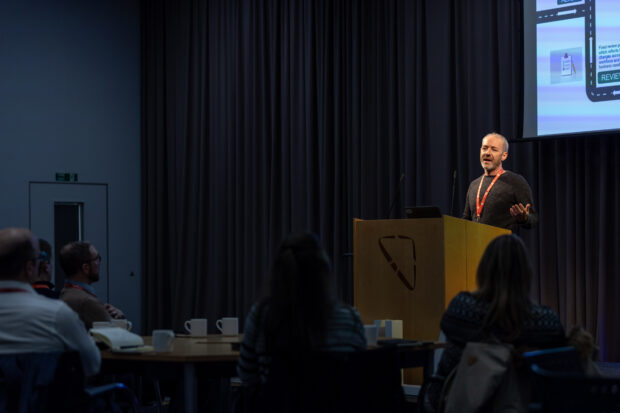
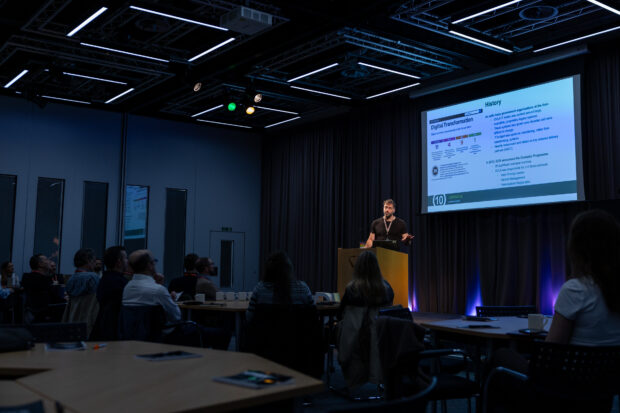
Tom stands at a podium in a dimly lit conference room, presenting slides to an audience. The projected slide displays a timeline.

Today, our platform handles 5 billion online interactions a year – things like renewing a driving licence or answering automated enquiries. Shared standards and automation mean less hands-on work, faster results, and simple tools for everyone to use.

The impact? Tasks that once took months now take minutes, and we produce more than 500,000 software builds every year.

It was fantastic to see attendees consider how these solutions can be adapted to speed up and simplify services across the public sector.

Investing in people and giving back to our communities

Next, I shared how we’re developing our people and giving back to our community through outreach activities.

I spoke through examples like our volunteer-led Science, Technology, Engineering and Maths (STEM) programme, which inspires young people to build their digital skills. Another great example is our Digital Voices advocacy group, which promotes digital development and career opportunities for colleagues of all backgrounds.

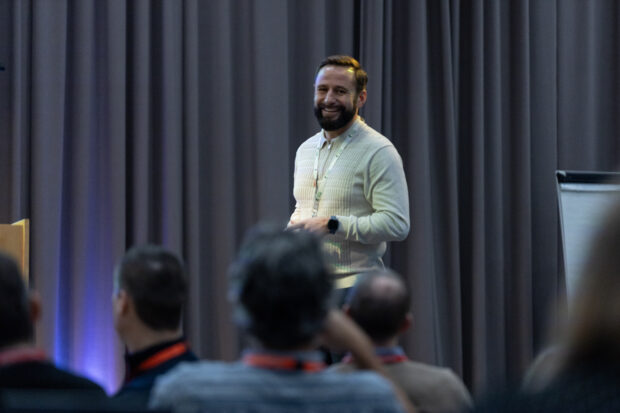
Simon stands in front of a grey curtain giving a presentation, with several audience members seated and facing toward him.

My presentation also mentioned our support of the Digital Inclusion Scheme and the UK government’s ‘IT Reuse for Good’ charter. Through this, we’ve donated more than 1,600 laptops to schools and charities across Wales, enabling young people to have access to the technology they need to succeed.

These initiatives sparked excellent discussions on how building a strong employer reputation, with the backing of senior leaders, can help to support local communities and attract the next generation of talent to the public sector.

This led us on nicely to the final talk, where our Capability and Talent Lead, Craig James, shared how we’re helping to develop our people through our Centre of Digital Excellence (CoDE) development programme.

CoDE offers 18 schemes and has helped more than 200 people start their digital careers, regardless of whether they have a background in technology. People often arrive from other professions bringing transferable skills that work brilliantly in technical roles. In some of our teams, half the staff are CoDE graduates!

So, what did our attendees gain from this discussion? Investing in people is just as important as investing in technology, and if they help their own teams grow, they can bring success to their organisations.

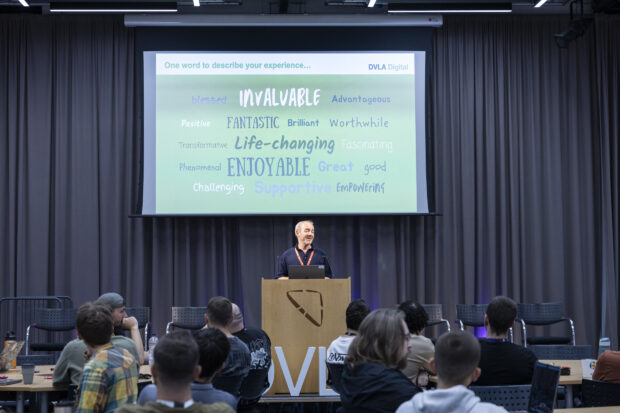
Craig stands behind a podium in a darkened conference room, speaking to an audience at seated tables.

Working together for better public services

What truly made the day special were the conversations we shared with attendees. Every organisation has unique circumstances, but a lot of common themes came up – embracing new technology, balancing competing priorities, and the ongoing mission to attract and develop digital talent.

Our experience has taught us that success doesn’t happen overnight – it takes persistent effort, meaningful investment in people, and the courage to embrace change.

I’d like to thank AWS for organising this event with us, and everyone who attended. Seeing everyone sharing their knowledge, experiences and ideas reminded us why events like this are so powerful!

Interested in joining us on our digital journey? Learn more about DVLA’s digital professions and read our collection of digital blogs.

Adblock test (Why?)


Homegrown talent: How DVLA is developing the next generation of digital experts

In 2018, we launched the Centre of Digital Excellence (CoDE) development programme to attract people to work and develop their digital skills at DVLA. The programme is part of our long term strategy to train people in the digital capabilities we need most.

Several years later, CoDE has delivered significant results, with more than 200 people joining the programme since it began. Many of our engineers and analysts are graduates from the programme, with some teams now comprising up to 50% CoDE graduates!

In this blog, I want to answer some of the questions you may have and offer practical advice for future CoDE students.

Talking to past and present students at Code Connect 2025. 

Are all CoDE apprentices school leavers?

Not always. While we welcome school leavers, we also recruit people seeking a career change. They often bring valuable life and work experience.

We run a range of different programmes each year – master’s, graduate schemes, and apprenticeships – with varying qualification requirements. Some go to university, while others prefer not to. We want to offer opportunities to the right people, regardless of the route they’ve taken.

Can you train people from non-IT backgrounds?

Absolutely! For example, our Master’s in Software Engineering programme accepts applicants with any degree in science, technology, engineering and mathematics (STEM).

We’ve maintained a 50/50 split between non-IT and technology degree participants, with non-IT graduates showing a slightly higher success rate in securing permanent roles. 

Can you only succeed with a degree?

No. Many of our apprentices have progressed to become senior engineers. We focus on what applicants do in their own time to develop their skills, which can be a stronger indicator of future success and lead to excellent outcomes.

What advice would you give to future cohorts?

  1. Say yes to opportunities and don’t be afraid to step outside of your comfort zone.

Whether it’s a task for your team, a speaking opportunity, or writing your own blog, every opportunity you take builds your skills, network and experience. These experiences will set you apart.

2. Never turn down small opportunities.

If someone asks if you want to see code they’ve written, look at a new testing process, or help with a ticket, try to prioritise it. These small gestures show people want to share their knowledge with you.

3. Be proactive and ask questions.

Write down anything you can’t ask immediately and follow up afterwards. There are no stupid questions, and curiosity shows engagement!

4. Take advantage of your unique environment.

You’re likely working with other current students or previous graduates. Since we run annual programmes, you’re never alone in this experience. Ask them what helped them succeed and make notes of what works for you to share with future cohorts.

5. Keep learning.

We probably hired you because you told us you enjoy learning about new technology or building things in your spare time. Don’t stop now. Nothing demonstrates your commitment like showing you’ve been reading up on topics discussed and want to get more involved.

Looking ahead

With the right support, people from all backgrounds can build successful digital careers. Each new group brings fresh perspectives that strengthen our teams and enhance our capabilities.

We’re committed to continuing this programme’s development, learning from every year, and expanding opportunities for future students.  As we celebrate the arrival of the 2025 CoDE cohort, we’re already laying the groundwork for 2026.

Keen to find out more? Check out our development programmes and sign up to Civil Service Jobs to be the first to hear about future opportunities.

Follow DVLA on Xfollow us on Facebook and connect with us on LinkedIn. You can also subscribe to the DVLA digital services blog.

Adblock test (Why?)


From placement to professional: my DVLA software engineering journey

DVLA has several Centre of Digital Excellence (CoDE) programmes to support career development in the digital profession.

If you’re looking to start a digital career, or simply improve your digital skills, DVLA is a great place to work. I started at DVLA as a Year in Industry student before joining the master’s degree programme and becoming a Junior Software Engineer.

This is my journey.

Becoming a CoDE student at DVLA

I applied for DVLA’s Year in Industry scheme as I saw it as a great opportunity to improve my programming skills and gain valuable industry experience in a supportive environment.

During the placement, I worked as a Software Development Engineer in Test (SDET), which gave me a great insight into the world of testing. This hands-on experience also gave me a significant advantage when I returned to university, as I was already familiar with concepts that were being introduced in my studies.

My main responsibility was writing functional tests, which involved learning and working with languages and frameworks such as Ruby, Cucumber, and Gherkin. I also really enjoyed working in an Agile environment by participating in biweekly sprints, daily stand ups, sprint reviews and retrospectives.

Additionally, I had the opportunity to attend careers events to help promote the Year in Industry scheme, which allowed me to develop my communication and networking skills.

I received plenty of support throughout my placement. The SDET community is very close-knit, and they’re always there to offer guidance when needed. My squad were incredibly welcoming and patient, allowing me to develop my skills at my own pace, which made my experience enjoyable as a new starter.

Returning on the Software Engineering MSc programme

After my Year in Industry, I was eager to return to DVLA. I really enjoyed the work environment – both the pace of work and the people were great! I had a consistent workload to keep me engaged without the pressure of stressful deadlines, which made for a balanced and enjoyable experience.

I applied for the MSc programme, which I’m still working on. It’s given me the opportunity to continue progressing my career at DVLA, while allowing me to earn a master’s qualification. It almost felt too good to be true! As part of the programme, we have a university day every Friday, which allows us time to focus on our studies without it interfering with our work at DVLA.

During my Year in Industry placement, I primarily focused on testing, but now I’m working as a developer. This shift has allowed me to expand my knowledge of software engineering from a developer’s perspective, learning new languages and frameworks along the way.

The MSc programme has been really helpful for my development. Not only has it helped me improve my practical coding skills but, through my university studies, it’s also allowed me to dive into the theory behind it. This mix of hands-on experience and deeper knowledge means I can take what I’m learning and apply it to different roles in software engineering, carrying that knowledge with me wherever I go.

Working at DVLA

It’s a lot of fun! I’ve really enjoyed getting to know everyone and the squads have been very supportive. They’re always happy to offer their time and provide feedback on my work, which has really helped me grow as a developer. There are a few former master’s degree students in my squad, who I’ve become good friends with, and they’ve been especially understanding whenever I’ve needed advice.

With the way technology is evolving, it’s an exciting time to be part of DVLA, and I can’t wait to see what’s next! Once I complete the MSc programme, I hope to have the opportunity to continue my career here as a software engineer. And who knows, maybe one day I’ll work my way up to Senior Software Engineer!

There are so many things that make DVLA a great place to work. The people, career opportunities, technology, and support all contribute to a great experience. If you’d like to pursue a career in digital with us, find out more about DVLA digital professions and development programmes and visit Civil Service Jobs for all the latest career opportunities.

Adblock test (Why?)


Gone in 60 seconds: On the road with our vehicle tax evasion enforcement team

We recently joined DVLA’s wheel-clamping partner, NSL, to find out how they’re tackling vehicle tax evasion in the Liverpool and Midlands regions.

Our visit was part of a wider campaign targeting locations of the UK where vehicle tax evasion is highest. In 2024, we took enforcement action – which includes fines and clamping – on more than 120,000 vehicles in the Liverpool and West Midlands areas.

NSL operate across the UK and work closely with local authorities and police forces who are able to use devolved powers to remove untaxed vehicles from our roads.

So, what does a typical day on the road with NSL look like? Our team travelled to DVLA’s Widnes and West Brom vehicle pounds to find out…

First stop: Widnes pound

We arrived at the pound where Enforcement Manager, Paul Davies, gave us a guided tour of the facility and the low down on the new fleet of state-of-the-art Automatic Number Plate Recognition (ANPR) vehicles.

After learning about how the team operate, we were taken to the vehicle storage facility which featured a remarkable collection of vehicles of all shapes and sizes. Some of the more unusual ones included a 1984 mobile library that had been converted into a camper van, a Subaru Impreza from the 90s complete with rally stickers, as well as various newer luxurious brands such as Mercedes, BMW and Audi – all impounded for having no tax.

Park and hide

We hit the road with the enforcement team on one of their daily patrols where we received reports of an untaxed van that had been attempting to park and hide down a side street. Our campaign slogan felt appropriate here: ‘hard to hide, easy to tax’. The van was clamped within 60 seconds and the owner had to tax the van and pay a release fee – a cost that could have been avoided if the vehicle keeper had kept their vehicle taxed.

A blue MINI being taken away on a tow truck.

Next, we recruited the work of NSL’s low loader lorry for some heavy lifting to pick up and impound an untaxed MINI in Warrington. This 20-year-old car had been abandoned on a residential street and the lift drew a small crowd of intrigued residents who were all too happy to see it gone. The car was in great condition for its age (except for its vehicle tax status), and so off it went on a MINI adventure to the pound.

Lights, ANPR cameras, action

Day 2 saw us on patrol again, but this time in West Bromwich and in one of the ANPR vehicles. Fitted with cameras on the roof, these vehicles can rapidly read vehicle registration plates and detect an untaxed vehicle instantly.

As we made our way around the Midlands market town, it appeared that all vehicles were taxed as they should be – good work West Brom! We also noticed countless personalised registration plates featuring the letters WBA, what better way to pay tribute to the local football team West Bromwich Albion FC!?

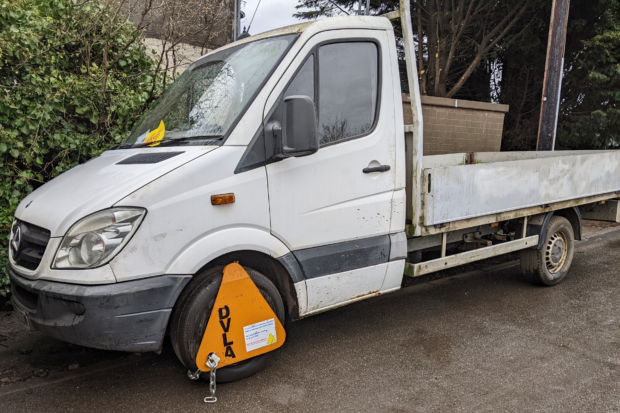
A white truck with a DVLA clamp on it.

However, there was no added extra time for this next vehicle. As we drove into a local industrial estate, thoughts of a fully taxed town were dashed when the ANPR camera detected an untaxed pick-up truck outside a mechanic’s workshop.

The team got to work immediately adding a new eye-catching accessory to the vehicle – a bright yellow DVLA clamp. As we were about to leave, the owner emerged from the yard with no one to blame but himself. As he paid his tax online on the spot plus a release fee, it was clear that he’d be taxing it, rather than risking it in the future!

The debrief

After an eventful 2 days, it was time to leave West Brom and head back to Swansea, but not before a debrief back at the pound. The visit gave us a real appreciation of the essential and sometimes difficult work undertaken by the enforcement team to crack down on vehicle tax evasion.

While more than 98% of vehicles on UK roads are taxed correctly, a small minority continue to break the law which costs HM Treasury millions of pounds every year – vital funds which would otherwise go towards public services.

It’s never been easier for motorists to tax their vehicles and there are a number of ways to do so from using our 24/7 online service to spreading the cost with Direct Debit options.

So remember, it’s important to make sure you tax your vehicle before using it on the road. It’s quick, easy and guarantees your vehicle avoids any yellow accessories or vehicle pound adventures! Tax it, don’t risk it.

Adblock test (Why?)