Notice: TR16 5BG, Mr David Fripp and Ms Peggy Bauch: environmental permit application advertisement
The Environment Agency consults the public on certain applications for waste operations, mining waste operations, installations, water discharge and groundwater activities. The arrangements are explained in its Public Participation Statement
These notices explain:
what the application is about
which Environment Agency office you can visit to see the application documents on the public register
when you need to comment by
The Environment Agency will decide:
whether to grant or refuse the application
what conditions to include in the permit (if granted
Press release: Warning for owners of unregistered boats after skippers prosecuted in Northamptonshire
Boat owners are being urged to make sure their vessels are registered – or face paying hefty fines.
The call comes after Environment Agency inspectors found two boats moored without their registration plates on the rivers Great Ouse and Nene.
The discovery resulted in the vessels’ owners being prosecuted and ordered to forfeit a combined total of more than £1,200.
Boats must be registered
It is a legal requirement for boaters to register any craft they keep, use or let for hire on Environment Agency waterways, and to clearly display a valid registration plate. Not doing so carries a maximum fine of £1,000, as well as a criminal record.
Mr Kevin Saggers of Lyn Road, Ely, and Mr Christopher King of Riverside Mead, Peterborough, both failed to register their vessels as required by law.
Mr Saggers, whose unregistered boat, named Lazy Lady, was found on 9 December 2016 on the Great Ouse at Littleport in Cambridgeshire, was proved guilty in absence and ordered to pay penalties totalling £734. Mr King, whose vessel, called Little Jo Larkin, was discovered on 26 July 2016 on the Nene at Stanground Marina in Peterborough, pleaded guilty and had to pay £493.
Their cases were heard at Peterborough Magistrates’ Court on 14 June and 22 June, respectively.
Offenders face £1,000 fines
Nathan Arnold, partnerships and development team leader at the Environment Agency said:
Our historic and precious waterways are an important part of our nation’s heritage and are enjoyed by hundreds of thousands of people every year.
A significant part of caring for them, protecting them, and ensuring people continue to enjoy them is funded by boaters paying their way. Those who don’t contribute as they should are threatening the future of our waterways – and we won’t hesitate to take action against them.
Unregistered boats are hazardous
As well as not contributing to the upkeep of waterways, unregistered boats can be unsafe, hazardous to other river users, and a pollution risk to the local environment.
The Environment Agency looks after 353 miles of navigable waterways in the Anglian network, which includes the Ancholme, Black Sluice, Glen, Welland, Nene, Great Ouse and Stour, as well as associated locks and navigation facilities like moorings, showers and toilets.
Guidance: How to trace, weigh and distribute fish products
Guidance on traceability, weighing and distribution of fish and fisheries products up to the point of first sale. For full details see Commission Implementing Regulation (EU) No 404/2011 of 8 April 2011 laying down detailed rules for the implementation of Council Regulation (EC) No 1224/2009 establishing a Community control system for ensuring compliance with the rules of the Common Fisheries Policy.
Fishery products must be traceable at all stages of production, processing and distribution, from catch or harvest to retail sale. As with all other European Union fisheries legislation, this continues to apply to UK vessels and waters.
Press release: Work starts on £11million North East flood scheme
The Environment Agency has joined forces with local businesses to reduce the risk of flooding to the community and give wildlife a boost in Teesside.
Work has started on the £11million project, which will increase flood protection from Greatham Creek while creating around 30 hectares of extra habitat.
The Environment Agency is working with local businesses in the area with SABIC UK providing funding towards the scheme and INOVYN ChlorVinyls providing some of their land for the additional habitat creation.
And they are working closely with partners at RSPB and Natural England to design and build a scheme which maximises benefits for the internationally designated habitat, and to ensure disruption to wildlife and visitors to the local area is kept to a minimum.
New habitat creation
The first phase of the project, which saw new flood defences built at Port Clarence to reduce flood risk from the River Tees at a cost of £4.5million, was finished in December 2015.
Phase two will see the Environment Agency raise existing flood embankments along Greatham Creek, to reduce the flood risk to Port Clarence and land which is south of the Creek.
There will also be a managed realignment of part of the current flood defences. This means a new embankment to the north of RSPB Saltholme Nature Reserve will be built around a larger area of land, and then the existing flood embankment will be breached.
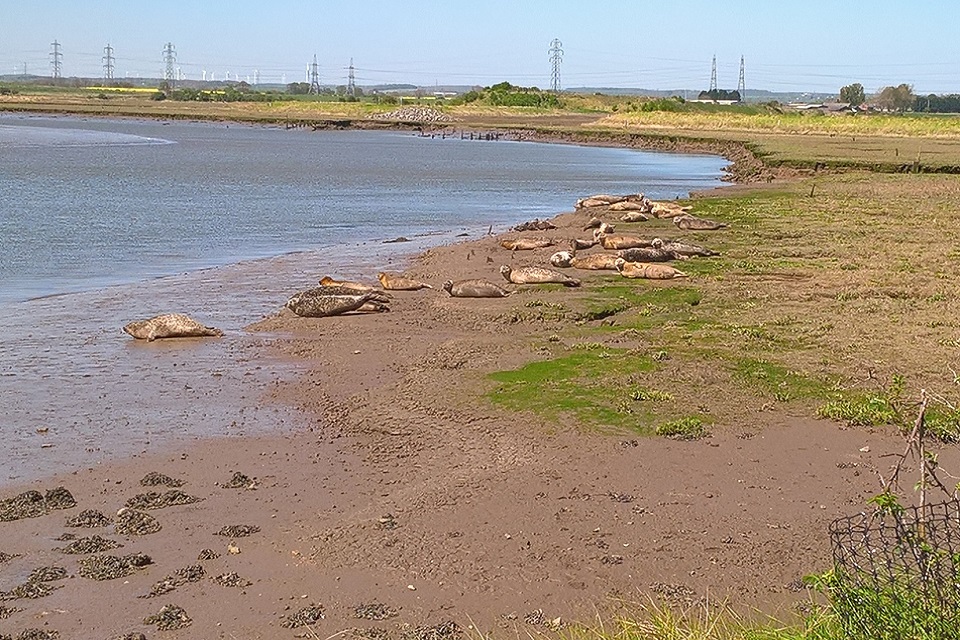
This results in the creation of around 30 hectares of intertidal habitat to the north of the nature reserve. It’s a popular area frequented by seals, and a variety of bird species including shelduck, knot and redshank.
Seals at Greatham Creek
Phase 2 is expected to be complete by the end of 2018. Together the projects reduce the risk of flooding from both the River Tees and Greatham Creek at Port Clarence, protecting 350 homes and 32 businesses.
‘Vastly improving existing defences’
The Environment Agency’s Senior Advisor on the scheme Phil Marshall said:
I remember well the devastating impact the tidal surge in December 2013 had on the area, affecting around 50 homes and businesses.
By working together with local industry we’re vastly improving existing defences to protect residents and businesses and reduce the risk of flooding now and into the future as sea levels start to rise.
It’s a great example of how we’re working closely with partners, businesses and communities to create long-term, sustainable solutions to flooding while also making enhancements to the environment.
This is a vital conservation area enjoyed by visitors from far and wide and we’re taking the opportunity to create 30 hectares of extra habitat to ensure wildlife continues to thrive.
In addition, while access to the creek is limited during the work, we are working with RSPB Saltholme to enable visitors to see live images from the creek of the ever popular seals.
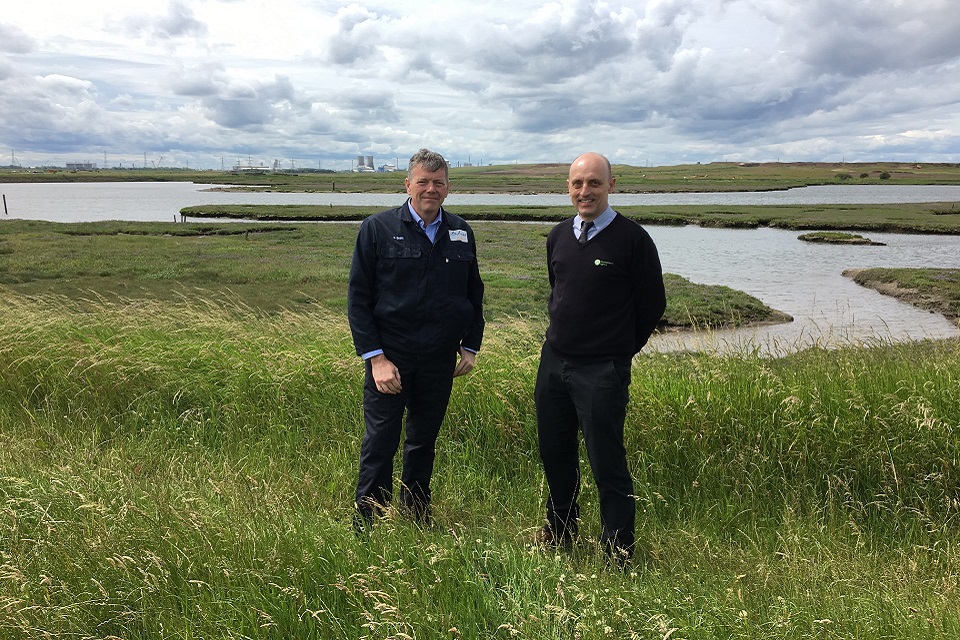
Image shows (L) Daren Smith, SABIC site director, and (R) Phil Marshall, Environment Agency Senior Advisor
Working in partnership
Daren Smith, SABIC Site Director (acting) added:
As a responsible company, SABIC take the protection of our environment and our communities extremely seriously. Our own land was devastated by the flood but our employees worked extremely hard and quickly with local agencies to rebuild some of the natural habitats that exist there.
SABIC are delighted to be working in partnership with the Environment Agency and other agencies to enable this vital sustainable project to be delivered.
Contractors BMMJV (BAM Nuttall and Mott MacDonald Joint Venture), are carrying out the work on behalf of the Environment Agency.
Phase 1 of the scheme saw new flood defences built in Port Clarence, consisting of a mixture of earth embankments, flood walls, and a raised section of the road on the approach to the Transporter Bridge.
In addition, the Environment Agency worked together with local business Wilton Engineering to install removable steel flood defences along the River Tees to improve flood protection while still allowing Wilton to operate from the river.
If you would like to know more about your risk of flooding and how to be prepared call Floodline on 0345 988 1188, or visit www.gov.uk/flood
News story: Minister celebrates world-class forest research
The world-leading role that UK research is playing in the fight against tree and plant pests was demonstrated to Environment Minister Thérèse Coffey recently during a visit to Forest Research in Edinburgh.
Forest Research is the UK’s principal organisation for forestry and tree related research and provides evidence and scientific advice in support of sustainable forestry. Between 2012 and 2019, the UK government will have invested more than £37 million into tree health research.
While at their Scottish base last week, the Minister learnt about the latest efforts to combat tree pests and diseases, forestry’s role in reducing climate change, and the best tree species to increase planting rates.
Speaking after her visit, Thérèse Coffey said:
We can all take pride in the UK’s world-leading forestry science and research which is making a vital contribution towards protecting our native trees and plants from pests and disease.
That is why we are continuing to invest millions of pounds into tree health research to shape the response that government and the forestry industry needs to take to keep our forests and woodlands healthy for future generations.
I also look forward to exploring further how institutions like Forest Research can contribute to government and industry’s continued drive to plant more trees.
Professor James Pendlebury, Chief Executive of Forest Research, said:
Forest Research is internationally renowned for the provision of science, research, evidence and forestry data services in support of sustainable forestry.
We were delighted to host Minister Coffey at our Northern Research Station, where we discussed tree health research and future management regimes to support tree planting in the light of climate change and biotic threats.
During her visit to Edinburgh, the Minister also held a roundtable with representatives from the forestry industry to discuss steps to increase tree planting.