Press release: Water companies make environmental improvements but Environment Agency urges more action

The majority of the UK’s water companies achieved close to or exceeded targets set to improve water quality, according to a new report published by the Environment Agency today.

Wessex Water and United Utilities were the top performing water companies, repeating last year’s success.
In a year when the Environment Agency introduced tougher standards, water companies made good progress in meeting the new targets. However, the total number of pollution incidents increased by 160 in 2016, the first increase since 2012.

While water companies continue to improve their reporting of pollution to ensure impact can be minimised and wildlife protected downstream, the Environment Agency has urged some water companies to make significant improvements to bring down pollution levels.

The report which ranks the nine big water and sewage companies in England on a range of measures needed to protect the environment also showed:

  • All companies achieved the target to complete work to build and upgrade infrastructure which will improve water quality, water resources and river biodiversity.

  • Eight out of nine water companies gained full marks for protecting water supply security. This is crucial following the dry winter as some rivers, reservoirs and groundwaters are lower than normal for the time of year but there are no water supply issues.

  • Safe recovery or disposal of sewage sludge took place 99.9% of the time and was mostly used to improve agricultural land, generate heat or power. And compliance with permits at sewage treatment and water treatment works is at 98.6% on average, while good is still short of the 100% target.

  • The number of serious pollution incidents has continued to decline. However there was an increase in total numbers of incidents and of the most damaging pollution incidents, nine up from four in the previous year.

Dr Toby Willison, Executive Director of Operations for the Environment Agency, said:

Water companies work hard to protect the environment. We have set more stringent targets and we are glad to see overall improvements but want to see more effort to avoid pollution incidents.

As a fair and effective regulator we are committed to publishing results, highlighting best practice but also taking action to address any poor practice.

While we welcome the good progress being made we will continue to address any failings and will take enforcement action in the most serious cases.

2016 was also the first year to see several million pound fines handed out by the courts to water companies for pollution incidents.

All water companies provide an essential public service and affect the health of rivers and how water can be used downstream by others. High environmental performance from water companies protects rivers and seas, supports wildlife and ensures people can enjoy the environment. Water companies also contributed £127 million last year to reduce risk of sewers flooding homes and protect local communities.

Annual water and sewerage company environmental performance reports are available on GOV.UK.


News story: Self-service approach reduces fees for some low-risk licences

The MMO has introduced an automated process for obtaining permission to carry out activities which are a low risk to the marine environment. Applicants are now able to self-assess their proposals against specific criteria using a new assistance tool. Where projects qualify they can complete an online form and instantly get a licence for their activity.

The new self-service scheme, which covers six categories of activity, has also enabled the MMO to reduce the associated cost for such applications from £175 to £50.

Some of the activities which may qualify for the new scheme are:

  • Burial at sea
  • Maintenance of existing structures and assets
  • Minor removals
  • Non-navigational clearance dredging
  • Beach maintenance activities
  • Deposit of markers

Continued improvement of marine licensing processes

Where people or organisations want to undertake activities in the marine area they may need prior permission (a ‘marine licence’) from the Marine Management Organisation under the Marine and Coastal Access Act 2009. Such activities may include construction, dredging, deposits or removal.

The MMO is continuing to enhance the marine licensing process to ensure that it is as efficient as possible, maximises value for money and proportionately manages risks to the marine environment.

It launched a fast-track scheme for some marine licence applications in 2013, which it extended in 2014. The MMO has carried out a further review of this process and the activities eligible for it. It has identified that a number of activities covered by the scheme were sufficiently consistent in nature and extent that they could be considered low risk to the marine environment and be suitable for self-service.

Proportionate approach to regulation

The MMO is able to lower the fee for such licences by removing the need for manual consideration by its case officers. Instead it has carried out risk-assessment work for the relevant activities in advance. As a result applicants who meet self-service criteria will be provided with a licence containing pre-determined standard conditions relevant to the activity selected.

The MMO is supporting applicants to assess their circumstances against self-service criteria by adding a function to its free online Geographical Information System (GIS). This tool helps applicants to understand any sensitivity associated with the location of their proposed activity and determine whether the self-service criterion is met.

More information about and guidance on the activities eligible for self-service processing is available in the marine licensing section.


News story: Self-service approach reduces fees for some low-risk licences

The MMO has introduced an automated process for obtaining permission to carry out activities which are a low risk to the marine environment. Applicants are now able to self-assess their proposals against specific criteria using a new assistance tool. Where projects qualify they can complete an online form and instantly get a licence for their activity.

The new self-service scheme, which covers six categories of activity, has also enabled the MMO to reduce the associated cost for such applications from £175 to £50.

Some of the activities which may qualify for the new scheme are:

  • Burial at sea
  • Maintenance of existing structures and assets
  • Minor removals
  • Non-navigational clearance dredging
  • Beach maintenance activities
  • Deposit of markers

Continued improvement of marine licensing processes

Where people or organisations want to undertake activities in the marine area they may need prior permission (a ‘marine licence’) from the Marine Management Organisation under the Marine and Coastal Access Act 2009. Such activities may include construction, dredging, deposits or removal.

The MMO is continuing to enhance the marine licensing process to ensure that it is as efficient as possible, maximises value for money and proportionately manages risks to the marine environment.

It launched a fast-track scheme for some marine licence applications in 2013, which it extended in 2014. The MMO has carried out a further review of this process and the activities eligible for it. It has identified that a number of activities covered by the scheme were sufficiently consistent in nature and extent that they could be considered low risk to the marine environment and be suitable for self-service.

Proportionate approach to regulation

The MMO is able to lower the fee for such licences by removing the need for manual consideration by its case officers. Instead it has carried out risk-assessment work for the relevant activities in advance. As a result applicants who meet self-service criteria will be provided with a licence containing pre-determined standard conditions relevant to the activity selected.

The MMO is supporting applicants to assess their circumstances against self-service criteria by adding a function to its free online Geographical Information System (GIS). This tool helps applicants to understand any sensitivity associated with the location of their proposed activity and determine whether the self-service criterion is met.

More information about and guidance on the activities eligible for self-service processing is available in the marine licensing section.


Press release: Calstock flood defence improvements

The existing Calstock flood embankment was improved in the 1980s following a significant flood in the village. It still plays an important role in reducing flood risk in Calstock, but requires periodic repairs.

In 2012/13 the Environment Agency carried out emergency work on just over 100 metres of the embankment. This work incorporated less than 10% of the total embankment length, but cost in excess of £300,000. Maintaining the current embankment in its existing location on a ‘patch and repair basis’ is not sustainable.

The Environment Agency is now looking at ways to continue to manage flood risk in the village. Likely options will include moving the existing embankment inland away from the river where it will be under less pressure from erosion.

Project manager Dan Boswell said:

It’s our priority to do everything we can to protect people from flooding.

Unfortunately the current embankment is no longer viable so we have to look at other options to maintain the current level of flood protection for Calstock. One of the options involves moving the existing embankment inland.

In addition to flood risk management benefits, moving the embankment would enable the creation of reed-bed habitat attracting additional wildlife. It is important to note that we are looking at all options which may be available to us. We will be talking to the community about these before final decisions are made.

The Environment Agency is looking to work with local partners to ensure that people can still use this area recreationally. Currently the Environment Agency has granted a permissive footpath across the embankment and they are keen that the footpath should continue in some form, but this will require the collaboration of local partners.

Over the next few months the Environment Agency’s consultants will be carrying out ground investigations and topographic surveys to help them develop suitable options. When they have developed these the Environment Agency will arrange a drop-in session in Calstock for the community to come along and view and comment on proposals. This is likely to take place in the autumn.

The Environment Agency is spending more than £2.5 billion to build flood schemes around the country, which will better protect 300,000 homes by 2021.


Press release: Special delivery for Kielder Salmon Centre

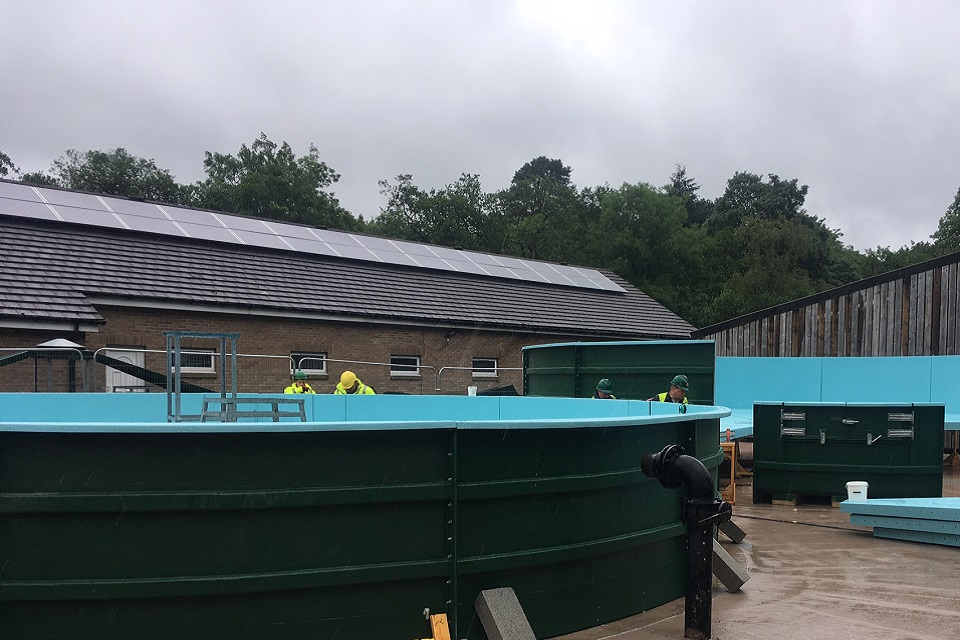
Two giant new fish tanks have been delivered to the hatchery at the Environment Agency’s Kielder Salmon Centre.

The fibre glass tanks, which measure 9 metres across by 1.5 metres deep, weigh more than 500kg and can hold 50,000 litres of water each, will be the final stop for thousands of young salmon before they are released into tributaries of the River Tyne.

The old tanks had been in use since the hatchery opened in 1980, and were at risk of failing and flooding the nearby office and visitor centre.

Image shows the new tanks being constructed

Young salmon will be ‘stronger and fitter’

Richard Bond, manager of Kielder Salmon Centre, said:

It was a relief to see the new tanks arrive safely, and our young salmon will be stronger and fitter in future because of the improved conditions we can now provide.

During the summer and autumn months up to 150,000 small fish aged between four to eight months will be stored in each tank.

There are only two manufacturers of tanks this size in the UK, so they had to be brought on a long road trip from Aberdeen down to the salmon centre.

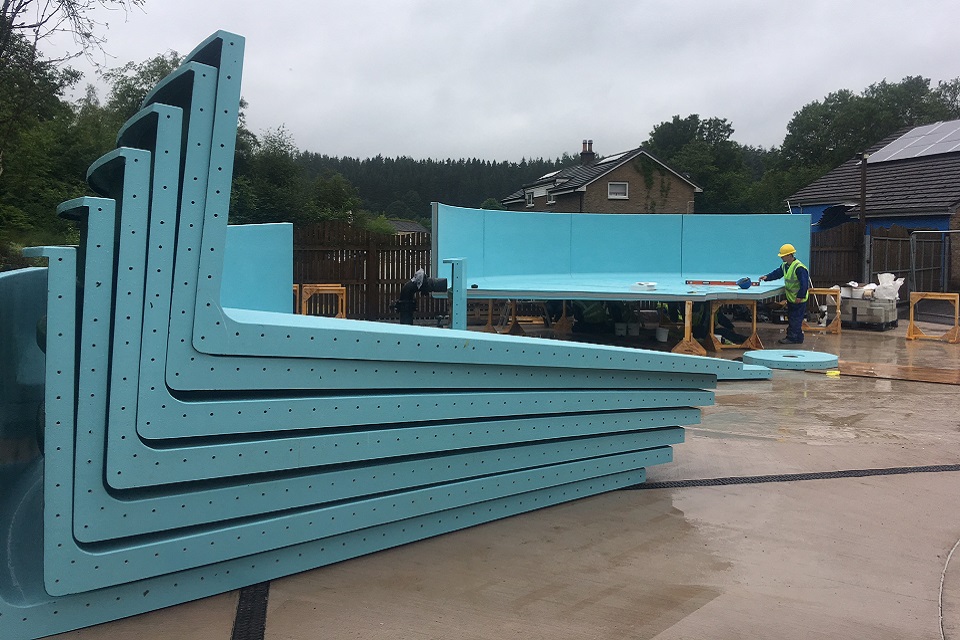
Image shows the new tanks being constructed

Specialist fitters were given the job of installing the £200,000 tanks on to concrete bases, specially strengthened to support the eventual 128 tonne weight of the tanks when filled.

The new concrete slab was laid with space and water supplies for five smaller tanks which it’s hoped will be installed in future as the work of the hatchery expands.

Kielder Salmon Centre is run by the Environment Agency and is open to visitors every day from April to September from 10am until 4pm. Visitors can take a self-guided tour to discover some incredible facts about the wild salmon, endangered freshwater mussels which are also looked after at the hatchery, and other interesting species in their local environment.