Press release: Companies pay nearly £30,000 to charity after pollution incident
Two companies have agreed to pay nearly £30,000 to a Norfolk charity after admitting their respective roles in a river pollution incident.
The pollution stemmed from rotting potatoes being stored in a warehouse rented by Lamb Weston/Meijer UK Ltd on land owned by Ralph Harrison & Co Ltd at Little Snoring Airfield, Norfolk.
As the potatoes decomposed they released liquid that entered the surface water drains at the site and subsequently passed into a tributary of the River Stiffkey at Little Snoring, near Fakenham, Norfolk.
The incident was reported to the Environment Agency in November 2015 and investigations were undertaken.
Environment Agency officers found that the liquid from the decomposing potatoes contained nutrients which affected a tributary of the River Stiffkey, reducing the dissolved oxygen in the water. This resulted in the death of fish and invertebrates in a 1km stretch of water.
It was found that Ralph Harrison & Co Ltd’s negligence had led to the pollution.
No written lease agreement was in place between the parties and no risk assessment had been prepared to set out what action would be taken to prevent the escape of polluting liquid.
Having taken into account the circumstances of the case, in particular the localised nature of the environmental harm, the action taken to prevent any further occurrences and the companies’ lack of previous convictions, the Environment Agency decided that in this instance, it would be appropriate to deal with the matter through Enforcement Undertakings (EU’s).
Lamb Weston offered to donate £23,100 to the Norfolk Rivers Trust for use in its projects around the River Stiffkey, while Ralph Harrison Co Ltd offered to donate £5,000 to the same charity.
Both companies agreed to take action to prevent such an incident happening again.
Lamb Weston employed a consultant to carry out an ecological survey, created a template emergency action plan, improved staff training and employed a new storage manager to be responsible for environmental management. It also improved potato storage processes and temperature systems and reimbursed Ralph Harrison & CO Ltd’s clean-up costs of £26,476.
Ralph Harrison & Co Ltd dredged the watercourse to remove remaining pollution and installed new valve and pump systems at the site to prevent any future incidents.
The companies now also have a written lease agreement, which had not previously been in place.
Marcus Sibley, Norfolk Environment Manager said:
Enforcement undertakings allow those who commit offences to restore the environment and to take steps to prevent a recurrence.
When appropriate, they allow a quicker resolution than a prosecution and help offenders who are prepared to take responsibility for their actions to put things right voluntarily working with their local communities.
The EU was offered in relation to an offence of pollution under Regulation 38 of the Environmental Permitting (England and Wales) Regulations 2010.
The EU was completed in February.
Transparency data: Weymouth Harbour Revision Order
On 11 May 2018, the Weymouth and Portland Borough Council made a formal application to the Marine Management Organisation (MMO) under section 14 of the Harbours Act 1964 for a Harbour Revision Order (HRO).
The proposed HRO would consolidate and modernise existing local statutory harbour legislation and confer further modernised powers on the Council. In particular, the HRO would confer powers on the Council to give general directions to vessels using Weymouth Harbour, together with powers by the harbour master appointed by the council to give special directions.
These powers are required to support the effective management of the vessels using Weymouth Harbour, as recommended in the Port Marine Safety Code. In addition the HRO would clearly define the harbour limits.
The application is undergoing a 42 day public consultation, starting on 21 May 2018. The deadline for submitting comments is 02 July 2018. For further information on the consultation process, please review the advertisement notice.
If you would like to make a representation please do so in writing via the harbourorders@marinemanagement.org.uk inbox. Representations should quote reference HRO/2018/00002.
Notice: HU12 0SU, Perenco UK Limited: environmental permit issued. EPR/PP3237CR/V005
The Environment Agency publish permits that they issue under the Industrial Emissions Directive (IED).
This decision includes the permit and decision document for:
Operator name: Perenco UK Limited
Installation name: Dimlington Gas Terminal
Permit number: EPR/PP3237CR/V005
Press release: Take care when buying your fishing licence online
The Environment Agency has received reports from anglers who have used third party websites and been charged up to double the price for a licence. There have also been instances of anglers being charged a fee but not receiving a licence as quickly as they would expect.
These websites are not endorsed by the Environment Agency and anyone wanting to buy a fishing licence should go direct to the GOV.UK website.
Please make sure you have the right website if you use a search engine to find GOV.UK. On the GOV.UK website you can buy a 12 month fishing licence from £30. Junior licences are free for 13-16 year olds at GOV.UK.
It’s quick and easy – just go to GOV.UK
Alternatively, you can call us on 0344 800 5386 or visit your local Post Office branch.
The GOV.UK site is the best way to give customers peace of mind knowing that whenever you go out fishing on waters that are open for angling you’ll be doing it legally. All fisheries licence income is used to fund work to protect and improve fish stocks and fisheries.
Kevin Austin, Deputy Director of Agriculture, Fisheries and the Natural Environment, Environment Agency said:
For complete peace of mind, make sure you visit GOV.UK to buy your fishing licence.
Money from fishing licences is used when we respond to fish kills, improving habitats for fish and facilities for anglers; plus fish restocking, invasive species eradication and working with partners to encourage people to take up fishing for the first time.
When customers purchase from GOV.UK they’ll receive a reference number allowing them to go fishing immediately.
Customers who use third party sites may not get this number immediately and will be considered to be fishing illegally if they go without a valid reference number or licence.
News story: NDA showcases the positive impact of nuclear clean-up in Scotland
The Nuclear Decommissioning Authority (NDA), the government organisation responsible for cleaning up the legacy from the UK’s early nuclear industry, held an event for Scottish Parliamentarians, stakeholders and representatives of Scottish communities to explain the environmental and economic benefits of the UK’s nuclear decommissioning programme.
(L-R): David Peattie, NDA CEO; Oliver Mundell, MSP; Gail Ross, MSP; Kenneth Gibson, MSP; Tom Smith, NDA Chair.
The NDA’s CEO, David Peattie, said:
The NDA’s 3 sites in Scotland have been at the leading edge of the UK’s nuclear industry for several decades, from Scotland’s first nuclear power station at Chapelcross, to the ground-breaking research at Dounreay and pioneering approaches to decommissioning and hazard reduction at Hunterston.
I am delighted to have had the opportunity to speak with such a diverse group of interested people about the NDA’s mission and the progress we’re making, but also about what we’re doing to leave a positive lasting legacy and support economic development, in partnership with the regeneration agencies, suppliers and local communities where we work.
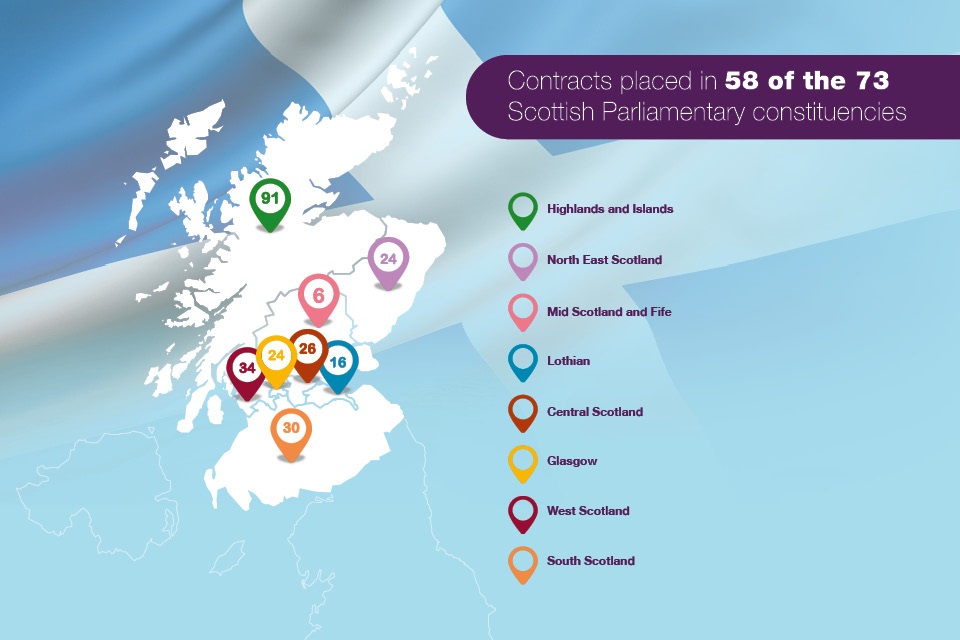
The NDA’s nuclear decommissioning programme is worth £280 million a year in Scotland, with over £22 million going to 250 contracts with Small and Medium-sized (SMEs) companies based in every region of Scotland. 58 of the 73 Scottish parliamentary constituencies are home to SMEs providing goods and services to support nuclear decommissioning across the whole of the UK.
An important part of the NDA’s work involves mitigating the impact of its decommissioning programme on these communities, working with partner organisations to encourage economic sustainability after the sites finally close. Since 2006, a total of £15 million of funding from the NDA has gone to support economic development initiatives in Scotland, and this has unlocked a further £50million of matched funding.
£300,000 to re-open a marine research centre on the island of Cumbrae, near Hunterston
Nuclear clean-up in Scotland
Almost 2,500 people working on NDA’s 3 Scottish sites.
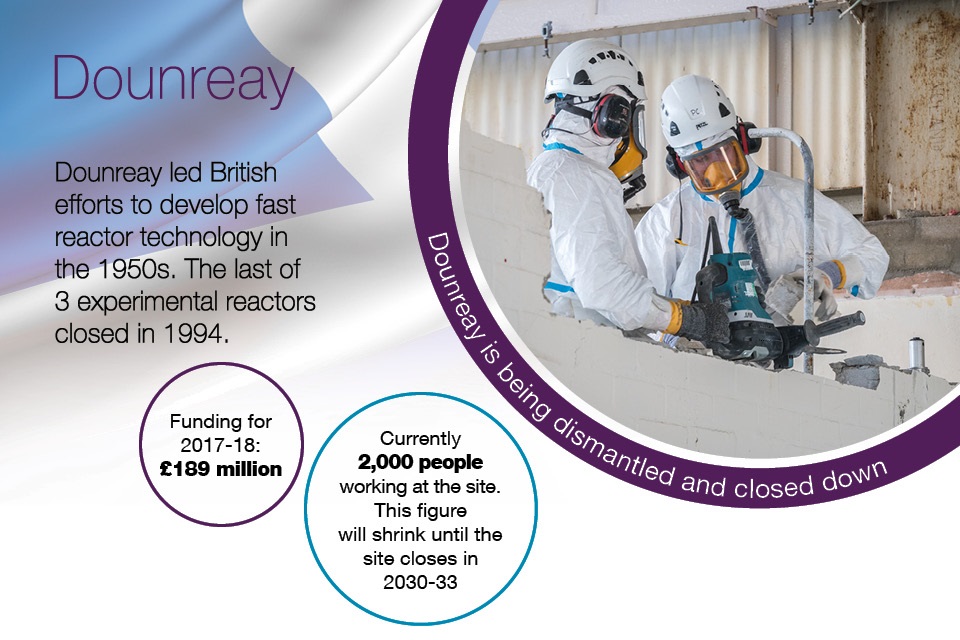
Dounreay
Dounreay led British efforts to develop fast reactor technology in the 1950s. The last of 3 experimental reactors
closed in 1994.
Dounreay is currently being dismantled and closed down.
Currently 2,000 people work at the site. This figure will shrink until the site closes in 2030-33.
Funding for 2017 to 2018: £189 million
Making the site safer by:
removal and destruction of hazardous metal coolant from 2 reactors
removing fuel elements that have been jammed for many years
completing preparations to demolish the oldest reactor on site
construction of underground vaults to dispose of Low Level Waste, in line with Scottish Government radioactive waste policy
treatment, packaging and immobilisation of hazardous liquid waste that has been stored for 20 years
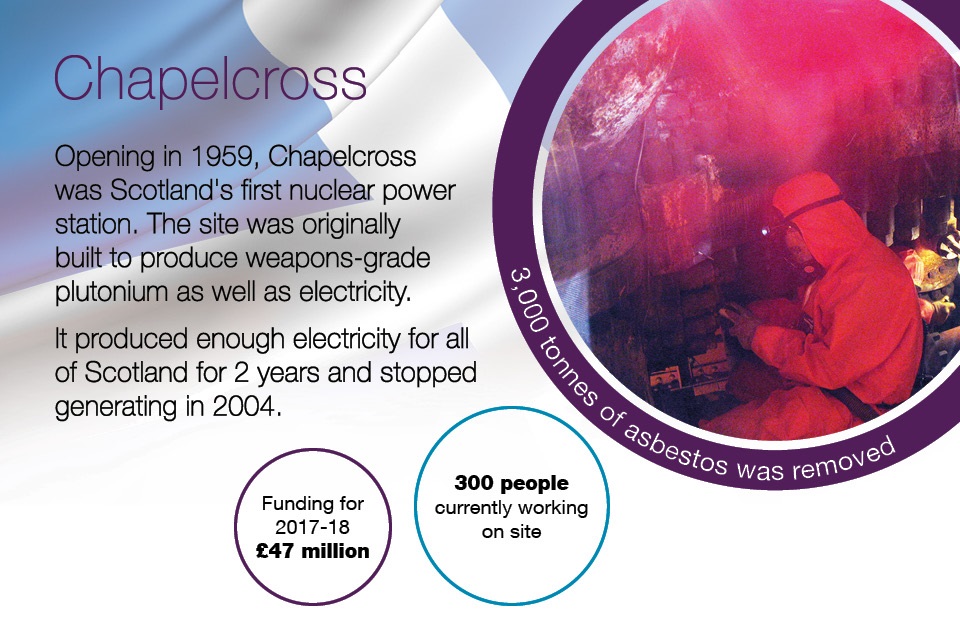
Chapelcross
Opening in 1959, Chapelcross was Scotland’s first nuclear power station. The site was originally built to produce
weapons-grade plutonium as well as electricity.
It produced enough electricity for all of Scotland for 2 years and stopped generating in 2004.
Around 300 people work at the site.
Funding for 2017 to 2018: £47 million
Making the site safer by:
removal of 3,000 tonnes of asbestos
spent fuel pond Number 1 emptied of radioactive waste, and drained
installation of equipment to process waste from pond Number 2
constructing a new storage facility for Intermediate Level Waste in line with Scottish Government policy for radioactive waste
structural steelwork and ducting removed from the 16 boilers
site closure in 2026
Hunterston A
Hunterston A opened in 1969 and generated electricity for 20 years.
The site produced enough electricity to power all Scotland for 3 years and will close in 2024.
Around 300 people work at the site.
Funding for 2017 to 2018: £42 million.
Making the site safer by:
installing aluminium cladding to weather-proof reactor buildings
spent fuel storage ponds emptied, drained and cleaned out
construction of shielded store for higher-activity waste
deploying robotic equipment to retrieve radioactive waste from 5 bunkers
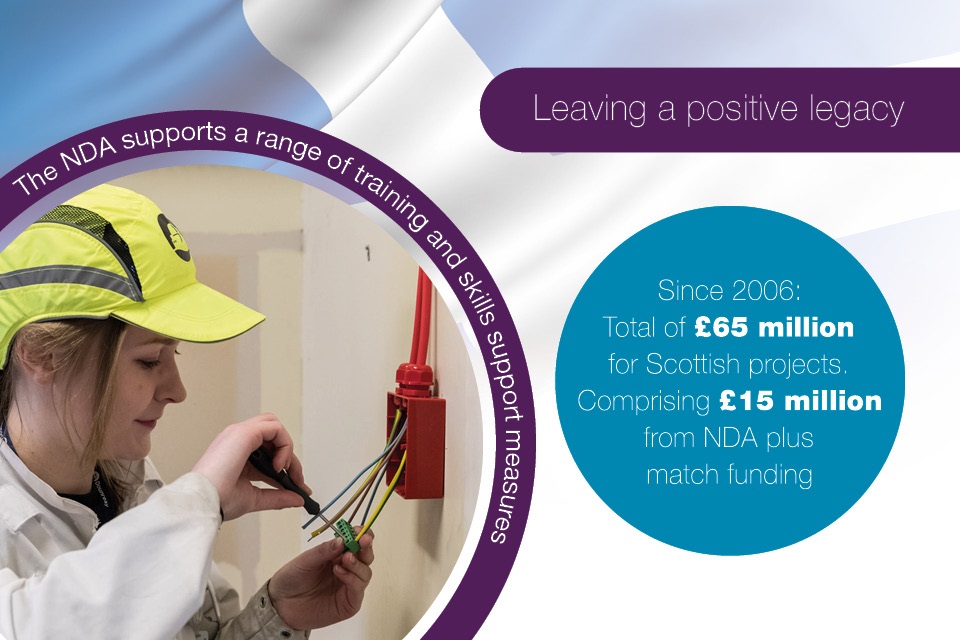
Leaving a positive legacy
The NDA is working with local communities to deal with the economic impact of closing sites.
Support is provided in partnership with local authorities and economic development bodies, with priorities focused on:
economic development initiatives
help for start-ups and business diversification
skills development and training
Since 2006: total of £65 million for Scottish projects. Comprising £15 million from NDA plus match funding.
Economic development examples
£2 million initial investment in Scrabster Harbour’s £20 million redevelopment programme:
underpins its fishing and tourism industries
enables the area to capitalise on the growing offshore renewables sector as well as oil and gas developments
£250,000 for North Ayrshire Youth Employment Scheme, aimed at tackling high unemployment rates among young people.
More than £14 million to a range of Caithness projects supporting economic diversification, employment initiatives, education and skills, social infrastructure and tourism.
£21 million nuclear archive for records from the entire UK nuclear industry. Located in Wick as part of the NDA’s commitment to help offset the economic impact of closing Dounreay.
£1.7 million for programmes at Chapelcross, working with Dumfries and Galloway Council, and Scottish Enterprise, to support local economic activities. Now focused on marketing land next to the site for industrial use, including renewables.
£300,000 to help re-open the UK’s oldest marine research centre on the island of Cumbrae, near Hunterston, which closed due to loss of grant funding.
Our Supply Chain
During 2016-17, 250 SMEs in Scotland were providing goods and services directly to the NDA’s English, Scottish and Welsh sites. The value of these contracts is around £22 million.
The NDA, through its businesses, Dounreay Site Restoration Ltd and Magnox Ltd, placed contracts with SMEs in every Scottish parliamentary region and in 58 of the 73 Scottish parliamentary constituencies.
Almost half of SMEs working for Dounreay are from the Caithness, Sutherland and Ross constituency, which represents the highest ‘buy local’ concentration of all NDA sites.