Press release: Expansion of wildlife protection sites in Essex

Two important sites for waterfowl in Essex have been afforded the strongest environmental protections available.

Allfleet’s Marsh and Brandy Hole, part of the Crouch and Roach estuaries, have now been made Special Protection Areas (SPA), Sites of Special Scientific Interest (SSSI) and designated as a Ramsar wetland of international importance.

Environment Minister, Thérèse Coffey said:

This is fantastic news for wildlife and the local community. The designation of this additional land into the existing protected area demonstrates that our management and stewardship of important wildlife habitats is achieving a high standard. We have committed to developing a Nature Recovery Network to protect and restore wildlife in our 25 Year Environment Plan. Through these plans we will be the first generation to leave the environment in a better state than we found it.

Both sites are now functioning as part of the Crouch & Roach Estuaries system. They support intertidal mudflats and developing saltmarsh and provide suitable habitat for the internationally important wintering water birds such as dark-bellied brent geese, lapwing, shoveler and golden plover amongst many other waterfowl species.

The Crouch and Roach Estuaries are an integral part of a continuous network of designated coastal habitats extending north from the Thames Estuary to the Colne Estuary, known as the Mid-Essex Coast.

Kate Jennings, Head of Site Conservation Policy, RSPB said:

The Essex coast used to be a place full of amazing and abundant wildlife, but over the last 400 years, land claim for agriculture, coastal erosion and rising sea levels have taken their toll. The extended designation recognises the importance of new mudflats and saltmarsh created to offset past losses, and is a major step towards restoring this spectacular place. The designation, protection and management of our finest and most valuable places for wildlife will be key in achieving this Government’s 25 Year Environment Plan, and this designation is particularly welcome as it will protect areas immediately adjacent to the RSPB’s Wallasea Island Wild Coast project, where we are working with partners including Defra and the Environment Agency to create more coastal habitat for people and nature.

Approximately 95 per cent of the area of our Sites of Special Scientific Interest and about 60 per cent of the total area of our most important or ‘priority’ wildlife habitats is now in good condition for wildlife or has management in place to restore its condition.

Since 2011 we have established management on approximately 130,000 hectares of land to create new wildlife-rich habitat in the wider countryside.


Press release: £1m culvert repair work to reduce flood risk set to begin

The £1million culvert repair project is due to start on Monday 23 July and is expected to take 13 weeks to complete.

Environment Agency contractors, JBA Bentley, will be on site to carry out the work in the Lancashire town to make Victoria Clough culvert structurally sound.

Culverts are structures which carry water underground. They were often built to allow development to take place around them such as roads, homes and businesses. Many people live and work near culverts and may not even know they are there.

A new culvert will be installed beneath the disused railway embankment to replace the existing one which has collapsed. The team will also re-line or replace a number of sections along the length of the culvert at locations under Victoria Road and the A56 Skipton Road.

A new and improved trash screen will also be fixed at the inlet of the culvert, to help reduce the risk of it becoming blocked with debris and making it easier and safer to clear when water levels are high.

During the period of work there will be disruption to traffic using the A56 and Victoria Road. There will need to be road closures on Valley Road and New Road with local diversions and temporary traffic lights put in place, and some parking restrictions on Victoria Road.

Paul Swales flood risk advisor at the Environment Agency said:

Earby has suffered devastating flooding over recent years, most notably the Boxing Day 2015 flood. We’re pleased to be starting this repair work which will bring significant flood risk benefits to homes and businesses.

We understand that this traffic management could cause some inconvenience so we will do all we can to minimise this disruption as much as possible. We’d like to thank residents and businesses for their patience and understanding while we carry out this essential work to reduce flood risk.

Funding for the project comes from £813k of Grant in Aid and £200k of Yorkshire Local Levy.

Since the floods of Boxing Day 2015, the Environment Agency has worked in partnership with Pendle Borough Council, Lancashire County Council and Yorkshire Water to develop schemes to reduce flood risk in Earby.

Options explored

The Environment Agency continues to explore other options to reduce flood risk from all sources in and around Earby. Over the next 12 months, the team will investigate the options in more detail, which include flood storage areas on Earby Beck, the New Cut and Victoria Clough and installing a flood defence wall at Boot Street.

The Environment Agency is looking for volunteer flood wardens to play a key part in keeping Earby prepared and informed before, during and after a flood. Anyone interested in becoming a flood warden can email heather.cottrill@environment-agency.gov.uk to find out more.

By signing up to the Environment Agency’s free Flood Warning service residents and businesses can receive flood alerts and flood warnings for Earby Beck and/or Earby New Cut directly to their phone and emails, 24/7. Find out if you’re at risk and register for free flood warnings.


Notice: WV13 2QF, Scanmetals (UK) Limited: environmental permit issued

The Environment Agency publish permits that they issue under the Industrial Emissions Directive (IED).

This decision includes the permit, decision document for:

  • Operator name: Scanmetals (UK) Limited
  • Installation name: Scanmetals (UK) Limited
  • Permit number: EPR/QP3237YA/V002


Press release: Milestone for managing seas in South of England reached

The Government has now adopted England’s South Marine Plan, which brings a new approach to managing the seas between Kent and Devon.

The new marine plan provides a policy framework which will be used to help inform decision-making on what activities take place in the marine environment and where how the marine environment is developed, protected and improved in the next 20 years. It will inform and guide decisions by regulators managing the development of industry in marine and coastal areas, while conserving and enhancing the environment and recognising leisure uses.

The marine plan, produced by the Marine Management Organisation (MMO) on behalf of the Department for Environment, Food and Rural Affairs, is the culmination of around 5 years of engagement with business, charities, representative organisations and individuals.

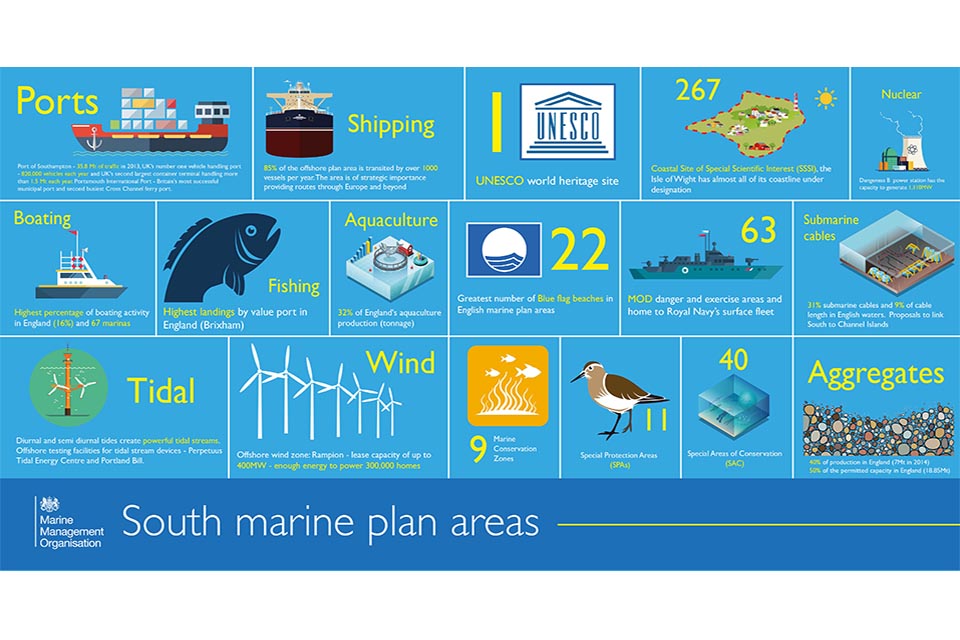
The plan will help business realise the economic benefits available from the Marine Plan area whilst ensuring the marine environment remains protected. Covering an area of approximately 1,700 kilometres of coastline and over 21,000 square kilometres of sea, the plan stretches from Felixstowe in Kent to the River Dart in Devon. This is a very dynamic marine area incorporating 9 world heritage sites and some of the busiest shipping channels in Europe.

The MMO is now working with Local Authorities in the area to ensure successful implementation of the new Plan.

Environment Minister Thérèse Coffey said:

The South Marine Plan is a significant milestone in our ambition to create healthy and biologically diverse seas and oceans, as outlined in our 25 Year Environment Plan.

Stretching from Kent to Devon, this is one of the most complex areas of the English coast and this plan will allow us to safeguard our sea life while supporting a more sustainable marine economy.

John Tuckett, Chief Executive Officer at the Marine Management Organisation, said:

This is a significant milestone for one of the most complex and used areas of the English coastline.

The South Marine Plan will help ensure that when activities take place, they happen in the best location and in the right way within the marine environment. We are now working closely with decision makers and stakeholders along the coast to ensure that the Plan is understood and used effectively.

By 2021 all English marine area will have marine plans in place. The South Marine Plan is the second to be adopted following the introduction of the first English marine plan established in the East of England in 2014.

South marine plan infographic

Notes to editors

short animation film to explain marine planning

Further background on marine planning:

  • There are 11 English marine plan areas, including inshore and offshore areas. Work continues to produce plans for the South East, South West, North East and North West, the target for adoption of the remaining plans is before March 2021.
  • Marine planning addresses the key issues for the marine area, including the coast, estuaries and tidal waters, as well as developments that impact on these areas. The plans will include a vision, objectives and detailed policies on how these objectives will be achieved.
  • Marine plans are used by public authorities as part of the decision making process for all new activities and developments in or affecting the marine area.
  • Marine plans build on the requirements of the Marine and Coastal Access Act and the Marine Policy Statement.

More information on marine plans is available elsewhere on GOV.UK

How will marine plans be used?

The plan is brought into effect through its use in decision-making. All public bodies are legally required to make all authorisation and enforcement decisions which are likely to affect the marine areas in accordance with marine plans, unless an exception states otherwise.

Such decisions vary widely and include The Crown Estate leasing the seabed for renewable energy, Environment Agency permitting of flood and coastal defence works and water discharges, Local Planning Authorities (LPAs) determining planning permissions, to Inshore Fisheries and Conservation Authorities (IFCAs) making fisheries byelaws.

The MMO will implement the adopted marine plans across all decision-making functions, including:

  • Marine licensing
  • Marine compliance and enforcement
  • Fisheries management and effort control
  • European Fisheries Funding
  • Coastal operations

The MMO is working to support other relevant authorities to adopt/implement the South Marine Plan in their decision-making processes.

The plans aren’t an enforcement tool as such, more a policy framework for the future use of the sea. (It’s not a law change in that people aren’t being expected to change currently occurring activity to comply with the plan.)

Will the plans result in activities being banned?

The plans are not a list of prohibited activities, but a strategic vision for the sustainable use of shared marine environment seeking to maximise opportunity and encouraging co-existence between many differing marine activities.


Statutory guidance: The South Marine plans documents

Updated: Modification report added

Published July 2018 the South Inshore and South Offshore Marine Plan provides guidance for sustainable development from Folkstone in Kent to the River Dart in Devon.

Marine plans address the key issues for the area, setting a vision and objectives. Detailed policies set out how these will be achieved and how issues will be managed or mitigated. The policies inform decision-making for any activity or development which is in or impacts on a marine area.

Our Marine Information System (MIS) supports decision-makers and applicants using the South Marine Plan. It includes overview of each plan policy by sector and a searchable map of relating data and evidence.

In developing the South Inshore and Offshore Marine Plan we have also published:

  • habitats regulations assessment
  • sustainability appraisal
  • approach to monitoring
  • modification report

Marine plans place sustainability at the centre of all decisions.

The Sustainability Appraisal (SA) provides an independent assessment of economic, social and environmental sustainability.

Public consultation on the Draft South Marine Plan and Draft Technical Annex was held between the 7 November 2016 and the 27 January 2017.

Following this consultation in accordance with the Marine and Coastal Access Act (S15 (7)), the Marine Management Organisation (MMO) are required to publish statements detailing any modifications made to the consultation draft and the reasons for the modifications. The south plan areas Statement of Public Participation describes how the MMO will analyse all responses to the consultation and produce a summary report setting out comments received and changes made to the plans as a result.

The purpose of this document is to summarise:

  • engagement process on the consultation draft
  • responses received, provide an overview of the levels of agreement with the plans supporting sustainable development and compliance with the Statement of Public Participation
  • changes made from the consultation draft to the South Marine Plan and Technical Annex