TMH appeals to public for missing patient

The following is issued on behalf of the Hospital Authority:

     The spokesperson for Tuen Mun Hospital (TMH) made the following appeal today (April 17) regarding an incident of an in-patient who left the hospital without notifying the ward staff:

     A 24-year-old male in-patient with unstable emotion left the hospital without notifying ward staff at around 3:30pm today. The security guards performed a full-scale search within the hospital compound immediately but unable to locate the patient.  TMH is very concerned about the incident and has reported to the police immediately.  The hospital is fully co-operating with the Police in the search. The patient's relative has been notified.

     The concerned patient is around 160cm tall with short hair. According to CCTV footage, the patient was in grey short sleeves top, dark blue shorts and barefoot when leaving TMH from the exit near the laundry and ran towards Tsing Chung Koon Road.

     The hospital appeals to the public to contact Tuen Mun Police Station at 3661 5810 if they know the whereabouts of the patient.


LegCo Finance Committee meetings

The following is issued on behalf of the Legislative Council Secretariat:

     The Legislative Council (LegCo) Finance Committee (FC) will hold a meeting from 9.35pm to 11.30pm today (April 17) in Conference Room 1 of the LegCo Complex.  During the meeting, FC members will continue to deliberate on the support measures for individuals and businesses impacted by the COVID-19 pandemic.  If the deliberation on the agenda item cannot be finished at today's meeting, an additional meeting will be held tomorrow (April 18) from 9am to 1pm in Conference Room 1 of the LegCo Complex.


CHP investigates four additional cases of COVID-19

     The Centre for Health Protection (CHP) of the Department of Health has announced that as of 4pm today (April 17), the CHP was investigating four additional confirmed cases of COVID-19, taking the number of cases to 1 022 in Hong Kong so far (comprising 1 021 confirmed cases and one probable case).
 
     In addition, the DH has been closely monitoring and reviewing the health quarantine and COVID-19 testing arrangements for inbound travellers. Starting from this Sunday (April 19), apart from the existing requirement that asymptomatic inbound travellers arriving on flights from the UK, the US and other areas in Europe have to proceed to the DH's Temporary Specimen Collection Centre (TSCC) at the AsiaWorld-Expo to collect their deep throat saliva samples and wait for the test results there, passengers arriving on other flights landing in mornings are also required to wait for the test results at the TSCC after collecting their deep throat saliva samples there.
 
     Given the increased number of passengers who will be waiting at the TSCC, the DH has implemented stringent infection control measures to protect the health of passengers. If the number of passengers on the flights from the above areas/time slot exceed the maximum capacity of TSCC, the passengers will be allowed to go home or a designated place after specimen collection for compulsory quarantine. If tested positive, they will be arranged for admission to hospital as soon as possible for treatment while their close contacts will be sent to designated quarantine centres. For those who are tested negative, they can go home or to a designated place to continue completion of the 14-day compulsory quarantine.
 
     Meanwhile, starting from today, people arriving in Hong Kong who have been to Daegu and Gyeongsangbuk-do in Korea, Iran or Emilia-Romagna, Lombardy and Veneto regions in Italy in the past 14 days are required to undergo compulsory quarantine at home or a designated place, the same arrangement as other travellers arriving from other countries/areas.
 
     The newly reported cases announced today involve one male and three females aged between 13 and 55. Among them, all had a travel history during the incubation period and three are overseas students. The CHP's epidemiological investigations and relevant contact tracing on the confirmed case are ongoing. For case details and contact tracing information, please see the Annex.
 
     The CHP urged members of the public to maintain an appropriate social distance with other people as far as possible in their daily lives. In particular, they should go out less and avoid social activities such as meal gatherings or other gatherings to reduce the chance of contacting infected persons, who may not present any symptoms, and minimise the risk of outbreak clusters emerging in the community.
      
      A spokesman for the CHP said, "In view of the proliferation of the disease and continuous increase in the number of cases reported around the world, members of the public are strongly urged to avoid all non-essential travel outside Hong Kong.
 
      "The CHP also strongly urges the public to maintain at all times strict personal and environmental hygiene, which is key to personal protection against infection and prevention of the spread of the disease in the community. On a personal level, members of the public should wear a surgical mask when having respiratory symptoms, taking public transport or staying in crowded places. They should also perform hand hygiene frequently, especially before touching the mouth, nose or eyes.
 
      "As for household environmental hygiene, members of the public are advised to maintain drainage pipes properly, regularly pour water into drain outlets (U-traps) and cover all floor drain outlets when they are not in use. After using the toilet, they should put the toilet lid down before flushing to avoid spreading germs."
 
      The CHP will report the cases to the World Health Organization, the National Health Commission, the Health Commission of Guangdong Province, relevant health authorities and the Hospital Authority.
 
      The CHP has set up hotlines (2125 1111 and 2125 1122), which operate from 8am to midnight daily, for public enquiries. As at 4pm today, a total of 93 638 calls were received.
 
      Moreover, the Government has launched the website "COVID-19 Thematic Website" (www.coronavirus.gov.hk) for announcing the latest updates on various news on COVID-19 infection and health advice to help the public understand the latest updates.
 
      To prevent pneumonia and respiratory tract infection, members of the public should always maintain good personal and environmental hygiene. They are advised to:

• Wear a surgical mask when taking public transport or staying in crowded places. It is important to wear a mask properly, including performing hand hygiene before wearing and after removing a mask;
• Perform hand hygiene frequently, especially before touching the mouth, nose or eyes, after touching public installations such as handrails or door knobs, or when hands are contaminated by respiratory secretions after coughing or sneezing;
• Maintain drainage pipes properly and regularly (about once a week) pour about half a litre of water into each drain outlet (U-trap) to ensure environmental hygiene;
• Cover all floor drain outlets when they are not in use;
• After using the toilet, put the toilet lid down before flushing to avoid spreading germs;
• Wash hands with liquid soap and water, and rub for at least 20 seconds. Then rinse with water and dry with a disposable paper towel. If hand washing facilities are not available, or when hands are not visibly soiled, performing hand hygiene with 70 to 80 per cent alcohol-based handrub is an effective alternative;
• Cover your mouth and nose with tissue paper when sneezing or coughing. Dispose of soiled tissues into a lidded rubbish bin, then wash hands thoroughly; and
• When having respiratory symptoms, wear a surgical mask, refrain from work or attending class at school, avoid going to crowded places and seek medical advice promptly.



Appeal for information on missing man in North Point (with photo)

     Police today (April 17) appealed to the public for information on a man who went missing in North Point.

     Ko Chin-ho, aged 49, went missing after he left his residence on Fortress Hill Road on April 14 morning. His family made a report to Police on April 16.

     He is about 1.7 metres tall, 59 kilograms in weight and of thin build. He has a round face with yellow complexion and short black hair. He was last seen wearing a pair of black-rimmed glasses, a beige long-sleeved windbreaker, black trousers and grey sports shoes.

     Anyone who knows the whereabouts of the missing man or may have seen him is urged to contact the Regional Missing Person Unit of Hong Kong Island on 2860 1040 or 9886 0034 or email to rmpu-hki@police.gov.hk, or contact any police station.


Photo  


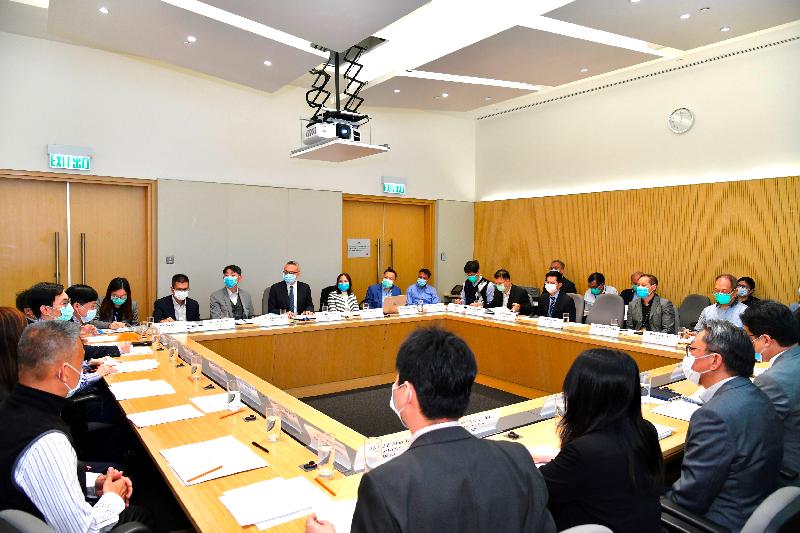
Government steps up mosquito prevention and control work (with photo)

     In view of the first local dengue fever (DF) case recorded this year, the inter-departmental Pest Control Steering Committee held a special meeting today (April 17) to review immediate actions taken to tackle the case and inter-departmental collaboration. Various bureaux and departments will stay vigilant to carry out mosquito prevention and control measures in order to reduce the risk of spreading DF in Hong Kong.
 
     In addition to advising people to take personal protective measures, the Government urges members of the public to always maintain strict environmental hygiene and remove stagnant water in a timely manner in outdoor and household settings with a view to minimising mosquitoes breeding and preventing the spread of DF and other mosquito-borne diseases.
 
     The Centre for Health Protection (CHP) of the Department of Health (DH) briefed the meeting on the latest situation and risk assessment of DF. The Food and Environmental Hygiene Department (FEHD) gave an account of the vector investigation and the mosquito prevention and control work conducted immediately at the areas within a 500-metre radius of the patient's residence in Sung Shan New Village in Yuen Long. These included collecting mosquito samples for DF virus tests, conducting fogging operations, spraying larvicide, putting in place additional new mosquito traps, and distributing DF prevention promotional leaflets to villagers. Also, the FEHD has already enhanced environmental management of the area, including removal of waste, disposal of articles that may contain water, clearing of stagnant water and keeping drains free of blockage.
 
     Various departments resolved to enhance comprehensive mosquito prevention and control work in areas under their purview in the coming few days, which include identifying black spots of mosquito infestation for immediately carrying out fogging operations, clearing of stagnant water and putting in place new mosquito traps at suitable locations. All parties will persevere in taking forward the related works.
 
     To target mosquito problems in rural areas, the Home Affairs Department will contact local groups to raise the anti-mosquito awareness of the public and take action, which will include disposing of articles that may contain water, clearing of stagnant water, and putting in place mosquito traps in private premises to reduce the number of adult mosquitoes.
 
     The Steering Committee has mapped out the work plan and targets for this year in January. Various departments have simultaneously started carrying out anti-mosquito works this month as planned to eliminate breeding grounds early, and at the same time commenced fogging operations that will continue until the end of the rainy season.
 
     Apart from releasing the Gravidtrap index to reflect the distribution of Aedes albopictus, the FEHD will also release the density index from this month to better quantify the effectiveness of mosquito control work as well as to enable various departments to grasp mosquito infestation conditions and conduct more targeted control measures. Starting this month, the FEHD has put in place about 5 000 newly designed Gravidtraps across the territory as a replacement for the ovitraps currently in use so as to directly count the population of adult mosquitoes.
 
     With regard to the experience of rodent prevention and control work in the past, the FEHD found that the condition of some of the back alleys are still not up to satisfaction. In particular, improper disposal of food waste by food premises and accumulation of miscellaneous items in back alleys have occurred repeatedly. Targeting irregularities of food premises such as food preparation, scullery and illegal dumping of refuse in back alleys, the FEHD will take more stringent enforcement actions as well as enhance environmental hygiene. In addition, various departments will target repair works that are usually more prone to rodent infestation and step up rodent control work at facilities including flower beds and gullies.
 
     The FEHD is conducting field trials of thermal imaging cameras with an artificial intelligence analytical function in Kowloon City District for recording rodent activity and the extent in order to collect data to upgrade the quantifying functions of rodent surveillance. At the meeting, the FEHD reported the progress of the field trials and explained how to apply the technology in measuring rodent activity. Before and after carrying out an anti-rodent operation in designated target areas in nine districts in May, the FEHD will also install thermal imaging cameras for analysis with a view to quantifying and reviewing the effectiveness of the operation. The FEHD is conducting tests on a poisonous bait with food flavours and is also testing a new break back trap during the special operations in six public markets. Being more sensitive than traditional traps, the newly designed break back traps are more effective in catching rodents. The tests are expected to be completed in July. If proved to be effective, they will be put into more extensive use.
 
     Representatives from three bureaux, 21 departments and an organisation attended today's meeting.
 
     Members of the public may visit the websites of the FEHD (www.fehd.gov.hk/english/pestcontrol/Pcas.html) and the CHP under the DH (www.chp.gov.hk/en/features/38847.html) for more information on pest control and dengue fever.

Photo