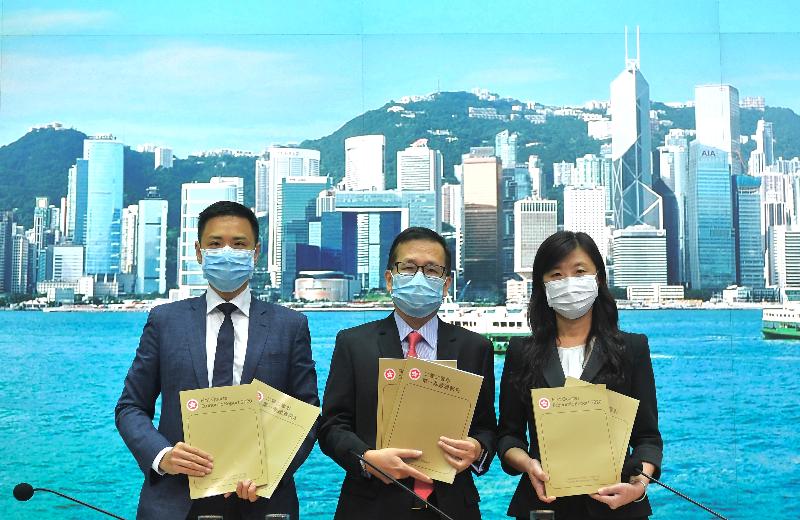
The Government released today (May 15) the First Quarter Economic Report 2020, together with the revised figures on Gross Domestic Product (GDP) for the first quarter of 2020.
The Government Economist, Mr Andrew Au, described the economic situation in the first quarter of 2020 and the latest GDP and price forecasts for 2020.
Main points
* The economic recession deepened in Hong Kong in the first quarter of 2020, as the threat of COVID-19 and the necessary anti-epidemic measures seriously disrupted a wide range of local economic activities and supply chains in the region. With the disease evolving into a pandemic in March, the economic fallout became even more severe. Real GDP contracted sharply by 8.9% in the first quarter from a year earlier, after declining by 3.0% in the preceding quarter. On a seasonally adjusted quarter-to-quarter comparison, real GDP plunged by 5.3% in the first quarter, after a decrease of 0.5% in the preceding quarter. Both rates of decline were the steepest for a single quarter on record.
* Total exports of goods saw a visibly enlarged year-on-year fall of 9.9% in real terms in the first quarter, weighed by the serious disruptions to economic activities in the Mainland, the regional supply chains and related trading activities amid the threat of COVID-19, and later by sharp moderation of economic activities worldwide. Exports of services plummeted by a record 37.8% in real terms from a year earlier, with inbound tourism at a standstill in February and March and cross-boundary transport and commercial services falling distinctly.
* Domestic demand weakened markedly. The year-on-year fall in private consumption expenditure widened sharply to 10.1% in real terms in the first quarter, as the threat of COVID-19 and resulting social distancing measures seriously disrupted consumption-related activities, while austere labour market conditions dealt a heavy blow to consumer sentiment. Overall investment expenditure continued to show a sharp year-on-year contraction of 14.3% in real terms amid subdued business sentiment and falling construction activity.
* The labour market showed further sharp deterioration in the first quarter. The seasonally adjusted unemployment rate soared to 4.2%, the highest in more than nine years. The underemployment rate likewise increased notably to an almost 10-year high of 2.1%. Total employment saw a record decrease.
* The local stock market showed a notable correction in the first quarter, with market sentiment hard hit by the economic fallout of the COVID-19 pandemic. The residential property market lacked clear direction amid immense uncertainties about the impact of the pandemic and the resultant large-scale monetary easing measures by the major central banks. Trading activities slowed down visibly, while flat prices edged down by 1% during the quarter.
* Looking ahead, as many major economies are still facing the serious threat of COVID-19, the global economy may continue to experience sharp contraction in the near term despite the massive monetary and fiscal support measures from central banks and governments worldwide. The progress of reopening the major economies and thus the timing and speed of recovery of the global economy will hinge on the developments of the pandemic and global public health situation, which are subject to huge uncertainties. Besides, the US‑Mainland economic and trade relations, geopolitical tensions and global financial market volatility continue to warrant attention. Amid a still austere external environment, Hong Kong's export performance will remain under pressure in the near term.
* Recently there have been signs that the epidemic is getting contained in Hong Kong. However, local economic activities indicate that business sentiment has remained subdued. As inbound tourism is likely to remain at a standstill until the pandemic is well contained and travel restrictions are gradually eased, the business environment facing the consumption- and tourism-related sectors will remain challenging in the near term.
* Considering the sharp economic contraction in the first quarter, the high uncertainties surrounding the pandemic, the difficult global economic situation, but also the cushioning effects of the massive relief measures rolled out by the Government, the real GDP growth forecast for 2020 as a whole has been revised downwards to -4% to -7%, as announced by the Financial Secretary on April 29. If the local epidemic remains well contained and our major trading partners are successful in reopening their economies, Hong Kong's economic performance will hopefully improve gradually in the second half of the year. The Government will continue to closely monitor the situation and introduce measures as necessary to support enterprises and safeguard jobs.
* Underlying consumer price inflation edged down to 2.9% in the first quarter from 3.0% in the preceding quarter. Inflationary pressure is likely to ease in the near term. Domestic cost pressures should continue to abate amid the austere local economic situation. External price pressures are expected to subside further in view of the deep global recession and the recent strengthening of the Hong Kong dollar along with the US dollar. Taking into account these factors and the actual outturn in the first quarter, the forecast rates of underlying and headline consumer price inflation for 2020 as a whole are revised downwards to 2.2% and 1.4% respectively, from 2.5% and 1.7% as announced in the Budget.
Details
GDP
According to the revised data on the GDP released today by the Census and Statistics Department, GDP contracted sharply by 8.9% in real terms in the first quarter of 2020 from a year earlier (the same as the advance estimate), after declining by 3.0% in the preceding quarter. On a seasonally adjusted quarter-to-quarter comparison, real GDP plunged by 5.3% in the first quarter (the same as the advance estimate), after a decrease of 0.5% in the preceding quarter (Chart).
The latest figures on GDP and its major expenditure components up to the first quarter of 2020 are presented in Table 1. Developments in different segments of the economy in the first quarter of 2020 are described below.
External trade
Total exports of goods plunged by 9.9% in real terms in the first quarter of 2020 from a year earlier, visibly larger than the 2.5% fall in the preceding quarter. Both exports to the Mainland and re-exports of Mainland origin dived in the first two months of the year combined as the threat of COVID-19 caused serious disruptions to economic activities in the Mainland, regional supply chains and related trading activities. For the first quarter as a whole, exports to the Mainland fell moderately. Exports to the US and the EU recorded further sharp falls, partly due to plunging demand in March when the disease spread to most parts of the world. Exports to many other major Asian markets also registered declines of varying degrees. On a seasonally adjusted quarter-to-quarter basis, total exports of goods fell by 9.2% in real terms in the first quarter, having increased by 2.0% in the preceding quarter.
Exports of services plummeted by a record 37.8% year-on-year in real terms in the first quarter, following an already very steep decline of 24.2% in the preceding quarter. Exports of travel services fell drastically, as the COVID-19 pandemic resulted in widespread travel restrictions and border controls across the world. Exports of business and other services showed a visibly enlarged decrease, dampened by the extremely austere external environment. Exports of transport services took a dive, as cross-boundary passenger flows came to a virtual halt in February and March and cargo flows turned more subdued. Exports of financial services fared relatively better and grew mildly from a year earlier, supported by active financial market trading amid the turbulent market situation. On a seasonally adjusted quarter-to-quarter basis, exports of services declined further by 16.8% in real terms in the first quarter, having decreased by 10.6% in the preceding quarter.
Domestic sector
Domestic demand weakened markedly. The year-on-year fall in private consumption expenditure widened sharply from 2.9% in real terms in the preceding quarter to 10.1% in the first quarter of 2020. The threat of COVID‑19 and resulting social distancing measures severely disrupted consumption-related activities, while austere labour market conditions heavily weighed on consumer sentiment. Residents' expenditure abroad plunged, as people delayed or cancelled their travel plans in the face of travel restrictions and quarantine measures around the world. On a seasonally adjusted quarter-to-quarter comparison, private consumption expenditure decreased by 6.7% in real terms in the first quarter after increasing by 0.3% in the preceding quarter. In contrast, government consumption expenditure grew notably by 8.3% year-on-year in real terms in the first quarter, after a 6.1% growth in the preceding quarter.
Overall investment spending in terms of gross domestic fixed capital formation fell significantly by 14.3% year-on-year in real terms in the first quarter, following a decline of 16.8% in the preceding quarter. Within the total, expenditure on acquisitions of machinery, equipment and intellectual property products showed another large decline of 18.0%, as there was a further deterioration of business sentiment amid the COVID-19 pandemic. Expenditure on building and construction continued to fall visibly by 9.1%, with both private and public sector activities shrinking further. Meanwhile, the costs of ownership transfer plunged along with the sharp fall in property transactions in both residential and non-residential segments.
The labour sector
The labour market showed further sharp deterioration in the first quarter. The seasonally adjusted unemployment rate soared to 4.2%, the highest in more than nine years, with lower-skilled workers experiencing a faster rise in unemployment. The underemployment rate likewise increased notably to an almost 10-year high of 2.1%. Total employment saw a record decrease, signifying significant job losses.
The asset markets
The local stock market saw a notable correction in the first quarter of 2020, as market sentiment was hard hit by the economic fallout of the COVID-19 pandemic. The Hang Seng Index (HSI) closed at 23 603 at end-March, down markedly by 16.3% from end-2019, the largest quarterly decline since the third quarter of 2015. On May 14, the HSI closed at 23 830.
The residential property market lacked clear direction in the first quarter of 2020 amid immense uncertainties about how the COVID-19 pandemic and the resultant large-scale monetary easing measures by the major central banks will affect the economy and the market. Trading activities slowed down visibly. The number of residential property transactions, in terms of the total number of sale and purchase agreements for residential property received by the Land Registry, declined visibly by 21% from the preceding quarter or 26% from a year earlier to 10 204 in the first quarter. Flat prices edged down by 1% during the first quarter, but the level in March 2020 still exceeded the 1997 peak by 117%. The index of home purchase affordability remained elevated at around 73% in the first quarter. Meanwhile, flat rentals continued to decrease amid a weak economy, by 4% during the quarter. The commercial and industrial property markets quietened further, with trading activities plunging to record low levels. Prices for major market segments exhibited diverse movements, while rentals fell.
Prices
Consumer price inflation remained moderate in the first quarter. Netting out the effects of the Government's one-off relief measures, underlying consumer price inflation edged down from 3.0% in the preceding quarter to 2.9% in the first quarter. While prices of pork and some other basic foodstuffs recorded larger increases, price pressures on many major CPI components showed easing of varying degrees. Domestically, the increase in private housing rentals decelerated further, as the effect of softening fresh-letting residential rentals over the past year or so continued to feed through. Business cost pressures also abated amid the austere local economic conditions, with wages rising at a slower pace and commercial rentals easing further. Meanwhile, external price pressures subsided. Alongside the weakened global demand and softened international commodity and energy prices amid the COVID-19 pandemic, inflation rates in many of Hong Kong's major import sources eased visibly towards the end of the quarter. These developments, together with the strengthening of the Hong Kong dollar along with the US dollar against other major currencies, have led to some softening of import prices. Headline consumer price inflation went down visibly from 3.0% in the preceding quarter to 2.0% in the first quarter, mainly reflecting the implementation of new one-off relief measures by the Government.
Latest GDP and price forecasts for 2020
Looking ahead, as many major economies are still facing the serious threat of COVID-19, the global economy may continue to experience sharp contraction in the near term despite the massive monetary and fiscal support measures from central banks and governments worldwide. The progress of reopening the major economies and thus the timing and speed of recovery of the global economy will hinge on the developments of the pandemic and global public health situation, which are subject to huge uncertainties. Besides, the US‑Mainland economic and trade relations, geopolitical tensions and global financial market volatility continue to warrant attention. Amid a still austere external environment, Hong Kong's export performance will remain under pressure in the near term.
Recently there have been signs that the epidemic is getting contained in Hong Kong. However, local economic activities indicate that business sentiment has remained subdued. As inbound tourism is likely to remain at a standstill until the pandemic is well contained and travel restrictions are gradually eased, the business environment facing the consumption- and tourism-related sectors will remain challenging in the near term.
Considering the sharp economic contraction in the first quarter, the high uncertainties surrounding the pandemic, the difficult global economic situation, but also the cushioning effects of the massive relief measures rolled out by the Government, the real GDP growth forecast for 2020 as a whole has been revised downwards to -4% to -7%, as announced by the Financial Secretary on April 29 (Table 2). If the local epidemic remains well contained and our major trading partners are successful in reopening their economies, Hong Kong's economic performance will hopefully improve gradually in the second half of the year. The Government will continue to closely monitor the situation and introduce measures as necessary to support enterprises and safeguard jobs. For reference, the latest forecasts by private sector analysts range from -3.0% to -8.7%, averaging around ‑5.1%.
On the inflation outlook, inflationary pressure is likely to ease in the near term. Domestic cost pressures should continue to abate amid the austere local economic situation. External price pressures are expected to subside further in view of the deep global recession and the recent strengthening of the Hong Kong dollar along with the US dollar. Taking into account these factors and the actual outturn in the first quarter, the forecast rates of underlying and headline consumer price inflation for 2020 as a whole are revised downwards to 2.2% and 1.4% respectively, from 2.5% and 1.7% as announced in the Budget (Table 2).
The First Quarter Economic Report 2020 is now available for online download, free of charge at www.hkeconomy.gov.hk/en/situation/index.htm. The Report of the Gross Domestic Product, First Quarter 2020, which contains the GDP figures up to the first quarter of 2020, is also available for online download, free of charge at the homepage of the Census and Statistics Department at www.censtatd.gov.hk.