Update on suspected food poisoning cases involving sandwiches

    The Centre for Health Protection (CHP) of the Department of Health today (May 28) provided an update on its investigation into the suspected food poisoning cases involving sandwiches announced since May 21, and reminded the public to maintain personal, food and environmental hygiene to prevent food-borne diseases.
      
     The CHP has today identified seven more clusters of suspected food poisoning related to those sandwiches. Epidemiological investigations show that all of the additional clusters purchased the sandwiches concerned before investigation and preventive and control measures instituted by the Food and Environmental Hygiene Department (FEHD) and the CHP has alerted the FEHD to the additional clusters. The newly reported clusters involved four males and 10 females aged 8 to 49. They developed gastroenteritis symptoms including abdominal pain, vomiting, diarrhoea and fever about five to 50 hours after consuming the sandwiches. Among them, 11 sought medical consultation and one required hospitalisation. 
 
     As of 4pm today, the CHP has identified a total of 96 clusters of suspected food poisonings affecting 229 persons. Among them, stool specimens of 12 affected persons and one food remnant sample tested positive for Group D Salmonella.

     All affected persons are now in stable condition. Investigations are proceeding.
     
    "Prolonged storage of food at room temperature may allow pathogens to grow and produce toxins. Members of the public should avoid consuming cooked or ready-to-eat food that has been kept at room temperature for several hours," the spokesman said.

    To prevent food-borne diseases, members of the public are reminded to maintain personal, food and environmental hygiene at all times. When dining out:

• Patronise only reliable and licensed restaurants;
• Avoid eating raw seafood;
• Be a discerning consumer in choosing cold dishes, including sashimi, sushi and raw oysters, at a buffet;
• Ensure food is thoroughly cooked before eating during a hot pot or barbecue meal;
• Handle raw and cooked foods carefully and separate them completely during the cooking process;
• Use two sets of chopsticks and utensils to handle raw and cooked food;
• Do not patronise illegal food hawkers;
• Drink boiled water;
• Do not try to use salt, vinegar, wine and wasabi to kill bacteria as they are not effective; and
• Always wash hands before eating and after going to the toilet.  


Missing man in Mong Kok located

     A man who went missing in Mong Kok has been located.

     Wu Wai-man, aged 36, went missing after he left his residence on Kwong Wa Street on May 25 noon. His family made a report to Police on May 26.

     The man returned to his residence this morning (May 28). He sustained no injuries and no suspicious circumstances were detected.


LegCo committee meetings

The following is issued on behalf of the Legislative Council Secretariat:
 
     The meeting of the Legislative Council (LegCo) Finance Committee (FC) originally scheduled for 8.45am and 3pm tomorrow (May 29) in Conference Room 1 of the LegCo Complex will be held at 9am and 3.45pm respectively.
 
     Meanwhile, the meeting of the LegCo Bills Committee on Franchised Taxi Services Bill originally scheduled for 10.45am tomorrow has been rescheduled.


Transcript of remarks by LegCo President on NPC’s passage of Decision on establishing and improving legal system and enforcement mechanisms for HKSAR to safeguard national security

The following is issued on behalf of the Legislative Council Secretariat:

     Following is the remarks by the President of the Legislative Council (LegCo), Mr Andrew Leung, on the passage of the Decision on establishing and improving the legal system and enforcement mechanisms for the Hong Kong Special Administrative Region (HKSAR) to safeguard national security by the National People's Congress (NPC) at the LegCo Complex today (May 28):

     The NPC adopted a Decision today to authorise the NPC Standing Committee to formulate relevant laws on establishing and improving the legal system and enforcement mechanisms for the HKSAR to safeguard national security.

     I am supportive of the NPC's Decision to safeguard national security and maintain the long-term prosperity and stability of Hong Kong, in the light of Hong Kong's current specific situation.

     The relevant laws target those acts of secession, subverting state power, organising and carrying out terrorist activities, as well as activities of foreign and external forces to interfere in the affairs of the HKSAR.

     I am glad to see the explanations by both the Central Government and the HKSAR Government that the implementation of "One Country, Two Systems" in Hong Kong remains unchanged.  The rights and freedom enjoyed by Hong Kong people and international investors in accordance with the law, including freedom of procession, freedom of assembly, freedom of expression, freedom of publication and of the press, and our daily life will not be affected.

     I believe the Decision will benefit Hong Kong's economic development, better safeguard people's livelihood and properties, and ensure the well-being of the community.  I hope the Executive Authorities will work hard in explaining the relevant issues to address the concerns of Hong Kong citizens and the international community.  We should also keep an open mind and adopt a pragmatic attitude towards this legislative work.


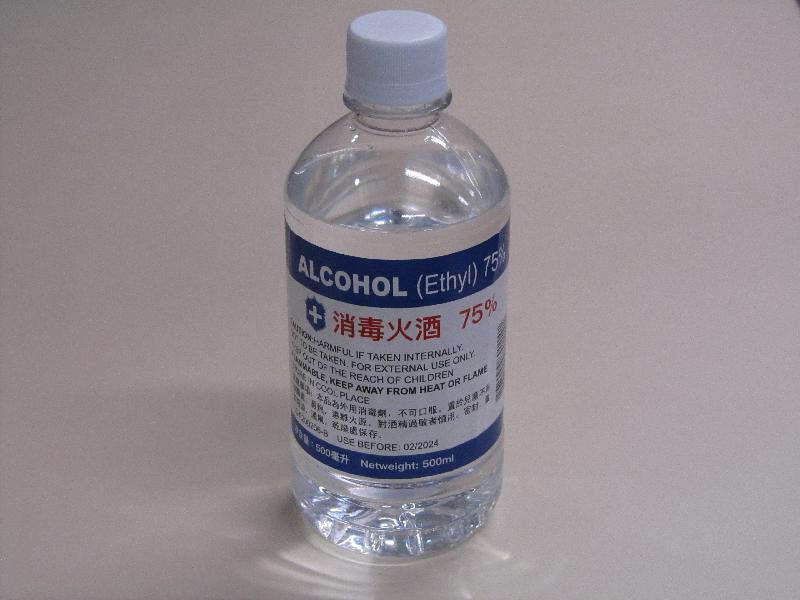
Hong Kong Customs discovers more disinfectant alcohol with suspected false claims (with photo)

     Hong Kong Customs yesterday (May 27) arrested a director of a pharmacy suspected of supplying disinfectant alcohol with false claims on its ethanol content and net volume. Customs appeals to traders to remove the disinfectant alcohol from their shelves.

     Customs earlier received information alleging the sale of disinfectant alcohol with a suspected false description on its composition at a pharmacy in Sha Tin. Customs officers were then deployed for immediate action to test-purchase a type of disinfectant alcohol labelled as containing 75 per cent ethanol in English from the pharmacy. Also labelled as 500 millilitres, the disinfectant alcohol was put on sale in transparent plastic bottles and sold at a price of $28 per bottle.

     Samples were sent to the Government Laboratory to establish its composition and safety. Test results revealed that the disinfectant alcohol consisted of 39 per cent ethanol, and its actual net volume was only 450 millilitres.

     The ethanol content and the net volume of the disinfectant alcohol were different from the product descriptions according to the test results, suspected to be in contravention of the Trade Descriptions Ordinance (TDO).

     Noting the test results, Customs yesterday conducted an immediate enforcement action and arrested a 36-year-old male director of the pharmacy.

     Apart from the pharmacy, over 100 retail spots in various districts were also checked yesterday and no such product was found for sale.

     An investigation is ongoing.

     Customs reminds members of the public to observe the following safety tips when purchasing disinfectant alcohol:
 

  • Pay attention to the product description shown on labels, including the manufacturing date and validity period;
  • Avoid choosing a disinfectant alcohol with unknown sources and limited information; and
  • Purchase products from recognised brands at reputable shops.

     This operation is part of the "Guardian" operation, which has been running for over four months as of today (May 28) since its launch on January 27. More than 4 800 officers have been mobilised to conduct over 32 000 inspections at retail spots in various districts. The operation will continue.

     Under the TDO, any person who supplies goods with a false trade description in the course of trade or business, or is in possession of any goods for sale with a false trade description, commits an offence. The maximum penalty upon conviction is a fine of $500,000 and imprisonment for five years.

     Under the Consumer Goods Safety Ordinance (CGSO), it is an offence to import, manufacture or supply consumer goods unless the goods comply with the general safety requirements for consumer goods. The maximum penalty upon conviction is a fine of $100,000 and imprisonment for one year on first conviction, and $500,000 and imprisonment for two years on a subsequent conviction.

     Members of the public may report any suspected violation of the TDO or the CGSO to Customs' 24-hour hotline 2545 6182 or its dedicated crime-reporting email account (crimereport@customs.gov.hk).

Photo