Hong Kong Customs seizes suspected counterfeit goods (with photo)

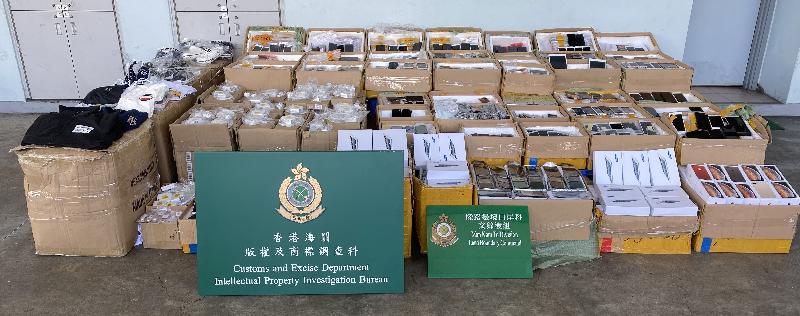
     Hong Kong Customs seized about 3 300 items of suspected counterfeit goods with an estimated market value of about $3.2 million at Man Kam To Control Point on June 13.

     Through risk assessment, Customs officers intercepted an incoming truck at Man Kam To Control Point on that day. The batch of suspected counterfeit goods, including mobile phones and accessories, clothing and footwear, was found inside the cargo compartment. The 44-year-old male driver was arrested.

     Investigation is ongoing and the arrested man has been released on bail pending further investigation.

     Under the Trade Descriptions Ordinance, any person who imports or exports any goods to which a forged trademark is applied commits an offence. The maximum penalty upon conviction is a fine of $500,000 and imprisonment for five years.

     Members of the public may report any suspected counterfeiting activities to Customs' 24-hour hotline 2545 6182 or its dedicated crime-reporting email account (crimereport@customs.gov.hk).

Photo  


Fourteen building plans approved in April

     The Buildings Department approved 14 building plans in April, with five on Hong Kong Island, five in Kowloon and four in the New Territories.
      
     Of the approved plans, nine were for apartment and apartment/commercial developments, two were for commercial developments, one was for factory and industrial developments, and two were for community services developments.
      
     In the same month, consent was given for works to start on nine building projects which, when completed, will provide 126 856 square metres of gross floor area for domestic use involving 2 165 units, and 55 065 sq m of gross floor area for non-domestic use. The department has received notification of commencement of superstructure works for five building projects.
      
     The department also issued 15 occupation permits, with three on Hong Kong Island, five in Kowloon and seven in the New Territories.
      
     Of the buildings certified for occupation, the gross floor area for domestic use was 164 187 sq m involving 2 526 units, and 41 038 sq m was for non-domestic use.
      
     The declared cost of new buildings completed in April totalled about $3.6 billion.
      
     In addition, six demolition consents involving six building structures were issued.
      
     The department received 2 182 reports about unauthorised building works (UBWs) in April and issued 267 removal orders on UBWs.
      
     The full version of the Monthly Digest for April can be viewed on the Buildings Department's homepage (www.bd.gov.hk).  


Police urge the public not to take part in unauthorised assemblies

     Police are aware that an organiser has filed a notification to hold a public meeting and a public procession on Hong Kong Island this afternoon (June 16). Upon risk assessment, Police regarded that the public meeting and procession are high-risk activities with crowd gatherings. To maintain public order and public safety, and protecting the rights and freedom of others, Police have issued a Letter of Objection to the organiser earlier. Police reiterate that anyone participating in such events may be found guilty of “taking part in an unauthorised assembly” under the Public Order Ordinance and be liable to a maximum penalty of five years’ imprisonment. Besides, engaging in public gatherings will also increase the risk of transmission of virus in the community and may violate the prohibition of group gatherings under the Prevention and Control of Disease (Prohibition on Group Gathering) Regulation.

     Police believe that such unauthorised assemblies and prohibited group gatherings will very likely cause serious obstruction to traffic on Hong Kong Island, potentially leading to delays in emergency services. Police will take into consideration different traffic conditions and implement temporary route diversion as well as traffic control measures accordingly. Police are calling on road users to watch out for any incidents that may occur in different districts and avoid going to affected areas. More importantly, drivers should follow the instructions given by police officers at the scene and avoid travelling to dangerous areas.

     Police stress that any group gatherings taking place during the ongoing pandemic can also increase the risk of spreading the virus. Police call upon members of the public to refrain from taking part in unauthorised assemblies and prohibited group gatherings. Police do not condone any illegal acts and will take resolute action to enforce the law, including making arrests.


Transcript of remarks by CE at media session before ExCo meeting (with video)

     Following is the transcript of remarks by the Chief Executive, Mrs Carrie Lam at a media session before the Executive Council meeting today (June 16):

Reporter: Hello, about the ban on public gatherings, you said that chances are that the ban may be relaxed but not lifted. Could you explain in English why, taking into account that the COVID-19 situation has stabilised? And second question about the central official saying the government in Mainland will have the jurisdiction in most serious national security cases, you said that you can’t comment on the specifics now but how can you reassure Hong Kong people that our independent judiciary power will not be undermined, and that including the final adjudication? And lastly about the proposed "referendum", your administration has criticised this "referendum" to see if there will be a strike over the national security laws, but some organisers said the right to strike is actually ensured by the Basic Law and they questioned if your government has violated provisions related to protection against anti-union discrimination. How do you make of their criticism? Thank you.
 
Chief Executive: First of all, the question about Cap.599G on prohibiting group gatherings. It applies to all sorts of group gatherings of a certain number of persons. It is not targeting a particular type of group gatherings. At the moment, we are prohibiting gatherings of more than eight persons, with some exceptions, for example provided under other regulations for religious gatherings and things like that. We really need to take into account the several factors that I have been explaining on this occasion in the last four months. This sort of social distancing measure is very significant and very relevant in any anti-epidemic work but we have to strike a balance between at least three main factors. One is the public health concerns. Secondly is the economy, the impact on the economy. Thirdly is the acceptance – or I would now call the tolerance – of the people because if you continue to keep these measures in place people become intolerant, so they will not comply with these regulations. At every stage of looking into this subject of group gathering we are trying to find a balance amongst the three factors.
 
     As far as the current situation is concerned, I would say that the public health, or the epidemic situation is rather stable but that doesn't mean that we need not be vigilant. You have seen other cities that have gone for some re-opening, relaxation and then they see a re-emergence of COVID-19 cases. The direction at this point in time, taking into account the impact on the economy and the people's acceptance, I would say is relaxation, but relaxing how far is not an exact science. It is something that we need to deliberate. I can say that we have fully deliberated and we are now seeking endorsement from the Executive Council because that particular regulation has to be authorised by the Chief Executive in Council.
 
     About comments made by the Deputy Director of the Hong Kong and Macao Affairs Office yesterday on an occasion to celebrate the 30th anniversary of the promulgation of the Basic Law, without the details about the provisions in the legislation and how they are going to be applied, it is not possible for me, and not appropriate, because I am not party to the law-making institution, to comment on the individual comments made by my Mainland counterparts, except to reiterate the very important principles guiding this law-making process. They are laid down in the explanatory statement to the draft Decision discussed by the National People's Congress leading to the approval on May 28. Included in the five main principles are the principles to ensure that there is full compliance with this very important principle of "One Country, Two Systems", that everything has to be done in accordance with the law and the legitimate rights and freedoms of the Hong Kong people are being safeguarded and protected. And I noticed that subsequent to that explanatory statement, the Hong Kong and Macao Affairs Office issued on May 29 another statement elaborating on this important principles and on top of that reiterated that this new piece of legislation will not change Hong Kong's high degree autonomy and will not affect judicial independence, including that of final adjudication.
 
     As far as this proposed "referendum", there is no such thing as a "referendum" in Hong Kong or in our political process. Your question is about whether strikes are legitimate and protected under the constitutional provisions of Basic Law. I think one has to look at the purpose of the strike. If the purpose of a strike has nothing to do whatsoever with the workplace, with being members of a union in voicing their concerns against the employers and so on, then it will not be covered by that sort of constitutional protection. Thank you.

 (Please also refer to the Chinese portion of the transcript.)


“Reduce and Recycle 2.0” Campaign launched to promote “Save More, Recycle More” concept (with photo)

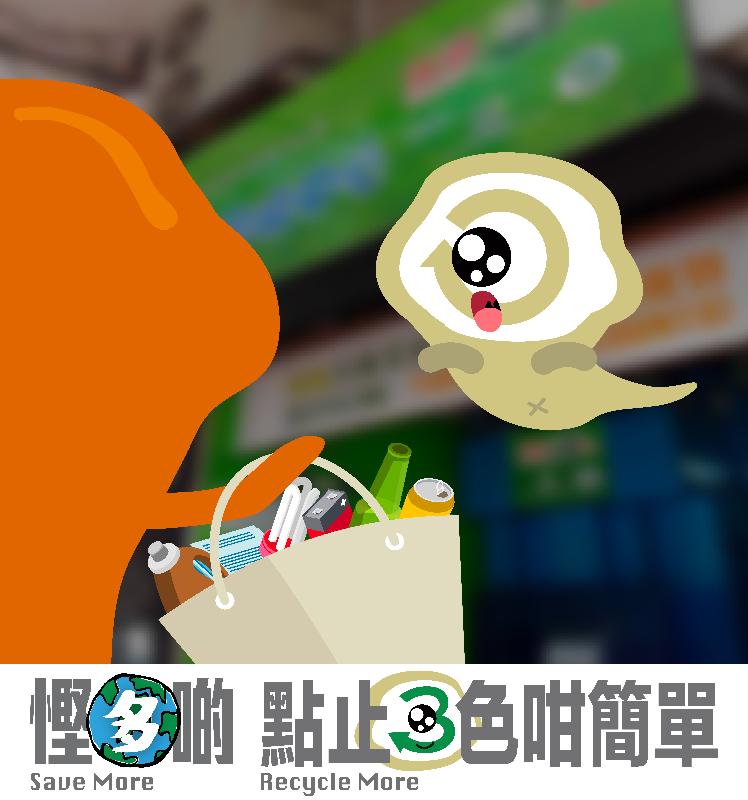
     The Environmental Campaign Committee (ECC) and the Environmental Protection Department (EPD) launched the "Reduce and Recycle 2.0" Campaign today (June 16) to encourage the public to go green and support green recovery and a circular economy while fighting against the COVID-19 epidemic. Apart from promoting waste reduction at source, the Campaign will step up calls on the public to make good use of the community recycling network and practise the green living concept of "Save More, Recycle More".
 
     The slogan "Blue for paper, yellow for aluminium cans and brown for plastic bottles" has been used to highlight the three common recyclables. However, recycling involves more than those three types of recyclables. The EPD is expanding its recycling network through the addition of outlets in the community and the collection of more recyclable types, including glass bottles, fluorescent lamps and tubes, rechargeable batteries, small electrical appliances, and regulated waste electrical and electronic equipment. The community recycling network of the EPD will ensure that all clean recyclables collected can be properly handled and turned into resources. As for fluorescent lamps and tubes, rechargeable batteries and electrical appliances, which contain chemical materials, they will be treated so that they are fit for recycling.
 
     The Campaign will promote various themes in phases. The first phase, which will last for about three months, was launched today.
 
     The first phase of the Campaign will highlight different types of recyclables and the community recycling network. The EPD is sparing no effort in developing the community recycling network. The Community Green Stations (CGSs) project started in 2015 to encourage the "Use Less, Waste Less" lifestyle concept and clean recycling through environmental education and community partnership. Meanwhile, the EPD is actively upscaling the existing Community Recycling Centres (CRCs) and extending their service to cover all 18 districts in the city by setting up new recycling points. The CGSs and the CRCs complement each other in developing a new recycling network to serve members of the public territory-wide. Both the CGSs and the CRCs will collect eight types of recyclables, namely paper, metals, different types of plastics (including styrofoam), glass containers, fluorescent lamps and tubes, rechargeable batteries, small electrical appliances and regulated waste electrical and electronic equipment.
 
     The second phase of the Campaign will focus on raising public awareness of plastic-free living and encourage the avoidance of single-use plastic tableware, packaging materials and more at source. There will also be new initiatives to promote clean recycling, including the Pilot Scheme on Collection and Recycling Services of Plastic Recyclable Materials in three districts (i.e. Eastern, Kwun Tong and Sha Tin) and the Pilot Scheme on Reverse Vending Machines (to prepare for the introduction of the Producer Responsibility Scheme on Plastic Beverage Containers later).
    
     The EPD has also set up outreaching teams, named Green Outreach, to provide property management companies and members of the public with on-site briefings on and assistance in carrying out waste separation and clean recycling. The Campaign will organise regional activities later and the Green Outreach teams will co-operate with community partners to disseminate the latest information on waste reduction and recycling and further promote the green lifestyle concept of "Save More, Recycle More".
 
     Besides the eight types of recyclables mentioned above, the Campaign will also focus on the promotion of food waste recycling at a later stage to tie in with Hong Kong's new milestone of converting food waste into energy.
 
     For the purpose of the Campaign, a new character, Greeny, will be introduced to partner with the Environment Bureau's ambassador Big Waster to promote the message "Save More, Recycle More". Complemented by online games and exhibitions, the duo will disseminate knowledge about waste reduction and recycling. Members of the public are welcome to visit the Facebook pages of Big Waster and the ECC for the green stories of Big Waster and his new buddy Greeny, as well as the latest information about waste reduction and recycling.

Photo