Annual update to the list of Financial Services Providers under the clearing obligation for OTC derivative transactions

The following is issued on behalf of the Hong Kong Monetary Authority:

     The Hong Kong Monetary Authority (HKMA) and the Securities and Futures Commission (SFC) today issued joint consultation conclusions on the annual update to the list of Financial Services Providers (FSP List) (Note 1) under the clearing obligation for over-the-counter (OTC) derivative transactions.
      
     In view of market feedback, the HKMA and the SFC will remove an entity that no longer conducts OTC derivatives business from their proposed FSP List (Note 2). The consultation conclusions paper and the updated FSP List can be downloaded from the websites of the HKMA and the SFC.
                        
Note 1: The FSP List includes entities that meet the following two criteria –
(i) They belong to a group of companies appearing on the list of global systemically important banks published by the Financial Stability Board, or on the list of dealer groups which undertook to the OTC Derivatives Supervisors Group to work collaboratively with central counterparties, infrastructure providers and global supervisors to make structural improvements to the global OTC derivatives markets; and
(ii) They are members of the largest central counterparties offering clearing for interest rate swaps in the United States, Europe, Japan and Hong Kong.

Note 2: See the March 2020 joint consultation paper on the annual update to the list of Financial Services Providers under the clearing obligation for over-the-counter derivative transactions.


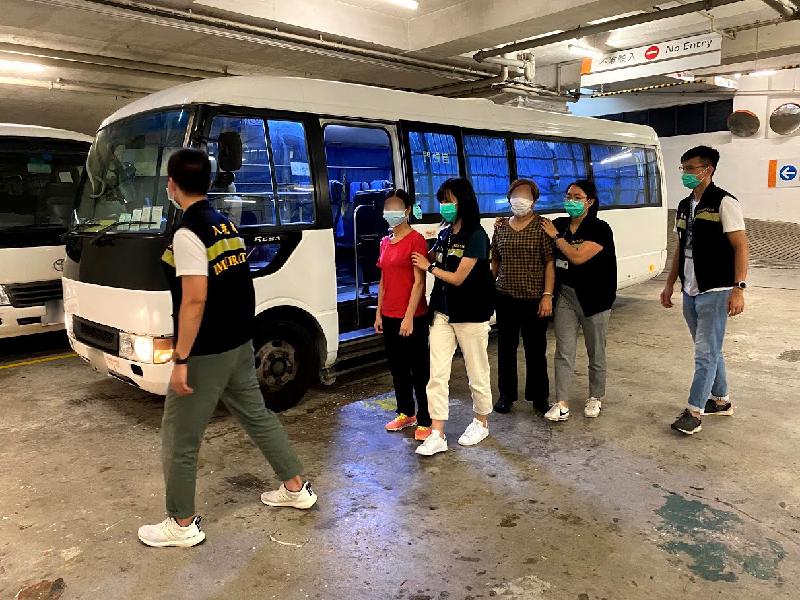
Sixteen persons arrested during anti-illegal worker operations (with photo)

     The Immigration Department (ImmD) mounted territory-wide anti-illegal worker operations codenamed "Twilight" on June 22 and 23. A total of 10 suspected illegal workers and six suspected employers were arrested.
 
     During the operations, ImmD Task Force officers raided 32 target locations including container sites, factories, recycling sites and restaurants. The suspected illegal workers comprised five men and five women, aged 33 to 54. Among them, one man was a holder of a recognisance form, which prohibits him from taking any employment. In addition, one man and three women were suspected of using and being in possession of forged Hong Kong identity cards. Meanwhile, four men and two women, aged 26 to 58, were suspected of employing the suspected illegal workers.
 
     "Any person who contravenes a condition of stay in force in respect of him shall be guilty of an offence. Also, visitors are not allowed to take employment in Hong Kong, whether paid or unpaid, without the permission of the Director of Immigration. Offenders are liable to prosecution and upon conviction face a maximum fine of $50,000 and up to two years' imprisonment. Aiders and abettors are also liable to prosecution and penalties," an ImmD spokesman said.
 
     The spokesman warned that, as stipulated in section 38AA of the Immigration Ordinance, illegal immigrants or people who are the subject of a removal order or a deportation order are prohibited from taking any employment, whether paid or unpaid, or establishing or joining in any business. Offenders are liable upon conviction to a maximum fine of $50,000 and up to three years' imprisonment. The Court of Appeal has issued a guideline ruling that a sentence of 15 months' imprisonment should be applied in such cases. It is an offence to use or possess a forged Hong Kong identity card or a Hong Kong identity card related to another person. Offenders are liable to prosecution and a maximum penalty of a $100,000 fine and up to 10 years' imprisonment.
 
     The spokesman reiterated that it is a serious offence to employ people who are not lawfully employable. The maximum penalty is imprisonment for three years and a fine of $350,000. The High Court has laid down sentencing guidelines that the employer of an illegal worker should be given an immediate custodial sentence. According to the court sentencing, employers must take all practicable steps to determine whether a person is lawfully employable prior to employment. Apart from inspecting a prospective employee's identity card, the employer has the explicit duty to make enquiries regarding the person and ensure that the answers would not cast any reasonable doubt concerning the lawful employability of the person. The court will not accept failure to do so as a defence in proceedings. It is also an offence if an employer fails to inspect the job seeker's valid travel document if the job seeker does not have a Hong Kong permanent identity card. The maximum penalty for failing to inspect such a document is imprisonment for one year and a fine of $150,000.
 
     Under the existing mechanism, the ImmD will, as a standard procedure, conduct initial screening of vulnerable persons, including illegal workers, illegal immigrants, sex workers and foreign domestic helpers, who are arrested during any operation with a view to ascertaining whether they are trafficking in persons (TIP) victims. When any TIP indicator is revealed in the initial screening, the officers will conduct a full debriefing and identification by using a standardised checklist to ascertain the presence of TIP elements, such as threats and coercion in the recruitment phase and the nature of exploitation. Identified TIP victims will be provided with various forms of support and assistance, including urgent intervention, medical services, counselling, shelter, temporary accommodation and other supporting services. The ImmD calls on TIP victims to report crimes to the relevant departments.

Photo  


LCQ6: Civil servants of the HKSAR Government

     Following is a question by the Hon Wu Chi-wai and a reply by the Secretary for the Civil Service, Mr Patrick Nip, in the Legislative Council today (June 24):

Question:

     It has been reported that the Secretary for the Civil Service has recently stated that under the "one country, two systems", civil servants employed by the Hong Kong Special Administrative Region (HKSAR) Government are civil servants of the State at the same time. Nevertheless, both the Basic Law and the Civil Service Code of HKSAR do not contain similar statements. In this connection, will the Government inform this Council:

(1) of the legal basis for the aforesaid statement; whether there are official documents which corroborate such a statement;

(2) as the relevant articles in the Law of the People's Republic of China on Civil Servants (the PRC Law on Civil Servants) provide that the civil servant system shall be under the leadership of the Communist Party of China and the guidance of the Thoughts and Theories of certain incumbent and former topmost leaders, and that civil servants shall support the socialist system, whether civil servants of HKSAR are required to comply with these articles; if so, whether civil servants of HKSAR will be subject to disciplinary actions for not complying with these articles; and

(3) whether it has plans to incorporate into the Civil Service Code of HKSAR the various requirements for civil servants of the State as provided in the PRC Law on Civil Servants; if so, of the details?

Reply:

President,

     Article 1 of the Basic Law stipulates that "[t]he Hong Kong Special Administrative Region is an inalienable part of the People's Republic of China". Article 12 of the Basic Law provides that "[t]he Hong Kong Special Administrative Region shall be a local administrative region of the People's Republic of China, which shall enjoy a high degree of autonomy and come directly under the Central People's Government".
      
     President Xi Jinping, in his address delivered at the Inaugural Ceremony of the Fifth Term Government of the Hong Kong Special Administrative Region on July 1, 2017, mentioned that "[a]s a special administrative region directly under the Central Government, Hong Kong has been re-integrated into China's national governance system since the very day of its return. The Central Government exercises jurisdiction over Hong Kong in accordance with China's Constitution and the Basic Law of the Hong Kong Special Administrative Region, and the corresponding systems and institutions have been set up for the special administrative region". Article 2 of the Basic Law stipulates that "[t]he National People's Congress authorizes the Hong Kong Special Administrative Region to exercise a high degree of autonomy and enjoy executive, legislative and independent judicial power, including that of final adjudication, in accordance with the provisions of this Law". Article 5 of the Basic Law also stipulates that the socialist system and policies shall not be practised in the Hong Kong Special Administrative Region. Therefore, under the principle of "One Country, Two Systems", the Hong Kong Special Administrative Region (HKSAR) is part of China, while practising systems (including the civil service system) different from those of the Mainland.
      
     Under Article 45 of the Basic Law, the Chief Executive shall be appointed by the Central People's Government, and Article 43 of the Basic Law provides that the Chief Executive shall be accountable to the Central People's Government and the HKSAR in accordance with the provisions of the Basic Law. Under Article 60 of the Basic Law, the head of the Government of the HKSAR shall be the Chief Executive; and under Article 99 of the Basic Law, civil servants of the HKSAR Government must be responsible to the Government of the HKSAR. The above Articles clearly demonstrate the link of civil servants of the HKSAR Government, through the HKSAR Government and its head (i.e. the Chief Executive), to the Central People's Government, under the constitutional order. Therefore, civil servants of the Government of the HKSAR are not only civil servants of the Government of the HKSAR, but also civil servants of the Government of the Hong Kong Special Administrative Region of the People's Republic of China.
      
     The full name of the "Hong Kong Special Administrative Region" is the "Hong Kong Special Administrative Region of the People's Republic of China", and "civil servants of the Government of the Hong Kong Special Administrative Region" means the same as "civil servants of the Government of the Hong Kong Special Administrative Region of the People's Republic of China".
      
     According to the Civil Service Code, civil servants shall serve the Chief Executive and the Government of the day with total loyalty and to the best of their ability. Also, civil servants, being a key component of the public service, have a constitutional role to give their best in serving the Chief Executive and the Government of the day. Under "One Country, Two Systems", when considering and handling policy matters and issues, civil servants of the HKSAR Government should not confine themselves only to the perspective from the HKSAR. They should deliver their work in accordance with the Basic Law, and the laws and systems of Hong Kong, while at the same time they should also take into consideration the perspective that Hong Kong is part of the country, so as to enable the discharge of their duties in a comprehensive and thorough manner.
      
     As mentioned above, under the principle of "One Country, Two Systems", the HKSAR practises systems different from those of the Mainland, including the civil service system. Article 103 of the Basic Law stipulates that "[t]he appointment and promotion of public servants shall be on the basis of their qualifications, experience and ability. Hong Kong's previous system of recruitment, employment, assessment, discipline, training and management for the public service, including special bodies for their appointment, pay and conditions of service, shall be maintained, except for any provisions for privileged treatment of foreign nationals". The Law of the People's Republic of China on Civil Servants (PRC Law on Civil Servants) does not apply to the civil servants of the HKSAR Government. In fact, Annex III of the Basic Law, which lists out the national laws to be applied in the HKSAR, does not include the PRC Law on Civil Servants. As such, there is no need to incorporate into the Civil Service Code of the HKSAR Government the requirements for Mainland civil servants as provided in the PRC Law.
 
     Thank you, President.


Operator and manager fined for illegal club operation

     A man and a company were each fined $2,500 at the Kowloon City Magistrates' Courts today (June 24) for contravening the Clubs (Safety of Premises) Ordinance.

     The courts heard that in June last year, officers from the Office of the Licensing Authority (OLA) of the Home Affairs Department conducted an inspection at a club on Hillwood Road in Tsim Sha Tsui, which had been operating with a certificate of compliance (CoC).

     During the investigation, the OLA officers found that the number of people at the club exceeded the maximum allowable capacity as stipulated in the CoC. Condition 6 of the CoC was breached.

     The man and the company, being the manager and the CoC holder of the club, were charged with contravening section 21(1)(a) and section 21(2) of the Ordinance respectively.

     A spokesman for the department reminded all CoC holders to comply with the conditions as stipulated therein. Enforcement action will continue to be taken against illegal club operation.


LCQ4: Flood prevention measures

     Following is a question by the Hon Wong Kwok-kin and a reply by the Secretary for Development, Mr Michael Wong, in the Legislative Council today (June 24):

Question:

     The Hong Kong Observatory issued the first Black Rainstorm Signal of this year on the 6th of this month. It has been reported that on that day, flooding occurred in extensive areas in Hong Kong which were affected by rainstorms. The flooding in Kowloon East, especially in the vicinity of Hoi Yuen Road and Tsui Ping Road, was particularly serious, and the Kwun Tong Road Underpass was even inundated for several hours, thereby severely affecting the traffic there. In this connection, will the Government inform this Council:

(1) of the details of the investigations conducted into the flooding reports received during the aforesaid rainstorms, and other follow-up work carried out; given that Kowloon East was not a flooding blackspot in the past, of the measures in place to prevent the recurrence of flooding in that district;

(2) of the designed flood discharge capacity of the aforesaid roads and underpass, as well as whether it has examined the need to enhance such capacity; and

(3) given that the rainy season has begun, of the new measures in place to ensure that the various flood prevention measures, drainage systems, seawalls and breakwaters can function properly to prevent the occurrence of severe flooding; whether it will step up its efforts such as clearing the blocked drains in the urban areas?

Reply:

President,

     During the rainy season, Hong Kong is from time to time threatened by inclement weather such as prolonged heavy rains and typhoons. The average annual rainfall of Hong Kong is about 2 400 millimetres, making Hong Kong one of the highest rainfall cities in the Pacific Rim. The Drainage Services Department (DSD) and the relevant government departments have been taking multi-pronged measures as well as constructing and maintaining the public stormwater drainage facilities according to their respective responsibilities to reduce the risk of flooding and eliminate flooding blackspots. Among the facilities, those serving the public roads are mainly constructed and maintained by the Highways Department (HyD).

     On June 6 this year, Hong Kong was affected by a trough of low pressure, resulting in continuous heavy rains. High rainfall was generally recorded in the widespread of the territory during the period. In the districts of Tsuen Wan, Sha Tin, Tai Po, Sai Kung and Kowloon East, the rainfall exceeded 200mm, accounting for almost 10 per cent of the average annual rainfall. In the period that the Black Rainstorm Signal was in force, the maximum hourly rainfall recorded by the rain gauge at Clear Water Bay Road in East Kowloon was 139mm, which was far higher than the level of hourly rainfall of 70mm for issuing the Black Rainstorm Signal.

     On that day, the DSD activated the Emergency Control Centre according to the established mechanism to monitor the flooding situations in different districts. It deployed more than 40 emergency teams to inspect areas in a number of districts where the drainage systems were prone to blockage by debris and obstacles washed down from the upstream, and also took emergency actions for the 25 flooding cases received. The affected locations resumed to their normal conditions shortly after the completion of the emergency actions.

     After consultation with relevant government departments, I provide the reply to the three parts of the question raised by Hon Wong as follows:

(1) On June 6, the DSD and HyD received a total of six flooding cases that took place at East Kowloon. Their locations include Kwun Tong Road Underpass, Kwun Tong Road near Tsui Ping Road and Tsui Ping Road near Fuk Ning Road. The more serious case occurred at the Kwun Tong Road Underpass. After inspection, the HyD unveiled that the gullies and the associated drains alongside the underpass were blocked by a large amount of sands and washout deposits, coupled with the continuous heavy rains, flooding took place at the underpass. With the joint efforts of the HyD and DSD on clearing the blocked road drainage facilities, the affected road sections were reopened on the same day.
     
     To reduce the risk of flooding in East Kowloon, the DSD and HyD specifically re-examined the flood prone areas immediately, including the road drainage facilities affected on this occasion to ensure clearance of drainage channels. With a view to reducing the flood risk and the associated traffic impact, the HyD will also deploy manpower to conduct targeted inspections and clearance during heavy rains for the road sections with higher flood risk. 

     The DSD will also conduct investigations into flooding cases and formulate appropriate improvement measures in accordance with the findings of the investigations. Improvement measures being considered include the study on the installation of monitoring sensors at the drainage system of Kwun Tong Road and Tsui Ping Road, and the optimisation of the operation of the stormwater storage tank at On Sau Road in the upstream with a view to enhancing the flood resilience and flood prevention capability of the areas concerned.

     In parallel, the DSD and the Civil Engineering and Development Department (CEDD) are implementing in phases various public works projects conducive to the enhancement of the flood prevention capability of East Kowloon. Under the project Development of Anderson Road Quarry Site, the CEDD is constructing a flood retention lake and a stormwater storage tank. It is anticipated that the date of operation would be in 2023-2024; and the surface runoff could be greatly reduced and the burden of the downstream drainage system relieved. As scheduled to commence construction works by 2020, the DSD's project Revitalisation of Tsui Ping River will improve certain bottlenecks at Tsui Ping Nullah. In addition, the DSD has commenced an investigation study on "Drainage Improvement Works in Kwun Tong" in 2018, which mainly includes the construction of stormwater storage tanks at Sau Nga Road Playground, Hoi Bun Road Park and Kwun Tong Ferry Pier Square; and the addition of stormwater drains within the district. The DSD plans to commence the detailed design work within this year for implementing the long-term improvement scheme the soonest possible.

(2) The roads and underpasses under HyD are designed with due consideration of the drainage requirements of individual circumstance and the required drainage facilities are constructed in accordance with the design standard. To cope with the drainage demand under heavy rains, a pumping system has been installed at the affected underpass at Kwun Tong Road. Under normal situation, the gullies in the underpass will collect the rainwater flowing in through the road surface. The rainwater will then be pumped out by the pumps and discharged into the sea through the nearby nullah at King Yip Street.

(3) After the subject flooding incident, the DSD, HyD and other works departments have stepped up the precautionary measures for typhoons and heavy rains, including clearing and maintaining the drainage channels, coastal seawalls and breakwater facilities. The DSD will strengthen the inspection of the drainage in the vicinity of different construction sites and require the responsible persons of the sites to take effective measures to prevent muddy water from being discharged to the public drainage systems and roads.

     To manage the risk of road flooding, the HyD has arranged contractors to inspect all the road drains and drainage systems of highway structures under their jurisdiction, and worked with the relevant government departments to strengthen the inspection and clearance works of the outfalls and drains of public roads to ensure that they are free from blockage. With the aim of reopening the affected roads within the shortest period of time to minimise the inconvenience caused to the public and ensure the safety of road users, the HyD will also enhance the cleansing of drainage facilities such as the roadside gullies and pumping systems in road underpasses. Besides, it will deploy additional resources to strive to inspect public roads before and after rainstorms for cleaning up the flooding and blockages that may occur due to rainstorms.  

     Apart from deploying emergency teams to handle flooding cases under emergency situations, the DSD will also endeavour to deploy manpower to make arrangements for "just-in-time clearance", inspecting the about 200 locations which are susceptible to blockage by litter or debris from surface runoff so as to ensure that drains can be cleared in a "in-time" and targeted manner.

     Further, government departments have set up storm surge early alert systems for a number of low-lying areas prone to seawater inundation. Upon the issuance of storm surge early alerts by the Hong Kong Observatory, the DSD will deploy pumping facilities and install flood barriers at the areas concerned, and provide sandbags to the residents and merchants in need in order to relieve the flood risk brought by storm surges.

     Thank you, President.