Transcript of remarks of press conference (with photo/video)

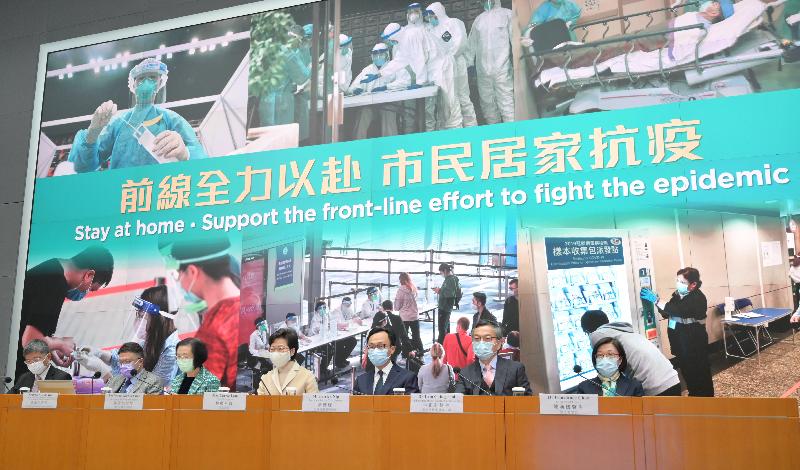
     The Chief Executive, Mrs Carrie Lam, held a press conference this afternoon (December 23). Also joining were the Secretary for Food and Health, Professor Sophia Chan; the Secretary for the Civil Service, Mr Patrick Nip; the Stanley Ho Professor of Respiratory Medicine of the Chinese University of Hong Kong, Professor David Hui; the Chairman of the Elderly Commission, Dr Lam Ching-choi; the Permanent Secretary for Food and Health (Health), Mr Thomas Chan and the Director of Health, Dr Constance Chan. Following is the transcript of remarks of the press conference.
 
Reporter: First, about the public having a choice over what vaccine they get. Chief Executive, according to what you said, you did say in your own words that this is not, well, market behaviour and people can't really choose which type of vaccine they get and there shouldn't be any choice. So why the backtrack now and when the time comes will there only be one type of vaccine available on the market and in the end people will still be unable to kind of choose what vaccine they want to get? And second question in regard to the fund and to provide financial support to people who might be unfortunately affected by the severe side effects like, what kind of people will be eligible to apply for financial help under this fund? Would it be, like, those really rare circumstances, really rare side effects, then they will be eligible, or whatever impact there will be, under whatever impact they will be having under the vaccination, they'll still be able to get some sort of financial help under the fund? Thank you.
 
Chief Executive: I cannot answer the second question if it concerns the clinical aspects of what constitutes serious adverse reactions arising from the vaccination. This has to be done by the clinicians under the drug monitoring or surveillance system to be established by the Secretary for Food and Health under the regulation made this morning. As far as details of the fund, whether there will be other prerequisites or criteria before individuals being affected will be eligible, this will be deliberated and discussed and then presented to the Finance Committee. But based on previous experience, for example on the Aids Trust Fund and other similar schemes, one would focus on the effects that this individual has been affected by the drug, by the diseases, by the virus, rather than to look into other circumstances before deciding on offering assistance to the individual. But this is only an illustration. I will suggest that you have to wait for us to present the details about this indemnity fund later on.
 
     Coming back to the question of choice of vaccine, this vaccination will still be a non-market behaviour. It is still a government vaccination programme because it is going to be authorised for use under emergency situation, as provided for in the regulation made today. The so-called specified purposes basically will be referring to the government vaccination programme. In other words, what I said on the last occasion is it will not be readily available in the market for an individual or clinician to buy and then to administer, which would then give the widest choice – if all the vaccines are available in the market then everybody could choose what vaccine to use. It remains what I said last time, as a government vaccination programme, especially we are making ourselves responsible for the authorisation of a vaccine for emergency use.
 
     What I have elaborated this afternoon, not deviating from what I said on the last occasion, is we would be giving individuals the choice in terms of the timing of receiving the vaccination, and also the site – where does this individual want to get the vaccination – and by that there will be choices because we now have procured three different vaccines. I imagine that once we have rolled out the programme, a particular vaccine will be administered in a particular site, for example a community vaccination centre versus a private doctor's clinic versus a hospital setting versus an elderly care home. If the individual is able to choose, I don't want to go to the vaccination centre, I prefer to go to a private doctor because the private doctor's site will use a particular vaccine, then the choice is there. But I don't see how we could offer different types of vaccine in one site. That would be extremely confusing, especially each of the three vaccines we have bought require two doses, so we have to manage the quantity to make sure that if you choose this, we will have a second dose available and ready for you to use. It has to be done in that way. There will be choices, but I will say that it has to be exercised in accordance with the government-administered vaccination programme. I hope that clears up the confusion or worries.

Reporter: Hi, Mrs Lam. So my first question on vaccination. Is the Government going to set any target, such as when to reach the 70 per cent herd immunity? And when you mentioned residents can choose the vaccines, what will the Government do if a large number of residents refuse to inject a certain type of vaccine? Will it delay your plan to reach such immunity? And about the joint meeting held in Shenzhen yesterday, it was understood that the Mainland is highly concerned about whether Hong Kong is able to reach zero infections, while some heavyweight representatives in pro-establishment camp, such as Tam Yiu-chung, also sent a letter directly to the Central Government seeking help. Do you think Beijing and your allies are unhappy with your current approach? What are your stance currently on universal testing and how far are we now from reaching such zero infections? At which point will Government consider reopening the border? Thank you.
 
Chief Executive: There are quite a number of questions there. First of all, we have now purchased enough vaccines to serve the whole of the Hong Kong population. We will continue to find a fourth technology, so that we can 100 per cent meet our Scientific Committee's recommendations in ensuring that Hong Kong people will get adequate coverage. At the end of the day, it's a question of public education, which will of course be based on objective scientific data and explanation, that when one looks at the vaccine, it's the safety, it's the efficacy, it's the quality. It's not a particular place. It's not a particular sentiment of where you want that vaccine to come from. I hope that the media will help us to disseminate this accurate information in approaching the subject of vaccination. Please do not try – I'm not suggesting that you are doing that – but let's don't try to politicise what is a scientific issue for the good of Hong Kong. We will continue to do the public education. One of the first things that Patrick Nip has to do is to step up the education through various media and we will continue to do so.
 
     It is very difficult to set a target. If you ask me, the target is everybody. We want everybody to be vaccinated so that it's not only protecting your oneself, it's protecting your family members, it's also protecting Hong Kong society at large. At the moment, it's very difficult for us to set a target.
 
     About the meeting that took place yesterday. I could tell you that this was another measure of support for the Hong Kong SAR Government in combating COVID-19 from the Central People's Government. Earlier on, the Central People's Government, upon my request, has assisted us in the Universal Community Testing Programme by sending us 580 technicians to undertake that massive exercise. They have helped us to renovate the AsiaWorld-Expo to provide more isolation and community facilities for the Hospital Authority. Right now they are steaming ahead to complete the construction of the interim hospital next to the AsiaWorld-Expo. They have also undertaken upon my request during my Beijing trip that, if the circumstances so require that we need a vaccine supply that is either developed or produced in the Mainland to serve the Hong Kong population, then the Central Government is happy to give us a certain supply.
 
     Yesterday's meeting was the continuation of that strong degree of support from the Central People's Government, that for the experts on both sides, officials from both sides, to have a good exchange of each other's strategy, measures and so on. If you said that the Central Government is concerned, of course they are concerned. I am concerned. All of us sitting here are very concerned. I want to have the cases down to zero as soon as possible. But this requires the concerted efforts of everybody in society. Just over the last fortnight, I'm sure you have reported on cases which you do not feel are responsible. They should never have happened – runaways from hospital, going out for parties and having these illegal upstairs bars in Hong Kong. Everybody has to share part of the responsibility and part of the pain in order to get Hong Kong out of the epidemic situation. The Government has the biggest role to play and we are doing that, but I would appeal to members of society to help us, especially in the coming holidays, to stay at home as far as possible, to avoid meeting with even relatives for family parties because of the serious situation.
 
     The joint meeting is not to give us instructions. I can guarantee you that that was not the purpose of the joint meeting. It was a joint meeting to express support and also to exchange views on how each side could help each other better and so on. Of course, I have said in my Policy Address that I will strive – we will strive – to achieve zero infections and we are doing that right now. To achieve zero infections requires a strategy. If you remember, one of the experts said publicly that he did not feel that Hong Kong's strategy in fighting the epidemic was wrong, but he did comment that perhaps in the execution we could be more refined, we could be more careful, more meticulous, and I agree that. There have been incidents where members of the community have to wait for a few days before being admitted into a quarantine centre, and members of the society have to wait before they get an SMS about the negative test. These are all the things we could improve, and I can say that every day we are identifying the necessity to improve our operation in order to bring Hong Kong out of the current wave of COVID-19 as soon as possible. Thank you.

(Please also refer to the Chinese portion of the transcript.)
Photo  


Hong Kong Customs seizes suspected dangerous drugs (with photos)

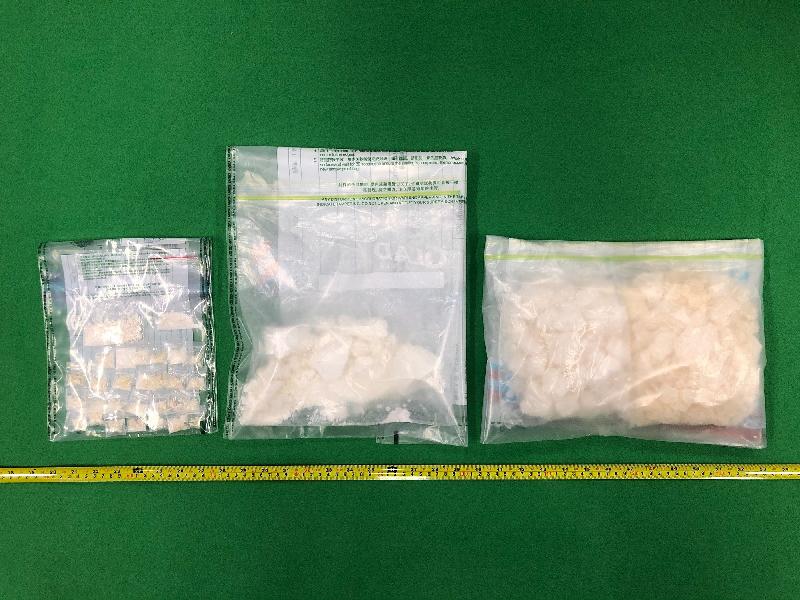
     â€‹Hong Kong Customs yesterday (December 22) seized about 1 kilogram of suspected ketamine, about 230 grams of suspected cocaine and about 30g of suspected crack cocaine with a total estimated market value of about $1 million in Sham Shui Po.

     During an anti-narcotics operation conducted in Sham Shui Po yesterday evening, Customs officers intercepted a man and raided his residential premises. About 1kg of suspected ketamine, about 230g of suspected cocaine and about 30g of suspected crack cocaine as well as a batch of drug manufacturing and packaging paraphernalia were seized. The 25-year-old man was then arrested.

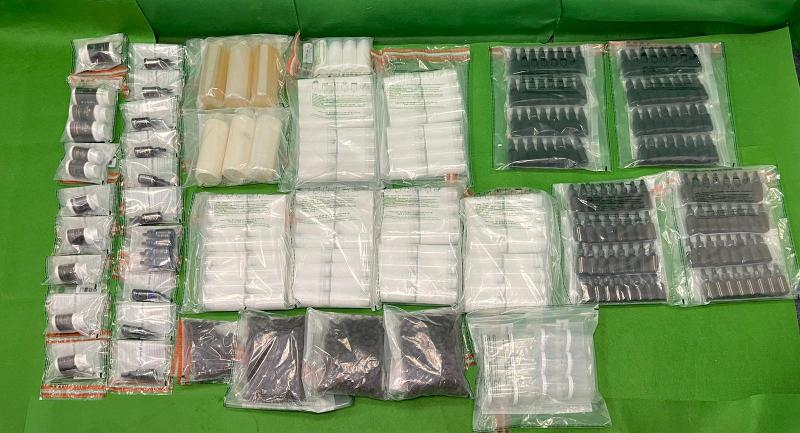
     Also, Customs seized about 30kg of products suspected of containing tetrahydro-cannabinol (THC) with a total estimated market value of about $50,000 at Hong Kong International Airport and in Kowloon Bay on December 7 and today (December 23) respectively.

     Customs officers inspected four air mail parcels from the United States at Hong Kong International Airport on December 7 and seized about 28kg of products suspected of containing THC.

     After follow-up investigation, Customs officers today arrested two persons, including a 33-year-old woman and a 47-year-old man, suspected to be in connection with the case and further seized about 2kg of products suspected of containing THC at a commercial premises in Kowloon Bay.

     Investigations of the two cases are ongoing.

     Customs will continue to maintain close contact with Hongkong Post and the logistics industries to step up action against drug trafficking through postal parcels or express courier channels.

     Under the Dangerous Drugs Ordinance, trafficking in a dangerous drug is a serious offence. The maximum penalty upon conviction is a fine of $5 million and life imprisonment.

     Under the Ordinance, cannabis and THC are classified as dangerous drugs. Importation of products (including food or drinks) containing cannabis or THC into Hong Kong is prohibited unless the relevant provisions in the Ordinance are complied with. In order to avoid breaching the law inadvertently, special attention should be paid to the packaging labels of those products.

     Customs also reminds members of the public to stay alert and not to participate in drug trafficking activities for monetary returns. They must not accept hiring or delegation from another party to carry controlled items into and out of Hong Kong. They are also reminded not to carry unknown items for other people, nor to release their personal data or home address to others for receiving parcels or goods.

     Members of the public may report any suspected drug trafficking activities to Customs' 24-hour hotline 2545 6182 or its dedicated crime-reporting email account (crimereport@customs.gov.hk).

Photo  Photo  


Over 46 000 taxi drivers participated in one-off compulsory testing scheme

     â€‹A one-off compulsory COVID-19 testing scheme for taxi drivers launched by the Transport Department (TD) was held from December 9 to 22 and a total of 13 Dedicated Testing Centres were set up across the territory. The TD today (December 23) said that with the unwavering support by the taxi trade, a total of 46 118 taxi drivers have undergone the test at the Centres. Amongst the test results of these taxi drivers, three of them were confirmed positive by the Department of Health (DH). The DH has contacted the concerned taxi drivers and followed up the cases according to the established procedures.

     Virus testing is an integral part of the epidemic control strategies. The TD thanked all the taxi drivers for their participation in the testing scheme which would help achieve the objective of "early identification, early quarantine and early treatment", and cut silent transmission chains and slow down the transmission of the virus in the community. The taxi trade has all along been fighting the virus together and taking various prevention measures to safeguard the health of drivers and passengers.

     For taxi drivers who have not yet undergone the test, they can arrange testing by themselves at their own expenses in a private laboratory recognised by the DH (see the list on www.coronavirus.gov.hk/pdf/List_of_recognised_laboratories_RTPCR.pdf), including any of the Community Testing Centres set up by the Government (see the list on www.communitytest.gov.hk/en/), and undergo the testing as instructed by the relevant staff.

     The TD reminds that in accordance with the Compulsory Testing Notice issued by the Secretary for Food and Health on December 5, 2020, a taxi driver driving a taxi during the period from December 25, 2020 to January 23, 2021 shall keep the test report or the relevant SMS or email notification containing the test result for checking by the enforcement agencies.

     Any person who fails to comply with the compulsory testing notice commits an offence and may be liable to a fixed penalty of $5,000, and will be issued with a compulsory testing order requiring this person to undergo the testing within a specified period. Failure to comply with the order is an offence and the offender may be liable on conviction to a fine at level 4 ($25,000) and imprisonment for six months.


United Christian Hospital announces three preliminary positive COVID-19 inpatient cases

The following is issued on behalf of the Hospital Authority:

     The spokesperson for United Christian Hospital (UCH) made the following announcement regarding three preliminary positive COVID-19 inpatient cases today (December 23):
 
     A 91-year-old female patient with terminal illness was admitted to a surgical ward in UCH on December 1. She was transferred to Palliative Care and Medical Ward on December 9 for further treatment. As she was clinically stable, she was discharged from the hospital on December 21. A community nurse visited the patient's home the next day to follow up on her and found that the patient was presented with mild shortness of breath and arranged for the patient to attend UCH Accident and Emergency Department (AED). Chest X-ray showed mild pneumonia and medical staff arranged COVID-19 nasopharyngeal swab test for her and the test result was preliminary positive. She was then transferred to isolation ward for further treatment and is currently in stable condition.
 
     Admission and discharge of patients in the ward as well as compassionate visiting arrangements have been suspended with immediate effect. The hospital has arranged thorough cleansing and disinfection of the concerned ward. The hospital's infection control team conducted contact tracing and two other female patients (aged 84 and 71) who had stayed in the same cubicle of the ward with the confirmed patient were tested preliminary positive for COVID-19. A total of 11 close contacts have been identified related to the above-said patients. One of them passed away due to underlying illness while one of them was discharged. The discharged patient will be followed up by the Centre for Health Protection of the DH. The remaining nine patients and the succumbed patient were tested negative for COVID-19 and under isolation treatment. The Hospital also arranged viral tests for other patients in the ward and all results are negative. As a precautionary measure, the hospital arranged testing for 14 patients who were transferred to Haven of Hope Hospital and the results are negative as well. Healthcare workers in the Palliative Care and Medical Ward are undergoing viral tests and all results came back negative so far. Also, environmental samples from the cubicle are all negative.
 
     During the home visit by our community nurse, the patient did not wear surgical mask properly and the nurse was classified as close contacts and needs to be quarantined. The Infection Control Team is now conducting further risk assessment and contact tracing for the nursing care and procedures and compassionate visiting arrangements during the patients' stay.

     Patients in the Palliative Care and Medical Ward are patients with terminal illness, our healthcare staff will assess the patient's situation and the patient's as well as his/her family's wishes, together with our operational situation to consider compassionate visit so families could take care and support the patients. All visitors entering the ward are required to comply with the infection control measures, which includes take temperature testing, wear surgical masks and perform hand hygiene. To safeguard the wellbeing of our patients and staff, healthcare workers will ask each visitor individually whether they have any symptoms and contact history with confirmed or quarantined cases. UCH will continue to closely monitor the health of our staff and patients and communicate with the Centre for Health Protection about the latest situation and to investigate the patient's source of infection.


Over 80 collection points across territory for public to submit deep throat saliva specimen

     To enable individuals who perceive themselves as having a higher risk of exposure or experience mild discomfort to undergo free testing, and to further facilitate members of the public to submit deep throat saliva specimen, starting from tomorrow (December 24), the Government will set up 23 additional specimen collection points in government premises in various districts across the territory (see Annex 1). Coupled with the 60 existing specimen collection points (including 47 designated general outpatient clinics (GOPCs) of the Hospital Authority (HA) and 13 designated clinics of the Department of Health (DH) (see Annex 2)), there will be a total of 83 specimen collection points across the territory to facilitate the public to undergo voluntary testing for "early identification, early isolation and early treatment".
      
     The operating hours of the 23 additional specimen collection points will be 9am to 1pm and 2pm to 3pm on Monday to Friday, and 9am to 11am on Saturday, Sunday and public holidays. In general, those who have a negative test result for COVID-19 will receive an SMS notification within three days after submitting the specimen. If the test result is positive, the DH will follow up immediately.
      
     The public should note that the above 23 additional specimen collection points will not distribute deep throat saliva specimen collection packs. If they wish to obtain specimen collection packs, they can visit the 47 designated GOPCs of the HA, all 121 post offices across the territory or vending machines set up at 20 MTR stations. Specimen collection packs can be obtained for free on a first-come-first-served basis while stocks last. For the locations of the aforementioned distribution/collection points and distribution/collection hours, as well as details of other means of testing, please browse the following website: https://www.coronavirus.gov.hk/eng/early-testing.html.
      
     A spokesman for the Food and Health Bureau urged all individuals who are in doubt about their own health condition, or individuals with exposure to infection risk (such as individuals who visited places with epidemic outbreaks or contacted confirmed cases) to undergo testing promptly for early identification of infected persons.