Missing woman in Tsing Yi located

     A woman who went missing in Tsing Yi has been located.

     Cheang Fong-choi, aged 65, went missing after she left her residence in Cheung Hang Estate in the afternoon of December 31, 2020. Her family made a report to Police on January 1.

     The woman was located in a shopping mall at Cheung Fat Estate yesterday (January 3) afternoon. She sustained no injuries and no suspicious circumstances were detected.


Key statistics on service demand of A&E Departments and occupancy rates in public hospitals

The following is issued on behalf of the Hospital Authority:

     During the winter surge, the Hospital Authority is closely monitoring the service demand of Accident and Emergency Departments and the occupancy rates in public hospitals. Key service statistics are being issued daily for public information. Details are in the appended table.


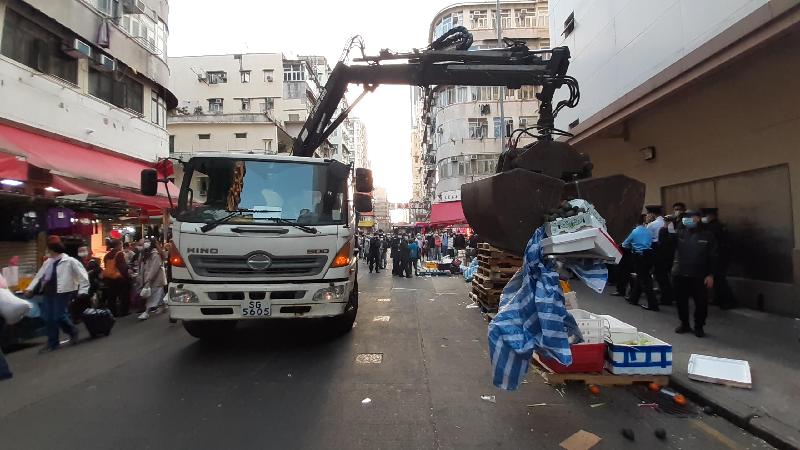
FEHD conducts joint operations near Pei Ho Street Market in Sham Shui Po to take stringent enforcement actions relating to anti-epidemic regulations and obstructions in public places (with photo)

     The Food and Environmental Hygiene Department (FEHD) today (January 3) conducted joint operations with the Police in the vicinity of the junction of Fuk Wah Street and Pei Ho Street and of the junction of Tai Nan Street and Nam Cheong Street in Sham Shui Po in two stages. During the joint operations, the two departments inspected a total of 15 catering premises. The FEHD initiated prosecution against six catering business operators suspected for breaching the requirements and directions (relating to distance or partition between tables or mask-wearing) under the Prevention and Control of Disease (Requirements and Directions) (Business and Premises) Regulation (Cap. 599F) (the Regulation); issued verbal warning to one licensed hawker suspected for causing obstruction in public places in contravention of the Summary Offences Ordinance (Cap. 228) (the Ordinance); and seized the abandoned articles of a hawker. The Police also issued six fixed penalty notices for illegal parking. In addition, the two departments cleared over 1.3 tonnes of commodities and paraphernalia on the carriageway with the use of a grab lorry.

     An FEHD spokesman said, "The latest directions issued by the Secretary for Food and Health in relation to social distancing measures in catering business and scheduled premises under the Regulation has been extended till January 6, 2021. Catering business operators must strictly comply with a series of requirements and restrictions, which include requirements that a mask must be worn within the premises except when the person is consuming food or drink at a table therein; tables must be arranged in a way to ensure there is a distance of at least 1.5 metres or some form of partition which could serve as an effective buffer between one table and another table etc. If a person responsible for carrying on a catering business contravenes the Regulation, he or she is liable to prosecution and, upon conviction, to a maximum fine of $50,000 and imprisonment for six months."

     The spokesman added, "Under section 4A of the Ordinance, any person who without lawful authority or excuse sets out or leaves any matter or thing which obstructs, inconveniences or endangers any person or vehicle in a public place shall be liable to a fine of $5,000 or to imprisonment for 3 months."

     The spokesman stressed that the FEHD will continue to step up law enforcement and publicity efforts and will deploy additional manpower to conduct joint operations with the Police to take stringent enforcement actions against offenders to ensure compliance of relevant regulations. The spokesman reminded responsible operators and the public to exercise self-discipline and co-operate to fight the virus together.

Photo  


CHP investigates 41 additional confirmed cases of COVID-19

     The Centre for Health Protection (CHP) of the Department of Health (DH) announced that as of 0.00am, January 3, the CHP was investigating 41 additional confirmed cases of coronavirus disease 2019 (COVID-19), taking the number of cases to 8 965 in Hong Kong so far (comprising 8 964 confirmed cases and one probable case).

     Among the newly reported cases announced, one had a travel history during the incubation period.

     A total of 845 cases have been recorded in the past 14 days (December 20 to January 2), including 775 local cases of which 280 are from unknown sources.
 
     The CHP's epidemiological investigations and relevant contact tracing on the confirmed cases are ongoing. For case details and contact tracing information, please see Annex or the list of buildings with confirmed cases of COVID-19 in the past 14 days and the latest local situation of COVID-19 available on the website "COVID-19 Thematic Website" (www.coronavirus.gov.hk).
 
     Meanwhile, the CHP reminded those who had visited the specified venues under the Prevention and Control of Disease (Compulsory Testing for Certain Persons) Regulation (Cap. 599J) to receive COVID-19 nucleic acid test according to the compulsory testing notice. The public are also urged to seek medical attention early if symptoms develop.

     Regarding the severe epidemic situation, the CHP called on members of the public to avoid going out, having social contact and dining out. They should put on a surgical mask and maintain stringent hand hygiene when they need to go out. The CHP strongly urged the elderly to stay home as far as possible and avoid going out. They should consider asking their family and friends to help with everyday tasks such as shopping for basic necessities.
 
     The spokesman said, "Given that the situation of COVID-19 infection remains severe and that there is a continuous increase in the number of cases reported around the world, members of the public are strongly urged to avoid all non-essential travel outside Hong Kong.

     "The CHP also strongly urges the public to maintain at all times strict personal and environmental hygiene, which is key to personal protection against infection and prevention of the spread of the disease in the community. On a personal level, members of the public should wear a surgical mask when having respiratory symptoms, taking public transport or staying in crowded places. They should also perform hand hygiene frequently, especially before touching the mouth, nose or eyes.

     "As for household environmental hygiene, members of the public are advised to maintain drainage pipes properly, regularly pour water into drain outlets (U-traps) and cover all floor drain outlets when they are not in use. After using the toilet, they should put the toilet lid down before flushing to avoid spreading germs."

     Moreover, the Government has launched the website "COVID-19 Thematic Website" (www.coronavirus.gov.hk) for announcing the latest updates on various news on COVID-19 infection and health advice to help the public understand the latest updates. Members of the public may also gain access to information via the COVID-19 WhatsApp Helpline launched by the Office of the Government Chief Information Officer. Simply by saving 9617 1823 in their phone contacts or clicking the link wa.me/85296171823?text=hi, they will be able to obtain information on COVID-19 as well as the "StayHomeSafe" mobile app and wristband via WhatsApp.

     To prevent pneumonia and respiratory tract infections, members of the public should always maintain good personal and environmental hygiene. They are advised to:

• Wear a surgical mask when taking public transport or staying in crowded places. It is important to wear a mask properly, including performing hand hygiene before wearing and after removing a mask;
• Perform hand hygiene frequently, especially before touching the mouth, nose or eyes, after touching public installations such as handrails or doorknobs, or when hands are contaminated by respiratory secretions after coughing or sneezing;
• Maintain drainage pipes properly and regularly (about once a week) pour about half a litre of water into each drain outlet (U-trap) to ensure environmental hygiene;
• Cover all floor drain outlets when they are not in use;
• After using the toilet, put the toilet lid down before flushing to avoid spreading germs;
• Wash hands with liquid soap and water, and rub for at least 20 seconds. Then rinse with water and dry with a disposable paper towel. If hand washing facilities are not available, or when hands are not visibly soiled, performing hand hygiene with 70 to 80 per cent alcohol-based handrub is an effective alternative;
• Cover your mouth and nose with tissue paper when sneezing or coughing. Dispose of soiled tissues into a lidded rubbish bin, then wash hands thoroughly; and
• When having respiratory symptoms, wear a surgical mask, refrain from work or attending class at school, avoid going to crowded places and seek medical advice promptly.


Government to gazette compulsory testing notice

     The Government will exercise the power under the Prevention and Control of Disease (Compulsory Testing for Certain Persons) Regulation (Cap. 599J) and publish in the Gazette a compulsory testing notice, which requires any person who had been present on three specified premises during the specified period (persons subject to compulsory testing) to undergo a COVID-19 nucleic acid test.

     A spokesman for the Food and Health Bureau (FHB) said today (January 3), "To cut the transmission chain in the community as soon as possible, the Government has expanded the scope for 'compulsory testing on mandatory basis'. If confirmed cases not epidemiologically linked to each other were found in two or more units in the same building in the past 14 days, the building would be included in the compulsory testing notice under Cap. 599J. Persons who had been present at the relevant building in the past 14 days will have to undergo compulsory testing. Two buildings fulfilling the above criteria will be covered by the compulsory testing notice."

     "In addition, as a cluster of cases was found in the construction sites for Tseung Kwan O – Lam Tin Tunnel, the Government issued a compulsory testing notice on December 9, 2020 and advised the construction sites to close down. A number of cases were recently found in the relevant construction sites again upon resumption of work. Accordingly, the Government would request persons who had been present at the relevant construction sites in the specified period to undergo testing again immediately."

     Details of persons subject to compulsory testing are as follows:

(1) Any person who had been present on any of the following specified premises for more than two hours at any time during the period from December 21, 2020 to January 3, 2021 (including but not limited to visitors, residents and workers) – 

1. Un Shing House of Un Chau Estate, 303 Un Chau Street, Sham Shui Po

2. Fai Lam House of Tsui Lam Estate, 11 Tsui Lam Road, Tseung Kwan O, Sai Kung

(2) Any person who had worked or had been present for more than two hours at the construction sites for contract number NE/2015/01 – Tseung Kwan O – Lam Tin Tunnel – Main Tunnel and Associated Works at any time during the period from December 21, 2020 to January 3, 2021

     Persons subject to compulsory testing have to undergo testing by January 6, 2021. If persons subject to compulsory testing have previously undergone testing between January 1 and January 3, 2021, they would be taken to have complied with the requirements set out in the compulsory testing notice.

     "Based on recent experience, persons subject to compulsory testing would feel more relieved if they receive SMS (mobile phone text message) notifications confirming the negative results of the tests. Such SMS notifications can also facilitate law enforcement. Therefore, the Government has updated the testing routes applicable to compulsory testing notices, which only include those where SMS notifications confirming negative test results would be issued to persons who underwent testing afterwards. The Government is reviewing the need for setting up mobile specimen collection stations near the relevant buildings. Apart from mobile specimen collection stations, persons subject to compulsory testing can also choose to attend any of the community testing centres in all districts to receive testing free of charge."

     Persons subject to compulsory testing may choose to undergo testing via the following routes: 

1. To visit any of the mobile specimen collection stations (see the list and target groups (if applicable) at www.coronavirus.gov.hk/eng/early-testing.html) for testing;

2. To attend any of the community testing centres (see the list at www.communitytest.gov.hk/en/);

3. To obtain a deep throat saliva specimen collection pack from any of the 121 post offices, vending machines set up at 20 MTR stations or 47 designated general outpatient clinics (GOPCs) of the Hospital Authority and return the specimen to one of the designated specimen collection points (see the distribution points and times, and the specimen collection points and times, at www.coronavirus.gov.hk/eng/early-testing.html); 

4. To undergo testing at any of the GOPCs of the Hospital Authority as instructed by a medical professional of the Hospital Authority; 

5. To self-arrange testing provided by private laboratories which are recognised by the Department of Health and can issue SMS notifications in respect of test results (see the list at www.coronavirus.gov.hk/pdf/List_of_recognised_laboratories_RTPCR.pdf); or

6. To use a specimen bottle distributed to the relevant specified premises by the Centre for Health Protection (if applicable), and return the specimen bottle with the sample collected as per the relevant guidelines.

     The spokesman cautioned that testing received at accident and emergency departments of the Hospital Authority or during hospital stays, or testing provided by private laboratories which cannot issue SMS notifications in respect of test results, does not comply with the requirements of the aforementioned compulsory testing notice.

     "If persons subject to compulsory testing have symptoms, they should seek medical attention immediately and undergo testing as instructed by a medical professional. They should not attend the mobile specimen collection stations or the community testing centres."

     Persons subject to compulsory testing must keep the SMS notification containing the result of the test for checking by a law enforcement officer when the officer requires the persons to provide information about their undergoing the specified test.

     Furthermore, persons subject to testing under the compulsory testing notice should, as far as reasonably practicable, take appropriate personal disease prevention measures including wearing a mask and maintaining hand hygiene, and, unless for the purpose of undergoing the specified test, stay at their place of residence and avoid going out until the test result is ascertained as far as possible.

     Any enquiries on compulsory testing arrangements may be addressed to the hotline at 6275 6901, which operates daily from 9am to 6pm. If persons subject to compulsory testing plan to conduct testing at any of the community testing centres, they can check the centre's appointment status in advance. The hotlines of the community testing centres are at www.communitytest.gov.hk/en/info/.

     The Government will continue to trace possibly infected persons who had been to the relevant premises, and seriously verify whether they had complied with the testing notice. Any person who fails to comply with the testing notice commits an offence and may be fined a fixed penalty of $5,000. The person would also be issued with a compulsory testing order requiring him or her to undergo testing within a specified time frame. Failure to comply with the order is an offence and the offender would be liable to a fine at level 4 ($25,000) and imprisonment for six months.

     The spokesman said, "The Government urges all individuals who are in doubt about their own health conditions, or individuals with infection risks (such as individuals who visited places with epidemic outbreaks or contacted confirmed cases), to undergo testing promptly for early identification of infected persons. The FHB will publish compulsory testing notices regarding particular groups when necessary taking into account the epidemic developments and the testing participation rate."