CHP reminds public on precautions against cold weather

     The Centre for Health Protection (CHP) of the Department of Health (DH) today (January 11) reminded the public, particularly the elderly and people with chronic illnesses, to adopt appropriate measures to protect their health in view of the cold weather.

     A spokesman for the CHP said that cold weather can easily trigger or exacerbate diseases, especially among the elderly and persons suffering from heart disease, respiratory illness or other chronic illnesses.

     "Elderly people have less insulating fat beneath their skin to keep them warm and their body temperature control mechanism may be weaker. Their body may not be able to appropriately respond to the cold weather," the spokesman said.

     Some senior persons may have decreased mobility, which can in turn slow down their ability to generate and conserve body heat. Chronic illnesses, such as hypertension, diabetes and endocrine disorders, may undermine the health of elderly people and lower their metabolic rate, subsequently causing their body to generate less heat.

     The CHP reminded the public, in particular the elderly and persons with chronic illnesses, to adopt the following preventive measures:

• Take note of the weather forecast. Wear warm clothing, including hats, scarves, gloves and socks accordingly;
• Consume sufficient food to ensure adequate calorie intake;
• Perform regular exercise to facilitate blood circulation and heat production;
• Stay in a warm environment and avoid prolonged outdoor exposure;
• Use heaters with care and maintain adequate indoor ventilation; and
• Seek medical advice if feeling unwell.
 
     In addition, the public should avoid alcoholic beverages.

     "Drinking alcohol cannot keep you warm. Alcohol accelerates the loss of body heat through dilated blood vessels, resulting in chilling instead," the spokesman said.

     "Parents should ensure that babies are sufficiently warm, but it is also important to keep babies lightly clothed to avoid overheating them," the spokesman added.

     Parents should observe the following safety measures when putting their children to bed:

• Keep the room well ventilated and with a comfortable temperature;
• Always place babies on their back to sleep. Babies usually sleep well without a pillow;
• Place babies on a firm and well-fitted mattress to sleep. Avoid soft objects and loose bedding;
• Leave their head, face and arms uncovered during sleep; and
• Let babies sleep in a cot placed in the parents' room and near their bed.

     To prevent pneumonia and respiratory tract infections, members of the public should always maintain good personal and environmental hygiene. They should adhere to the following advice:

• A surgical mask can prevent transmission of respiratory viruses from ill persons. It is essential for persons who are symptomatic (even if having mild symptoms) to wear a surgical mask;
• Wear a surgical mask when taking public transport or staying in crowded places. It is important to wear a mask properly, including performing hand hygiene before wearing and after removing a mask;
• Avoid touching your eyes, mouth and nose;
• Perform hand hygiene frequently, especially before touching the mouth, nose or eyes, after touching public installations such as handrails or doorknobs, or when hands are contaminated by respiratory secretions after coughing or sneezing;
• Maintain drainage pipes properly and regularly (about once a week) pour about half a litre of water into each drain outlet (U-trap) to ensure environmental hygiene;
• Cover all floor drain outlets when they are not in use;
• After using the toilet, put the toilet lid down before flushing to avoid spreading germs;
• Wash hands with liquid soap and water, and rub for at least 20 seconds. Then rinse with water and dry with a disposable paper towel. If hand washing facilities are not available, or when hands are not visibly soiled, performing hand hygiene with 70 to 80 per cent alcohol-based handrub is an effective alternative;
• Cover your mouth and nose with tissue paper when sneezing or coughing. Dispose of soiled tissues into a lidded rubbish bin, then wash hands thoroughly; and
• When having respiratory symptoms, wear a surgical mask, refrain from work or attending class at school, avoid going to crowded places and seek medical advice promptly.
• Receive seasonal influenza vaccination, which is recommended for all persons aged 6 months or above except those with known contraindications; and
• Persons at higher risk of getting influenza and its complications, including the elderly and children, should receive seasonal influenza vaccination early. Please see details of the vaccination programmes and scheme on the CHP’s website.

     Food-borne diseases, particularly those linked to hot pot cuisine, are also common in cold weather. The following preventive measures should be taken:

• Wash hands before handling and consuming food;
• Do not patronise unlicensed vendors or those with poor hygienic standards while selecting food;
• Wash and cook all food thoroughly;
• Vegetables should be washed thoroughly in clean running water before cooking and consumption. When appropriate, scrub vegetables with hard surfaces with a clean brush to remove dirt and substances, including pesticide residues and contaminants, from the surface and crevices;
• Shrimps should be fully cooked by cooking them until the shells turn red and the flesh turns white and opaque;
• For shellfish like scallops and geoduck, scrub the shells thoroughly and remove internal organs;
• Most hot pot ingredients should be stored in a refrigerator at 4 degrees Celsius or below, while frozen food should be stored in a freezer at -18 degrees C or below;
• Never use raw eggs as a dipping sauce for hot pot; and
• Use different sets of chopsticks to handle raw and cooked food to avoid cross-contamination.

     In addition, the public should not use charcoal as a cooking fuel in poorly ventilated areas, especially indoors, to avoid harmful exposure to carbon monoxide (CO) and prevent CO poisoning. While using other kinds of fuel, the public should also ensure adequate ventilation.

     For more health information, the public may call the DH's Health Education Hotline (2833 0111) or visit the CHP's website and Facebook Fanpage.

     The public may also call Dial-a-Weather (1878 200) or visit the website of the Hong Kong Observatory for the latest weather information and forecast, or its page on Weather Information for Senior Citizens.


Sustained enhancement measures against pandemic at Tseung Kwan O-Lam Tin Tunnel works site

     With the COVID-19 pandemic situation remaining severe, the Civil Engineering and Development Department (CEDD) said today (January 10) that their project teams, including resident site supervision staff and contractors, have been striving hard to uphold hygienic conditions on site, through the implementation of various preventive measures.

     Observing the guidelines of the Centre for Health Protection (CHP), the teams have been strictly enforcing a range of measures, the spokesman for the CEDD said.  Among these are body temperature checking for all people entering the sites, the provision of surgical masks and other protective equipment, requirements for all personnel on site to wear masks, and the provision of changing, resting places and toilet facilities in multiple locations to suit the works fronts. Besides, the teams have stepped up the cleaning and disinfection of work environments, including daily cleaning and disinfection of changing rooms and toilets.

     Once becoming aware on January 2 that a number of workers on the Tseung Kwan O-Lam Tin Tunnel works site (contract number: NE/2015/01) were preliminarily confirmed to have contracted COVID-19, the CEDD immediately liaised with the CHP and, following its advice, arranged for all site personnel to undertake COVID-19 testing, together with thorough cleaning and disinfection of the relevant locations (including related changing and resting places and toilets on the works site). Furthermore, in accordance with the advice of the CHP, the contractor has closed down the site since January 4, prohibiting unauthorised entry, and suspended all works from the same date onwards. The contractor will continue to maintain site cleanliness and hygiene during the suspension period. Given the potential hazards of construction sites, the CEDD urges the public not to trespass on the site area.

     To further strengthen measures against the pandemic, the contractor will limit the number of people simultaneously using the changing facilities at any one time, similarly for the resting places. Moreover, each worker will be assigned a designated location for resting and changing, in order to reduce the risk of cross infection. The contractor will as far as possible set up more locations for meal breaks and resting, and arrange more staggered lunch hours, in order to further uphold social distancing. In addition, the project team will step up surveillance and patrol to ensure strict compliance with the measures.

     Before resumption of works, the contractor will arrange for professional cleaners to further clean and disinfect the workplaces. On top of this, with a view to better protecting health and safety on site, the contractor will require all personnel entering the site to display the negative result of a COVID-19 nucleic acid test taken in addition to that mandatorily required by the CHP, before they will be allowed access. 

     The project team will continue to enforce the measures against COVID-19 strictly, and maintain close liaison with the CHP, to ensure the proper implementation of preventive measures against the pandemic.


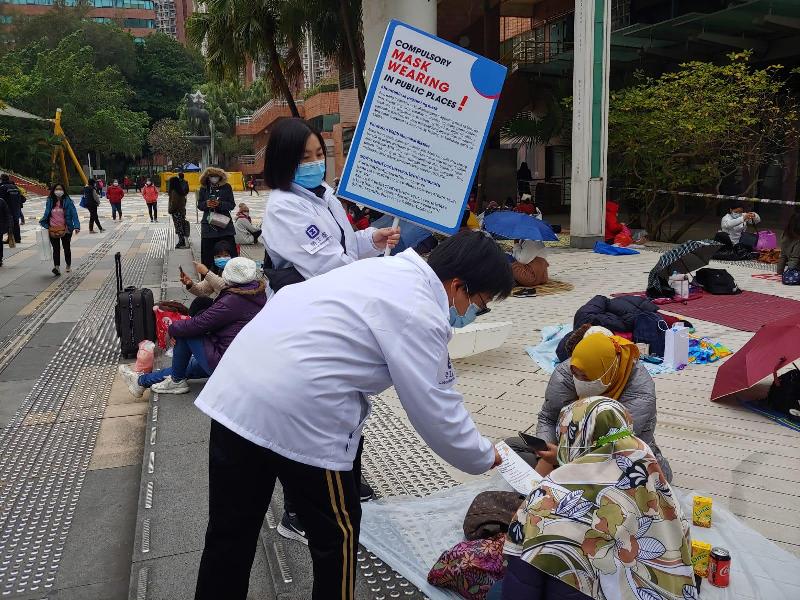
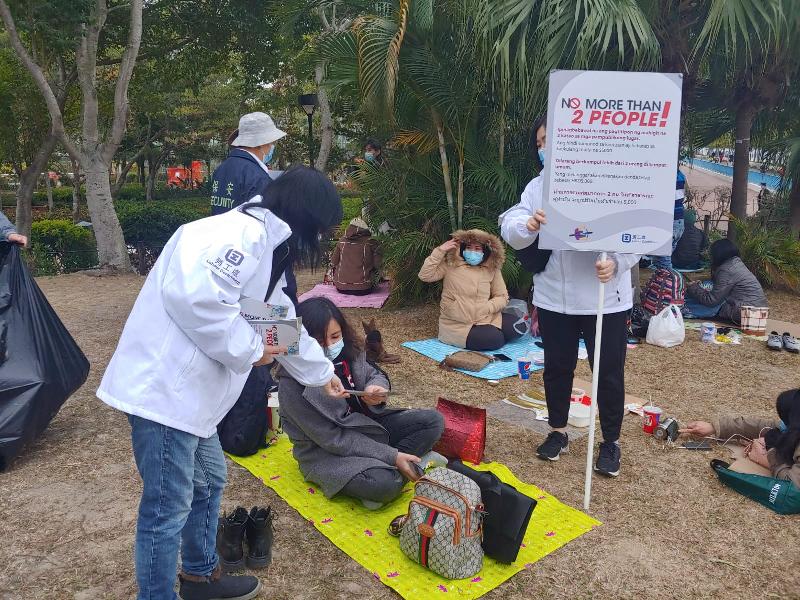
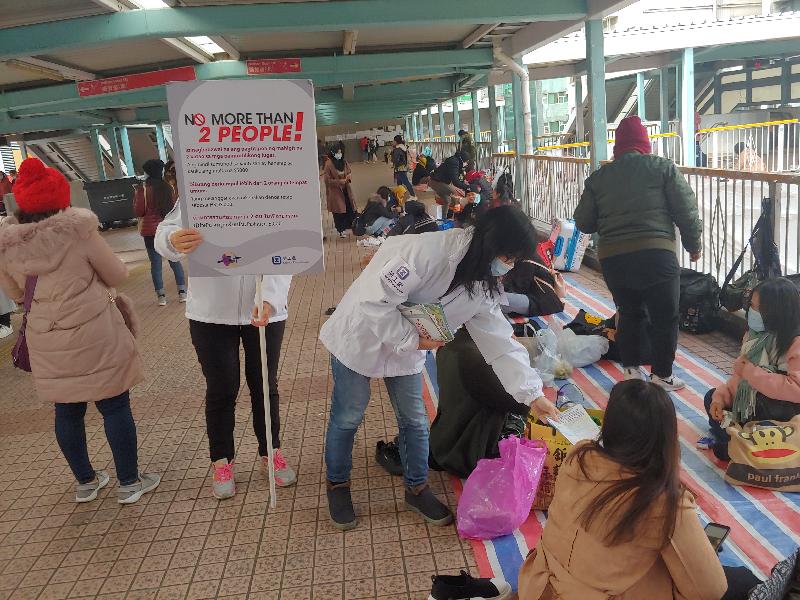
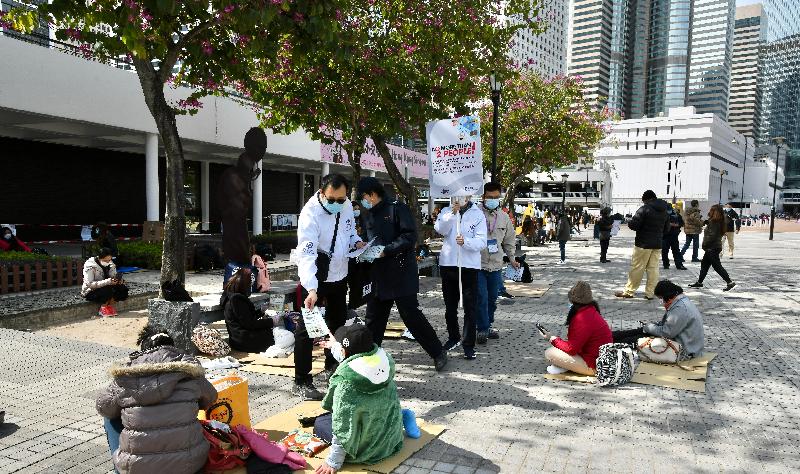
Government appeals to foreign domestic helpers to comply with anti-epidemic regulations and measures on mask-wearing and prohibition of group gatherings of more than two persons in public places (with photos)

     The Labour Department (LD) today (January 10) conducted joint operations in collaboration with the Hong Kong Police Force (the Police), the Food and Environmental Hygiene Department (FEHD), the Home Affairs Department and the Leisure and Cultural Services Department (LCSD), including mobile broadcasts in popular gathering places of foreign domestic helpers (FDHs) to call upon them to comply with the anti-epidemic regulations on the mask-wearing and prohibition of group gatherings of more than two persons in public places.

     The LD arranged mobile broadcast on January 9 and 10 at popular FDH gathering places (including Tamar Park in Admiralty, Victoria Park in Causeway Bay, footbridge near Fa Yuen Street in Mong Kok, and various places at Central, Sha Tin and Ma On Shan). Publicity vans were arranged to broadcast reminders in Chinese, English and major FDH languages (including Tagalog, Bahasa Indonesia and Thai) to call upon FDHs to comply with the regulations on the mask-wearing and prohibition of group gatherings of more than two persons in public places. During the joint operations on January 10, multiple-language promotional leaflets were distributed by officers from relevant government departments to appeal to FDHs to maintain environmental hygiene and refrain from conducting unlicensed hawking activities, including cooked food or other hawking activities. Also, the Police increased manpower to step up patrols at those places and the FEHD took follow-up actions to keep those places clean.

     A Government spokesman said, "According to the Prevention and Control of Disease (Prohibition on Group Gathering) Regulation (Cap. 599G) and the Prevention and Control of Disease (Wearing of Mask) Regulation (Cap. 599I), a person who participates in a prohibited group gathering of more than two persons in public places or fails to wear a mask in accordance with the requirement may be charged a fixed penalty of $5,000. The Government will continue to conduct publicity to FDHs and remind them to strictly observe the relevant regulations, and to avoid gatherings (including in boarding facilities), food sharing and other social activities on their rest days and stay at home for rest as far as possible to safeguard their personal health."

     The Government will continue to step up publicity and enforcement, and as needed conduct joint operations to ensure compliance with the relevant requirements. The Government also appeals to FDHs to exercise self-discipline and co-operate to fight the virus together and abide by the law.

Photo  Photo  Photo  Photo  Photo  


CHP investigates 31 additional confirmed cases of COVID-19

     The Centre for Health Protection (CHP) of the Department of Health (DH) announced that as of 0.00am, January 10, the CHP was investigating 31 additional confirmed cases of coronavirus disease 2019 (COVID-19), taking the number of cases to 9 243 in Hong Kong so far (comprising 9 242 confirmed cases and one probable case).

     Among the newly reported cases announced, three had a travel history during the incubation period.

     A total of 671 cases have been recorded in the past 14 days (December 27 to January 9), including 618 local cases of which 196 are from unknown sources.

     The CHP's epidemiological investigations and relevant contact tracing on the confirmed cases are ongoing. For case details and contact tracing information, please see the Annex or the list of buildings with confirmed cases of COVID-19 in the past 14 days and the latest local situation of COVID-19 available on the website "COVID-19 Thematic Website" (www.coronavirus.gov.hk).

     Meanwhile, the CHP reminded those who had visited specified venues under the Prevention and Control of Disease (Compulsory Testing for Certain Persons) Regulation (Cap. 599J) to receive COVID-19 nucleic acid testing according to the compulsory testing notice. The public are also urged to seek medical attention early if symptoms develop.
 
     Regarding the severe epidemic situation, the CHP called on members of the public to avoid going out, having social contact and dining out. They should put on a surgical mask and maintain stringent hand hygiene when they need to go out. The CHP strongly urged the elderly to stay home as far as possible and avoid going out. They should consider asking their family and friends to help with everyday tasks such as shopping for basic necessities.

     The spokesman said, "Given that the situation of COVID-19 infection remains severe and that there is a continuous increase in the number of cases reported around the world, members of the public are strongly urged to avoid all non-essential travel outside Hong Kong.

     "The CHP also strongly urges the public to maintain at all times strict personal and environmental hygiene, which is key to personal protection against infection and prevention of the spread of the disease in the community. On a personal level, members of the public should wear a surgical mask when having respiratory symptoms, taking public transport or staying in crowded places. They should also perform hand hygiene frequently, especially before touching the mouth, nose or eyes.

     "As for household environmental hygiene, members of the public are advised to maintain drainage pipes properly, regularly pour water into drain outlets (U-traps) and cover all floor drain outlets when they are not in use. After using the toilet, they should put the toilet lid down before flushing to avoid spreading germs."

     Moreover, the Government has launched the website "COVID-19 Thematic Website" (www.coronavirus.gov.hk) for announcing the latest updates on various news on COVID-19 infection and health advice to help the public understand the latest updates. Members of the public may also gain access to information via the COVID-19 WhatsApp Helpline launched by the Office of the Government Chief Information Officer. Simply by saving 9617 1823 in their phone contacts or clicking the link wa.me/85296171823?text=hi, they will be able to obtain information on COVID-19 as well as the "StayHomeSafe" mobile app and wristband via WhatsApp.

     To prevent pneumonia and respiratory tract infections, members of the public should always maintain good personal and environmental hygiene. They are advised to:

• Wear a surgical mask when taking public transport or staying in crowded places. It is important to wear a mask properly, including performing hand hygiene before wearing and after removing a mask;
• Perform hand hygiene frequently, especially before touching the mouth, nose or eyes, after touching public installations such as handrails or doorknobs, or when hands are contaminated by respiratory secretions after coughing or sneezing;
• Maintain drainage pipes properly and regularly (about once a week) pour about half a litre of water into each drain outlet (U-trap) to ensure environmental hygiene;
• Cover all floor drain outlets when they are not in use;
• After using the toilet, put the toilet lid down before flushing to avoid spreading germs;
• Wash hands with liquid soap and water, and rub for at least 20 seconds. Then rinse with water and dry with a disposable paper towel. If hand washing facilities are not available, or when hands are not visibly soiled, performing hand hygiene with 70 to 80 per cent alcohol-based handrub is an effective alternative;
• Cover your mouth and nose with tissue paper when sneezing or coughing. Dispose of soiled tissues into a lidded rubbish bin, then wash hands thoroughly; and
• When having respiratory symptoms, wear a surgical mask, refrain from work or attending class at school, avoid going to crowded places and seek medical advice promptly.


Public hospitals daily update on COVID-19 cases

The following is issued on behalf of the Hospital Authority:

     As at 9am today (January 10), 48 COVID-19 confirmed patients were discharged from hospital in the last 24 hours. Including a patient (case number: 9170) discharged on January 8, a total of 8 423 patients with confirmed or probable infection have been discharged so far.

     At present, there are 688 negative pressure rooms in public hospitals with 1 253 negative pressure beds activated. A total of 601 confirmed patients are currently hospitalised in 23 public hospitals and a community treatment facility, among which 39 patients are in critical condition, 44 are in serious condition and the remaining 518 patients are in stable condition.

     The Hospital Authority will maintain close contact with the Centre for Health Protection to monitor the latest developments and to inform the public and healthcare workers on the latest information in a timely manner.

     Details of the above-mentioned patients are as follows:
 

Patient condition Case numbers
Discharged 6349, 6495, 7580, 7734, 8007, 8011, 8271, 8288, 8307, 8339, 8372, 8401, 8407, 8457, 8499, 8525, 8559, 8596, 8645, 8655, 8682, 8683, 8696, 8705, 8713, 8730, 8744, 8755, 8758, 8769, 8771, 8783, 8793, 8804, 8812, 8828, 8855, 8857, 8861, 8889, 8891, 8896, 9003, 9017, 9083, 9136, 9169, 9171
Critical 1989, 3496, 5409, 5735, 5754, 6125, 6232, 6255, 6444, 6547, 6607, 6754, 6794, 6913, 7021, 7123, 7259, 7323, 7424, 7680, 8018, 8055, 8078, 8126, 8195, 8323, 8384, 8449, 8452, 8564, 8636, 8820, 8900, 8937, 9049, 9060, 9062, 9081, 9164
Serious 5511, 5739, 5745, 5990, 6386, 6543, 6681, 6824, 6850, 6920, 6921, 7076, 7127, 7208, 7305, 7468, 7632, 7653, 7824, 7964, 7980, 7986, 8187, 8221, 8235, 8245, 8443, 8446, 8477, 8558, 8587, 8603, 8611, 8738, 8819, 8832, 8931, 9015, 9033, 9040, 9045, 9124, 9133, 9166