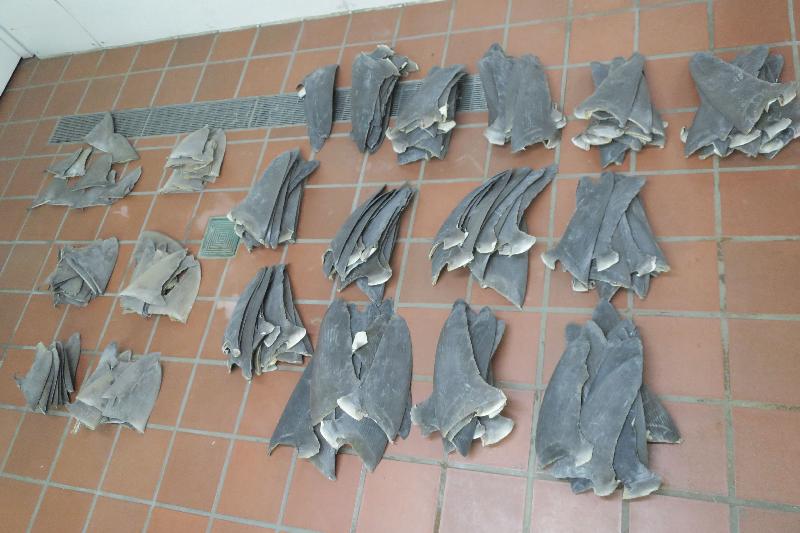
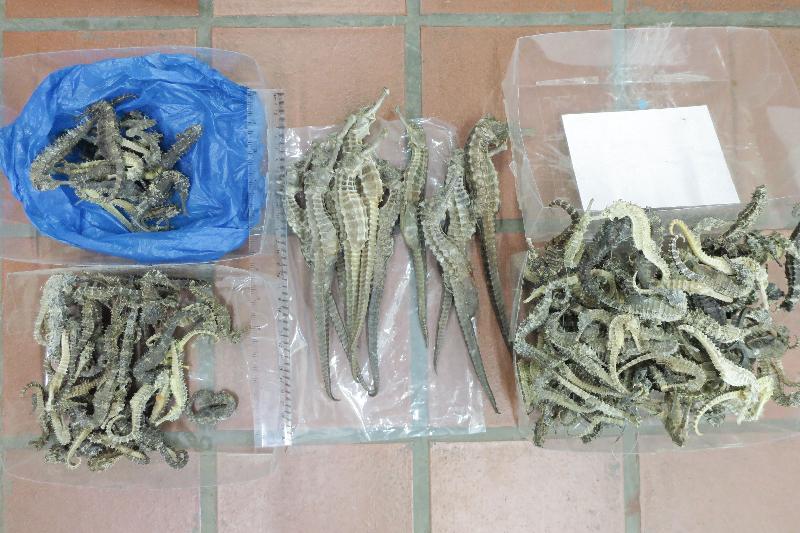
Three travellers jailed for smuggling dried shark fins and dried seahorses (with photos)

     Three travellers who smuggled dried shark fins and dried seahorses were convicted for violating the Protection of Endangered Species of Animals and Plants Ordinance, and were sentenced to imprisonment today (January 11).
 
     A spokesman for the Agriculture, Fisheries and Conservation Department (AFCD) said that the three travellers arrived in Hong Kong on August 23, 2019, from Manila, the Philippines. About 48, 63 and 72 kilograms of dried fins from silky sharks (Carcharhinus falciformis) were respectively found in the check-in baggage of these three travellers by Customs officers, as well as some 0.56kg of dried seahorses in one of the travellers' check-in baggage.
 
     Subsequent to follow-up investigations, the AFCD charged the men with illegal import of listed species in Appendix II to the Convention on International Trade in Endangered Species of Wild Fauna and Flora (CITES). They were convicted at the District Court earlier and each sentenced to 18 months' imprisonment today.
 
     Silky sharks and seahorses are listed in Appendix II to the CITES and regulated under the Ordinance in Hong Kong. Any person importing, exporting or possessing specimens of endangered species not in accordance with the Ordinance commits an offence and will be liable to a maximum fine of $10 million and imprisonment for 10 years. The specimens will also be forfeited upon conviction.
 
     To enquire about the control of endangered species or to report suspected irregularities, the public can call the AFCD on 1823 or visit www.cites.hk.

Photo  Photo  


CHP investigates 41 additional confirmed cases of COVID-19

     The Centre for Health Protection (CHP) of the Department of Health (DH) announced that as of 0.00am, January 11, the CHP was investigating 41 additional confirmed cases of coronavirus disease 2019 (COVID-19), taking the number of cases to 9 284 in Hong Kong so far (comprising 9 283 confirmed cases and one probable case).

     Among the newly reported cases announced, three had a travel history during the incubation period.

     A total of 632 cases have been recorded in the past 14 days (December 28 to January 10), including 577 local cases of which 181 are from unknown sources.

     The CHP's epidemiological investigations and relevant contact tracing on the confirmed cases are ongoing. For case details and contact tracing information, please see the Annex or the list of buildings with confirmed cases of COVID-19 in the past 14 days and the latest local situation of COVID-19 available on the website "COVID-19 Thematic Website" (www.coronavirus.gov.hk).

     Meanwhile, the CHP reminded those who had visited specified venues under the Prevention and Control of Disease (Compulsory Testing for Certain Persons) Regulation (Cap. 599J) to receive COVID-19 nucleic acid testing according to the compulsory testing notice. The public are also urged to seek medical attention early if symptoms develop.
 
     Regarding the severe epidemic situation, the CHP called on members of the public to avoid going out, having social contact and dining out. They should put on a surgical mask and maintain stringent hand hygiene when they need to go out. The CHP strongly urged the elderly to stay home as far as possible and avoid going out. They should consider asking their family and friends to help with everyday tasks such as shopping for basic necessities.

     The spokesman said, "Given that the situation of COVID-19 infection remains severe and that there is a continuous increase in the number of cases reported around the world, members of the public are strongly urged to avoid all non-essential travel outside Hong Kong.

     "The CHP also strongly urges the public to maintain at all times strict personal and environmental hygiene, which is key to personal protection against infection and prevention of the spread of the disease in the community. On a personal level, members of the public should wear a surgical mask when having respiratory symptoms, taking public transport or staying in crowded places. They should also perform hand hygiene frequently, especially before touching the mouth, nose or eyes.

     "As for household environmental hygiene, members of the public are advised to maintain drainage pipes properly, regularly pour water into drain outlets (U-traps) and cover all floor drain outlets when they are not in use. After using the toilet, they should put the toilet lid down before flushing to avoid spreading germs."

     Moreover, the Government has launched the website "COVID-19 Thematic Website" (www.coronavirus.gov.hk) for announcing the latest updates on various news on COVID-19 infection and health advice to help the public understand the latest updates. Members of the public may also gain access to information via the COVID-19 WhatsApp Helpline launched by the Office of the Government Chief Information Officer. Simply by saving 9617 1823 in their phone contacts or clicking the link wa.me/85296171823?text=hi, they will be able to obtain information on COVID-19 as well as the "StayHomeSafe" mobile app and wristband via WhatsApp.

     To prevent pneumonia and respiratory tract infections, members of the public should always maintain good personal and environmental hygiene. They are advised to:

• Wear a surgical mask when taking public transport or staying in crowded places. It is important to wear a mask properly, including performing hand hygiene before wearing and after removing a mask;
• Perform hand hygiene frequently, especially before touching the mouth, nose or eyes, after touching public installations such as handrails or doorknobs, or when hands are contaminated by respiratory secretions after coughing or sneezing;
• Maintain drainage pipes properly and regularly (about once a week) pour about half a litre of water into each drain outlet (U-trap) to ensure environmental hygiene;
• Cover all floor drain outlets when they are not in use;
• After using the toilet, put the toilet lid down before flushing to avoid spreading germs;
• Wash hands with liquid soap and water, and rub for at least 20 seconds. Then rinse with water and dry with a disposable paper towel. If hand washing facilities are not available, or when hands are not visibly soiled, performing hand hygiene with 70 to 80 per cent alcohol-based handrub is an effective alternative;
• Cover your mouth and nose with tissue paper when sneezing or coughing. Dispose of soiled tissues into a lidded rubbish bin, then wash hands thoroughly; and
• When having respiratory symptoms, wear a surgical mask, refrain from work or attending class at school, avoid going to crowded places and seek medical advice promptly.


Woman sentenced for breaching compulsory quarantine order

     A 40-year-old woman was sentenced to immediate imprisonment for 14 days by the Eastern Magistrates' Courts today (January 11) for violating the Compulsory Quarantine of Certain Persons Arriving at Hong Kong Regulation (Cap. 599C) (the Regulation).

     The woman was earlier issued a compulsory quarantine order stating that she must conduct quarantine at home for 14 days. Before the expiry of the quarantine order, she left the place of quarantine on August 30, 2020, without reasonable excuse nor permission given by an authorised officer. She was charged with contravening sections 8(1) and 8(5) of the Regulation and was sentenced by the Eastern Magistrates' Courts today to immediate imprisonment for 14 days. 

     Pursuant to the Regulation, starting from February 8, 2020, save for exempted persons, all persons who have stayed in the Mainland, Macao or Taiwan in the 14 days preceding arrival in Hong Kong, regardless of their nationality or travel documents, will be subject to compulsory quarantine for 14 days. Moreover, pursuant to the Compulsory Quarantine of Persons Arriving at Hong Kong from Foreign Places Regulation (Cap. 599E), starting from December 25, 2020, all persons arriving at Hong Kong (either via the airport or land boundary control points) who have stayed in places outside China on the day of arrival at Hong Kong or during the 21 days before that day have to undergo compulsory quarantine for 21 days in designated quarantine hotels. Breaching a quarantine order is a criminal offence and offenders are subject to a maximum fine of $25,000 and imprisonment for six months.

     A spokesman for the Department of Health said the sentence sends a clear message to the community that breaching a compulsory quarantine order is a criminal offence that the Government will not tolerate, and solemnly reminded the public to comply with the Regulation. As of today, a total of 97 persons have been convicted by the courts for breaching compulsory quarantine orders and have received sentences including immediate imprisonment for up to 14 weeks or a fine of up to $15,000. The spokesman reiterated that resolute actions will be taken against anyone who has breached the relevant regulations.


Government to gazette compulsory testing notice

     The Government will exercise the power under the Prevention and Control of Disease (Compulsory Testing for Certain Persons) Regulation (Cap. 599J) and publish in the Gazette a compulsory testing notice, which requires any person who had been present at three specified premises during the specified period (persons subject to compulsory testing) to undergo a COVID-19 nucleic acid test.

     A spokesman for the Food and Health Bureau (FHB) said today (January 11), "To cut the transmission chain in the community as soon as possible, the Government has expanded the scope for 'compulsory testing on mandatory basis'. If confirmed cases not epidemiologically linked to each other were found in two or more units in the same building in the past 14 days, the building would be included in the compulsory testing notice under Cap. 599J. Persons who had been present at the relevant building in the past 14 days will have to undergo compulsory testing. Three buildings fulfilling the above criteria will be covered by the compulsory testing notice today."

     Details of persons subject to compulsory testing are as follows:

     Any person who had been present at any of the following specified premises for more than two hours at any time during the period from December 29, 2020, to January 11, 2021 (including but not limited to visitors, residents and workers), have to undergo testing by January 14, 2021. If persons subject to compulsory testing have previously undergone testing between January 9 and January 11, 2021, they would be taken to have complied with the requirements set out in the compulsory testing notice.
 
1. Kit Yat House of Yat Tung (2) Estate, 8 Yat Tung Street, Tung Chung
2. King Tao House of King Lam Estate, 38 Po Lam Road North, Tseung Kwan O
3. Tower 7 of Metro Harbour View, 8 Fuk Lee Street, Tai Kok Tsui
 
     "Based on recent experience, persons subject to compulsory testing would feel more relieved if they receive SMS (mobile phone text message) notifications confirming the negative results of the tests. Such SMS notifications can also facilitate law enforcement. Therefore, the Government has updated the testing routes applicable to compulsory testing notices, which only include those where SMS notifications confirming negative test results would be issued to persons who underwent testing afterwards. The Government is reviewing the need for setting up mobile specimen collection stations near the relevant buildings. Apart from mobile specimen collection stations, persons subject to compulsory testing can also choose to attend any of the community testing centres in all districts to receive testing free of charge."

     Persons subject to compulsory testing may choose to undergo testing via the following routes:
 
1. To visit any of the mobile specimen collection stations (see the list and target groups (if applicable) at www.coronavirus.gov.hk/eng/early-testing.html) for testing;
 
2. To attend any of the community testing centres (see the list at www.communitytest.gov.hk/en/);
 
3. To obtain a deep throat saliva specimen collection pack from any of the 121 post offices, vending machines set up at 20 MTR stations or 47 designated general outpatient clinics (GOPCs) of the Hospital Authority and return the specimen to one of the designated specimen collection points (see the distribution points and times, and the specimen collection points and times, at www.coronavirus.gov.hk/eng/early-testing.html);
 
4. To undergo testing at any of the GOPCs of the Hospital Authority as instructed by a medical professional of the Hospital Authority;
 
5. To self-arrange testing provided by private laboratories which are recognised by the Department of Health and can issue SMS notifications in respect of test results (see the list at www.coronavirus.gov.hk/pdf/List_of_recognised_laboratories_RTPCR.pdf); or
 
6. To use a specimen bottle distributed to the relevant specified premises by the Centre for Health Protection (if applicable), and return the specimen bottle with the sample collected as per the relevant guidelines.

     The spokesman cautioned that testing received at accident and emergency departments of the Hospital Authority or during hospital stays, or testing provided by private laboratories which cannot issue SMS notifications in respect of test results, does not comply with the requirements of the aforementioned compulsory testing notice.

     "If persons subject to compulsory testing have symptoms, they should seek medical attention immediately and undergo testing as instructed by a medical professional. They should not attend the mobile specimen collection stations or the community testing centres."

     Persons subject to compulsory testing must keep the SMS notification containing the result of the test for checking by a law enforcement officer when the officer requires the persons to provide information about their undergoing the specified test.

     Furthermore, persons subject to testing under the compulsory testing notice should, as far as reasonably practicable, take appropriate personal disease prevention measures including wearing a mask and maintaining hand hygiene, and, unless for the purpose of undergoing the specified test, stay at their place of residence and avoid going out until the test result is ascertained as far as possible.

     Any enquiries on compulsory testing arrangements may be addressed to the hotline at 6275 6901, which operates daily from 9am to 6pm. If persons subject to compulsory testing plan to conduct testing at any of the community testing centres, they can check the centre's appointment status in advance. The hotlines of the community testing centres are at www.communitytest.gov.hk/en/info/.

     The Government will continue to trace possibly infected persons who had been to the relevant premises, and seriously verify whether they had complied with the testing notice. Any person who fails to comply with the testing notice commits an offence and may be fined a fixed penalty of $5,000. The person would also be issued with a compulsory testing order requiring him or her to undergo testing within a specified time frame. Failure to comply with the order is an offence and the offender would be liable to a fine at level 4 ($25,000) and imprisonment for six months.

     The spokesman said, "The Government urges all individuals who are in doubt about their own health conditions, or individuals with infection risks (such as individuals who visited places with epidemic outbreaks or contacted confirmed cases), to undergo testing promptly for early identification of infected persons. The FHB will publish compulsory testing notices regarding particular groups when necessary taking into account the epidemic developments and the testing participation rate." 


SJ’s speech at Ceremonial Opening of the Legal Year 2021

     Following is the speech by the Secretary for Justice, Ms Teresa Cheng, SC, at the Ceremonial Opening of the Legal Year 2021 today (January 11):
 
Chief Justice, members of the Judiciary, Chairman of the Bar Association, President of the Law Society, distinguished guests, ladies and gentlemen,
 
     The holding of the opening of the legal year here at the Court of Final Appeal, with its live broadcast to the public, is testimony to Hong Kong's strong legal traditions and the resilience and tenacity of the legal community notwithstanding unforeseeable challenges beyond one's control. The coronavirus has posed immense challenges to the world and Hong Kong is not spared.
 
Judicial Independence
 
     In my 2019 speech, I condemned the totally baseless, arbitrary and even malicious attacks on some of our judges, urging the community to dispel such unwarranted misunderstanding by reading the court judgments. Last year, I have witnessed multiple occasions by which similar reminders have had to be made.
 
     Our judicial independence is premised on the solid infrastructure that has been laid down primarily in the Basic Law – the security of tenure (Note 1), the immunity of judges (Note 2), the non-revolving door (Note 3), and importantly the expressed provision in Article 85 of the Basic Law that guarantees judicial independence, free from any interference (Note 4). The judicial oath, taken by all judges, requires them to safeguard the law and administer justice, without fear or favour. Judges are required to adjudicate cases independently and impartially. Comments and discussions on court decisions are always permissible within the boundary of the law if done rationally and objectively. Yet some remarks that have surfaced are nothing like that. Any unfair or unfounded remarks with the ulterior motive of exerting pressure or undue influence on our judges in dispensing justice will be to no avail.
 
Doxxing
 
     Doxxing activities towards judges and other persons involved in the administration of justice were on the rise and must be curtailed. As "guardian of the public interest" (Note 5), I sought and obtained an injunction order to restrain the conduct of such activities towards Judges, Judicial Officers and their family members. In granting this injunction, the Court noted:
 
     "It remains fundamental to the rule of law that litigants and the general public are able to place reliance on and have confidence in a Court system that is free from bias, and that the Judge or Judicial Officer in any case is the person who decides that case according to its evidence and the applicable law." (Note 6)
 
     It is a serious matter to act in breach of an injunction order. Any person who acts in violation of an injunction order may be held in contempt of court and is liable to a fine or imprisonment, including an immediate custodial sentence as ordered by the Court in a recent decision (Note 7).
 
     As I have stated in 2018, "(a)ll of us jointly bear the responsibility to respect, promote and further the rule of law as a fundamental basis of our society" (Note 8). It lies in every individual and institution to be forthcoming in defending our judiciary and the rule of law against these baseless and malicious attacks and, for some, to refrain from blindly uttering such statements.
 
National Security Law
 
     Another baseless challenge to our rule of law relates to the promulgation of the National Security Law in Hong Kong. National security is within the purview of the Central Authorities. The National People's Congress (NPC) is the highest organ of state power in the People's Republic of China and its Standing Committee was entrusted to formulate the National Security Law. Pursuant to Article 18 of the Basic Law, it was added to Annex III, promulgated and became applicable to the HKSAR.
 
     Article 23 of the Basic Law does not change the fundamental principles set out above. It imposes a constitutional responsibility on the HKSAR to enact legislation in respect of certain offences relating to national security. Yet the Central Authorities always have the power and duty to legislate on matters of national security, especially when this responsibility of the HKSAR has not been fulfilled. It is entirely misconceived to say that the principle of "one country, two systems" has been undermined.
 
     Many unfair and ill-informed criticisms have been made against the designation of judges by the Chief Executive, with remarks that it will undermine Hong Kong's judicial system. It should be reiterated that the Chief Executive only designates a list of judges in different levels of courts to hear cases involving issues of national security, rather than assigning which judge to preside over a specific case.
 
Understanding the Basic Law
 
     The National Security Law brings into sharp focus the constitutional order of Hong Kong. China is a unitary state, and the powers of the branches of the HKSAR emanate from the Central Authorities. The Constitution and the Basic Law form the constitutional basis of the HKSAR. A proper understanding of this concept is of utmost importance to comprehend our legal system.
 
     The Basic Law 30th Anniversary Legal Summit with the theme "Back to Basics" reminds us of the fundamentals necessary for the proper understanding of the Basic Law. A key takeaway from the Summit is entirely the same as a finding in the Court of Appeal decision dealing with the Emergency Regulations Ordinance (ERO): that the HKSAR Government is "very much an executive-led government" (Note 9).
 
The Emergency Regulations Ordinance
 
     The judgment delivered by the Court of Final Appeal regarding the ERO (Note 10) is particularly significant. It upheld the compatibility of the ERO with the Basic Law, and recognised that in circumstances of public danger, it is "'essential' to give the executive 'wide and flexible legislative powers' whether or not the legislature is sitting" (Note 11). The court continued:
 
     "It should be remembered that the purpose of the ERO is to provide the (Chief Executive in Council) with wide and flexible legislative powers in times of emergency or public danger in order to deal quickly and adequately with the situation in question." (Note 12)
 
     In upholding the constitutionality of the ERO and the proportionality of the Prohibition on Face Covering Regulation which restricted the use of facial coverings during public order events we saw in 2019 with deteriorating law and order (Note 13), the Court took the view that when striking a fair balance between the societal and individual interests, the interests of Hong Kong as a whole is important. I echo this view – rights and freedoms are not absolute but are subject to lawful restrictions including the interests of public safety, public order and the protection of the rights and freedoms of others (Note 14). One final statement in the judgment is noteworthy:
 
     "… And finally, the interests of Hong Kong as a whole should be taken into account since the rule of law itself was being undermined by the actions of masked lawbreakers who, with their identities concealed, were seemingly free to act with impunity." (Note 15)
 
Criminal Appeals
 
     This year marks a significant increase in the amount of applications for the review of sentence lodged under section 81A of the Criminal Procedure Ordinance (Note 16), with 17 applications lodged in 2020 compared to four in 2019. Of the 12 such applications decided in 2020, 11 were allowed. In four of the cases, the Court of Appeal repeated the sentencing principle as set out in Wong Chi Fung (Note 17) of the necessity to emphasise deterrence and punishment in large-scale unlawful assembly cases involving violence be applied.
 
Vision 2030
 
     Under the "Vision 2030 for Rule of Law" initiative, and benefiting from the guidance of the Task Force formed under it, we noted that objective data shall be referred to in ascertaining the practice of the rule of law and important elements including cultural, socio-economic and local traditions (both legal and indigenous) are features that must be taken into account.
 
     Locally, we have started projects that will promote the proper understanding and recognition of the rule of law, the Constitution and the Basic Law at various levels of society, through a multi-faceted approach such as animated short videos, drama, interactive workshops, and exposure to international conferences. These "3Es" projects – representing "Engagement, Empowerment, and Enrichment", aim to raise awareness of a law-abiding society, equip youth with the correct understanding of the rule of law, and provide the legal community with opportunities to broaden their knowledge and international exposure.
 
Other DoJ Initiatives
 
     The coronavirus has changed the way we deliver conferences. The use of technology and live feed has enabled us to reach out to more people in more jurisdictions and to provide recordings on the legalhub.gov.hk website. In a way, it is a blessing in disguise. Yet, some of our events which are best conducted by way of physical meetings to facilitate personal interactions have to be postponed. They include the Asian-African Legal Consultative Organization annual meeting, the United Nations Commission on International Trade Law (UNCITRAL) Working Group III Intersessional Meeting and the Advanced Course that my department is co-organising with The Hague Academy of International Law and the Asian Academy of International Law.
 
     We have also reached a Supplemental Arrangement (Note 18) with the Supreme People's Court to bring the 1999 Arrangement Concerning Mutual Enforcement of Arbitral Awards (Note 19) more in line with the spirit and intent of the New York Convention (Note 20) and international arbitration practice (Note 21). Legislative measures will be needed to implement the same.
 
     As to new initiatives, the Department of Justice will continue to pursue and promote the development of LawTech. As set out in the Policy Address, we will be facilitating the development of the Hong Kong legal cloud to provide safe, secure and affordable data storage services for local legal and dispute resolution communities. Furthermore, with the use of online dispute resolution (ODR) being more prevalent, and apart from already signing up to the Asia-Pacific Economic Cooperation ODR Framework, we have also established a DOJ Project Office for Collaboration with UNCITRAL to study pertinent legal issues stemming from the increasing use of emerging technology. With input from UNCITRAL, we are planning to set up an Inclusive Global Legal Innovation Platform to facilitate studies in this particular aspect.
 
     Last year, an online international conference to celebrate the 40th anniversary of the United Nations Convention on Contracts for the International Sale of Goods (CISG) was conducted. A public consultation on Hong Kong's proposed application of the CISG was completed and we are analysing and compiling the results.
 
WTO Case with US
 
     In protecting our legitimate rights, Hong Kong has formally taken steps under the World Trade Organization framework to resolve its dispute with the United States with respect to its origin markings requirement imposed on Hong Kong products. We believe that the US requirement is contrary to a number of WTO-covered agreements, undermines the rule-based multilateral trading system, and does not respect Hong Kong's status as a separate customs territory.
 
Conclusion
 
     Ladies and gentlemen, today is a very special day: the Ceremonial Opening of the Legal Year 2021, the former Chief Justice Mr Geoffrey Ma's 65th birthday, and Chief Justice Cheung's first day in assuming the role of Chief Justice. To the new Chief Justice I offer my heartfelt congratulations, and I am confident that he will continue to safeguard the independence of the Judiciary and the rule of law in Hong Kong. With this, I wish you all a very happy and healthy new year.
 
Note 1: Article 89 of the Basic Law guarantees the security of tenure for judges, and states that they can only be removed for inability to discharge his or her duties or for misbehaviour.
Note 2: Article 85 of the Basic Law provides that members of the judiciary shall be immune from legal action in the performance of their judicial functions.
Note 3: Upon appointment, judges at the District Court level and above are precluded from returning to practice in Hong Kong as a barrister or solicitor. This "non-revolving door" system prevents perceived conflicts of interest and enhances the independence of the judiciary.
Note 4: Article 85 of the Basic Law reads:
"The courts of the Hong Kong Special Administrative Region shall exercise judicial power independently, free from any interference. Members of the judiciary shall be immune from legal action in the performance of their judicial functions."
Note 5: Secretary for Justice v Persons unlawfully and wilfully conducting themselves in any of the acts prohibited under paragraph 1(a), (b) or (c) of the indorsement of claim [2020] HKCFI 2785 (HCA 1847/2020, 13 November 2020) at paragraphs 8 and 35.
Note 6: Secretary for Justice v Persons unlawfully and wilfully conducting themselves in any of the acts prohibited under paragraph 1(a), (b) or (c) of the indorsement of claim [2020] HKCFI 2785 (HCA 1847/2020, 13 November 2020) at paragraph 37.
Note 7: Secretary for Justice v Chan Kin Chung [2020] HKCFI 3147, (HCMP 744/2020, 28 December 2020) at paragraph 59.
Note 8: Speech by the Secretary for Justice at the Ceremonial Opening of the Legal Year 2018 at www.doj.gov.hk/en/community_engagement/speeches/20180108_sj1.html.
Note 9: See the Court of Appeal judgment in Kwok Wing Hang & Others v Chief Executive in Council & Anor [2020] 2 HKLRD 771, [2020] HKCA 192 and Leung Kwok Hung v Secretary for Justice & Anor [2020] 2 HKLRD 771, [2020] HKCA 192 at paragraph 92.
Note 10: Kwok Wing Hang & Others v Chief Executive in Council & Anor [2020] HKCFA 42 and Leung Kwok Hung v Secretary for Justice & Anor [2020] HKCFA 42.
Note 11: Kwok Wing Hang, Leung Kwok Hung [CFA] at paragraph 44.
Note 12: Kwok Wing Hang, Leung Kwok Hung [CFA] at paragraph 61.
Note 13: Kwok Wing Hang, Leung Kwok Hung [CFA] at paragraphs 87 to 97.
Note 14: Kwok Wing Hang, Leung Kwok Hung [CFA] at paragraph 100.
Note 15: Kwok Wing Hang, Leung Kwok Hung [CFA] at paragraph 146.
Note 16: Criminal Procedure Ordinance, Cap. 221.
Note 17: Secretary for Justice v Wong Chi Fung [2018] 2 HKLRD 699, which was endorsed by the Court of Final Appeal in Secretary for Justice v Wong Chi Fung (2018) 21 HKCFAR 35.
Note 18: Supplemental Arrangement Concerning Mutual Enforcement of Arbitral Awards between the Mainland and the Hong Kong Special Administrative Region, signed on November 27, 2020.
Note 19: Arrangement Concerning Mutual Enforcement of Arbitral Awards between the Mainland and the Hong Kong Special Administrative Region, signed on June 21, 1999.
Note 20: Convention on the Recognition and Enforcement of Foreign Arbitral Awards, signed on June 10, 1958.
Note 21: The Supplemental Arrangement amends the 1999 Arbitration Arrangement in four aspects, namely: (i) expressly including the term "recognition" when referring to enforcement of arbitral awards; (ii) providing that a party may apply for preservation measures before or after the court's acceptance of an application to enforce an arbitral award for greater certainty; (iii) aligning the scope of arbitral awards with the prevalent approach of "seat of arbitration"; and (iv) removing the current restriction and allow parties to make simultaneous applications to both the courts of the Mainland and the HKSAR for enforcement of an arbitral award.