Transcript of remarks by CE at media session (with photos/video)

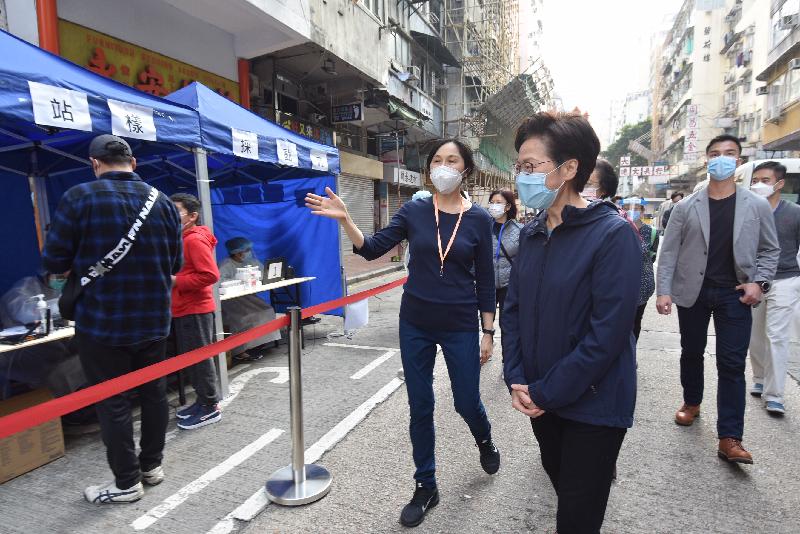
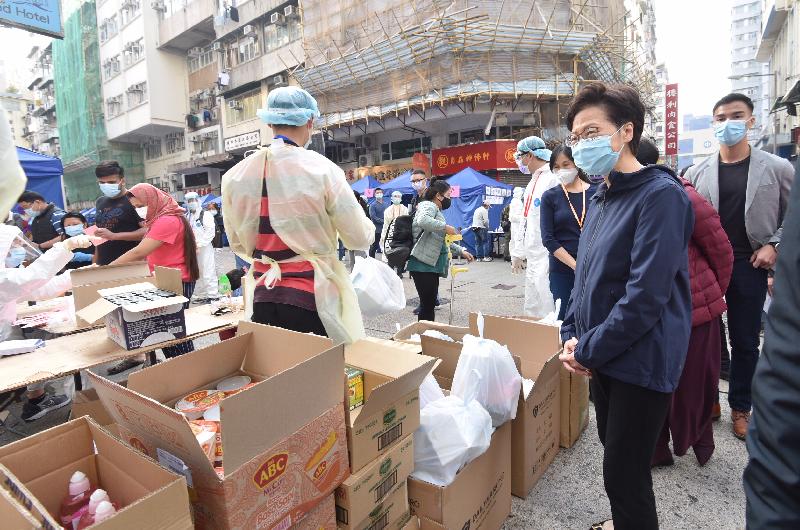
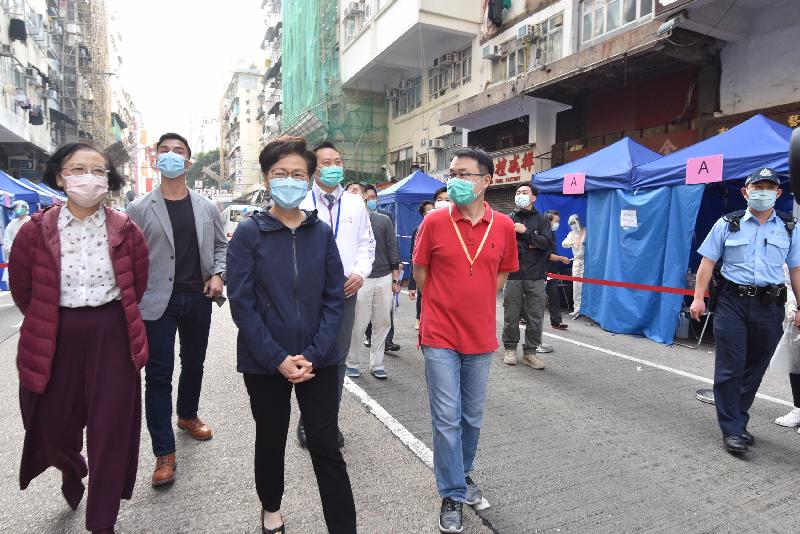
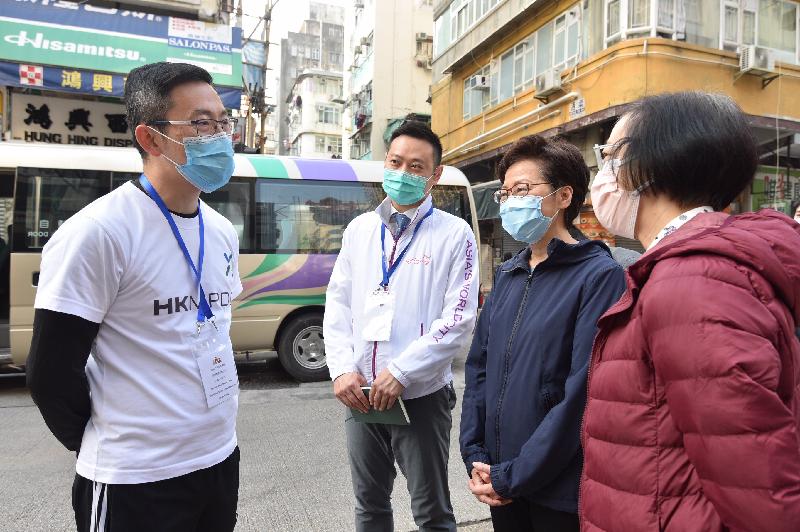
     Following is the transcript of remarks by the Chief Executive, Mrs Carrie Lam, at a media session with the Secretary for Food and Health, Professor Sophia Chan, and the Secretary for Home Affairs, Mr Caspar Tsui after inspecting the compulsory testing in the specified "restricted area" in Jordan this afternoon (January 23):
 
Reporter: Two questions. First of all, will the Government consider offering some sort of compensation to the affected residents, because some people, they're supposed to go to work but because of the lockdown, they're not able to go to work. The second question is, are there plans already to impose such a lockdown in other areas? Is Sham Shui Po going to be the next? And are you under pressure from Beijing to impose this lockdown, because it kind of resembles the way that the Mainland Chinese Government imposed the lockdown?
 
Chief Executive: The first question, as I have said on many occasions, any public health measures, especially in terms of mandating people to subject to tests, requiring shops and premises to close, require the full co-operation of the citizens and also the businesses. The Government is obliged to provide all the needed assistance, in this case, for example, we know that the residents being affected are not allowed to leave their home for up to 48 hours, so what the Government has done is we provide them with food packs which we believe should be able to support them for the next two days, and if there are other necessary requests, they could always call our hotline and we will try to help. That's the approach that we have taken in supporting this type of operation.
 
     The second point is, I must make it very clear that what we are doing is not what people see in other places as a lockdown, because a lockdown normally means that you are not allowed to go out for a period. But in our case, this prohibition is linked to the tests, that's why in English we call this a "restriction-testing declaration". It is for the purpose of the compulsory testing. Once the compulsory testing for the entire area has been completed, then the order will be lifted and people will be allowed to go out. I would say that there is a difference between what we are doing in Hong Kong and what people normally refer to as "city lockdown" in other parts of the world.
 
     In combating COVID-19, I have said this many times, the Central People's Government attaches great importance to our situation and always stands ready to help. Whenever the Chief Executive asks for assistance in whatever form, they would try to help. We have seen this being demonstrated fully in the provision of masks at the very early stage of the pandemic and also in the provision of almost 600 medical technicians to help us to do the universal mass testing in September, and recently also in the completion of the interim hospital after helping us to provide an extra 1 000 beds in AsiaWorld-Expo for isolation and community treatment purpose. I may as well tell you that on the question of vaccines, I have also asked for support, and this was in line with what I was given to understand when I visited Beijing last November, and I said this in my Policy Address, that if there was a need, then the Central Government will always try to help by providing a certain amount of vaccines that are either developed or produced in the Mainland for the use of the Hong Kong residents, and on this I have made a particular request to the Central People's Government. It is really the approach and the attitude of helping, and not mandating Hong Kong SARG (Special Administrative Region Government) to take whatever measures, because I think the Central Government fully appreciates the differences in context between Hong Kong and the Mainland and the differences in our legal regime and the differences in how our people behave and react in terms of the government regulations. I am under no pressure whatsoever from the Central People's Government in doing this particular operation or in doing other anti-COVID-19 work.
 
(Please also refer to the Chinese portion of the transcript.)

Photo  Photo  Photo  Photo  Photo  Photo  Photo  


CHP investigates 81 additional confirmed cases of COVID-19

     The Centre for Health Protection (CHP) of the Department of Health (DH) announced that as of 0.00am, January 23, the CHP was investigating 81 additional confirmed cases of coronavirus disease 2019 (COVID-19), taking the number of cases to 10 010 in Hong Kong so far (comprising 10 009 confirmed cases and one probable case).

     Among the newly reported cases announced, three are imported cases.

     A total of 776 cases have been recorded in the past 14 days (January 9 to 22), including 734 local cases of which 266 are from unknown sources.
 
     The CHP's epidemiological investigations and relevant contact tracing on the confirmed cases are ongoing. For case details and contact tracing information, please see the Annex or the list of buildings with confirmed cases of COVID-19 in the past 14 days and the latest local situation of COVID-19 available on the website "COVID-19 Thematic Website" (www.coronavirus.gov.hk).
 
     Meanwhile, the CHP reminded those who had visited specified venues under the Prevention and Control of Disease (Compulsory Testing for Certain Persons) Regulation (Cap. 599J) to receive COVID-19 nucleic acid testing according to the compulsory testing notice. The public are also urged to seek medical attention early if symptoms develop.

     Regarding the severe epidemic situation, the CHP called on members of the public to avoid going out, having social contact and dining out. They should put on a surgical mask and maintain stringent hand hygiene when they need to go out. The CHP strongly urged the elderly to stay home as far as possible and avoid going out. They should consider asking their family and friends to help with everyday tasks such as shopping for basic necessities.
 
     The spokesman said, "Given that the situation of COVID-19 infection remains severe and that there is a continuous increase in the number of cases reported around the world, members of the public are strongly urged to avoid all non-essential travel outside Hong Kong.
 
     "The CHP also strongly urges the public to maintain at all times strict personal and environmental hygiene, which is key to personal protection against infection and prevention of the spread of the disease in the community. On a personal level, members of the public should wear a surgical mask when having respiratory symptoms, taking public transport or staying in crowded places. They should also perform hand hygiene frequently, especially before touching the mouth, nose or eyes.
 
     "As for household environmental hygiene, members of the public are advised to maintain drainage pipes properly, regularly pour water into drain outlets (U-traps) and cover all floor drain outlets when they are not in use. After using the toilet, they should put the toilet lid down before flushing to avoid spreading germs."
 
     Moreover, the Government has launched the website "COVID-19 Thematic Website" (www.coronavirus.gov.hk) for announcing the latest updates on various news on COVID-19 infection and health advice to help the public understand the latest updates. Members of the public may also gain access to information via the COVID-19 WhatsApp Helpline launched by the Office of the Government Chief Information Officer. Simply by saving 9617 1823 in their phone contacts or clicking the link wa.me/85296171823?text=hi, they will be able to obtain information on COVID-19 as well as the "StayHomeSafe" mobile app and wristband via WhatsApp.
 
     To prevent pneumonia and respiratory tract infections, members of the public should always maintain good personal and environmental hygiene. They are advised to:

• Wear a surgical mask when taking public transport or staying in crowded places. It is important to wear a mask properly, including performing hand hygiene before wearing and after removing a mask;
• Perform hand hygiene frequently, especially before touching the mouth, nose or eyes, after touching public installations such as handrails or doorknobs, or when hands are contaminated by respiratory secretions after coughing or sneezing;
• Maintain drainage pipes properly and regularly (about once a week) pour about half a litre of water into each drain outlet (U-trap) to ensure environmental hygiene;
• Cover all floor drain outlets when they are not in use;
• After using the toilet, put the toilet lid down before flushing to avoid spreading germs;
• Wash hands with liquid soap and water, and rub for at least 20 seconds. Then rinse with water and dry with a disposable paper towel. If hand washing facilities are not available, or when hands are not visibly soiled, performing hand hygiene with 70 to 80 per cent alcohol-based handrub is an effective alternative;
• Cover your mouth and nose with tissue paper when sneezing or coughing. Dispose of soiled tissues into a lidded rubbish bin, then wash hands thoroughly; and
• When having respiratory symptoms, wear a surgical mask, refrain from work or attending class at school, avoid going to crowded places and seek medical advice promptly.


Princess Margaret Hospital announces a patient tested preliminarily positive to COVID-19

The following is issued on behalf of the Hospital Authority:

     The spokesperson for Princess Margaret Hospital (PMH) made the following announcement today (January 23) concerning a patient preliminarily tested positive to COVID-19:
 
     A 52-year-old male patient was admitted to PMH Accident and Emergency Department (AED) on January 22 due to epigastric pain, vomiting and fever. He did not have other respiratory symptoms at the time. Medical staff arranged an admission screening test of COVID-19 for the patient according to established procedures and he was then transferred to the surgical ward for further treatment.
 
     The patient today received the preliminary positive result of the COVID-19 test which he underwent in community on January 22. His test arranged by the hospital upon admission was also positive for COVID-19. The patient was immediately transferred to the isolation ward for further treatment with stable condition.
 
     The hospital's infection control team conducted contact tracing accordingly. A patient who had stayed in the adjacent bed of the patient concerned in the surgical ward was classified as a close contact and will be quarantined for 14 days. The hospital will arrange viral tests for the patient.
 
     All staff members working in AED and the surgical ward concerned were equipped with appropriate personal protective equipment in accordance with infection control guidelines. No aerosol generating procedures had been performed during that period. So far no staff members have been classified as close contacts.
 
     The hospital has arranged thorough cleansing and disinfection of the ward concerned. PMH will continue to closely monitor the health condition of our staff and patients and communicate with the Centre for Health Protection about the latest situation.


Public hospitals daily update on COVID-19 cases

The following is issued on behalf of the Hospital Authority:

     As at 9am today (January 23), 50 COVID-19 confirmed patients were discharged from hospital in the last 24 hours. So far, a total of 8 998 patients with confirmed or probable infection have been discharged.
 
     At present, there are 676 negative pressure rooms in public hospitals with 1 224 negative pressure beds activated. A total of 731 confirmed patients are currently hospitalised in 24 public hospitals and a community treatment facility, among which 38 patients are in critical condition, 31 are in serious condition and the remaining 662 patients are in stable condition.
 
     The Hospital Authority will maintain close contact with the Centre for Health Protection to monitor the latest developments and to inform the public and healthcare workers on the latest information in a timely manner.
 
     Details of the above-mentioned patients are as follows:
 

Patient condition Case numbers
Discharged 6846, 7124, 8416, 8427, 8527, 8603, 8989, 9035, 9100, 9104, 9110, 9112, 9125, 9165, 9179, 9182, 9209, 9212, 9222, 9230, 9256, 9260, 9277, 9300, 9319, 9322, 9323, 9339, 9341, 9351, 9357, 9365, 9373, 9386, 9390, 9409, 9426, 9433, 9434, 9459, 9469, 9488, 9491, 9512, 9598, 9615, 9637, 9714, 9789, 9870
Critical 1989, 3496, 5409, 5511, 5735, 5754, 6125, 6444, 6547, 6607, 6754, 6794, 6913, 7021, 7123, 7259, 7323, 8018, 8078, 8126, 8195, 8221, 8323, 8384, 8449, 8452, 8818, 8900, 9049, 9062, 9135, 9166, 9267, 9438, 9694, 9730, 9884, 9907
Serious 5990, 6232, 6386, 6543, 6824, 6850, 7076, 7305, 7468, 7653, 7964, 8443, 8819, 8820, 8832, 9030, 9040, 9045, 9055, 9066, 9115, 9185, 9240, 9247, 9284, 9404, 9502, 9542, 9662, 9766, 9852


Update on testing at specified “restricted area” in Jordan (as at 1pm)

     The Government today (January 23) made a "restriction-testing declaration" and issued a compulsory testing notice in respect of specified "restricted area" in Jordan. As at 1pm today, around 3 000 persons have undergone testing in the temporary specimen collection stations at the "restricted area". Working staff had visited over 50 buildings within the "restricted area", involving around 1 000 households.