Effective Exchange Rate Index
The effective exchange rate index for the Hong Kong dollar on Friday, January 29, 2021 is 100.7 (down 0.3 against yesterday's index).
The effective exchange rate index for the Hong Kong dollar on Friday, January 29, 2021 is 100.7 (down 0.3 against yesterday's index).
The Town Planning Board today (January 29) announced amendments to the approved Yuen Long Outline Zoning Plan (OZP).
The amendments mainly involve the rezoning of a site at near the junction of Castle Peak Road – Yuen Long and Yau Tin East Road from "Government, Institution or Community" to "Government, Institution or Community(6)" with stipulation of maximum building height restriction for a proposed social welfare service complex cum youth hostel development. Two sites are also rezoned to take forward the decisions of the Rural and New Town Planning Committee of the Board on two s.12A applications, and two "Comprehensive Development Area" sites are rezoned to reflect the existing developments. Opportunity is also taken to amend the Notes and Explanatory Statement of the OZP to reflect the above amendments and to update the general information of various land use zonings and the planning area, where appropriate.
The draft Yuen Long OZP No. S/YL/24 incorporating the amendments is now available for public inspection during office hours at (i) the Secretariat of the Board, (ii) the Planning Enquiry Counters, (iii) the Tuen Mun and Yuen Long West District Planning Office, (iv) the Yuen Long District Office, (v) the Ping Shan Rural Committee and (vi) the Shap Pat Heung Rural Committee.
Any person may make written representation in respect of the amendments to the Secretary of the Board on or before March 29. Any person who intends to make a representation is advised to read the revised Town Planning Board Guidelines No. 29B on "Submission and Publication of Representations, Comments on Representations and Further Representations under the Town Planning Ordinance" (TPB PG-No. 29B).
Submission of a representation should comply with the requirements set out in TPB PG-No. 29B. In particular, the representer should take note of the following:
* If the representer fails to provide his or her full name and the first four alphanumeric characters of his or her Hong Kong identity card or passport number as required under TPB PG-No. 29B, the representation submitted shall be treated as not having been made; and
* The Secretariat of the Board reserves the right to require the representer to provide identity proof for verification.
The Guidelines and the submission form are available at locations (i) and (ii) above and the Board's website (www.info.gov.hk/tpb).
Copies of the draft Yuen Long OZP are available for sale at the Map Publications Centres in North Point and Yau Ma Tei. The electronic version of the OZP can be viewed at the Board's website (www.info.gov.hk/tpb).
The Government will launch a public consultation tomorrow (January 30) to seek the views of the telecommunications industry, relevant stakeholders and members of the public on the implementation of a Real-name Registration Programme for Subscriber Identity Module (SIM) Cards. The implementation of the registration programme seeks to facilitate the sustainable and healthy development of Hong Kong's telecommunications services and more effective enforcement against criminal activities associated with SIM cards.
Currently, mobile service users in Hong Kong obtain mobile services mainly through subscription of SIM service plans (SSPs) or purchasing pre-paid SIM (PPS) cards. It has been the established practice for the operators to require SSP users to provide personal particulars for regular billing and customer service purposes, whereas PPS users can pay to top up a card's value as they wish and are not required to sign any fixed-term contract or register personal particulars.
In recent years, due to their anonymous nature, PPS cards have been exploited by criminals in undertaking illegal activities. Without any regulatory requirement to register PPS users, it is difficult for law enforcement agencies (LEAs) to trace and identify the ringleaders behind the scenes, creating impediments for tackling crimes. The prevalence of telephone deception cases involving use of anonymous PPS cards has adversely affected legitimate users of telecommunications services, undermining public confidence in the integrity of telecommunications services.
Anonymous PPS cards are used in various kinds of crimes, such as telephone deception, e-shopping scams, employment fraud and investment fraud. Victims have ended up suffering from monetary losses and emotional harm. In addition, anonymous PPS cards have also been exploited by criminals in planning and committing other serious and organised crimes, such as human smuggling, drug trafficking, syndicated burglary, smuggling, technology crime and immigration-related racketeering. PPS cards have also been deployed to detonate home-made bombs remotely, blatantly putting the community at risk. In recent years, bombs equipped with PPS cards for remote detonation were found in populous spots in the city. Had these bombs exploded, the consequences would have been unimaginable.
The Secretary for Commerce and Economic Development, Mr Edward Yau, said today (January 29), "There is a pressing need to plug this loophole by implementing a real-name registration programme to facilitate the prevention and detection of crimes related to the use of PPS cards so as to maintain people's confidence in the integrity of telecommunications services in Hong Kong."
The Under Secretary for Security, Mr Sonny Au, remarked, "Among serious crimes involving local SIM cards, over 70 per cent involved use of anonymous PPS cards. In telephone deception cases involving use of local SIM cards, 90 per cent are anonymous ones. Anonymous PPS cards enable criminals to avoid identification, tracking and investigation. Even if criminals are arrested, the behind-the-scenes criminal syndicate masterminds continue to be at large. Early implementation of the registration programme will help combat and prevent crimes involving use of anonymous SIM cards, thereby protecting the safety of our citizens and their property."
The Government proposes to implement the Real-name Registration Programme for SIM Cards through a regulation made pursuant to the Telecommunications Ordinance, providing the necessary legal basis for telecommunications operators to register, collate and keep the registration information of users as required under the regulation. The real-name registration programme would cover all SIM cards issued by local telecommunications operators for use in Hong Kong.
With regard to SSPs, telecommunications operators have already been keeping users' particulars. With the proposed real-name registration programme, they will not be required to undergo re-registration. Therefore, the programme should not have an impact on these users.
Key requirements of the real-name registration programme are as follows:
(1) Users should provide information set out in the identity documents (Hong Kong identity card or other acceptable identity documents such as travel documents for visitors), including the name, date of birth and identity document number, as well as the documents' copies, for registration. A company or corporation can be registered as a PPS user if it can provide business registration information and designate a person as a representative or responsible person, with his or her personal particulars provided;
(2) Registration of a SIM user below the age of 16 should be endorsed by an "appropriate adult";
(3) Each user can register no more than three PPS cards with each operator that provides public mobile telecommunications services;
(4) Telecommunications operators should check, clarify and verify the information provided by users, and deregister the SIM cards concerned if there are reasonable grounds to believe that the information provided is false, misleading or incomplete;
(5) The records of the registered SIM card users should be kept by the respective telecommunications operators for at least 12 months after the SIM cards have been deregistered;
(6) Registered personal particulars should be kept by the respective telecommunications operators and should not be disclosed to other parties, including the Government and LEAs. LEAs could request telecommunications operators to provide SIM cards' registration records under the regulation only if required;
(7) Under the regulation, LEAs could only request the registration information of a SIM card (i.e. the name and basic identity document information), but not call records and other contents. LEAs would need court warrants to obtain registration information. However, in certain urgent or emergency situations (e.g. bomb threats, kidnapping and other serious crimes), LEAs could, with the authorisation of an officer not below the rank of Superintendent, request telecommunications operators to provide registration information of a SIM card without a warrant.
To enable telecommunications operators to make preparations for complying with the registration requirements, including setting up and upgrading their systems or databases, the Government proposes to implement the programme in phases. Registration should be made in accordance with the regulation for new PPS cards and SSPs that are sold 120 days after the date of commencement of the regulation. From then, all new SIM cards will need to comply with the real-name registration requirement before service activation. Under the existing proposal, all SIM cards will need to comply with the real-name registration requirement within 360 days after commencement of the regulation. Regarding current SSPs, telecommunication operators would update the registration information of their customers upon renewal of existing contracts in order to comply with the requirements of the regulation.
The Government will consolidate views received upon the conclusion of the consultation period and table the regulation at the Legislative Council, with a view to completing the legislative process within the current legislative session.
The public consultation will end on February 28. The consultation document can be downloaded from the website of the Communications and Creative Industries Branch of the Commerce and Economic Development Bureau (www.cedb.gov.hk/ccib). Members of the public may submit their views to the Commerce and Economic Development Bureau by email (SIM@cedb.gov.hk), fax (2511 1458) or post (Communications and Creative Industries Branch, Commerce and Economic Development Bureau, 21/F, West Wing, Central Government Offices, 2 Tim Mei Avenue, Tamar, Hong Kong).
The Centre for Food Safety (CFS) of the Food and Environmental Hygiene Department today (January 29) announced the test results of a recently completed seasonal food surveillance project on Lunar New Year (LNY) food (second phase). The test results on 40 samples collected were all satisfactory.
"The CFS announced the first-phase test results on LNY food earlier this month. As the LNY is around the corner, the CFS has completed the second phase of the surveillance project. Different types of LNY food, including steamed puddings (e.g. turnip puddings and festive cakes), fried dumplings (e.g. sesame balls and crispy triangles), candies, glutinous rice balls, nuts and dried aquatic products, were collected from different retailers (including online retailers) for chemical and microbiological tests as well as nutrition content analysis," a spokesman for the CFS said.
Chemical tests targeted preservatives, antioxidants, metallic contaminants and more. Microbiological tests covered different food poisoning pathogens. For nutrition content analysis, contents of total fat and sugars of the samples were tested to see if the test results comply with their declared values on the nutrition labels.
The spokesman urged the food trade to observe the relevant laws and regulations in the preparation of food, follow Good Manufacturing Practice and use permitted food additives only in an appropriate manner. Retailers should source food from reliable suppliers, and conduct quality checks of incoming materials and end products to ensure that ingredients used are within legal standards. In addition, the food trade should maintain proper records in accordance with the requirements of the Food Safety Ordinance to allow source tracing if needed.
He also advised consumers to buy LNY food from reliable retailers with good hygiene conditions; make sure the packaging of prepackaged cakes and snacks is intact and the products have not expired; refer to the nutrition labels on the sugar, salt (sodium) and fat content and more for healthier choices; and pay attention to the hygiene conditions of food containers and the personal hygiene of staff when buying loose-packed food (e.g. candied lotus seeds, nuts and melon seeds).
"Consumers should choose food products with natural colours. Bright white pistachios may have been bleached and melon seeds with unnatural gloss may have had mineral oil added. Consumption of these food products can cause gastrointestinal discomfort," the spokesman said.
"Festive cakes that are not for immediate consumption should be kept refrigerated or stored according to the instructions on the package, and should be eaten before they expire. Reheat hot-served festive cakes thoroughly before consumption, consume them as soon as possible, and avoid keeping them at room temperature for a long time. Foods like nuts and melon seeds should not be kept for a long time. Those with mould or an abnormal smell or taste should not be eaten," he added.
The spokesman reminded the public to maintain a balanced diet and avoid foods that are high in energy, sugar, salt or fat during the LNY.
Please visit the CFS website (www.cfs.gov.hk) for more food safety tips.
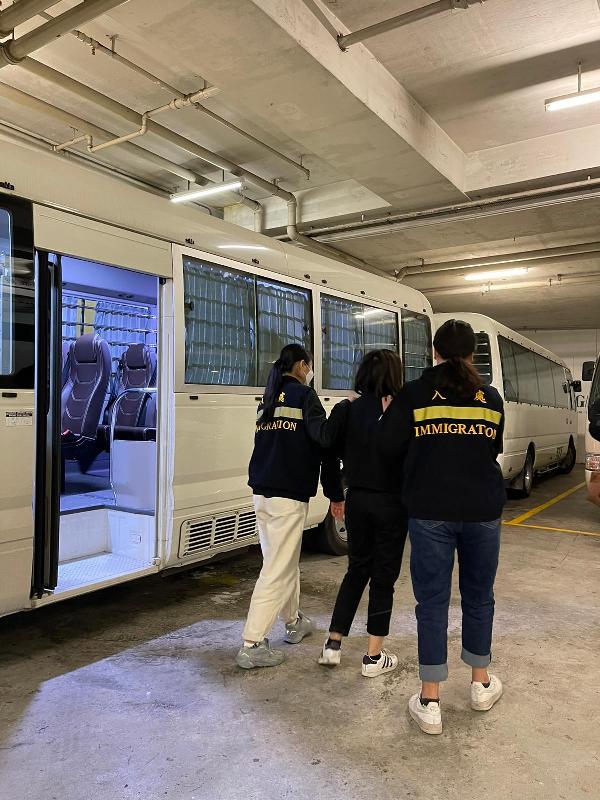
The Immigration Department (ImmD) mounted a series of territory-wide anti-illegal worker operations, including operations codenamed "Twilight" and "Rally", from January 25 to yesterday (January 28). A total of eight suspected illegal workers and seven suspected employers were arrested.
During operations "Twilight" and "Rally", ImmD Task Force officers raided 640 target locations including a car park, a construction site, industrial buildings, premises under renovation, residential buildings, restaurants, a salon, stores and warehouses. Eight suspected illegal workers and seven employers were arrested. The suspected illegal workers comprised two men and six women, aged 28 to 57. Among them, one man and one woman were holders of recognisance forms, which prohibit them from taking any employment. In addition, one man and one woman were suspected of using and being in possession of forged Hong Kong identity cards. Meanwhile, four men and three women, aged 27 to 74, were suspected of employing the illegal workers.
"Any person who contravenes a condition of stay in force in respect of him shall be guilty of an offence. Also, visitors are not allowed to take employment in Hong Kong, whether paid or unpaid, without the permission of the Director of Immigration. Offenders are liable to prosecution and upon conviction face a maximum fine of $50,000 and up to two years' imprisonment. Aiders and abettors are also liable to prosecution and penalties," an ImmD spokesman said.
The spokesman warned that, as stipulated in section 38AA of the Immigration Ordinance, illegal immigrants or people who are the subject of a removal order or a deportation order are prohibited from taking any employment, whether paid or unpaid, or establishing or joining in any business. Offenders are liable upon conviction to a maximum fine of $50,000 and up to three years' imprisonment. The Court of Appeal has issued a guideline ruling that a sentence of 15 months' imprisonment should be applied in such cases. It is an offence to use or possess a forged Hong Kong identity card or a Hong Kong identity card related to another person. Offenders are liable to prosecution and a maximum penalty of a $100,000 fine and up to 10 years' imprisonment.
The spokesman reiterated that it is a serious offence to employ people who are not lawfully employable. The maximum penalty is imprisonment for three years and a fine of $350,000. The High Court has laid down sentencing guidelines that the employer of an illegal worker should be given an immediate custodial sentence. According to the court sentencing, employers must take all practicable steps to determine whether a person is lawfully employable prior to employment. Apart from inspecting a prospective employee's identity card, the employer has the explicit duty to make enquiries regarding the person and ensure that the answers would not cast any reasonable doubt concerning the lawful employability of the person. The court will not accept failure to do so as a defence in proceedings. It is also an offence if an employer fails to inspect the job seeker's valid travel document if the job seeker does not have a Hong Kong permanent identity card. The maximum penalty for failing to inspect such a document is imprisonment for one year and a fine of $150,000.
Under the existing mechanism, the ImmD will, as a standard procedure, conduct initial screening of vulnerable persons, including illegal workers, illegal immigrants, sex workers and foreign domestic helpers, who are arrested during any operation with a view to ascertaining whether they are trafficking in persons (TIP) victims. When any TIP indicator is revealed in the initial screening, the officers will conduct a full debriefing and identification by using a standardised checklist to ascertain the presence of TIP elements, such as threats and coercion in the recruitment phase and the nature of exploitation. Identified TIP victims will be provided with various forms of support and assistance, including urgent intervention, medical services, counselling, shelter, temporary accommodation and other supporting services. The ImmD calls on TIP victims to report crimes to the relevant departments.