Import of poultry meat and products from areas in Japan and France suspended

    The Centre for Food Safety (CFS) of the Food and Environmental Hygiene Department announced today (February 3) that in view of a notification from the Ministry of Agriculture, Forestry and Fisheries of Japan about an outbreak of highly pathogenic H5 avian influenza in Ibaraki Prefecture in Japan, and from the World Organisation for Animal Health (OIE) about an outbreak of highly pathogenic H5N8 avian influenza in Ardennes Department in France, the CFS has instructed the trade to suspend the import of poultry meat and products (including poultry eggs) from the above-mentioned areas with immediate effect to protect public health in Hong Kong.

     A CFS spokesman said that according to the Census and Statistics Department, Hong Kong imported about 70 tonnes of chilled poultry meat, about 5,680 tonnes of frozen poultry meat and about 270.17 million poultry eggs from Japan, and about 80 tonnes of chilled poultry meat, about 11,860 tonnes of frozen poultry meat and about 1.07 million poultry eggs from France last year.

    "The CFS has contacted the Japanese and French authorities over the issues and will closely monitor information issued by the OIE and the relevant authorities on the avian influenza outbreaks. Appropriate action will be taken in response to the development of the situation," the spokesman said.


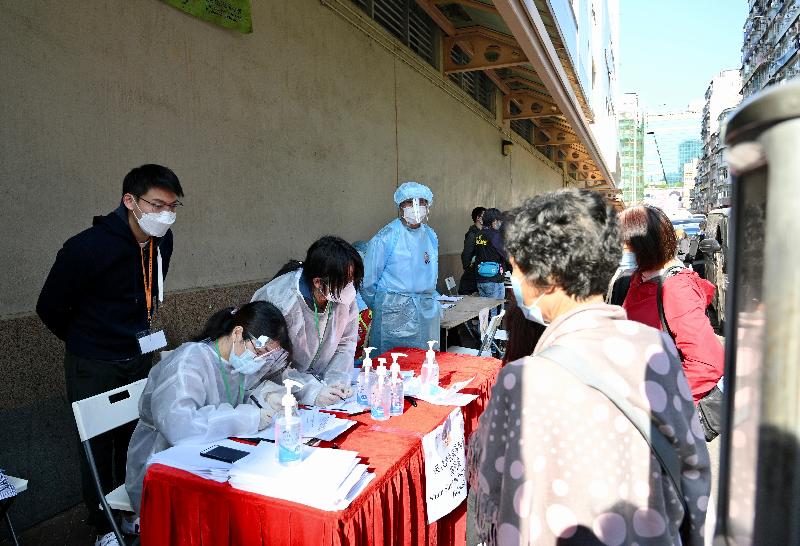
Government finishes exercise on “restriction-testing declaration” in respect of specified “restricted area” in Sham Shui Po and enforcement operation on breaches of compulsory testing notice (with photo)

     The Government yesterday (February 2) exercised the power under the Prevention and Control of Disease (Compulsory Testing for Certain Persons) Regulation (Cap. 599J) to make a "restriction-testing declaration" (declaration) effective from 7pm yesterday, by which people (hereafter referred to as "persons subject to compulsory testing") within the specified "restricted area" in Sham Shui Po (i.e. the 17 buildings in the area between 239-263 Ki Lung Street, 89 Nam Cheong Street, 256-280 Tai Nan Street and 60-74 Pei Ho Street ) were required to stay in their premises and undergo compulsory testing. Persons subject to compulsory testing were required to stay in their premises until all such persons identified in the area had undergone testing and the test results were mostly ascertained. Moreover, the Government issued a compulsory testing notice yesterday, requiring persons who had been present at any of the buildings for more than two hours from January 20 to February 2, 2021, even if they were not present in the "restricted area" at the time when the declaration took effect, to undergo compulsory testing before February 4. The Government announced the completion of the compulsory testing exercise at around 7am today (February 3) and carried out enforcement actions in the "restricted area" afterwards to verify that all people in the "restricted area" had undergone compulsory testing. The Government reopened the roads at around 9am and reopened the relevant district at around 10am, but the enforcement operation was on-going.

     In this exercise, the Home Affairs Department (HAD), the Sham Shui Po District Office, the Wan Chai District Office, the Food and Health Bureau, the Hong Kong Police Force, the Customs and Excise Department, the Architectural Services Department, the Electrical and Mechanical Services Department, the Food and Environmental Hygiene Department and the Auxiliary Medical Service mobilised around 620 staff to arrange for implementation of the declaration and enforcement actions for breaches of the compulsory testing notice issued earlier.

     The Government provided simple food for persons subject to compulsory testing, including boxed corn, instant noodles, bread, canned food, cup noodles, cakes, crackers, soy milk, etc, so as to facilitate the dinner arrangements of some persons subject to compulsory testing. One box of masks and hand sanitisers, etc, were also distributed to persons subject to compulsory testing to help them fight the virus.

     The HAD also set up a hotline for people restricted by the declaration to make enquiries and seek assistance. 

     The Government thanks persons subject to compulsory testing for their support and understanding. With everyone's co-operation and efforts, coupled with the tireless efforts of the testing contractors, residents have been informed about their testing results by SMS notification. After finishing the compulsory testing exercise at about 7am today, the Government took enforcement actions in the "restricted area" immediately to verify that all people in the "restricted area" have undergone testing according to the requirements of the declaration and the compulsory testing notice. Persons who could present an SMS notification containing a negative testing result or wore a wristband as proof of having undergone the compulsory testing could leave the "restricted area" through the designated exit after providing personal information to a prescribed officer. As at 10am, 13 persons were found not having undergone compulsory testing and a compulsory testing order was issued to them. Taking into account of the above situation, the Secretary for Food and Health revoked the "restriction-testing declaration" in accordance with Cap. 599J (see attachment).

     The Government hopes the some 180 households who have not answered the door to contact the Government for arrangement of testing as soon as possible after they read the notices put up by the Government, in the hope to eliminate the possible risk of a further spread of the virus in the community.

     The Government understands that residents in the district are worried and anxious because of the increase in confirmed cases in recent days. The Government hopes this temporary inconvenience will completely cut the local transmission chains in the district and ease residents' worries and fear, so that they will regain confidence in resuming social and business activities in the area, and return to a normal life.

     The Government thanks all participating Government staff and the testing agencies for their hard work. The Government also thanks the persons subject to compulsory testing again for their support and understanding, and their full co-operation during this period in undergoing testing and waiting for the result at home.

     The Government as a whole is united in fighting against the virus despite all the difficulties, and provided testing for all the residents in the district within a short period of time in the hope of achieving zero cases in the district.

     The Government will seriously follow up on the compliance situation of the compulsory testing notices and the "restriction-testing declaration" by persons subject to compulsory testing. Any person who fails to comply with the compulsory testing notices commits an offence and may be liable to a fixed penalty of $5,000. The person will also be issued with a compulsory testing order, requiring him or her to undergo testing within a specified time frame. Failure to comply with the order or the "restriction-testing declaration" is an offence and the offender may be liable to a fine of level 4 ($25,000) and imprisonment for six months.

Photo  


LCQ1: Provision of assistance for the unemployed

     Following is a question by the Hon Vincent Cheng and a reply by the Secretary for Labour and Welfare, Dr Law Chi-kwong, in the Legislative Council today (February 3):
 
Question:
 
     The latest seasonally adjusted unemployment rate is 6.6 per cent, hitting a record high in 16 years, with the numbers of unemployed and underemployed persons reaching as high as 240 000 and 130 000 respectively. As shown in the findings of a survey, over 60 per cent of the respondents indicated that amid the epidemic, their income had decreased and that they might lose their jobs. With the Lunar New Year approaching, waves of businesses closing down and layoffs may spark off anytime. In this connection, will the Government inform this Council:
 
(1) as some political parties have projected that the introduction of an unemployment assistance scheme offering a monthly subsidy of $6,000 or $9,000 to each unemployed person for a period of six months will involve public money in the amount of $8.8 billion or $13 billion respectively, which is far lower than the amount of $80-odd billion spent on the Employment Support Scheme, what justifications the Government's refusal to introduce an unemployment assistance scheme on the grounds that it will spend a huge sum of public money; 

(2) given the fluctuating epidemic situation and the worsening employment situation, some academics have anticipated that the unemployment rate will rise to 7 per cent within a short period of time, whether the Government will consider afresh introducing a time-limited unemployment assistance scheme or new assistance schemes; if not, what new measures it will put in place to help members of the public face up to the imminent waves of layoffs; and 

(3) whether it will, by drawing reference from the earlier practice of redeploying resources from the Beat Drugs Fund to uses which aimed at raising the awareness of mental health among members of the public, redeploy resources from other funds to provide assistance to the unemployed and underemployed; if so, of the details; if not, the reasons for that?

Reply:
 
President,
 
     In consultation with relevant bureaux and departments, my consolidated reply to the Member's question is as follows:
 
     As recently released, the seasonally adjusted unemployment rate rose by 0.3 percentage point from September – November 2020 to 6.6 per cent in October – December 2020. The unemployment rate usually went down in December over the years, as Hong Kong's economy was generally more robust in the same month. However, the fourth wave of the Coronavirus Disease 2019 epidemic was at its peak in Hong Kong in December last year and the Employment Support Scheme has ended. Therefore, when the unemployment rate picked up, the seasonally adjusted unemployment rate deviated more substantially from the actual situation. Compared to September – November 2020, the number of unemployed persons increased by 1 500 (equivalent to about 0.04 per cent of the labour force) in October – December 2020.
 
     Nonetheless, in view of the continuous fluctuations of the fourth wave of the epidemic which has seriously affected Hong Kong's economy and labour market, the HKSAR Government (the Government) will keep in view changes of the actual circumstances and strive to keep on exploring ways to strengthen assistance for the unemployed and their families. Over the past year, in light of the tremendous challenges brought about by the epidemic to Hong Kong's employment situation and overall economy, the Government has implemented a host of measures to create and stabilise job opportunities. We expeditiously introduced the Anti-epidemic Fund (AEF) not just to enhance Hong Kong's overall anti-epidemic capability but also provide suitable relief to sectors and individuals hard-hit by the epidemic or affected by the anti-epidemic and social distancing measures. Coupled with the Government's injection into the AEF and relief measures under the 2020-21 Budget, a financial commitment totalling over $300 billion, which represents about 11 per cent of the Gross Domestic Product, has been incurred. The Financial Secretary anticipated that the consolidated deficit for the current financial year will surge from the original estimate of $139.1 billion to about $300 billion whereas fiscal reserves will drop to around $800 billion, equivalent to 12 to 13 months of government expenditure and close to the level after the SARS epidemic in 2003. The Government will, having regard to the development of the epidemic and the situation of different sectors, review the effectiveness of the relief measures and introduce enhancements if needed. 
 
     Funding under the AEF has been earmarked to create time-limited jobs within two years. As at end-December 2020, around 31 000 jobs have been created under the Job Creation Scheme, of which those jobs created in the Government and in the non-governmental sector are approximately equal in proportion. Among these jobs, around 14 000 have been filled, while the recruitment of the remaining 17 000 has already commenced or will commence shortly. In addition, we rolled out the Greater Bay Area Youth Employment Scheme on January 8 this year with 2 000 places. As at end-January, more than 170 enterprises have registered with the scheme's secretariat to express their interest in joining the scheme, offering a total of 1 100 job vacancies. The vetted vacancies are being uploaded to the scheme's dedicated website by batches for graduates to apply. 
 
     Separately, the Comprehensive Social Security Assistance (CSSA) Scheme has all along served its function as a safety net effectively. With the local unemployment rate continuing to rise since late 2019, the number of CSSA unemployment cases has also increased. Over the past 12 months (at end-December 2020), the total number of CSSA unemployment cases has recorded a nearly 55 per cent increase, which shows that the CSSA Scheme has been providing necessary assistance to the unemployed. The Government has launched the "Special Scheme of Assistance to the Unemployed" under the CSSA Scheme on June 1, 2020 for a period of one year to temporarily relax the asset limits for able-bodied persons by 100 per cent. To render further support to the unemployed, the Government sought approval from the Legislative Council Finance Committee in January 2021 to implement another time-limited new arrangement under the special scheme during the six months of April 1 to September 30, 2021. Specifically, the cash value of insurance policies of able-bodied CSSA applicants will not be counted as assets during the grace period of one year. 
 
     The effectiveness of the Love Upgrading Special Scheme launched by the Employees Retraining Board (ERB) is particularly impressive. The ERB launched Phase 1 and Phase 2 of the Love Upgrading Special Scheme in October 2019 and July 2020 respectively, enabling participating trainees to receive retraining of their own choices. The maximum amount of monthly allowance per trainee during the training period has substantially increased from $4,000 to $5,800 starting from May 2020. The ERB has launched Phase 3 of the Love Upgrading Special Scheme in January 2021 with a doubled quota for 20 000 trainees. The ERB will also continue to assist the unemployed and underemployed by providing around 140 000 places yearly through its regular training courses.  
 
     The Labour Department (LD) has, starting from September 2020, raised the ceiling of on-the-job training (OJT) allowance payable to employers under the Employment Programme for the Elderly and Middle-aged, the Youth Employment and Training Programme and the Work Orientation and Placement Scheme with a view to further encouraging employers to hire the elderly and middle-aged, young people and persons with disabilities and provide them with OJT. The LD also launched a pilot scheme concurrently to encourage eligible persons to complete OJT under the above employment programmes through the provision of a retention allowance, thereby stabilising employment. 
 
     In addition, the Community Care Fund has launched the first round of the "One-off Living Subsidy for Low-income Households Not Living in Public Housing and Not Receiving Comprehensive Social Security Assistance" Programme (Living Subsidy Programme) and the "One-off Allowance for New Arrivals from Low-income Families" Programme in July and September 2020 respectively. The second round of the Living Subsidy Programme has just been rolled out in January 2021. The total budget of the above Programmes amounts to around $4.7 billion.
 
     In addition to the above short-term assistance, according to the Employment Ordinance, if an employee who has been employed under a continuous contract is dismissed and meets the specified conditions and the qualifying length of service, he/she is entitled to severance payment (SP) or long service payment (LSP). The maximum amount of SP and LSP is $390,000. These provisions would provide economic support to the employees concerned to help alleviate their financial hardship caused by the loss of employment. 
 
     Since there are currently no systems such as pay-as-you-go income tax system, contributory social insurance system or central provident fund system in place, and the Government cannot obtain detailed tax information of all employees in Hong Kong, the implementation of a new unemployment assistance system will require serious and thorough deliberation as well as public discussion. Apart from considering the new system in tandem with the existing SP and LSP systems, we have to look into and evaluate the impacts of such a systemic change on the conduct of employers and employees as well as the overall economy, and the ways to meet the resources required for the substantial work arising from system administration and abuse prevention. 
 
     Regarding the suggestion on introducing a time-limited unemployment assistance system, as I have mentioned above, the CSSA Scheme as well as the aforesaid short-term measures with wide coverage have assisted unemployed persons and their families in tiding over short-term financial difficulties during the epidemic and economic downturn. Therefore, the temporary unemployment assistance, if provided, will overlap with these existing measures. Moveover, according to past experience, we should not be optimistic that the proposed so-called "temporary" unemployment assistance could complete within a short time.
 
     In any case, we will continue to listen to members of the public and provide more assistance for the unemployed and their families in the light of the development and needs. Once concrete progress is made, we will make it known to the public and report to the Legislative Council.
 
     Thank you, President.


LCQ2: Supporting cross-boundary passenger service sector

     Following is a question by the Hon Frankie Yick and a reply by the Secretary for Transport and Housing, Mr Frank Chan Fan, in the Legislative Council today (February 3):

Question:

     Since February last year, the Government has closed most of the boundary control points one after another to cope with the epidemic, resulting in the number of cross-boundary travellers plunging and cross-boundary passenger service business coming to a standstill. Some cross-boundary passenger service operators (operators) have pointed out that while the Government did provide operators with a one-off subsidy based on the number of conveyances under the first-round relief measures, the subsidy was just a drop in the bucket. As the various operators had to meet overheads despite having zero income during the past year, they have used up their reserves and have no way to borrow money, and are at the end of their tether. In this connection, will the Government inform this Council: 

(1) given that even though the various boundary control points will hopefully reopen following the launch of relevant vaccination programmes, the various operators are now on the brink of closing down as the Government is watching with folded arms, what measures the Government has put in place to ensure that when the various boundary control points reopen, the cross-boundary passenger services provided by operators which have not yet closed down will be adequate to meet the demand; 

(2) given that conveyances which have been left idle in the open air for a long time need to have quite a number of their parts repaired or replaced before they can travel safely again, whether the Government will consider providing operators with a "business resumption allowance" to facilitate their preparation for resuming operation; if so, of the details; if not, the reasons for that; and 

(3) whether it will consider including cross-boundary passenger service practitioners as a priority group for administration of the vaccines for Coronavirus Disease 2019, so as to reduce their risk and cross-boundary travellers' risk of contracting the disease, thereby enhancing the protection for the cross-boundary passenger service sector? 

Reply:

President,

     My consolidated reply to the Hon Frankie Yick's question is as follows:

     Cross-boundary land-based and ferry passenger services, being key components of the transport and traffic network, are conducive to promoting the connectivity between Hong Kong and the Mainland and Macao, as well as facilitating the development of the Guangdong-Hong Kong-Macao Greater Bay Area. The Government has been closely monitoring the operation and provision of cross-boundary passenger services to ensure that the services provided by operators can meet the demands of the community, which include:

(i) Guangdong/Hong Kong and Hong Kong/Macao cross-boundary coach (CBC) services providing point-to-point connection between Hong Kong and the Mainland as well as Macao; 

(ii) cross-boundary hire cars providing higher-end and more personalised cross-boundary point-to-point transport services; and

(iii) cross-boundary ferries plying between Hong Kong and Macao as well as a number of the Mainland cities. 

     In response to the development of COVID-19, the governments of Guangdong, Hong Kong and Macao have been taking appropriate measures under the co-operation mechanism on joint prevention and control of the epidemic. Impacted by the anti-epidemic measures, only limited cross-boundary land-based services have been provided since February 2020, while cross-boundary ferry services have been completely halted. We understand that the ongoing epidemic is seriously affecting the livelihood of the cross-boundary passenger transport trade and its employees. In this regard, the Government has provided subsidies under the Anti-epidemic Fund and rolled out a number of measures to ease the difficulty on the trade and its employees, which include:

(i) each CBC and each cross-boundary hire car is provided with non-accountable subsidies totalling $65,000 and $55,000 respectively;

(ii) each local CBC driver is provided with subsidies totalling $23,400;

(iii) land-based cross-boundary passenger transport operators are provided with rent waiver for facilities such as ticket offices, regulator kiosks and passenger waiting halls in government premises until March 31, 2021;

(iv) parking spaces within the Shenzhen Bay Port have been arranged for the trade to park their CBCs for free;

(v) waivers of Closed Road Permit fees for CBCs and cross-boundary hire cars, vehicle licence and examination fees for commercial vehicles, as well as the fees payable for issue or renewal of Passenger Service Licence and Passenger Service Licence Certificate for CBCs are provided until December 29, 2021;

(vi) each eligible cross-boundary ferry vessel is provided with non-accountable subsidies totalling $1,500,000; and

(vii) the Employment Support Scheme, which provides subsidies to eligible employers for paying wages of their employees for six months, helps alleviate the financial burden of eligible employers in the cross-boundary passenger transport trade and retain their employees.

     Since the epidemic situation is still very severe at present, the normal operation of cross-boundary passenger services cannot be resumed. We have been maintaining close communication with the cross-boundary passenger transport trade and fully understand the trade's wish to resume its operation as soon as possible. In this regard, the governments of Guangdong, Hong Kong and Macao have been maintaining liaison so that once the epidemic situation is under control, the cross-boundary people flow amongst the three places can be enabled as soon as possible and the cross-boundary passenger transport service trade can also resume its operation. We are glad to learn that while enduring the challenging times at present, the cross-boundary passenger transport operators have been fully prepared to ensure that they can promptly resume operation to provide appropriate cross-boundary passenger services for meeting public demand when normal operation of passenger clearance services resumes.  

     The Government fully understands the predicament faced by the cross-boundary passenger transport trade at present, and has taken note of the trade's views on further support measures. The Hong Kong Special Administrative Region Government will continue to closely monitor the development of the epidemic situation and enhance communication and co-operation with the relevant authorities in the Mainland and Macao. We aim to resume cross-boundary passenger transport once the epidemic situation is under control. We will proactively formulate measures pertinent to the trade and render necessary assistance, with a view to ensuring the smooth operation of cross-boundary passenger services.

     We have also taken note of the trade's suggestion that cross-boundary passenger service employees should be included as a priority group for COVID-19 vaccination, which will be taken into account by the Government when formulating vaccination policies. The Government's goal is to provide vaccines free of charge for the majority of Hong Kong residents within 2021 through a vaccination programme led by the Government. Having regard to various factors including the views of experts, the supply of vaccines, etc, the Government will consider according priority to the target groups of healthcare workers, staff of residential care homes and the elderly, etc, as well as related persons for people's livelihood and daily necessities such as cross-boundary drivers.


Tender results of re-opening of 15-year Government Bonds under Institutional Bond Issuance Programme

The following is issued on behalf of the Hong Kong Monetary Authority:

     The Hong Kong Monetary Authority (HKMA), as representative of the Hong Kong Special Administrative Region Government (HKSAR Government), announces that a tender of 10-year Government Bonds through the re-opening of existing 15-year Government Bond issue 15GB3007 under the Institutional Bond Issuance Programme was held today (February 3). 
 
     A total of HK$1.7 billion 15-year Government Bonds were offered today. A total of HK$5.336 billion tender applications were received. The bid-to-cover ratio, i.e. the ratio of bonds applied for to bonds issued, is 3.14. The average price accepted is 110.07, implying an annualised yield of 1.012 per cent. 

HKSAR Government Institutional Bond Issuance Programme Government Bond tender results
—————————————————————————————————-
Tender results of re-opening of 15-year Government Bonds under the Institutional Bond Issuance Programme:
 

Tender Date : February 3, 2021
Issue Number : 15GB3007 (Re-open)
Stock Code : 4227 (HKGB 2.13 3007)
Issue and Settlement Date : February 4, 2021
Tenor : 10-year
Maturity Date : July 16, 2030
Coupon Rate : 2.13 per cent
     
Amount Applied : HK$5.336 billion
Amount Allotted : HK$1.7 billion
Bid-to-Cover Ratio* : 3.14
Average Price Accepted (Yield) : 110.07 (1.012 per cent)
Lowest Price Accepted (Yield) : 109.62 (1.060 per cent)
Pro-rata Ratio : About 36 per cent
Average Tender Price (Yield) : 109.23 (1.102 per cent)

* Calculated as the amount of bonds applied for over the amount of bonds issued.