DH endorses batch recall of mercury-tainted proprietary Chinese medicine (with photo)

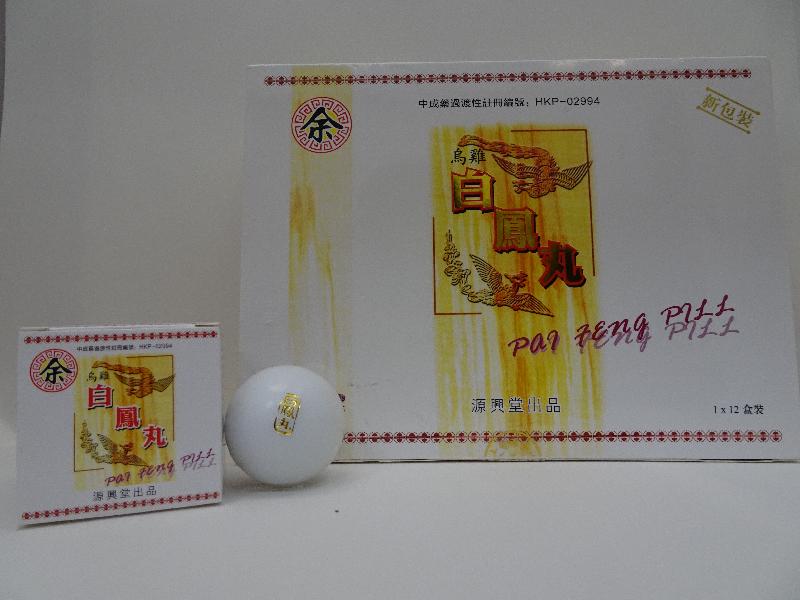
     The Department of Health (DH) today (February 3) endorsed Bak Cao Tong (HK) Chinese Herbs Manufacturers and Trading Limited (Bak Cao Tong), the registration holder of a proprietary Chinese medicine (pCm) called [Yuan Heng Tong] Pai Feng Pill (registration number: HKP-02994), to recall from the market one of the batches of the product (batch number: 02994181227) as a sample has been found that the mercury level exceeded the standard formulated by Chinese Medicine Council of Hong Kong (CMCHK).

     The batch recall was conducted as a sample of the above pCm obtained through the DH's market surveillance was found by the Government Laboratory today to contain about 1.75 times the permitted level of mercury under the registration criteria of pCms formulated by CMCHK.

     According to the product label, the above pCm is indicated for derangement of vital energy and blood, exhaustion, sores in waists and back as well as insomnia. Preliminary investigations revealed that Bak Cao Tong imported the above batch from the Mainland for external packing in Hong Kong before its distribution to the local market. The DH's investigation is ongoing.

     "Prolonged exposure to mercury can damage the neurological system and kidneys. No related adverse events of the concerned product have been received so far," a spokesman for the DH said.

     Bak Cao Tong has set up a hotline (2614 3466) for related enquiries. The DH will closely monitor the recall.

     According to section 52 of the Public Health and Municipal Services Ordinance (Cap 132), selling any drug not of the nature, substance or quality demanded by the purchaser is liable to a maximum penalty of a fine of $10,000 and three months' imprisonment. Upon completion of the investigation, the DH will work with the Department of Justice on prosecution matters and will refer this case to the CMCHK for possible disciplinary action.

     Members of the public who have purchased the above pCm should stop using it immediately. Those who have used the above pCm and feel unwell should seek advice from healthcare professionals. People who have the above pCm should submit it to the DH's Chinese Medicine Regulatory Office on 16/F, AIA Kowloon Tower, Landmark East, 100 How Ming Street, Kwun Tong, during office hours for disposal.

Photo  


CHP investigates 19 additional confirmed cases of COVID-19

     The Centre for Health Protection (CHP) of the Department of Health (DH) announced that as of 0.00am, February 3, the CHP was investigating 19 additional confirmed cases of coronavirus disease 2019 (COVID-19), taking the number of cases to 10 531 in Hong Kong so far (comprising 10 530 confirmed cases and one probable case).
  
     A total of 791 cases have been recorded in the past 14 days (January 20 to February 2), including 743 local cases of which 283 are from unknown sources.
 
     The CHP's epidemiological investigations and relevant contact tracing on the confirmed cases are ongoing. For case details and contact tracing information, please see the Annex or the list of buildings with confirmed cases of COVID-19 in the past 14 days and the latest local situation of COVID-19 available on the website "COVID-19 Thematic Website" (www.coronavirus.gov.hk).
 
     Meanwhile, the CHP reminded those who had visited specified venues under the Prevention and Control of Disease (Compulsory Testing for Certain Persons) Regulation (Cap. 599J) to receive COVID-19 nucleic acid testing according to the compulsory testing notice. The public are also urged to seek medical attention early if symptoms develop.
 
     Regarding the severe epidemic situation, the CHP called on members of the public to avoid going out, having social contact and dining out. They should put on a surgical mask and maintain stringent hand hygiene when they need to go out. The CHP strongly urged the elderly to stay home as far as possible and avoid going out. They should consider asking their family and friends to help with everyday tasks such as shopping for basic necessities.
 
     The spokesman said, "Given that the situation of COVID-19 infection remains severe and that there is a continuous increase in the number of cases reported around the world, members of the public are strongly urged to avoid all non-essential travel outside Hong Kong.
 
     "The CHP also strongly urges the public to maintain at all times strict personal and environmental hygiene, which is key to personal protection against infection and prevention of the spread of the disease in the community. On a personal level, members of the public should wear a surgical mask when having respiratory symptoms, taking public transport or staying in crowded places. They should also perform hand hygiene frequently, especially before touching the mouth, nose or eyes.
 
     "As for household environmental hygiene, members of the public are advised to maintain drainage pipes properly, regularly pour water into drain outlets (U-traps) and cover all floor drain outlets when they are not in use. After using the toilet, they should put the toilet lid down before flushing to avoid spreading germs."
 
     Moreover, the Government has launched the website "COVID-19 Thematic Website" (www.coronavirus.gov.hk) for announcing the latest updates on various news on COVID-19 infection and health advice to help the public understand the latest updates. Members of the public may also gain access to information via the COVID-19 WhatsApp Helpline launched by the Office of the Government Chief Information Officer. Simply by saving 9617 1823 in their phone contacts or clicking the link wa.me/85296171823?text=hi, they will be able to obtain information on COVID-19 as well as the "StayHomeSafe" mobile app and wristband via WhatsApp.
 
     To prevent pneumonia and respiratory tract infections, members of the public should always maintain good personal and environmental hygiene. They are advised to:
 
• Wear a surgical mask when taking public transport or staying in crowded places. It is important to wear a mask properly, including performing hand hygiene before wearing and after removing a mask;
• Perform hand hygiene frequently, especially before touching the mouth, nose or eyes, after touching public installations such as handrails or doorknobs, or when hands are contaminated by respiratory secretions after coughing or sneezing;
• Maintain drainage pipes properly and regularly (about once a week) pour about half a litre of water into each drain outlet (U-trap) to ensure environmental hygiene;
• Cover all floor drain outlets when they are not in use;
• After using the toilet, put the toilet lid down before flushing to avoid spreading germs;
• Wash hands with liquid soap and water, and rub for at least 20 seconds. Then rinse with water and dry with a disposable paper towel. If hand washing facilities are not available, or when hands are not visibly soiled, performing hand hygiene with 70 to 80 per cent alcohol-based handrub is an effective alternative;
• Cover your mouth and nose with tissue paper when sneezing or coughing. Dispose of soiled tissues into a lidded rubbish bin, then wash hands thoroughly; and
• When having respiratory symptoms, wear a surgical mask, refrain from work or attending class at school, avoid going to crowded places and seek medical advice promptly.


Hong Kong Customs and Macao Judiciary Police strengthen co-operation to step up enforcement action against transnational drug trafficking activities (with photos)

     Hong Kong Customs and the Macao Judiciary Police (MJP) conducted a joint operation in January this year to combat transnational drug trafficking activities. A total of about 7.5 litres of suspected liquid cocaine with an estimated market value of about $9.7 million (worth about MOP25 million in Macao) were seized.

     During the operation, Hong Kong Customs inspected two air express parcels from France and Argentina being transshipped to Macao through Hong Kong and suspected there were dangerous drugs concealed inside. The parcels concerned were then handed over to the MJP for a controlled delivery operation. The MJP later arrested two men, aged 19 and 39, after discovering that they were the parcel receivers.

     Hong Kong Customs will continue to maintain a close partnership with the MJP and overseas law enforcement agencies to combat transnational drug trafficking activities using postal parcel and express courier channels through intelligence exchanges and joint enforcement actions.

     Under the Dangerous Drugs Ordinance, trafficking in a dangerous drug is a serious offence. The maximum penalty upon conviction is a fine of $5 million and life imprisonment.

     Members of the public may report any suspected drug trafficking activities to Hong Kong Customs' 24-hour hotline 2545 6182 or its dedicated crime-reporting email account (crimereport@customs.gov.hk).

Photo  Photo  


HKMC’s public bond issues

The following is issued on behalf of the Hong Kong Monetary Authority:
 
     The Hong Kong Mortgage Corporation Limited (HKMC) is pleased to announce today (February 3) the successful launch of a 2-year Hong Kong dollar (HKD) and a 3-year offshore Renminbi (CNH) public bond issues (the Issues) under the U.S.$12 Billion Medium Term Note Programme in the institutional market. The dual-tranche issuance comprises HK$7 billion 2-year and CNH2.5 billion 3-year bonds and was well received by local and overseas institutional investors. Major terms of the Issues are highlighted in Annex.
      
     The HK$10 billion-equivalent Issues are the largest public corporate bond offering with book-building and pricing conducted in Hong Kong. They have not only helped to diversify the HKMC's funding sources and broaden its investor base in a cost-effective manner, but also support the HKMC to achieve its core policy missions and social objectives.
      
     The Executive Director and Chief Executive Officer of the HKMC, Mr Raymond Li, said, "The HKD and CNH public bond issues have set a good benchmark for local and other high grade issuers. They also provided investing community with high-quality debt instruments to satisfy their need for portfolio diversification and created a win-win situation for investors, banks and the HKMC. I trust that the HKMC will continue to contribute to the development of the local financial market, especially the debt and offshore Renminbi markets."


Government finishes exercise on “restriction-testing declaration” in respect of specified “restricted area” in Jordan and enforcement operation on breaches of compulsory testing notice

     The Government yesterday (February 2) exercised the power under the Prevention and Control of Disease (Compulsory Testing for Certain Persons) Regulation (Cap. 599J) to make a "restriction-testing declaration" (declaration) effective from 7pm yesterday, under which people (hereafter referred to as "persons subject to compulsory testing") within the specified "restricted area" in Jordan (i.e. 23-27 Cheong Lok Street, 22-28 Cheong Lok Street, 13 Chi Wo Street and 322-326A Nathan Road) were required to stay in their premises and undergo compulsory testing. Persons subject to compulsory testing were required to stay in their premises until all such persons identified in the area had undergone testing and the test results were mostly ascertained. Moreover, the Government issued a compulsory testing notice yesterday, requiring persons who had been present at any of the buildings for more than two hours from January 20 to February 2, 2021, even if they were not present in the "restricted area" at the time when the declaration took effect, to undergo compulsory testing before February 4. The Government announced the completion of the compulsory testing exercise at around 7.30am today (February 3) and carried out enforcement actions in the "restricted area" afterwards to verify that all people in the "restricted area" had undergone compulsory testing. The Government announced that the enforcement operation ended at about 11.30am today.

     In this exercise, the Home Affairs Department (HAD), the Yau Tsim Mong District Office, the Tai Po District Office, the Hong Kong Police Force, Hong Kong Customs and the Architectural Services Department mobilised around 280 staff to arrange for implementation of the declaration and enforcement actions for breaches of the compulsory testing notice issued earlier.

     The Government provided simple food for persons subject to compulsory testing, including instant noodles, macaroni, canned food, soy milk and bottled water, so as to facilitate the dinner arrangements of some persons subject to compulsory testing. One box of masks and hand sanitisers etc, were also provided to persons subject to compulsory testing to help them fight against the virus.

     The HAD also set up a hotline for people restricted by the declaration to make enquiries and seek assistance. 

     The Government thanks persons subject to compulsory testing for their support and understanding. With everyone's co-operation and efforts, coupled with the tireless efforts of the testing contractors, residents have been informed about their testing results by SMS notification. After finishing the compulsory testing exercise at about 7.30am today, the Government took enforcement action in the "restricted area" immediately to verify that all people in the "restricted area" have undergone testing according to the requirements of the declaration and the compulsory testing notice. Persons who could present an SMS notification containing a negative testing result or wore a wristband as proof of having undergone the compulsory testing could leave the "restricted area" through the designated exit after providing personal information to a prescribed officer. The enforcement operation was completed at about 11.30am and a compulsory testing order was issued to seven persons. Taking into account the above situation, the Secretary for Food and Health revoked the "restriction-testing declaration" in accordance with Cap. 599J (see attachment).

     The Government aimed at finishing this compulsory testing exercise at about 7am today with a view to allowing residents to start going to work. However, after over 300 residents had undergone testing, one indeterminate test result was found and the Centre for Health Protection needed to follow up on it, and the Government could only allow residents to leave the "restricted area" at about 7.30am. The Government appeals for the residents' understanding. The relevant case is now waiting for the arrangement of the Centre for Health Protection for admission to hospital.

     The Government hopes the some 40 households who have not answered the door will contact the Government for arrangement of testing as soon as possible after they read the notices put up by the Government, in the hope of eliminating the possible risk of further spread of the virus in the community.

     The Government understands that residents in the district are worried and anxious because of the increase in confirmed cases in recent days. The Government hopes this temporary inconvenience will completely cut the local transmission chains in the district and ease residents' worries and fear, so that they will regain confidence in resuming social and business activities in the area, and return to a normal life.

     The Government thanks all participating government staff and the testing agencies for their hard work. The Government also thanks the persons subject to compulsory testing again for their support and understanding, and their full co-operation during this period in undergoing testing and waiting for the result at home.

     The Government as a whole is united in fighting against the virus despite all the difficulties, and provided testing for all the residents in the district within a short period of time in the hope of achieving zero cases in the district.

     The Government will seriously follow up on the compliance situation of the compulsory testing notices and the "restriction-testing declaration" by persons subject to compulsory testing. Any person who fails to comply with the compulsory testing notices commits an offence and may be liable to a fixed penalty of $5,000. The person will also be issued with a compulsory testing order, requiring him or her to undergo testing within a specified time frame. Failure to comply with the order or the "restriction-testing declaration" is an offence and the offender may be liable to a fine of level 4 ($25,000) and imprisonment for six months.