Government gazettes compulsory testing notice

     The Government exercised the power under the Prevention and Control of Disease (Compulsory Testing for Certain Persons) Regulation (Cap. 599J) and published in the Gazette a compulsory testing notice, which requires any person who had been present at two specified premises during the specified period (persons subject to compulsory testing) to undergo a COVID-19 nucleic acid test.

     Currently, in all districts in Hong Kong, if one or more new confirmed cases are found in the residential buildings (including buildings for both commercial and residential uses), or there are sewage samples tested positive which implied possible infection risks, the buildings will be included in the compulsory testing notice.

     For testing targeting at workplaces, if two or more confirmed cases are found in a workplace, it will be included in the compulsory testing notice.

     Two buildings fulfilling the above criteria were included in the compulsory testing notice today (February 15).

     Details of the compulsory testing notice are as follows:

     Any person who had been present at any specified premises listed in Annex 1 for more than two hours at any time during the period from February 2 to February 15, 2021 (including but not limited to visitors, residents and workers), have to undergo testing by February 17, 2021. If persons subject to compulsory testing have previously undergone testing between February 13 and February 15, 2021, they would be taken to have complied with the requirements set out in the compulsory testing notice.

     The Government will set up mobile specimen collection stations at Heng Fa Chuen and Tin Chung Court in Tin Shui Wai tomorrow (February 16). The opening dates and operating hours of the mobile specimen collection stations in various districts providing free COVID-19 nucleic acid testing services for the general public are stated in Annex 2. Apart from mobile specimen collection stations, persons subject to compulsory testing can also choose to attend any of the community testing centres in all districts to receive testing free of charge.

     Persons subject to compulsory testing may choose to undergo testing via the following routes:

1.  To visit any of the mobile specimen collection stations (see the list and target groups (if applicable) at www.coronavirus.gov.hk/eng/early-testing.html) for testing;
2.  To attend any of the community testing centres (see the list at www.communitytest.gov.hk/en/);
3.  To obtain a deep throat saliva specimen collection pack from any of the 121 post offices, vending machines set up at 20 MTR stations or 47 designated general outpatient clinics (GOPCs) of the Hospital Authority and return the specimen to one of the designated specimen collection points (see the distribution points and times, and the specimen collection points and times, at www.coronavirus.gov.hk/eng/early-testing.html);
4.  To undergo testing at any of the GOPCs of the Hospital Authority as instructed by a medical professional of the Hospital Authority;
5.  To self-arrange testing provided by private laboratories which are recognised by the Department of Health (DH) and can issue SMS notifications in respect of test results (see the list at www.coronavirus.gov.hk/pdf/List_of_recognised_laboratories_RTPCR.pdf);or
6.  To use a specimen bottle distributed to the relevant specified premises by the Centre for Health Protection (if applicable), and return the specimen bottle with the sample collected as per relevant guidelines.

     A spokesman for the Food and Health Bureau cautioned that testing received at accident and emergency departments of the Hospital Authority or during hospital stays, or testing provided by private laboratories which cannot issue SMS notifications in respect of test results, does not comply with the requirements of the aforementioned compulsory testing notice.

     "If persons subject to compulsory testing have symptoms, they should seek medical attention immediately and undergo testing as instructed by a medical professional. They should not attend the mobile specimen collection stations or the community testing centres."

     Persons subject to compulsory testing must keep the SMS notification containing result of the test for checking by a law enforcement officer when the officer requires the persons to provide information about their undergoing the specified test.

     Furthermore, persons subject to testing under the compulsory testing notices should, as far as reasonably practicable, take appropriate personal disease prevention measures including wearing a mask and maintaining hand hygiene, and, unless for the purpose of undergoing the specified test, stay at their place of residence and avoid going out until the test result is ascertained as far as possible.

     Any enquiries on compulsory testing arrangements may be addressed to the hotline at 6275 6901, which operates daily from 9am to 6pm. If persons subject to compulsory testing plan to conduct testing at any of the community testing centres, they can check the centre's appointment status in advance. The hotlines of the community testing centres are available at www.communitytest.gov.hk/en/info/.

     The Government will continue to trace possibly infected persons who had been to the relevant premises, and seriously verify whether they had complied with the testing notices. Any person who fails to comply with the testing notices commits an offence and may be fined a fixed penalty of $5,000. The person would also be issued with a compulsory testing order requiring him or her to undergo testing within a specified time frame. Failure to comply with the order is an offence and the offender would be liable to a fine at level 4 ($25,000) and imprisonment for six months.

     Relevant officers of different government departments are empowered to perform certain functions under the relevant Regulations under the Prevention and Control of Disease Ordinance (Cap. 599), including requesting individuals to provide information and assistance when necessary. Any person who fails to comply with the relevant request commits an offence and would be liable to a fine at level 3 ($10,000). Collection and use of any personal data for conducting COVID-19 tests must meet the requirements under the Personal Data (Privacy) Ordinance (Cap. 486). Government departments or testing service providers which handle the relevant information may provide the data to DH or other relevant departments for anti-epidemic purpose as necessary. The workflow does not involve the provision of any personal data to organisations or persons outside Hong Kong.

     The spokesman said, "The Government urges all individuals who are in doubt about their own health conditions, or individuals with infection risks (such as individuals who visited places with epidemic outbreaks or contacted confirmed cases), to undergo testing promptly for early identification of infected persons."
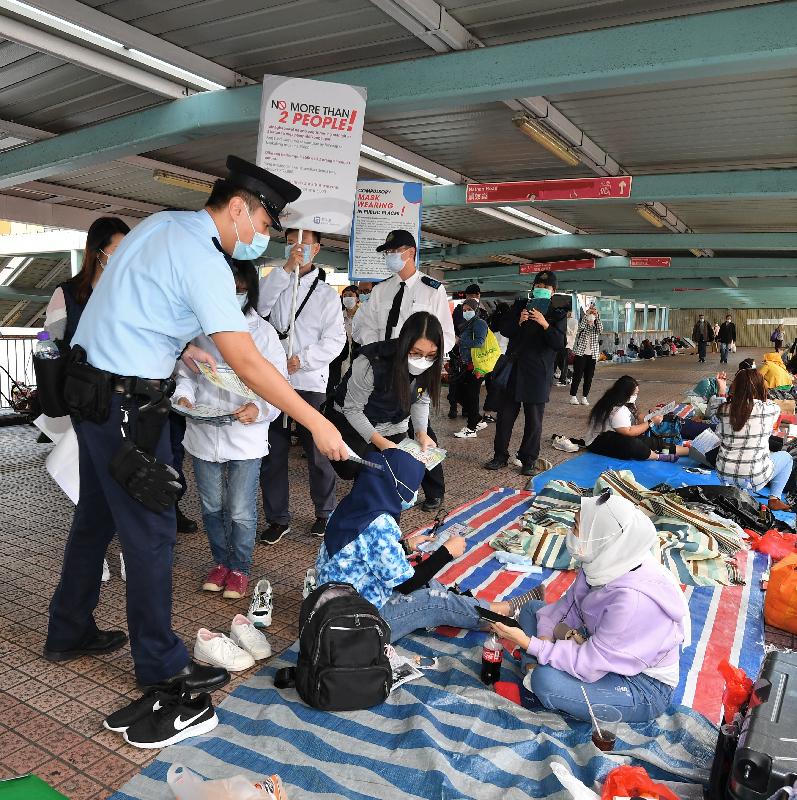

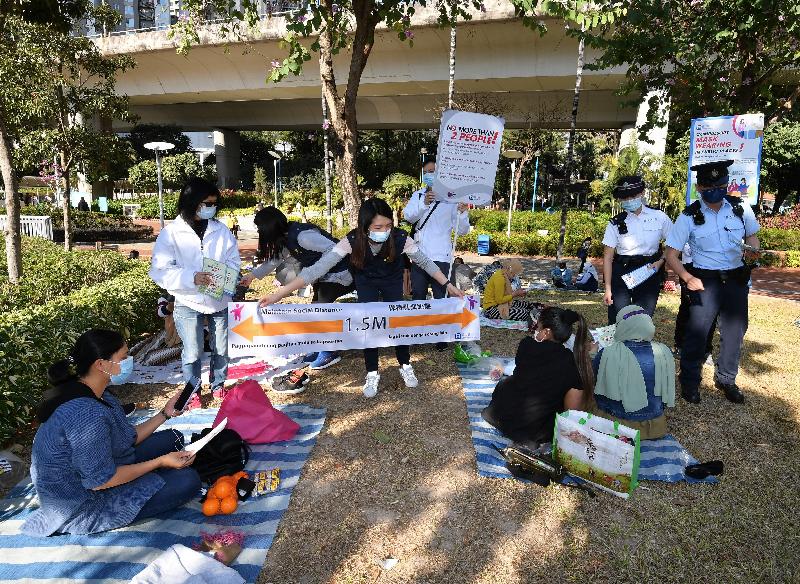
Government appeals to foreign domestic helpers to comply with regulations on mask-wearing and prohibition of group gatherings of more than two persons in public places (with photos)

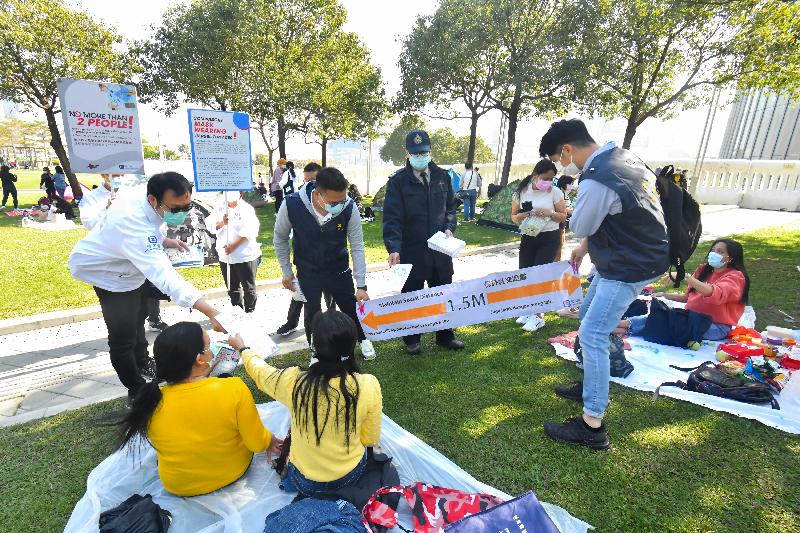
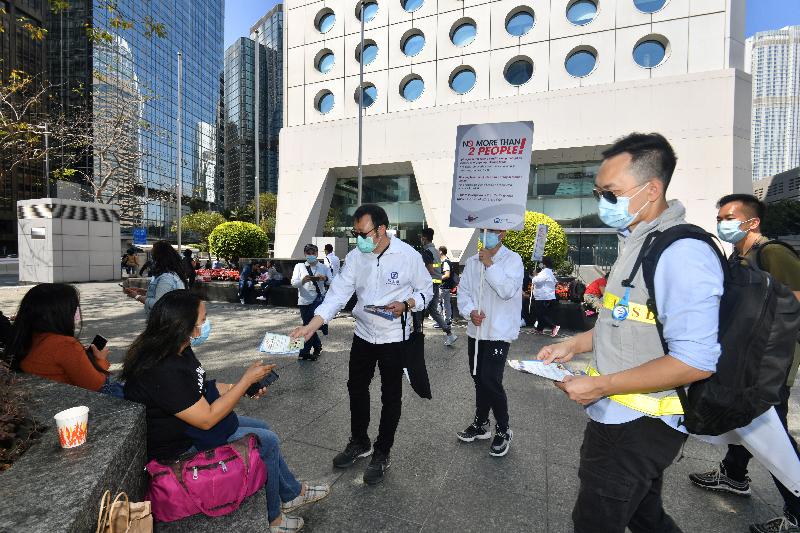
     The Labour Department (LD) today (February 15) said that joint operations during the Chinese New Year holidays were conducted in collaboration with the Hong Kong Police Force (the Police), the Food and Environmental Hygiene Department (FEHD), the Home Affairs Department and the Leisure and Cultural Services Department, including mobile broadcasts in popular gathering places of foreign domestic helpers (FDHs) to call upon them to comply with the anti-epidemic regulations on the mask-wearing and prohibition of group gatherings of more than two persons in public places.  
      
     From February 12 to February 15, government departments conducted joint operations at popular FDH gathering places (including Tamar Park in Admiralty, Victoria Park in Causeway Bay, Wan Chai, footbridge near Fa Yuen Street in Mong Kok, Central, Lai Chi Kok, Shatin and Tsuen Wan) for four consecutive days.  The LD arranged publicity vans to park in the above-mentioned districts to broadcast reminders in Chinese, English and major FDH languages (including Tagalog, Bahasa Indonesia and Thai) to call upon FDHs to comply with the regulations on mask-wearing and prohibition of group gatherings of more than two persons in public places.  During the joint operations, multilingual promotional leaflets were distributed by officers from the departments concerned to appeal to FDHs to maintain environmental hygiene and refrain from conducting unlicensed hawking activities, including cooked food or other hawking activities. Also, the Police increased manpower to step up patrols at those places and the FEHD took follow-up actions to keep those places clean.
      
     A Government spokesman said, "According to the Prevention and Control of Disease (Prohibition on Group Gathering) Regulation (Cap. 599G) and the Prevention and Control of Disease (Wearing of Mask) Regulation (Cap. 599I), a person who participates in a prohibited group gathering of more than two persons in public places or fails to wear a mask in accordance with the requirement may be charged a fixed penalty of $5,000.  The Government will continue to conduct publicity to FDHs and remind them to strictly observe the relevant regulations, and to avoid gatherings (including in boarding facilities), food sharing and other social activities on their rest days and stay at home for rest as far as possible to safeguard their personal health."
      
     The Government will continue to step up publicity and enforcement, and as needed conduct joint operations to ensure compliance with the relevant requirements. The Government also appeals to FDHs to exercise self-discipline and co-operate to fight the virus together and abide by the law.

Photo  Photo  Photo  Photo  Photo  


CE inspects COVID-19 sewage-related virus surveillance work (with photos/video)

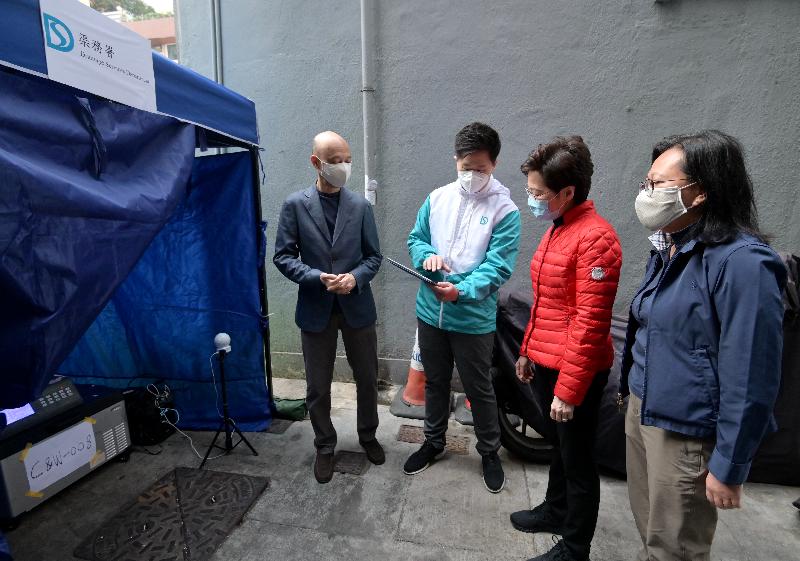
     The Chief Executive, Mrs Carrie Lam, accompanied by the Secretary for the Environment, Mr Wong Kam-sing, and the Director of Drainage Services, Ms Alice Pang, today (February 15) inspected the surveillance work to detect the COVID-19 virus in sewage to learn more about how to help with the identification of asymptomatic patients in the community through sewage surveillance.
      
      Mrs Lam and the officials this morning visited a sewage sampling site in Central and Western District set up by the Drainage Services Department (DSD) to inspect the sampling workflow. She thanked the DSD colleagues and contractors for their continuous support in conducting hours-long sampling work at specified outdoor sites upon very short notice every day to collaborate with the research team.
      
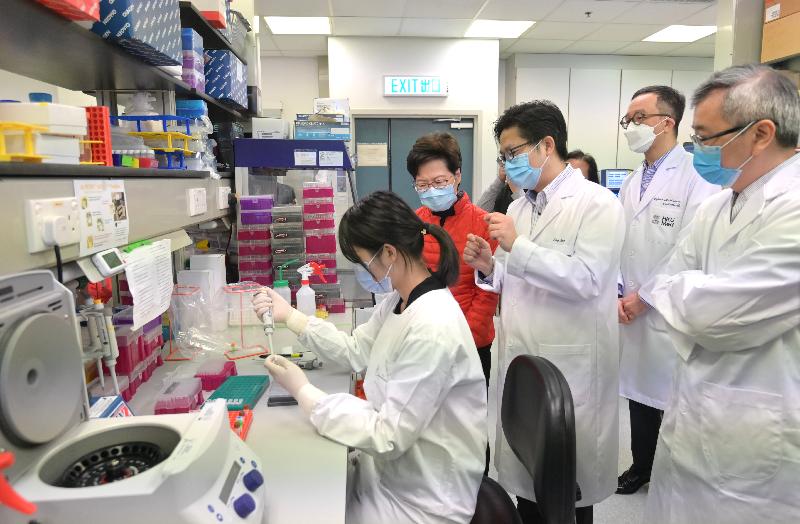
     They then went to the public health laboratory of the University of Hong Kong (HKU) and were briefed by Professor Gabriel Leung, the Dean of Li Ka Shing Faculty of Medicine of HKU, and Professor Zhang Tong of the Environmental Microbiome Engineering and Biotechnology Laboratory of the Department of Civil Engineering of HKU, on the treatment of samples and testing process matters. Mrs Lam also chatted with a number of researchers and PhD students and noted that they continued to work industriously even during the Lunar New Year holidays. She said that the Hong Kong Special Administrative Region Government has been vigorously promoting the development of innovation and technology (I&T) in Hong Kong in recent years and that universities’ research capabilities and their level is an important foundation of I&T.
      
     The Government's Environmental Protection Department (EPD) and the DSD have been collaborating with the cross-disciplinary team of HKU in the research of sewage surveillance since last year. Following continued improvement and verification, the technology has been applied in monitoring the situation of the spread of the COVID-19 virus in the community and individual buildings, providing crucial support for the Food and Health Bureau in its identification of buildings and places for compulsory testing or "restriction-testing declaration" operations. From the end of last year till now, the Government has conducted compulsory testing operations on more than 110 buildings with positive sewage testing results, identifying more than 50 confirmed cases. A significant number of them were found before there were confirmed cases in the buildings, and the results have been remarkable. The laboratory of HKU can currently process 24 samples per day. The Government is seeking to increase the testing capability as soon as possible with the purchase of more equipment and collaboration with other private laboratories.
      
     The research project concerned is funded by the Health and Medical Research Fund (HMRF) of the Government. As the Chief Executive said earlier, technological research and application is part of the Government's strategy and response in the fight against the epidemic. The Government's HMRF approved a total of $170 million to support 49 medical research projects on COVID-19 by local universities. In addition, the University Grants Committee and the Research Grants Council have to date granted $350 million to subsidise research projects in relation to COVID-19 and other novel infectious diseases.
      
     "I thank the cross-disciplinary team of HKU and colleagues of government departments, including the DSD and the EPD, for their hard work over a period of time in the past, and standing fast at their posts during the Lunar New Year holidays to fight the virus through sewage surveillance. The anti-epidemic work of the Government has all along been based on science. The sewage surveillance project is an extremely good example of our joint efforts with local scientific teams to fight the virus with technology. We will continue to leverage technology to achieve even better results in our anti-epidemic work," Mrs Lam said.

Photo  Photo  


CHP investigates nine additional confirmed cases of COVID-19

     The Centre for Health Protection (CHP) of the Department of Health (DH) announced that as of 0.00am, February 15, the CHP was investigating nine additional confirmed cases of coronavirus disease 2019 (COVID-19), taking the number of cases to 10 789 in Hong Kong so far (comprising 10 788 confirmed cases and one probable case).
 
     Among the newly reported cases announced, five are imported cases.
 
     A total of 327 cases have been recorded in the past 14 days (February 1 to 14), including 286 local cases of which 86 are from unknown sources.
 
     The CHP's epidemiological investigations and relevant contact tracing on the confirmed cases are ongoing. For case details and contact tracing information, please see the Annex or the list of buildings with confirmed cases of COVID-19 in the past 14 days and the latest local situation of COVID-19 available on the website "COVID-19 Thematic Website" (www.coronavirus.gov.hk).
 
   Meanwhile, the CHP reminded those who had visited specified venues under the Prevention and Control of Disease (Compulsory Testing for Certain Persons) Regulation (Cap. 599J) to receive COVID-19 nucleic acid testing according to the compulsory testing notice. The public are also urged to seek medical attention early if symptoms develop.
 
     The CHP called on members of the public to avoid going out, having social contact and dining out. They should put on a surgical mask and maintain stringent hand hygiene when they need to go out. The CHP strongly urged the elderly to stay home as far as possible and avoid going out. They should consider asking their family and friends to help with everyday tasks such as shopping for basic necessities.
 
     The spokesman said, "Given that the situation of COVID-19 infection remains severe and that there is a continuous increase in the number of cases reported around the world, members of the public are strongly urged to avoid all non-essential travel outside Hong Kong.
 
     "The CHP also strongly urges the public to maintain at all times strict personal and environmental hygiene, which is key to personal protection against infection and prevention of the spread of the disease in the community. On a personal level, members of the public should wear a surgical mask when having respiratory symptoms, taking public transport or staying in crowded places. They should also perform hand hygiene frequently, especially before touching the mouth, nose or eyes.
 
     "As for household environmental hygiene, members of the public are advised to maintain drainage pipes properly, regularly pour water into drain outlets (U-traps) and cover all floor drain outlets when they are not in use. After using the toilet, they should put the toilet lid down before flushing to avoid spreading germs."
 
     Moreover, the Government has launched the website "COVID-19 Thematic Website" (www.coronavirus.gov.hk) for announcing the latest updates on various news on COVID-19 infection and health advice to help the public understand the latest updates. Members of the public may also gain access to information via the COVID-19 WhatsApp Helpline launched by the Office of the Government Chief Information Officer. Simply by saving 9617 1823 in their phone contacts or clicking the link wa.me/85296171823?text=hi, they will be able to obtain information on COVID-19 as well as the "StayHomeSafe" mobile app and wristband via WhatsApp.
 
     To prevent pneumonia and respiratory tract infections, members of the public should always maintain good personal and environmental hygiene. They are advised to:
 
• Wear a surgical mask when taking public transport or staying in crowded places. It is important to wear a mask properly, including performing hand hygiene before wearing and after removing a mask;
• Perform hand hygiene frequently, especially before touching the mouth, nose or eyes, after touching public installations such as handrails or doorknobs, or when hands are contaminated by respiratory secretions after coughing or sneezing;
• Maintain drainage pipes properly and regularly (about once a week) pour about half a litre of water into each drain outlet (U-trap) to ensure environmental hygiene;
• Cover all floor drain outlets when they are not in use;
• After using the toilet, put the toilet lid down before flushing to avoid spreading germs;
• Wash hands with liquid soap and water, and rub for at least 20 seconds. Then rinse with water and dry with a disposable paper towel. If hand washing facilities are not available, or when hands are not visibly soiled, performing hand hygiene with 70 to 80 per cent alcohol-based handrub is an effective alternative;
• Cover your mouth and nose with tissue paper when sneezing or coughing. Dispose of soiled tissues into a lidded rubbish bin, then wash hands thoroughly; and
• When having respiratory symptoms, wear a surgical mask, refrain from work or attending class at school, avoid going to crowded places and seek medical advice promptly.


Public hospitals daily update on COVID-19 cases

The following is issued on behalf of the Hospital Authority:

     As at 9am today (February 15), 22 COVID-19 confirmed patients were discharged from hospital in the last 24 hours. So far, a total of 10 207 patients with confirmed or probable infection have been discharged.
 
     At present, there are 679 negative pressure rooms in public hospitals with 1 237 negative pressure beds activated. A total of 348 confirmed patients are currently hospitalised in 23 public hospitals and a community treatment facility, among which 21 patients are in critical condition, 17 are in serious condition and the remaining 310 patients are in stable condition.
 
     The Hospital Authority will maintain close contact with the Centre for Health Protection to monitor the latest developments and to inform the public and healthcare workers on the latest information in a timely manner.
 
     Details of the above-mentioned patients are as follows:
 

Patient condition Case numbers
Discharged 9517, 9647, 9916, 9981, 10002, 10055, 10225, 10418, 10425, 10464, 10473, 10496, 10510, 10512, 10521, 10554, 10597, 10601, 10632, 10713, 10746, 10752
Critical 1989, 3496, 6125, 6547, 6607, 6794, 8018, 8078, 8323, 9049, 9135, 9267, 9438, 9612, 9907, 9953, 10358, 10367, 10379, 10585, 10643
Serious 6386, 7021, 7076, 7468, 8221, 9055, 9550, 9733, 9793, 9858, 9867, 9998, 10023, 10083, 10431, 10503, 10708