ExCo Convenor speaks on Budget

The following is issued on behalf of the Executive Council Secretariat:
 
     Following is the transcript of remarks by the Convenor of the Non-official Members of the Executive Council (ExCo), Mr Bernard Chan, at a media session on the 2021-22 Budget in the Legislative Council Complex this afternoon (February 24):
 
Reporter: What do you make of people saying that this Budget gives a perception that during these particular difficult times that the Government is planning to give fewer benefits, sweeteners, to people and also having some of the welfare payments cut? Is it really helping those who are really in need?
 
Convenor of ExCo Non-official Members: This is an extremely difficult Budget. I have to say that perhaps this is the same problem almost every country is going to face. While you have to continue to stabilise the economy, you still ought to provide financial assistance to those who have been affected by the pandemic. You can imagine many industries have been affected. So how do you strike a balance? Hong Kong for two consecutive years now is in negative growth and already the Financial Secretary predicted that we will be in financial deficit for many years to come, so how do we strike a balance? We are not going to be able to please everyone. But I think what was announced just now is rather measured. He had already taken those into consideration, so there is enough financial assistance given to those being affected, but of course, it is never going to be enough. He has to strike a balance given that there are limited resources he has to work with. Mind you that there is no guarantee that our economy will rebound by end of this year or even next year. We just don't know how long this pandemic will last. So he needs to save enough for future days too. But I think he has already done the best he can.

(Please also refer to the Chinese portion of the transcript.)


Hong Kong Customs detects animal smuggling case (with photo)

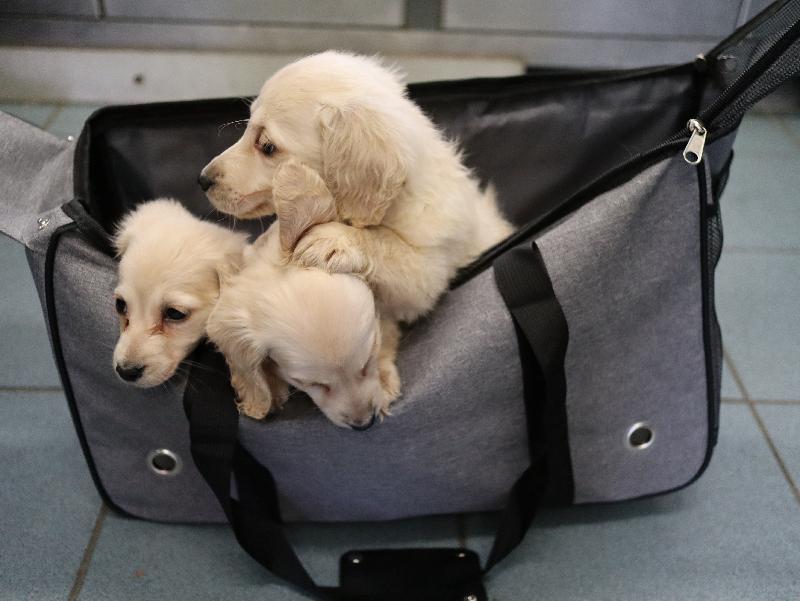
     Hong Kong Customs yesterday (February 23) detected an animal smuggling case and found six suspected smuggled puppies at Man Kam To Control Point with an estimated market value of about $110,000.

     Customs officers intercepted an incoming lorry at Man Kam To Control Point for inspection yesterday evening and found six suspected smuggled puppies inside two pet carrier bags in the driving compartment. The 35-year-old male driver was then arrested.

     An investigation is ongoing and the six puppies have been handed over to the Agriculture, Fisheries and Conservation Department.

     Smuggling is a serious offence. Under the Import and Export Ordinance, any person found guilty of importing or exporting unmanifested cargo is liable to a maximum fine of $2 million and imprisonment for seven years.

     Under the Rabies Regulation, any person found guilty of illegally importing animals, carcasses or animal products is liable to a maximum fine of $50,000 and imprisonment for one year.

     Members of the public may report any suspected smuggling activities to Customs' 24-hour hotline 2545 6182 or its dedicated crime-reporting email account (crimereport@customs.gov.hk).

Photo  


LCQ19: Compulsory testing and exemptions of compulsory quarantine

     Following is a question by Dr the Hon Pierre Chan and a written reply by the Secretary for Food and Health, Professor Sophia Chan, in the Legislative Council today (February 24):
 
Question:
 
     Recently, the Government has invoked on a number of occasions the Prevention and Control of Disease (Compulsory Testing for Certain Persons) Regulation (Cap. 599J) to (i) issue compulsory testing notices (Notices) requiring that any person who has been present at the premises specified in the Notice for more than two hours during a specified period to undergo a polymerase chain reaction-based nucleic acid test for the Coronavirus Disease 2019 (COVID-19) by a specified deadline, and (ii) make restriction-testing declarations (Declarations) requiring that persons within the "restricted area" specified in the Declaration stay in their premises and undergo compulsory testing in accordance with the Government's arrangement, and they may leave only after the test results have mostly been ascertained. All premises within the restricted areas have been included in the relevant Notices. On the other hand, it has been reported that from time to time there were cases as follow: persons who had been exempted from compulsory quarantine when entering Hong Kong (exempted persons) were not confirmed, until a number of days after their arrival in Hong Kong, to have contracted COVID-19. In this connection, will the Government inform this Council:
 
(1) of the following information related to each Declaration (set out in Table 1 in chronological order of the date of the Declaration):
     (i) the date on which the Declaration was made,
     (ii) the boundaries of the restricted area(s),
     (iii) the affected residents –
          (a) the number of households, and
          (b) the number of residents,
     (iv) the testing and law enforcement situations –
          (a) the number of persons who underwent the testing,
          (b) the number of persons confirmed to have contracted COVID-19,
          (c) the number of households not answering the door and the number of residents involved, and
          (d) the number of fixed penalty notices (FPNs) issued to persons for non-compliance with the Declaration, and
     (v) the manpower and public expenditure involved in the entire operation –
          (a) the number of staff members of the Government,
          (b) the number of staff members of the contractor(s), and
          (c) the public expenditure;
 
Table 1

(i) (ii) (iii) (iv) (v)
(a) (b) (a) (b) (c) (d) (a) (b) (c)


(2) of the following information related to the residential buildings covered by each Notice (set out in Table 2 in chronological order of the date of the Notice);
     (i) the date on which the Notice was issued,
     (ii) the name(s) of the building(s) involved,
     (iii) the affected residents of each building –
          (a) the number of households, and
          (b) the number of residents,
     (iv) the testing and law enforcement situations of each building –
          (a) the number of persons who underwent the testing,
          (b) the number of persons confirmed to have contracted COVID-19, and
          (c) the number of FPNs issued to persons for non-compliance with the Notice, and
     (v) the manpower and public expenditure involved in the entire operation –
          (a) the number of staff members of the Government,
          (b) the number of staff members of the contractor(s), and
          (c) the public expenditure;
 
Table 2

(i) (ii) (iii) (iv) (v)
(a) (b) (a) (b) (c) (a) (b) (c)


(3) of the respective numbers of exempted persons who entered Hong Kong from (i) the Mainland, Macao and Taiwan, as well as (ii) foreign places, in each month since January last year; and
 
(4) of the number of exempted persons, since January last year, who were confirmed to have contracted COVID-19 within 14 days after their entry into Hong Kong, with a breakdown by the country/region from which they came?
 
Reply:
 
President,
 
     In consultation with the Home Affairs Bureau, which is responsible for co-ordinating the enforcement operations for compulsory testing notices and operations for "restriction-testing declaration", as well as other related Government departments, my reply to the various parts of the question raised by Dr the Hon Pierre Chan is as follows:
 
(1) and (2) The Government has been refining its anti-epidemic strategies in accordance with the development of the epidemic, including following the three key principles of "compulsory testing on a mandatory basis, targeted testing on an obligatory basis and testing on a voluntary basis" to conduct large-scale COVID-19 testing for groups of different risks with a view to achieving "early identification, early isolation and early treatment", and cutting the transmission chains in the community as far as possible.
 
     Regarding compulsory testing on a mandatory basis, the Government has implemented the Prevention and Control of Disease (Compulsory Testing for Certain Persons) Regulation (Cap. 599J) since November 15, 2020.  As at February 18, 2021, the Government has exercised the power under the regulation multiple times to issue compulsory testing notices (CTNs) and require any person who had been present during specified periods at more than 470 specified premises (including dance clubs/venues, restaurants, residential buildings, workplaces, construction sites, a department store and hospitals) to undergo compulsory testing.  Those who are subject to the notices include but are not limited to residents, visitors and workers.
 
     Generally speaking, persons subject to compulsory testing may choose to undergo testing via multiple routes as follows: (i) to visit any of the mobile specimen collection stations; (ii) to attend any of the community testing centres; (iii) to obtain a deep throat saliva specimen collection pack from any of the 121 post offices, vending machines set up at 20 MTR stations or 47 designated general outpatient clinics (GOPCs) of the Hospital Authority and return the specimen to one of the designated specimen collection points; (iv) to undergo testing at any of the GOPCs of the Hospital Authority as instructed by a medical professional of the Hospital Authority; (v) to self-arrange testing provided by private laboratories which are recognised by the Department of Health (DH) and can issue SMS notifications in respect of test results; or (vi) to use a specimen bottle distributed by the Centre for Health Protection (if applicable), and return the specimen bottle with the sample collected as per the relevant guidelines.
 
     The Government enforces CTNs by arranging staff to verify the testing certifications of residents at the entrances/exits of buildings covered by CTNs and conduct checks in the buildings to ask residents to provide the SMS notification received through a mobile phone, or related certification to verify whether they had complied with the requirement. As at February 18, 2021, the Government had deployed about 890 people to conduct 12 times blitz operations and checked the test reports of more than 5 000 residents, of which about 300 had violated the CTN. The Government has issued fixed penalties of $5,000 and/or compulsory testing orders to them, requiring them to undergo testing within a specified period. Non-compliance with a compulsory testing order is an offence, and offenders are liable to a fine of $25,000 and imprisonment for six months.  The enforcement actions are ongoing, and expenses involved are yet to be calculated.
 
     Subject to the epidemic development and the infection control need, the Government will also delineate restricted areas and make a "restriction-testing declaration" (RTD). Persons within the areas are required to stay in their premises and undergo compulsory testing in accordance with the arrangements by the Government, and can only leave after the relevant test results are mostly ascertained. All buildings within the restricted areas, whether or not confirmed cases were found therein, would be included in the CTN. Any person who had been present in buildings in the restricted area for more than two hours in the past 14 days, even if they were not present in the restricted area at the time when the RTD took effect, also have to undergo compulsory testing.
 
     From January 23 to February 10, the Government has delineated 26 restricted areas in multiple districts (including Yau Tsim Mong District, Eastern District, Kwun Tong District, Yuen Long District, Sham Shui Po District, Kowloon City District, Tuen Mun District and Sha Tin District) with RTDs issued, and carried out enforcement operations to verify that all people in the "restricted areas" had undergone compulsory testing. Nearly 12 000 man-time of civil servants were mobilised in the relevant operations, during which more than 24 000 people were tested in designated restricted areas. 20 confirmed cases were found and 234 persons were found not having undergone compulsory testing.  Compulsory testing orders and/or fixed penalties of $5,000 were issued to them. The Government will continue to step up enforcement, and handle those persons who have not complied with the CTN in a strict manner.
 
     Please refer to the following link for details of CTNs issued in respect of specified premises and RTDs for restricted areas issued by the Government:
www.coronavirus.gov.hk/pdf/compulsorytestingnotice_premises_ENG.pdf .
 
(3) Pursuant to the Compulsory Quarantine of Certain Persons Arriving at Hong Kong Regulation (Cap. 599C) and Compulsory Quarantine of Persons Arriving at Hong Kong from Foreign Places Regulation (Cap. 599E), all persons having stayed in places outside Hong Kong for any period prior to their arrival in Hong Kong, with the exception of persons exempted by the Chief Secretary for Administration in accordance with the relevant regulations, must be subject to compulsory quarantine, regardless of nationality and travel documents used.
 
     To maintain necessary operation of the society and economy of Hong Kong, and to ensure an uninterrupted supply of all daily necessities to the public, the Chief Secretary for Administration has, in accordance with the relevant regulations, exempted persons (for example, consular and diplomatic officers, crew members of aircraft and cross-boundary goods vehicle drivers, etc.) from the compulsory quarantine requirement upon arrival in Hong Kong. Nevertheless, in a bid to guard against the importation of cases as far as practicable, the Government has been adjusting relevant quarantine and testing measures based on ongoing prevention and control risk assessments.
 
     In view of the severity of the global pandemic situation, the Government has time after time tightened the testing, quarantine and isolation arrangements for persons arriving Hong Kong (including normal inbound travellers and exempted persons) in accordance with the development of the epidemic situation. In response to the raging of virus variant, the Government tightened the quarantine arrangement for persons who have stayed in places outside China in December 2020 and January 2021. All persons who have stayed in Group A specified places under the Prevention and Control of Disease (Regulation of Cross-boundary Conveyances and Travellers) Regulation (Cap. 599H) (hereinafter "Group A specified places"), which currently includes Brazil, Ireland, South Africa and the United Kingdom, will not be allowed to board for Hong Kong. Exempted persons (including air crew members) having stayed in Group A specified places must be subject to self-isolation at designated quarantine hotels for 21 days upon arrival in Hong Kong. They must also be subject to "test-and-hold" arrangement (i.e. undergo testing and wait for the result at the Hong Kong International Airport (HKIA) or designated location) and undergo testing on the 12th and 19th or 20th day upon arrival in Hong Kong. Meanwhile, the Government has also extended the quarantine period to 21 days for all inbound travellers who have stayed in non-Group A specified places outside China.
 
     In accordance with the prevention and control risk assessments, the Government announced on February 5, 2021 to further tighten the testing and isolation arrangements for exempted persons. With effect from February 20, 2021, all exempted persons entering Hong Kong at the HKIA must be subject to "test-and-hold" arrangement. To further mitigate possibility of exempted persons' contact with the local community during the exemption period, the Government has set up designated quarantine channels for air crew members and other exempted persons at the HKIA. After undergoing testing and immigration procedures, air crew members and other exempted persons will use the respective designated channels to arrive at the designated pick-up points for travelling to their accommodation by point-to-point transportation. The new measure is in place with a view to minimising the chance of transmission of the virus from imported cases into the community.
 
     All air crew members who have stayed in any places outside China but have not stayed in Group A specified places during the 21 days prior to arrival in Hong Kong must self-isolate at the airport hotel (i.e. Headland Hotel or Hong Kong SkyCity Marriott Hotel) arranged by airlines until their next duty flight after undergoing testing. If the aforementioned air crew members are local-based crew who wish to leave the airport area, they must self-isolate at a designated quarantine hotel for 14 days (with testing to be done on the 12th day following their arrival) before entering the local community. They must also be subject to medical surveillance for 7 days afterwards (with testing to be done on the 15th and 19th or 20th day following their arrival) before operating again. Freight crew who have only laid over in Anchorage in Alaska of the United States of America, which is subject to closed-loop management in segregation from the local community during the layover, will be exempted and they will not be subject to self-isolation at designated quarantine hotels. They will still be subject to 21-day medical surveillance and undergo testing on the 7th, 12th, 15th and 19th or 20th day following their arrival.
 
     All other exempted persons must also be subject to "test-and-hold" arrangement and undergo repeated testing during their stay in Hong Kong. In addition, except Consul Generals or representatives in Hong Kong and government officials at equivalent/higher level, all other government officials carrying out governmental duties who have stayed in any places outside China (but have not stayed in Group A specified places) during 21 days prior to arrival in Hong Kong must be subject to self-isolation for 21 days at an accommodation arranged by respective organisations. They must also be subject to repeated testing during the self-isolation period.
 
     As for persons who are arriving Hong Kong from China at land boundary control points under Cap.599C, normal inbound travellers will be subject to compulsory quarantine for 14 days at home or other accommodation, while exempted persons (except those under regular testing arrangement) must undergo testing.
 
     Apart from the testing arrangement, the DH would arrange 21-day/14-day medical surveillance for the abovementioned exempted persons during their stay in Hong Kong. Persons under medical surveillance are required to wear masks and check their body temperature twice daily, and they should report to the DH if feeling unwell. In addition, exempted persons are also subject to body temperature check and health declaration procedures performed by the DH at boundary control points during arrival clearance.
 
     The number of Notification of Medical Surveillance issued to exempted persons (including those exempted under Cap. 599C and 599E) between February 2020 and January 2021 at various boundary control points are as follows:
 

Month Number of Notification of Medical Surveillance issued to exempted persons at various boundary control points in service
February 2020 93 602
March 2020 39 211
April 2020 36 039
May 2020 40 220
June 2020 45 943
July 2020 53 405
August 2020 41 155
September 2020 45 689
October 2020 43 885
November 2020 45 440
December 2020 46 145
January 2021 42 584

Note 1: Boundary control points in service include Hong Kong International Airport, Hong Kong-Zhuhai-Macao Bridge Hong Kong Port, Shenzhen Bay, Man Kam To, Lok Ma Chau, Sha Tau Kok and Heung Yuen Wai (commenced service on August 26, 2020).
Note 2: Exempted persons are issued with new Notification of Medical Surveillance every time when they enter Hong Kong (except in cases set out in note 3 below).
Note 3: Currently, "cross-boundary goods vehicle drivers and necessary accompanying personnel" with valid Notification of Medical Surveillance issued in the past 14 days are not issued with new Notification of Medical Surveillance afresh every time they enter Hong Kong.
 
     The DH does not maintain the breakdown figures of exempted persons arriving at boundary control points by courtries/places.
 
(4) Since July 2020 (as at February 15, 2021), the Centre for Health Protection of the DH recorded 227 COVID-19 cases involving sea crew and air crew members, with 14.1 per cent from the Philippines, 12.3 per cent from Russia, 11.9 per cent from the United States of America and 10.6 per cent from India. The DH does not maintain the figures of confirmed cases for other exempted persons.


LCQ6: Art Tech

     Following is a question by the Hon Lau Kwok-fan and a written reply by the Secretary for Home Affairs, Mr Caspar Tsui, in the Legislative Council today (February 24):

Question:

     The Chief Executive has indicated in the 2020 Policy Address that the Government will actively promote and support the development of Art Tech. To this end, the Secretary for Home Affairs will take the lead in setting up a cross-bureau task force (task force) and invite the participation of representatives from the relevant sectors and non-governmental organisations in the formulation of strategies and measures to develop and promote Art Tech. Furthermore, the Government has set aside a total of $100 million under four relevant funds (i.e. the Arts and Sport Development Fund, the Innovation and Technology Fund, the Film Development Fund and the CreateSmart Initiative) for the relevant sectors to apply for funding for implementing projects on developing and promoting the integration of technology and arts. In this connection, will the Government inform this Council:

(1) of the criteria adopted by the Government for inviting representatives from the relevant sectors to be members of the task force, as well as the (i) definition of "Art Tech", (ii) long-term goals and (iii) key performance indicators to be adopted by the task force;

(2) of the respective portions of the $100 million funding coming from the four aforesaid funds, the criteria to be adopted (e.g. the goals to be achieved) for vetting and approving the relevant funding applications, as well as the maximum amount of subsidy to be provided for each approved application; whether the subsidies provided by these funds for art projects of non-Art Tech categories will be correspondingly reduced;

(3) whether the Government will collaborate with those institutions which currently offer relevant courses (e.g. The Hong Kong Academy for Performing Arts, City University of Hong Kong, Hong Kong Baptist University, Hong Kong Design Institute, and Hong Kong Institute of Vocational Education) in promoting Art Tech, and encourage qualified persons to teach the relevant courses, so as to train Art Tech talents and facilitate the alignment of the courses offered by institutions and the demand of the industry; and

(4) given that the East Kowloon Cultural Centre, which is currently under construction and will be commissioned in 2023, will provide Testbed Studio for applying Art Tech, how the Government ensures that the Testbed Studio and the entire Cultural Centre will (i) be equipped with the facilities needed for developing and trying out Art Tech and (ii) provide the relevant sectors with convenient channels for hiring facilities; whether it has formulated eligibility criteria for hiring the Testbed Studio?

Reply:

President,

(1) The Inter-departmental Task Force on Arts Technology (Task Force) led by the Secretary for Home Affairs convened its first meeting on February 17. The meeting discussed the strategies and measures of the Task Force in developing and promoting arts technology (arts tech) in the future. The Task Force will consult the relevant industries and their representatives on the work plan as appropriate, and will invite representatives from the relevant industries or non-government organisations to attend the Task Force meetings as necessary.

     Arts tech is developing rapidly and can cover a wide area. It may not be appropriate to give an official definition to it. Broadly speaking, arts tech can be interpreted as applying technology (such as virtual reality, extended reality, real-time animation, etc.) in artistic creation to enhance the content and delivery of artistic creation, support the succession of arts and deepen audience engagement and experience. The long-term goal of the Task Force is to provide employment and industry development opportunities for arts practitioners and technology talents and to bring new experience to audience simultaneously so as to further promote Hong Kong's cultural essence where the East meets the West. As the development of arts tech is still in the preliminary stage, the Government has not set any key performance indicators at this stage.

(2) As mentioned in the 2020 Policy Address, relevant policy bureaux have set aside a total of $100 million under funds or schemes of their respective purview (including the Arts and Sport Development Fund, the Innovation and Technology Fund, the Film Development Fund and the CreateSmart Initiative) for individuals interested in promoting arts tech to apply. The schemes above have dedicated objectives with different target applicants (details are at Annex). Applicants may submit application to the relevant funds or schemes, depending on the content of their proposals. The Government will continue to support the development of different arts projects.

     For the Arts and Sport Development Fund, the Home Affairs Bureau launched the application of the 10th round of the Arts Capacity Development Funding Scheme (ACDFS) in December 2020. A new category of "Arts Tech" was added in the 10th round of the ACDFS to support proposals that seek to integrate arts and technology, as well as encourage applicants to creatively apply technology to meet their artistic goals and vision. The proposals should contribute to the four objectives of the ACDFS, including capacity development of arts practitioners, arts groups, art forms and/or the arts sector; programme/content development; audience building; and arts education.

     As for the CreateSmart Initiative and the Film Development Fund, the Commerce and Economic Development Bureau will actively encourage and consider funding applications with arts tech elements while fulfilling the established eligibility criteria and strategic directions. Application of new technologies in the local film industry and other creative sectors will enhance the quality, variety and user experiences of products and services. It will help promote Hong Kong as Asia's creative capital.

     The Innovation and Technology Fund welcomes funding applications from the arts tech industry to help promote its development through different schemes. The Technology Voucher Programme and the General Support Programme under the Innovation and Technology Fund are relevant to the application of technology and IT culture for the promotion of arts tech. The Technology Voucher Programme provides funding to enterprises and organisations to use technological services and solutions to improve productivity, or upgrade or transform their business processes. The General Support Progamme supports non-research and development projects that contribute to the upgrading and development of our industries as well as the fostering of an innovation and technology culture in Hong Kong. There is no cap on the number of funded projects and funding amounts under the funding schemes of the Innovation and Technology Fund. The Innovation and Technology Commission welcomes applications from the arts sector, applications from which had been accepted by the Innovation and Technology Fund in the past.

(3) The existing programmes related to arts or creative media offered by the post-secondary institutions cover topics related to arts tech, which helps to equip students with knowledge relevant to arts tech and inspire them to progress with the times. Moreover, the post-secondary institutions enjoy academic freedom and autonomy in programme development. They would liaise with stakeholders from time to time to keep abreast of the latest manpower trends and industry needs, with a view to ensuring that their programmes continue to serve the needs of the community and nurture talents in arts tech.

     The Hong Kong Academy for Performing Arts has also provided programmes covering arts tech under the School of Theatre and Entertainment Arts to nurture talents for the industry.

(4) Kowloon East is a pilot area to develop a smart city in Hong Kong. As a catalyst for the implementation of the Smart City Blueprint for Hong Kong, the East Kowloon Cultural Centre (EKCC) will promote arts tech at community level through diversified arts tech programmes and interactive education activities in a bid to foster interests in and understanding of the arts and technology in the community, particularly among young people. In the meantime, novel and interactive theatre experience will help broaden the audience base for performing arts and promote cultural inclusiveness.

     The EKCC will inject new impetus into the performing arts through innovative technology, and explore the infinite possibilities of innovative technology with artists. The EKCC will provide local artists with an incubation platform to support them from the stage of developing creative concept and connect them with partners from different sectors. They can join hands to develop arts tech programmes from an experimental "work-in-progress" creation to a complete and mature work. The EKCC will also actively encourage community engagement in art projects to arouse public interest and understanding of arts tech by bringing diversified arts tech programmes, art installation, exhibitions, workshops, and interactive educational activities.


LCQ5: Public works projects

     Following is a question by Dr the Hon Junius Ho and a written reply by the Secretary for Development, Mr Michael Wong, in the Legislative Council today (February 24):

Question:

     In recent years, a number of large-scale infrastructure projects (e.g. the Hong Kong-Zhuhai-Macao Bridge and the Shatin to Central Link projects) have experienced serious cost overruns and delays. Some members of the public have queried the capability of the Government to control the expenditure of public works projects and monitor their progress, and are worried that similar problems may arise in new works projects. In this connection, will the Government inform this Council:

(1) of the number of public works contracts awarded by the Government and the total expenditure involved in each year since the 2018-2019 financial year;

(2) of the following details of the public works projects implemented by the Development Bureau or the Transport and Housing Bureau which were upgraded to Category A as approved by the Finance Committee of this Council in the 2018-2019 legislative session or thereafter (set out by project name in a table):
(i) the numbers and names of the consultancy firms engaged,
(ii) the expenditures on consultancy fees involved, and
(iii) the specific criteria adopted for selecting consultancy firms and contractors; and

(3) regarding those public works projects that experienced serious cost overruns and delays in the past five years, whether the Government has conducted a detailed analysis on and review of the causes for the cost overruns and delays (including whether perfunctory supervision by government officials was involved), and what specific measures are in place to prevent similar problems from occurring in future works projects?

Reply:

President,

     The Government has been continuously investing in capital works to improve people's quality of life, enhance Hong Kong's long-term competitiveness and promote its economic development. The annual capital works expenditure has been maintained at an average level of $70 billion since 2017. We expect the annual capital works expenditure will continue to grow and exceed $100 billion in coming years.

     In view of the challenges of high construction cost and ageing construction work force faced by Hong Kong in recent years, the Development Bureau (DEVB) established the Project Cost Management Office (PCMO) in June 2016, and upgraded it to the Project Strategy and Governance Office (PSGO) in April 2019 for promoting "Construction 2.0" proactively and implementing various measures to enhance the performance of public works projects.

     The Government's reply to the three parts of the question raised by Dr the Hon Junius Ho is as follows:

(1) The Government has regularly submitted reports to the Public Works Subcommittee, listing out the prices of major contracts awarded (each with a contract sum exceeding $30 million) in each quarter. The total sum and number of major contracts awarded from fiscal year 2018-19 to 2020-21 are tabled as follows:
 

Fiscal Year 2018-19 2019-20 2020-21
(As at the 4th quarter of 2020)
Total Contract Sum
(Number of Contract)
$79.7 billion
(78)
$64.6 billion
(55)
$64.5 billion
(78)

(2) In the 2018-19 to 2020-21 Legislative Council (LegCo) sessions, the Finance Committee (FC) of LegCo approved the upgrading of 58 Public Works Programme (PWP) items under the DEVB and the Transport and Housing Bureau to Category A. The associated consultancy agreements awarded by the works departments under 44 PWP items are tabulated in Annex. For the remaining 14 items, seven of them have not awarded consultancy agreements yet and seven of them have been entrusted to other parties (e.g. the Hong Kong Housing Authority, the Airport Authority Hong Kong, etc.) for implementation.

     When selecting a consultant or a contractor, the works departments will take into account the technical capability and past performance of a tenderer in addition to the tender price. Generally, a "two-envelope two-stage" approach is adopted in tendering for consultancy agreements and works contracts. Tenderers are required to submit technical proposals and price proposals separately to the Tender Assessment Panel of the works departments. The Tender Assessment Panel will evaluate the tenders in two stages, first the technical proposal and then the price proposal. Afterwards, the overall score will be calculated based on the weightings stipulated in the tender documents and only the tenderer with the highest overall score will be awarded the contract. Depending on the nature of the project, the weightings of a tender's scores on technical aspects against the overall score are 54 per cent to 72 per cent for consultancy agreements, and 40 per cent to 60 per cent for works contracts.

     For those works contracts of simple nature, the Tender Assessment Panel will consider both the tender price and past performance of a tenderer in evaluating the tender. Tenderers are not required to submit technical proposals.

(3) Although some large-scale infrastructure projects have experienced delays or have to apply for additional funding in recent years, in fact, the overall estimation and management performance of the Capital Works Programme (CWP) have remained sound. The FC approved a total of 515 Category A projects with funding amounting to about $890 billion over the past ten years. Among these approved projects, 27 required application to the FC for additional provisions totalling about $67 billion mainly due to unforeseen circumstances. In other words, increased estimates were deemed necessary in about 5 per cent of the approved projects and their corresponding additional provisions amounted to about 7.5 per cent of the total funding approved.

     On the other hand, despite the fact that there were projects requiring additional provisions owing to individual circumstances, projects under the CWP have generally been completed within the original Approved Project Estimates (APE), and some even managed to have surplus. For example, for the 605 Category A projects with their final accounts settled in the past ten years, their final expenditure totalled about $162.5 billion while their total original APE was about $180 billion. Though some projects needed to apply for additional provisions from the FC, the surplus from other projects were not only able to offset the cost overruns but also managed to secure a balance of $17.5 billion. In short, the total expenditures of these projects only accounted for about 90 per cent of their total original APEs.

     As far as cost overruns in works projects are concerned, we have reviewed the major causes of cost overruns in PWP items in the past five years. The major reasons for applying for additional funding provisions include additional works due to unforeseen circumstances; higher-than-expected tender returns; increased project contingencies to cover unforeseen adverse ground/underground condition; and increased provision for price adjustments to cope with higher-than-expected increase in construction costs.

     As for progress delays, the causes of serious delays in some major projects were mainly due to unforeseen circumstances, which include unforeseen site condition affecting the works progress, inclement weather, as well as delay in obtaining funding approval.

     As mentioned above, the DEVB established the PCMO in June 2016, and upgraded it to the PSGO in April 2019, to enhance the performance of infrastructure projects through various measures, such as:

(i) Strengthening the cost management process

  • Conduct project vetting process starting from inception stage with regular reviews and take follow-up actions to track project development from the detailed design stage to the funding application stage. Monitor the performance of projects by the Project Surveillance System on a continuous basis until project completion.

(ii) Enhancing project delivery capability

  • Establish the Centre of Excellence for Major Project Leaders to provide high-level project management and leadership development programme.

(iii) Leading strategic developments to enhance cost-effectiveness

  • Promote "Construction 2.0", and reform the construction industry by advocating innovation, professionalisation and revitalisation.

(iv) Enhancing collaboration with international counterparts and local industry stakeholders

  • Collaborate with the Construction Industry Council and local industry stakeholders to promote cost monitoring measures to construction projects in private sector.
  • Communicate with authorities in the Mainland, Australia, Singapore and the United Kingdom, and draw on relevant practice and experience when devising policies for enhancing the performance of public works projects.

     Since its establishment, the PCMO/PSGO has scrutinised more than 280 public works projects (Note). These projects have commenced smoothly, and some have reached the final stage of construction. We are confident that these projects will not experience cost-overruns or serious delays. Moreover, by adopting the above strategies and collaborating with the industry to promote cost management measures, we are happy to see that the industry has given more weight to cost management culture.

Note: The total estimated project cost was $520 billion, and $70 billion has been saved through optimising project designs.