Government gazettes compulsory testing notice

     The Government exercised the power under the Prevention and Control of Disease (Compulsory Testing for Certain Persons) Regulation (Cap. 599J) and published in the Gazette a compulsory testing notice, which requires any person who had been present at eight specified premises during the specified period (persons subject to compulsory testing) to undergo a COVID-19 nucleic acid test.

     Currently, in all districts in Hong Kong, if one or more new confirmed cases are found in the residential buildings (including buildings for both commercial and residential uses), or there are sewage samples tested positive which implied possible infection risks, the buildings will be included in the compulsory testing notice.

     For testing targeting at workplaces, if two or more confirmed cases are found in a workplace, it will be included in the compulsory testing notice.

     Eight buildings fulfilling the above criteria were included in the compulsory testing notice today (February 25).

     Details of the compulsory testing notice are as follows:

     Any person who had been present at any specified premises listed in Annex 1 for more than two hours at any time during the period from February 12 to February 25, 2021 (including but not limited to visitors, residents and workers), have to undergo testing by February 27, 2021. If persons subject to compulsory testing have previously undergone testing between February 23 and February 25, 2021, they would be taken to have complied with the requirements set out in the compulsory testing notice.

      Furthermore, a spokesman for the Food and Health Bureau reminds the public that in accordance with the compulsory testing notice issued earlier, all household members of close contacts are required to undergo compulsory testing. Any person who had lived with a person who is placed under quarantine pursuant to section 22 of the Prevention and Control of Disease Regulation (Cap. 599A) (person under quarantine) in the same residential unit on the date of commencement of quarantine or during the 14 days before that day, and who becomes aware of the quarantine of the person under quarantine when the relevant quarantine has not yet been completed, have to undergo testing within two days of he/she becoming aware of the person under quarantine has been placed under quarantine and report to the Government the result of the test by phone (at 6275 6901), fax (at 2530 5872) or email (ct@csb.gov.hk) within three days of undergoing the test.

     The Government will set up mobile specimen collection stations at the following locations tomorrow (February 26). Please see Annex 2 for details of service scope:
· Carpark of Quarry Bay Community Hall
· Island Harbourview, Tai Kok Tsui
· Oi Man Estate, Ho Man Tin
· Lai Chi Kok Community Hall
· One Regent Place, Yuen Long
· Trackside Villas, Tai Po Kau
· Ocean Shores, Tiu Keng Leng

     The service period of the mobile specimen collection stations at Edinburgh Place in Central and Tung Chung North Park will be extended to February 28 (Sunday) and March 4 (Thursday) respectively. Starting from February 27, the Government will set up mobile specimen collection station at Butterfly Bay Community Centre in Tuen Mun; the mobile specimen collection station at Muk Lun Street Playground will be relocated to Wong Tai Sin Square and will be open to March 7 (Sunday) tentatively, and the service period of the mobile specimen collection station at Tai Po Community Centre will also be extended to March 7 (Sunday). The opening dates and operating hours of the mobile specimen collection stations in various districts providing free COVID-19 nucleic acid testing services for the general public are stated in Annex 2. Apart from mobile specimen collection stations, persons subject to compulsory testing can also choose to attend any of the community testing centres in all districts to receive testing free of charge.

     Persons subject to compulsory testing may choose to undergo testing via the following routes:
1.  To visit any of the mobile specimen collection stations (see the list and target groups (if applicable) at www.coronavirus.gov.hk/eng/early-testing.html) for testing;
2.  To attend any of the community testing centres (see the list at www.communitytest.gov.hk/en/);
3.  To obtain a deep throat saliva specimen collection pack from any of the 121 post offices, vending machines set up at 20 MTR stations or 47 designated general outpatient clinics (GOPCs) of the Hospital Authority and return the specimen to one of the designated specimen collection points (see the distribution points and times, and the specimen collection points and times, at www.coronavirus.gov.hk/eng/early-testing.html);
4.  To undergo testing at any of the GOPCs of the Hospital Authority as instructed by a medical professional of the Hospital Authority;
5.  To self-arrange testing provided by private laboratories which are recognised by the Department of Health (DH) and can issue SMS notifications in respect of test results (see the list at www.coronavirus.gov.hk/pdf/List_of_recognised_laboratories_RTPCR.pdf); or
6.  To use a specimen bottle distributed to the relevant specified premises by the Centre for Health Protection (if applicable), and return the specimen bottle with the sample collected as per relevant guidelines.

     The spokesman cautioned that testing received at accident and emergency departments of the Hospital Authority or during hospital stays, or testing provided by private laboratories which cannot issue SMS notifications in respect of test results, does not comply with the requirements of the aforementioned compulsory testing notice.

     "If persons subject to compulsory testing have symptoms, they should seek medical attention immediately and undergo testing as instructed by a medical professional. They should not attend the mobile specimen collection stations or the community testing centres."

     Persons subject to compulsory testing must keep the SMS notification containing result of the test for checking by a law enforcement officer when the officer requires the persons to provide information about their undergoing the specified test.

     Furthermore, persons subject to testing under the compulsory testing notices should, as far as reasonably practicable, take appropriate personal disease prevention measures including wearing a mask and maintaining hand hygiene, and, unless for the purpose of undergoing the specified test, stay at their place of residence and avoid going out until the test result is ascertained as far as possible.

     Any enquiries on compulsory testing arrangements may be addressed to the hotline at 6275 6901, which operates daily from 9am to 6pm. If persons subject to compulsory testing plan to conduct testing at any of the community testing centres, they can check the centre's appointment status in advance. The hotlines of the community testing centres are available at www.communitytest.gov.hk/en/info/.

     The Government will continue to trace possibly infected persons who had been to the relevant premises, and seriously verify whether they had complied with the testing notices. Any person who fails to comply with the testing notices commits an offence and may be fined a fixed penalty of $5,000. The person would also be issued with a compulsory testing order requiring him or her to undergo testing within a specified time frame. Failure to comply with the order is an offence and the offender would be liable to a fine at level 4 ($25,000) and imprisonment for six months.

     Relevant officers of different government departments are empowered to perform certain functions under the relevant Regulations under the Prevention and Control of Disease Ordinance (Cap. 599), including requesting individuals to provide information and assistance when necessary. Any person who fails to comply with the relevant request commits an offence and would be liable to a fine at level 3 ($10,000). Collection and use of any personal data for conducting COVID-19 tests must meet the requirements under the Personal Data (Privacy) Ordinance (Cap. 486). Government departments or testing service providers which handle the relevant information may provide the data to DH or other relevant departments for anti-epidemic purpose as necessary. The workflow does not involve the provision of any personal data to organisations or persons outside Hong Kong.

     The spokesman said, "The Government urges all individuals who are in doubt about their own health conditions, or individuals with infection risks (such as individuals who visited places with epidemic outbreaks or contacted confirmed cases), to undergo testing promptly for early identification of infected persons."


Shatin Hospital announces a Legionella infection case

The following is issued on behalf of the Hospital Authority:

     The spokesman for the Shatin Hospital (SH) made the following announcement today (February 25) regarding a Legionella infection case:
      
     A 85-year-old male patient in the Medical and Geriatric Ward of SH was diagnosed with Legionnaires' Disease (LD) on February 23. The Centre for Health Protection (CHP) will visit the ward and collect water samples from the hospital on February 26. The source of infection for the patient is still being investigated. The patient is currently receiving treatment at the Prince of Wales Hospital. He is in serious condition. Medical surveillance will be performed on patients who have been staying in the ward concerned with the confirmed case at the same time period.
      
     The hospital has already implemented a series of precautionary and infection control improvement measures in the ward concerned, including:
 
1. Suspending use of related basin faucets; and
2. Installing bacterial filters on basin faucets and shower heads
 
     The case has been reported to the Hospital Authority Head Office according to established guidelines. In addition to the above precautionary and improvement measures, the hospital has reminded all medical and nursing staff to be vigilant and continue to closely monitor the situation of the ward. Moreover, the hospital will co-operate with the CHP in the investigation of the source of infection.


CHP investigates two suspected food poisoning clusters

     The Centre for Health Protection (CHP) of the Department of Health is today (February 25) investigating two suspected food poisoning clusters affecting five persons, and reminded the public to maintain personal, food and environmental hygiene to prevent food-borne diseases.
 
     The first cluster involved two females aged 59 and 87, who developed abdominal pain, nausea, vomiting and diarrhoea about two hours after having lunch at a restaurant in Tseung Kwan O on February 24.
 
     The other cluster involved three females aged 46 to 68, who developed similar symptoms about two to three hours after having lunch at the same restaurant on the same day.
     
     All of the affected persons sought medical advice and required hospitalisation. They are in stable condition. Among them, one was discharged today.
     
     "We have alerted the Food and Environmental Hygiene Department to the incident and investigations are ongoing," a spokesman for the CHP said.
     
     To prevent food-borne diseases, members of the public are reminded to maintain personal, food and environmental hygiene at all times. When dining out:
 
• Patronise only reliable and licensed restaurants;
• Avoid eating raw seafood;
• Be a discerning consumer in choosing cold dishes, including sashimi, sushi and raw oysters, at a buffet;
• Ensure food is thoroughly cooked before eating during a hot pot or barbecue meal;
• Handle raw and cooked foods carefully and separate them completely during the cooking process;
• Use two sets of chopsticks and utensils to handle raw and cooked food;
• Do not patronise illegal food hawkers;
• Drink boiled water;
• Do not try to use salt, vinegar, wine and wasabi to kill bacteria as they are not effective; and
• Always wash hands before eating and after going to the toilet.


CHP investigates case of Legionnaires’ disease in hospital

     The Centre for Health Protection (CHP) of the Department of Health is today (February 25) investigating a case of Legionnaires' disease (LD) in Shatin Hospital (SH), and stressed the importance of using and maintaining properly designed man-made water systems, and that susceptible groups should strictly observe relevant precautions.
      
     The male patient, aged 85 with underlying illness, was admitted to SH on February 1 due to medical conditions. He developed fever, cough and yellowish sputum on February 19. His clinical diagnosis was pneumonia. He is currently in serious condition.
      
     His urine specimen was tested positive for Legionella species upon laboratory testing. Initial enquiries revealed that the patient had no travel history in the incubation period.
      
     "Epidemiological investigations with SH are ongoing to identify potential sources of infection, high-risk exposure and clusters, if any. Relevant water samples and environmental swabs will be collected from potential sources for laboratory testing," a spokesman for the CHP said.
      
     Tracing of contacts including staff and in-patients in ward is ongoing and those identified will be put under medical surveillance. The CHP has provided health advice against LD to staff and in-patients, including those with weakened immunity who should use sterile or boiled water for drinking, tooth brushing and mouth rinsing. Investigation is ongoing.
      
     Legionellae are found in various environmental settings and grow well in warm water (20 to 45 degrees Celsius). They can be found in aqueous environments such as water tanks, hot and cold water systems, cooling towers, whirlpools and spas, water fountains and home apparatus which support breathing. People may become infected when they breathe in contaminated droplets (aerosols) and mist generated by artificial water systems, or when handling garden soil, compost and potting mixes.
      
     Immunocompromised persons should:

     •Use sterile or boiled water for drinking, tooth brushing and mouth rinsing;
     •Avoid using humidifiers, or other mist- or aerosol-generating devices. A shower may also generate small aerosols; and
     •If using humidifiers, or other mist- or aerosol-generating devices, fill the water tank with only sterile or cooled freshly boiled water, and not water directly from the tap. Also, clean and maintain humidifiers/devices regularly according to manufacturers' instructions. Never leave stagnant water in a humidifier/device. Empty the water tank, wipe all surfaces dry, and change the water daily.
      
     The public should observe the health advice below:

•Observe personal hygiene;
•Do not smoke and avoid alcohol consumption;
•Strainers in water taps and shower heads should be inspected, cleaned, descaled and disinfected regularly or at a frequency recommended by the manufacturer;
•If a fresh-water plumbing system is properly maintained, it is not necessary to install domestic water filters. Use of water filters is not encouraged as clogging occurs easily, which can promote growth of micro-organisms. In case water filters are used, the pore size should be 0.2 micrometres (µm) and the filter needs to be changed periodically according to the manufacturer's recommendations;
•Drain and clean water tanks of buildings at least quarterly;
•Drain or purge for at least one minute infrequently used water outlets (e.g. water taps, shower heads and hot water outlets) and stagnant points of the pipework weekly or before use;
•Seek and follow doctors' professional advice regarding the use and maintenance of home respiratory devices and use only sterile water (not distilled or tap water) to clean and fill the reservoir. Clean and maintain the device regularly according to the manufacturer's instructions. After cleaning/disinfection, rinse the device with sterile water, cooled freshly boiled water or water filtered with 0.2  µm filters. Never leave stagnant water in the device. Empty the water tank, keep all surfaces dry, and change the water daily; and
•When handling garden soil, compost and potting mixes:
1. Wear gloves and a face mask;
2. Water gardens and compost gently using low pressure;
3. Open composted potting mixes slowly and make sure the opening is directed away from the face;
4. Wet the soil to reduce dust when potting plants; and
5. Avoid working in poorly ventilated places such as enclosed greenhouses.
 
     The public may visit the CHP's LD page, the Code of Practice for Prevention of LD and the Housekeeping Guidelines for Cold and Hot Water Systems for Building Management of the Prevention of LD Committee, and the CHP's risk-based strategy for prevention and control of LD.  


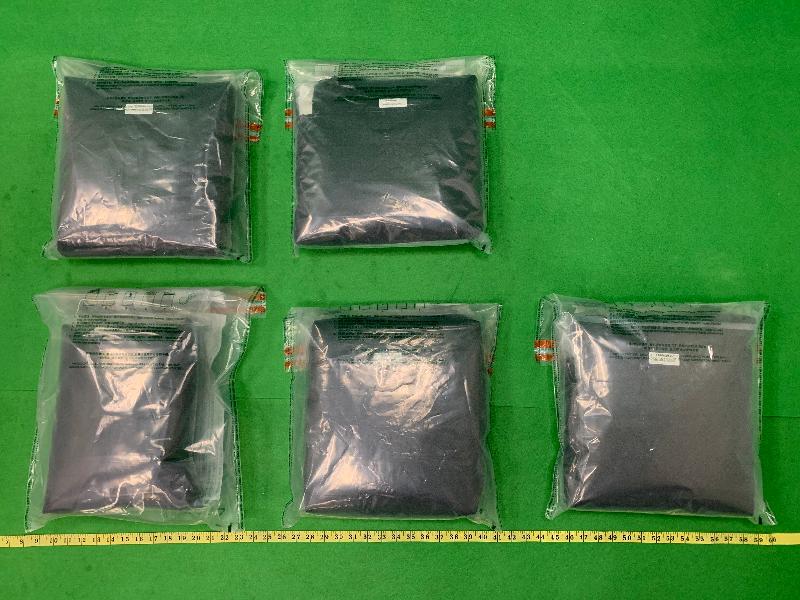
Hong Kong Customs seizes suspected ketamine worth about $15.4 million (with photo)

     Hong Kong Customs seized about 26 kilograms of suspected ketamine with an estimated market value of about $15.4 million at Hong Kong International Airport (HKIA) on February 19. Two men were subsequently arrested in Yau Ma Tei yesterday (February 24).

     Customs officers inspected two air consignments, both declared as carrying fabric, arriving in Hong Kong from Pakistan at HKIA on February 19 and found the batch of suspected ketamine inside three carton boxes loaded with fabric.

     After follow-up investigation, Customs officers yesterday arrested two men, aged 23 and 26, suspected to be in connection with the case in Yau Ma Tei.

     The duo have been jointly charged with one count of trafficking in a dangerous drug and will appear at the West Kowloon Magistrates' Courts tomorrow (February 26).

     Customs reminds members of the public to stay alert and not to participate in drug trafficking activities for monetary return. They must not accept hiring or delegation from another party to carry controlled items into and out of Hong Kong. They are also reminded not to carry unknown items for other people, nor to release their personal data or home address to others for receiving parcels or goods.

     Under the Dangerous Drugs Ordinance, trafficking in a dangerous drug is a serious offence. The maximum penalty upon conviction is a fine of $5 million and life imprisonment.

     Members of the public may report any suspected drug trafficking activities to Customs' 24-hour hotline 2545 6182 or its dedicated crime-reporting email account (crimereport@customs.gov.hk).

Photo