Grading of beach water quality released

     The Environmental Protection Department (EPD) today (February 26) released the latest grading of water quality for four gazetted beaches that are open all year round for swimming (see Note).       
   
     Four beaches were rated as Good (Grade 1).
 
Grade 1 beaches are:         

Clear Water Bay Second Beach Golden Beach
Deep Water Bay Beach Silverstrand Beach

 
     Compared with the grading released last week, Silverstrand Beach has been upgraded from Grade 2 to Grade 1.
 
     Under the present grading system, beaches are classified into four grades, namely Good (Grade 1), Fair (Grade 2), Poor (Grade 3) and Very Poor (Grade 4), according to the level of E. coli in the water. Grades are calculated on the basis of the geometric mean of the E. coli counts on the five most recent sampling occasions.
 
     A summary of beach grades is published weekly before the weekend. The latest beach grades based on the most current data may be obtained from the EPD's website on Beach Water Quality (www.epd.gov.hk/epd/beach) or the beach hotline, 2511 6666.
 
Note: In view of the latest situation of COVID-19, the Leisure and Cultural Services Department announced that all gazetted beaches were closed from December 10, 2020, until further notice.


Hong Kong Customs seizes suspected cocaine worth about $126 million (with photos)

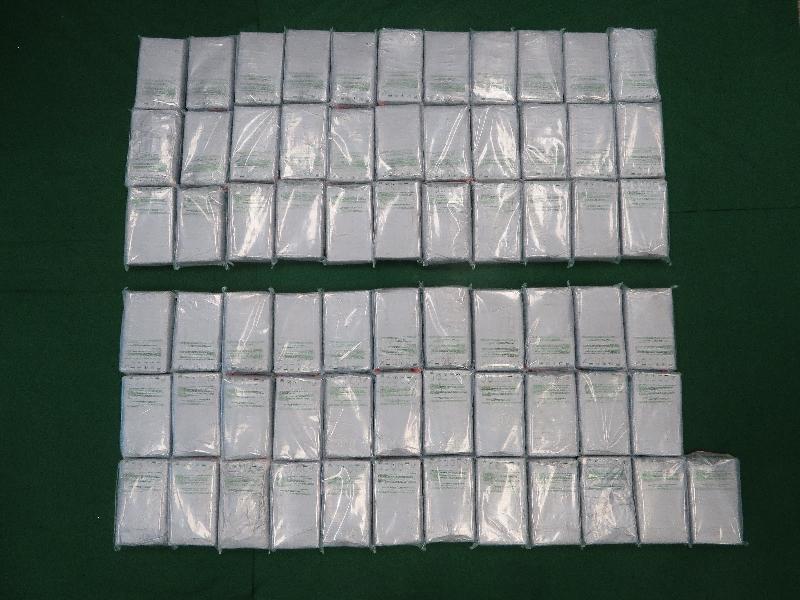
     Hong Kong Customs seized about 80 kilograms of suspected cocaine with an estimated market value of about $126 million from a transshipment container at the Kwai Chung Customhouse Cargo Examination Compound on February 23.

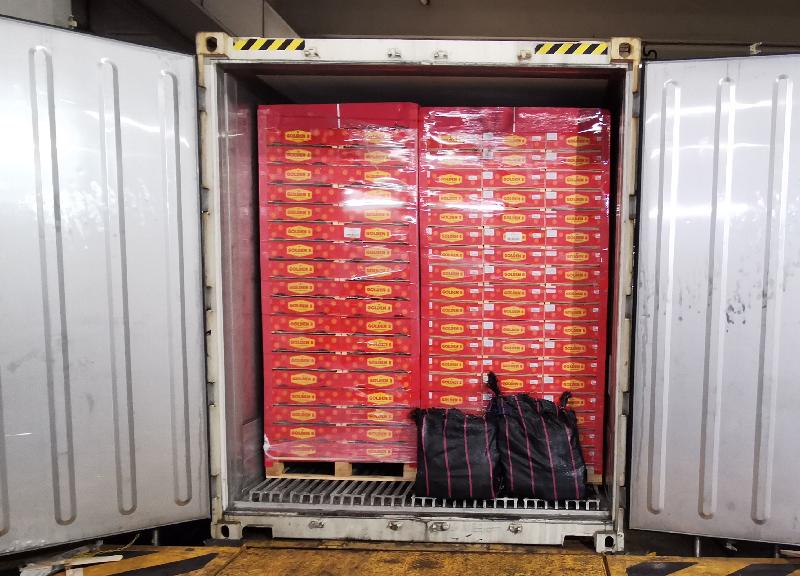
     Following intelligence sharing with overseas law enforcement agencies and risk assessment, Customs officers selected a 40-foot container, declared as containing grapes, from Peru heading for the Mainland via Hong Kong for inspection.

     Upon examination, Customs officers found the batch of suspected cocaine inside two nylon bags that were placed by the side of the container doors.

     After follow-up investigation, a 53-year-old man suspected to be in connection with the case was arrested the next day.

     Investigation is ongoing.

     Risk assessment has all along been an effective strategy adopted by Customs to intercept the import and transit movements of dangerous drugs in various channels. The department will continue to step up anti-narcotic efforts through risk assessment and intelligence analysis with international co-operation.

     Under the Dangerous Drugs Ordinance, trafficking in a dangerous drug is a serious offence. The maximum penalty upon conviction is a fine of $5 million and life imprisonment.

     Members of the public may report any suspected drug trafficking activities to Customs' 24-hour hotline 2545 6182 or its dedicated crime reporting email account (crimereport@customs.gov.hk).

Photo  Photo  


Youth Development Commission announces list of funded organisations under Youth Development Fund

     The Youth Development Commission (YDC) announced today (February 26) the list of funded organisations of the Funding Scheme for Youth Entrepreneurship in the Guangdong-Hong Kong-Macao Greater Bay Area (the Entrepreneurship Scheme) and the Funding Scheme for Experiential Programmes at Innovation and Entrepreneurial Bases in Guangdong-Hong Kong-Macao Greater Bay Area (the Experiential Scheme) under the Youth Development Fund.

     During the application period, the YDC received applications from more than 40 non-governmental organisations (NGOs) for the two schemes. The relevant assessment panels under the YDC vetted all applications, arranged assessment interviews with eligible applicants and conducted site visits to partnering entrepreneurial bases in the Guangdong-Hong Kong-Macao Greater Bay Area (GBA) of individual recommended organisations. After completing the assessment, about $130 million will be granted under the Entrepreneurship Scheme to support 16 NGOs to organise youth entrepreneurship projects in the GBA, providing capital subsidy to about 230 youth start-ups (involving more than 800 young people) and rendering entrepreneurial support and incubation services to more than 4 000 young people. As for the Experiential Scheme, about $5 million will be granted to 15 NGOs to organise short-term experiential projects at innovative and entrepreneurial bases in the GBA, benefiting the first batch of about 700 young people. The funded organisations are listed in the Annex.

     "There has been rapid development in the innovative and entrepreneurial ecosystem and bases in the GBA in recent years, which provides valuable opportunities for Hong Kong young people who wish to make business ventures. All funded organisations are well-established and experienced youth service organisations. I encourage young people who intend to start businesses in Hong Kong and Mainland GBA cities to grasp the opportunity and actively participate in the schemes," the Chief Secretary for Administration and Chairman of the YDC, Mr Matthew Cheung Kin-chung, said.

     Under the Entrepreneurship Scheme, funded organisations will provide selected young entrepreneurs with a capital subsidy of up to $600,000 as well as entrepreneurial support and incubation services, including helping them settle in entrepreneurial bases in the GBA. Moreover, as an enhancement measure promulgated by the Chief Executive's 2020 Policy Address, funded organisations will strengthen their entrepreneurial support for start-ups in terms of corporate governance, adaptability and digital competence. As for the Experiential Scheme, funded organisations will organise short-term experiential projects at entrepreneurial bases in Mainland GBA cities, with a view to enhancing Hong Kong young people's understanding of the entrepreneurial bases in Mainland GBA cities, as well as the relevant policies and supporting measures on innovation and entrepreneurship in the Mainland. This will in turn assist them in considering their plans of settling in the relevant entrepreneurial bases and starting businesses therein in the future.

     The YDC launched on the same day the thematic website "We Venture" (www.weventure.gov.hk/en/), which sets out information of the funded organisations and their entrepreneurship or experiential projects, including the backgrounds of the organisations, project descriptions, application criteria and methods, information of entrepreneurial bases, and methods of enquiry. Interested young people may browse the website for details and directly approach relevant organisations for enquiries and applications.


Import of poultry meat and products from Linköping Municipality and Mjölby Municipality, Östergötland County in Sweden suspended

     The Centre for Food Safety (CFS) of the Food and Environmental Hygiene Department announced today (February 26) that in view of a notification from the Swedish Board of Agriculture about an outbreak of highly pathogenic H5N8 avian influenza in Linköping Municipality, Östergötland County in Sweden, the CFS has instructed the trade to suspend the import of poultry meat and products (including poultry eggs) from Linköping Municipality and its adjacent Mjölby Municipality, with immediate effect to protect public health in Hong Kong.

     A CFS spokesman said that according to the Census and Statistics Department, Hong Kong imported about 1,550 tonnes of frozen poultry meat from Sweden last year.

     "The CFS has contacted the Swedish authorities over the issues and will closely monitor information issued by the World Organisation for Animal Health and relevant authorities on the avian influenza outbreaks. Appropriate action will be taken in response to the development of the situation," the spokesman said.


CFS announces food safety report for January

     The Centre for Food Safety (CFS) of the Food and Environmental Hygiene Department today (February 26) released the findings of its food safety report for last month. The results of about 4 100 food samples tested were satisfactory except for nine samples that were announced earlier. The overall satisfactory rate was 99.8 per cent.
      
     A CFS spokesman said about 900 food samples were collected for microbiological tests, about 3 200 samples were taken for chemical and radiation level tests.
      
     The microbiological tests covered pathogens and hygiene indicators, the chemical tests included pesticides, preservatives, metallic contaminants, colouring matters, veterinary drug residues and others, while the radiation level tests included testing of radioactive caesium and iodine from samples collected from imported food of different regions.
      
     The samples comprised about 1 700 samples of vegetables and fruit and their products; about 300 samples of cereals, grains and their products; about 300 samples of meat and poultry and their products; about 500 samples of milk, milk products and frozen confections; about 600 samples of aquatic and related products; and about 700 samples of other food commodities (including beverages, bakery products and snacks).
      
     The nine unsatisfactory samples comprised two frozen confection samples detected with counts of hygiene indicator organisms exceeding the legal limits, a goldfish sample found to contain trace amounts of malachite green, a prepackaged date sample found to contain sorbic acid and sulphur dioxide and in breach of the food labelling regulation, a crab sample detected with excessive cadmium, a pork sample found to contain sulphur dioxide, a rice roll sample detected with excessive benzoic acid, a chayote sample detected with excessive methomyl residue, and a sample of prepackaged ice-cream product found with a quantity of milk solids, other than fat, not in compliance with the legal requirement.
      
     The CFS has taken follow-up action on the unsatisfactory samples including informing the vendors concerned of the test results, instructing them to stop selling the affected food items and tracing the sources of the food items in question.
      
     The spokesman reminded the food trade to ensure that food for sale is fit for human consumption and meets legal requirements. Consumers should patronise reliable shops when buying food and maintain a balanced diet to minimise food risks.