Testing for staff at Hong Kong International Airport continues

     The one-off compulsory testing scheme for airport staff, implemented by the Airport Authority Hong Kong (AA) following appointment by the Hong Kong Special Administrative Region Government, was completed on February 25. A voluntary weekly testing scheme for certain target groups will commence on March 5 while the ongoing free testing services for all other airport staff will continue.
      
     During the period from February 4 to 25, over 87 000 airport staff members underwent polymerase chain reaction-based nucleic acid testing for COVID-19, in accordance with the compulsory testing notice issued by the Secretary for Food and Health issued on February 2. No positive cases were recorded among those tested.
      
     The active participation of airport staff in the testing scheme has demonstrated the continual strong support of members of the airport community for the implementation of various anti-epidemic measures, thereby contributing to the protection of public health in Hong Kong. The record of no positive cases among those tested is a testament to the tight and effective anti-epidemic measures undertaken at the airport, as well as the heightened sense of protection against infection among airport staff. The Government would like to thank the AA for its staunch support in the overall anti-epidemic and testing measures, as well as implementing this compulsory testing scheme in an organised matter.
      
     As an important part of the COVID-19 infection control strategy of "preventing the importation of cases and the spreading of the virus in the community", this compulsory testing scheme is a proactive anti-epidemic measure by the Government to identify symptomless infected individuals in the airport community and break any silent chains of community transmission through one-off mass testing. As the next step, the Government and the AA will roll out a voluntary weekly testing scheme, starting on March 5, targeting certain groups of airport staff, such as the persons carrying out quarantine procedures at the airport, handling cold chain logistics and cleaning aircraft cabins, who may have a higher risk of exposure to COVID-19 from outside Hong Kong. Free tests will be provided to the aforesaid staff. The AA has already informed the relevant companies of the details of the testing scheme. In order to protect the health of such staff as well as the airport community as a whole, the Government appeals to the relevant staff for their active participation in the scheme. The AA will set up a dedicated testing centre at the airport, and hopes that the relevant employers can facilitate the participation of their staff in the scheme.
      
     As for other airport staff, the Government will continue to provide deep throat saliva specimen bottles at Terminal 1 of the airport to meet their testing needs as far as possible.
      
     The Government urges the airport community to actively participate in the aforesaid schemes in an effort to protect public health and minimise the risk of community transmission, thereby contributing to the overall control of the epidemic.
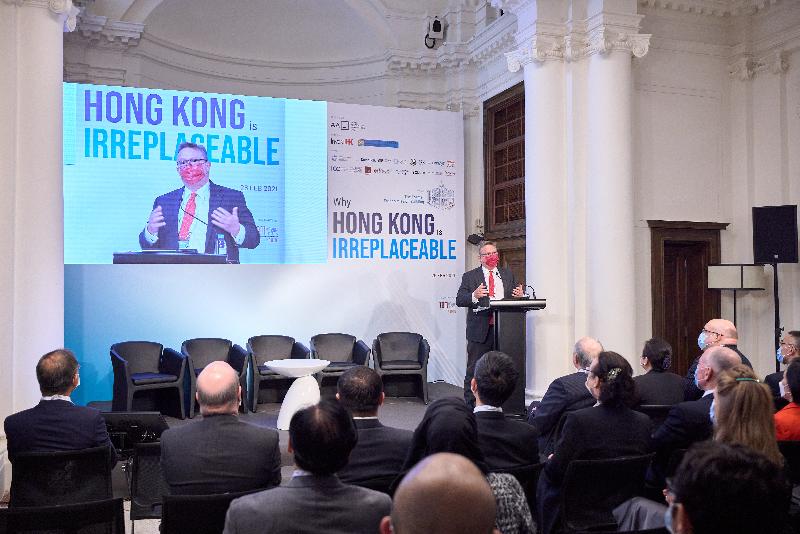
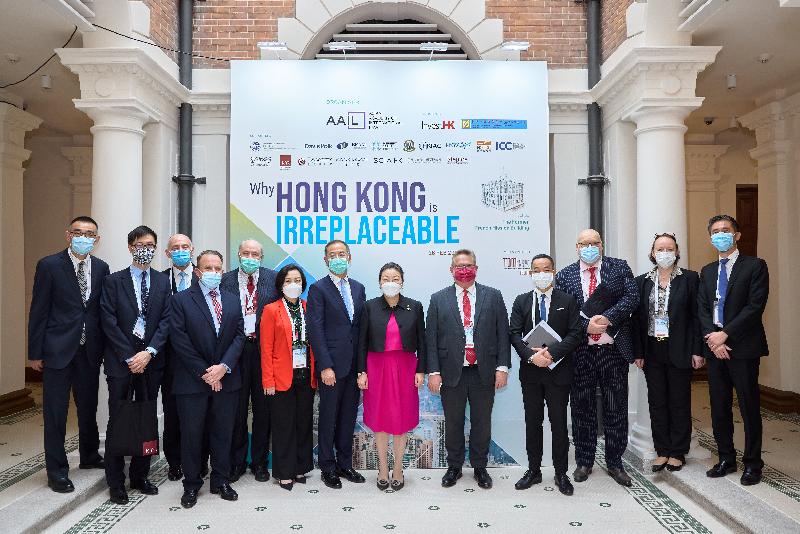

Hong Kong is an irreplaceable legal hub (with photos)

     A webinar jointly held by Invest Hong Kong (InvestHK) and the Asian Academy of International Law (AAIL) last Friday (February 26) with an aim to explore Hong Kong's leading legal hub status in the region of Asia attracted more than 900 participants from around the globe.
      
     Top-notch legal and dispute resolution practitioners at the "Why Hong Kong is Irreplaceable" webinar shared in-depth insights into Hong Kong's unique strengths as a legal hub for deal-making and dispute resolution services in the Asia-Pacific region and why it is a gateway to and from the Mainland for doing international business.
      
     The Chairman of the AAIL, Dr Anthony Neoh, SC, and the Director-General of Investment Promotion, Mr Stephen Phillips, opened the event by giving welcoming remarks. The Chief Executive of the Hong Kong Monetary Authority, Mr Eddie Yue, and the Secretary for Justice, Ms Teresa Cheng, SC, also gave keynote speeches and concluding remarks at the event.
      
     Mr Phillips said at the event, "Hong Kong is a preferred choice for international investors from around the world and the Mainland. The rule of law and the common law legal system in the context of 'one country, two systems' provides a solid and robust foundation for businesses to operate in Hong Kong. Hong Kong's comprehensive range of specialist legal services is highly valued by the international and Mainland investor community."
      
     Partner & Chair (Asia) of Davis Polk & Wardwell LLP Mr Martin Rogers moderated the panel on deal-making. Drawing on the panel's collective 150 years of providing legal advice, Partner of King & Wood Mallesons Mr Paul Starr, Partner of Herbert Smith Freehills Mr Tommy Tong, Partner of Kwok Yih & Chan Mr Conrad Chan and General Counsel of Bank of China (Hong Kong) Limited Ms Carmen Kan shared their insights in their areas of specialism.
      
     Partner of Mayer Brown Dr Thomas So moderated a panel on dispute resolution covering Hong Kong's highly regarded status as a legal hub for a variety of modes of resolution. The panellists, all leaders in their field, were Partner of Debevoise & Plimpton LLP Mr David W Rivkin; Partner of Gibson, Dunn & Crutcher LLP Mr Brian Gilchrist; Partner of Steptoe & Johnson HK LLP Ms Susan Munro; and Partner of Freshfields Bruckhaus Deringer Mr John Choong.
      
     The expert panellists discussed Hong Kong's unique strengths as a legal hub for deal-making and dispute resolution services. They said that the city is a preferred international legal hub given its strong rule of law characterised by an independent judiciary guaranteed by the Basic Law and under "one country, two systems". This impartiality lays the very important foundation of a fair, predictable and transparent environment for international investors to make deals and resolve disputes in Hong Kong. In addition, the common law system in Hong Kong and the use of both English and Chinese in Hong Kong courts are distinct advantages.
      
     Speakers at the dispute resolution services panel highlighted that eBRAM, the online arbitration system, has proved to be very effective under the current pandemic situation. The Arrangement Concerning Mutual Assistance in Court-ordered Interim Measures in Aid of Arbitral Proceedings by the Courts of the Mainland and of the Hong Kong Special Administrative Region was described as a game-changer. The Hong Kong International Arbitration Centre (HKIAC) has received applications to Mainland courts covering assets of US$1.9 billion and to date Mainland courts have granted orders totalling US$1.5 billion. And Hong Kong is the only jurisdiction outside the Mainland that can provide this service.
      
     Supporting organisations included the Law Society of Hong Kong and the Hong Kong Bar Association, the HKIAC, the South China International Arbitration Center (HK) and the China International Economic and Trade Arbitration Commission, plus major international law firms.
      
About InvestHK
      
     InvestHK is the department of the Hong Kong Special Administrative Region Government responsible for attracting foreign direct investment and supporting overseas and Mainland businesses to set up or expand in Hong Kong. It provides free advice and customised services for overseas and Mainland companies. For more information, please visit www.investhk.gov.hk.
      
     For photos, please visit: www.flickr.com/photos/investhk/albums/72157718480142082.

Photo  Photo  


Public hospitals daily update on COVID-19 cases

The following is issued on behalf of the Hospital Authority:

     As at 9am today (March 1), 11 COVID-19 confirmed patients were discharged from hospital in the last 24 hours. So far, a total of 10 547 patients with confirmed or probable infection have been discharged.
 
     At present, there are 673 negative pressure rooms in public hospitals with 1 202 negative pressure beds activated. A total of 228 confirmed patients are currently hospitalised in 22 public hospitals, a community treatment facility and the North Lantau Hospital Hong Kong Infection Control Centre, among which 16 patients are in critical condition, 12 are in serious condition and the remaining 200 patients are in stable condition.
 
     The Hospital Authority will maintain close contact with the Centre for Health Protection to monitor the latest developments and to inform the public and healthcare workers on the latest information in a timely manner.
 
     Details of the above-mentioned patients are as follows:
 

Patient condition Case numbers
Discharged 10403, 10607, 10804, 10832, 10837, 10890, 10893, 10899, 10964, 10976, 10985
Critical 1989, 3496, 6125, 6607, 6794, 8018, 8078, 9049, 9135, 9612, 9907, 10358, 10367, 10379, 10585, 10904
Serious 6386, 7076, 7468, 8221, 9055, 9550, 9793, 10083, 10611, 10898, 10942, 10953


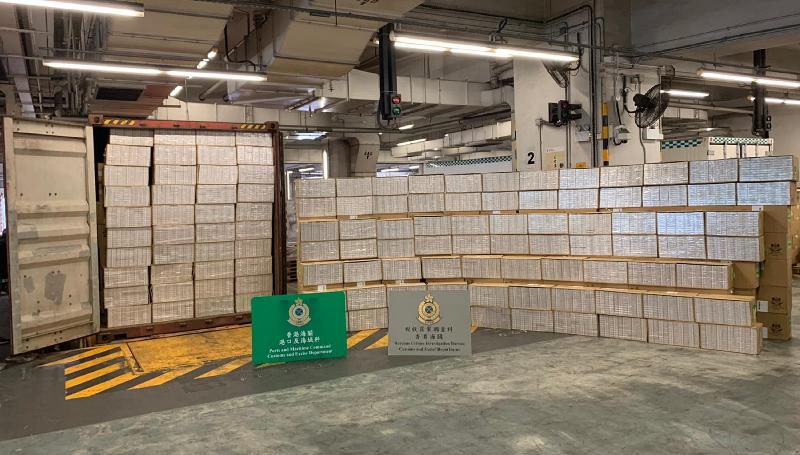
Hong Kong Customs seizes suspected illicit cigarettes worth about $45 million (with photo)

     Hong Kong Customs seized about 16.5 million suspected illicit cigarettes with an estimated market value of about $45 million and a duty potential of about $31 million at the Kwai Chung Customhouse Cargo Examination Compound on February 26.

     Through intelligence analysis, Customs officers selected a seaborne container arriving in Hong Kong from Poland via Malaysia for inspection. Upon inspection, Customs officers found the batch of suspected illicit cigarettes inside 1 650 cartons in the container.

     Investigation is ongoing.

     Customs will continue its intelligence analysis and risk assessment for interception at source to combat illicit cigarette activities.

     Under the Dutiable Commodities Ordinance, anyone involved in dealing with, possession of, selling or buying illicit cigarettes commits an offence. The maximum penalty upon conviction is a fine of $1 million and imprisonment for two years.

     Members of the public may report any suspected illicit cigarette activities to Customs' 24-hour hotline 2545 6182 or its dedicated crime-reporting email account (crimereport@customs.gov.hk).

Photo  


FEHD provides financial support for licence holders of food factories in food courts

     A spokesman for the Food and Environmental Hygiene Department (FEHD) announced today (March 1) that the Government has launched the Food Courts Subsidy Scheme under the fourth round of the Anti-epidemic Fund (AEF) to provide financial support to operators of eligible licensed food factories in operation. Application for the Scheme started today.

     The Government launched earlier the Catering Business Subsidy Scheme under the fourth round of the AEF to provide financial relief to the eligible licence holders of catering businesses providing dine-in services. A total of 16 315 applications have been received with 15 836 approved for the first tranche. The FEHD has earlier reminded eligible applicants to submit as early as possible a notification confirming their catering businesses are still in operation for the department to disburse the second tranche of the subsidy. So far, a sum of over $1,835 million has been disbursed under the Scheme. 

     Taking into account that the operators of food stalls in food courts inside shopping malls have also been affected by the measures on suspension of evening dine-in services imposed by the Government earlier on, the Government has launched the Food Courts Subsidy Scheme under the fourth round of the AEF to provide financial support to operators of eligible licensed food factories in operation. According to the Scheme, "food court" means a place inside a shopping mall comprising licensed food factories and an adjoining seating area (with both tables and chairs/stools) provided by the property management/owner of the shopping mall for non-exclusive use by its visitors, which may include patrons of the licensed food factories.
 
     Application for the Food Courts Subsidy Scheme will run from today until March 31. The subsidy scheme requires an applicant at the time of application to make a declaration, including indicating that the food business is still in operation, and if the business is not operated by the licence holder, consent from every operator(s) in respect of the food business on supporting the application for the subsidy scheme is required. A one-off subsidy ranging from $20,000 to $100,000 will be given to licence holders of food factories according to the floor area of the premises as specified on the licence for their business operation. 

     The application form and guidelines can be obtained from District Environmental Hygiene Offices of the FEHD or downloaded from the website of the FEHD (www.fehd.gov.hk), where details of the scheme are also available. Eligible food factory licence holders should submit their applications to the District Environmental Hygiene Offices of the FEHD in person or by mail. Upon receipt of the completed application form and supporting documents and after verification, the FEHD will disburse the subsidy in approximately two weeks by mailing crossed cheques to the corresponding licensed food premises.